
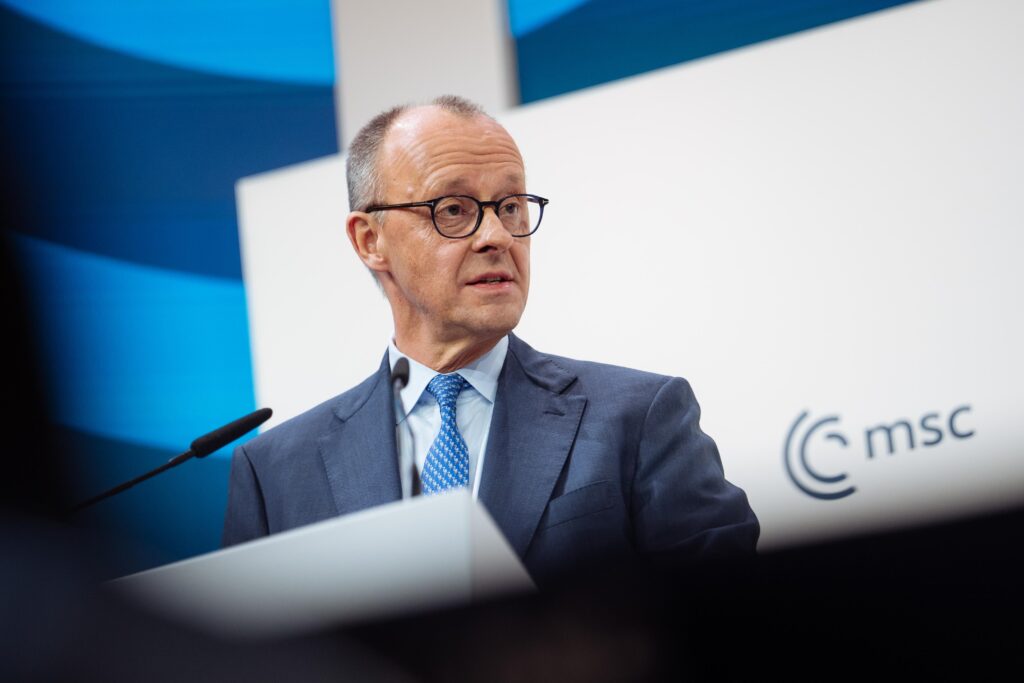
The 62nd Munich Security Conference opened in Munich on 13 February 2026 with a mood of damage inspection. In the gilded halls of the Bayerischer Hof, Germany’s chancellor declared the post-war order effectively over, Washington defended the alliance while attaching conditions, and Europe’s leaders quietly began planning for scenarios once considered unthinkable. What was once the anchor of transatlantic certainty now looked like a stress test of NATO’s political core, with Ukraine, Greenland and the future of American guarantees hanging over every conversation.
Two forces framed almost every conversation. The first was Europe’s war on its doorstep, now heading into a fifth year, and the practical question of whether deterrence can be sustained without reflexively assuming American permanence. The second was the Greenland crisis: not about an island’s minerals or bases alone, but about whether Washington treats allies as sovereign partners or as strategic assets.
Even the conference’s own declared theme, repeated in the opening keynote, signalled that this was intended as a funeral for complacency. “Under Destruction” was not presented as a metaphor for distant instability but as a diagnosis of the Western political architecture itself.
Merz’s Obituary for the Old Order
Germany’s chancellor began his speech by declaring a rupture. “Diese Ordnung, so unvollkommen sie selbst zu ihren besten Zeiten war, sie gibt es so nicht mehr” (“This order, as imperfect as it was even at its best, no longer exists”). Merz located the break in a return to openly coercive geopolitics, describing an era “von Macht und vor allem Großmachtpolitik” and arguing that the contest is as much about dependencies, technology and supply chains as tanks.
His speech directly tied the transatlantic problem to America’s own internal ideological turn. Merz accepted that last year’s warning from J.D. Vance described a real widening gulf, then rejected the prescription: “Der Kulturkampf der MAGA-Bewegung in den USA ist nicht unserer.” He linked that to concrete policy disagreements rather than abstract cultural taste, invoking climate commitments, trade and the boundary between free speech and human dignity.
Merz’s hard edge, however, was not an argument for severing the alliance. He framed NATO as a mutual advantage, a “gemeinsame[r] Wettbewerbsvorteil” for both sides. The message is a warning against American unilateralism, not a European declaration of independence.
Where the implications become explosive was his willingness to bring nuclear questions into the daylight. Merz confirmed talks with Emmanuel Macron about a joint European nuclear deterrent, insisting: “We’re not doing this by writing NATO off. We’re doing it by building a strong, self-supporting European pillar within the alliance.” A European nuclear umbrella is normally treated as political dynamite. In Munich this year, it was treated as insurance, and the fact that Merz raised it publicly is itself evidence that the old assumptions about permanent American guarantees have eroded.
Rubio’s Unity Pitch, With Conditions Attached
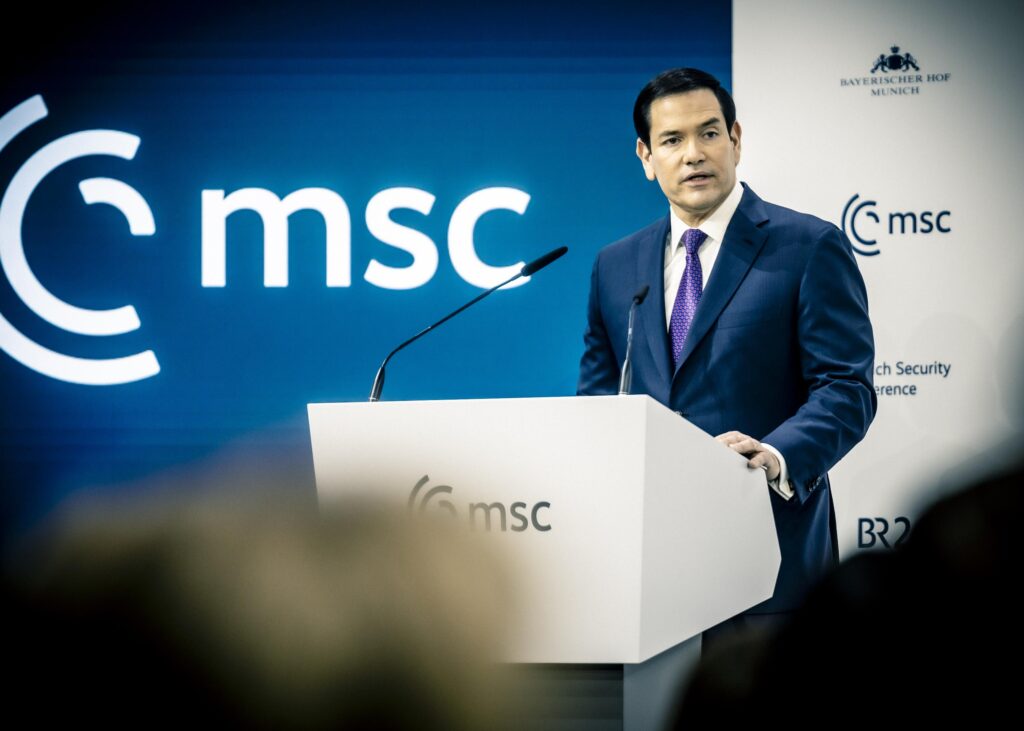
If Merz delivered the autopsy, Washington’s response was an attempt to control the interpretation. In his keynote, Rubio tried to re-anchor the relationship in shared identity. “For us Americans, our home may be in the Western Hemisphere, but we will always be a child of Europe.”
The second half of the pitch, however, was corrective, even scolding. Rubio argued that the West’s post-Cold War confidence slid into a “dangerous delusion” about a borderless world and a depoliticised global economy. In one of the most quoted passages, he condemned “a pursuit of a world without borders” and described “mass migration” as something that “threatens the cohesion of our societies” and “the continuity of our culture”.
He also attacked European climate policy in language that landed as an imported culture war. In the Foreign Policy transcript, Rubio blamed “a climate cult” for policies “impoverishing our people” and treated migration and climate as shared Western self-harm that must be reversed.
Rubio did not only lecture Europe about borders and energy. He also sought to rewrite how global institutions are valued. “The United Nations … has no answers and has played virtually no role,” he said, portraying the United Nations as impotent in Gaza and Ukraine while crediting American force and pressure for results.
For European listeners, the unease was sharpened by what Rubio did not say. Reuters reported that he did not mention Russia during the speech and did not refer to NATO by name, despite addressing Europe’s primary security forum in wartime Europe.
That combination explains the paradox of the reception in the room: applause without full buy-in. Chatham House described the standing ovation as relief that Rubio at least said “the fate of Europe will never be irrelevant to our own”, paired with “immediate unease” at the limits he placed on American support.
The formal European readouts were polite, and some were genuinely appreciative of the softer tone. But they also signposted that Europe is building policy on pessimistic scenarios. Ursula von der Leyen said she was “reassured” and highlighted Rubio’s line about wanting “a strong Europe in the Alliance”. The crucial follow-on, offered by France’s foreign minister Jean-Noël Barrot, was that Europe’s project of independence is not contingent on American rhetoric: “Is it going to change our strategy? Of course not.”
Kallas Rejected the “Civilisational Erasure” Storyline
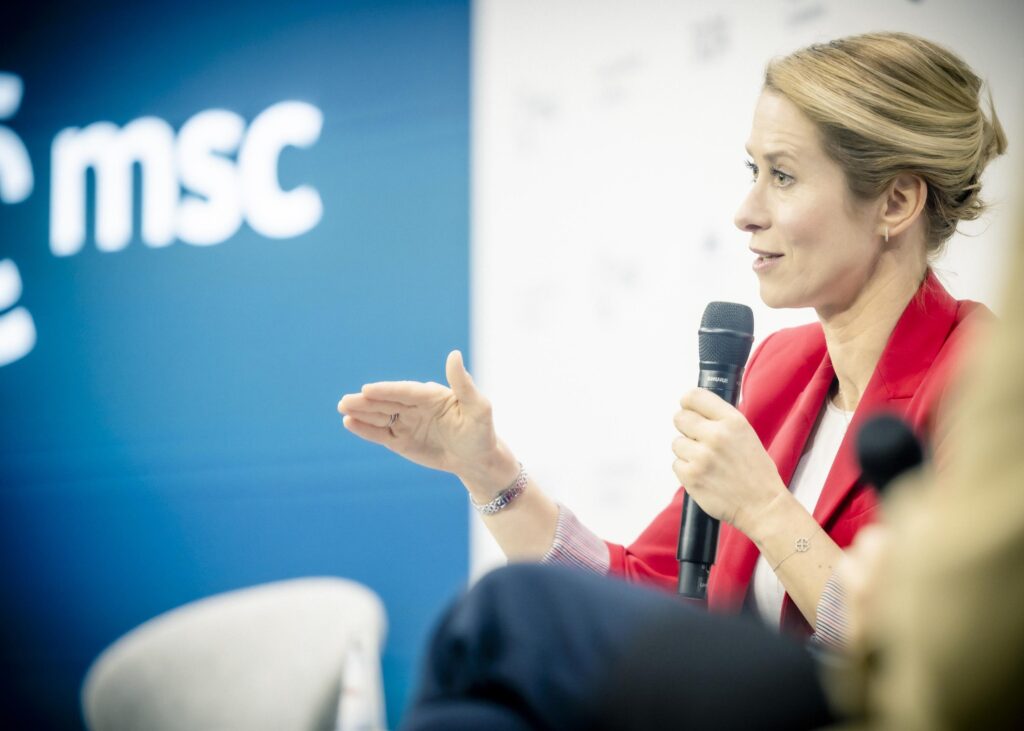
Kallas’s intervention mattered because it did not treat Rubio’s speech as a normal transatlantic disagreement about budgets or capabilities. It treated it as an argument about political legitimacy: who gets to define the West, and whether Europe is being asked to accept an American culture-war frame as an entry ticket to security.
In her keynote address, published in full by the European External Action Service, Kallas delivered a direct rebuttal: “Contrary to what some may say, woke, decadent Europe is not facing civilisational erasure.”
She countered Rubio’s civilisational pessimism with an argument about attractiveness and enlargement. “People still want to join our club,” she said, adding, pointedly, that interest is not limited to Europeans: “When I was in Canada last year I was told that over 40 percent of Canadians have an interest in joining the EU.”
That line reframed the transatlantic argument as one Europe intends to win on confidence, not deference: Europe is portrayed as a destination that countries seek out, not a failing province in need of American ideological correction.
Kallas also made the security argument explicit. She warned against a negotiated end to the Ukraine war that rewards Moscow beyond what it has achieved militarily, saying: “The greatest threat Russia presents right now is that it gains more at the negotiation table than it has achieved on the battlefield.” Her critique of the “erasure” narrative is not a side-show culture argument. It is tied to deterrence: if alliance cohesion is eroded by ideological policing from Washington, Europe’s ability to hold a line on Ukraine and on territorial integrity becomes weaker.
The Nordic Readout: Reassurance Welcomed, Red Lines Enforced
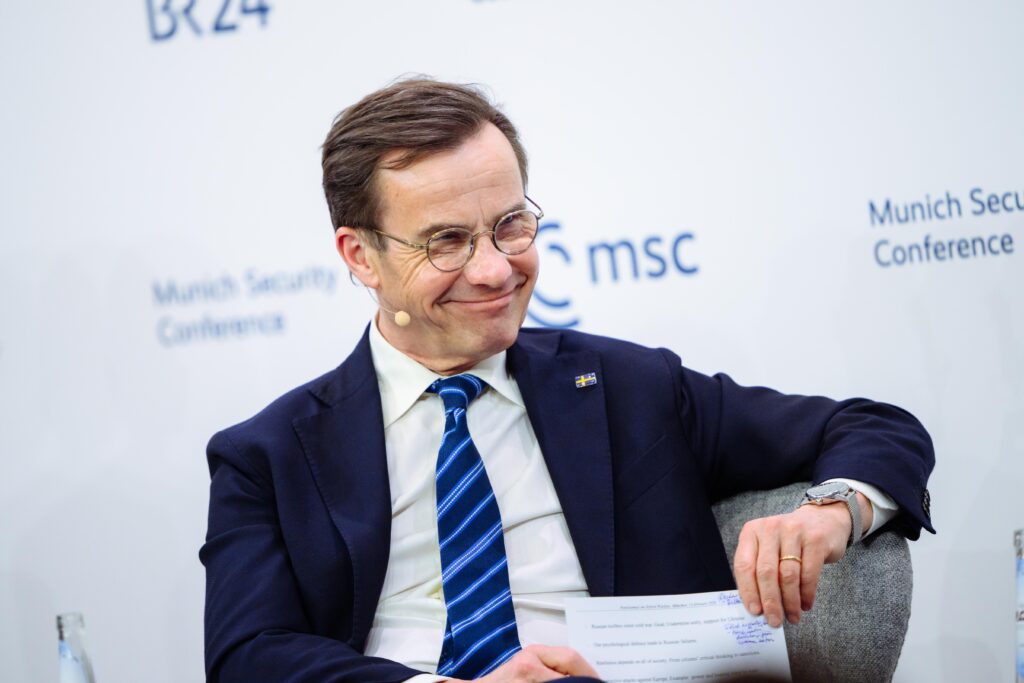
The Nordic states arrived in Munich with their own version of strategic realism: unambiguously pro-alliance, but increasingly unwilling to pretend that volatility in Washington is an abstract risk for future historians.
Finland’s reaction was the clearest example of what “relief, not agreement” looks like. Finland’s foreign minister, Elina Valtonen, called Rubio’s speech “exactly what has been needed both in Europe and in the United States”, praising the outreach tone and Rubio’s repeated use of “together”. The subtext is hard to miss: European allies now celebrate basic rhetorical affirmation because its absence has become thinkable.
Sweden’s public messaging combined cautious encouragement with a reminder that values and sovereignty are not negotiable. Sweden’s foreign minister, Maria Malmer Stenergard, said Rubio was “extending a hand” to Europe and voiced hope that the softer tone would replace recent destructive rhetoric, while also criticising his attacks on climate policy and warning that Sweden sees the “international rules-based world order” as essential for smaller states.
Sweden’s prime minister, Ulf Kristersson, had already been sharper about the Greenland question weeks earlier, calling US rhetoric “threatening” and saying: “The United States should thank Denmark, which has been a very loyal ally over the years.” That timeline means Rubio’s warmer words were heard against a background of territorial pressure, not just ideological argument.
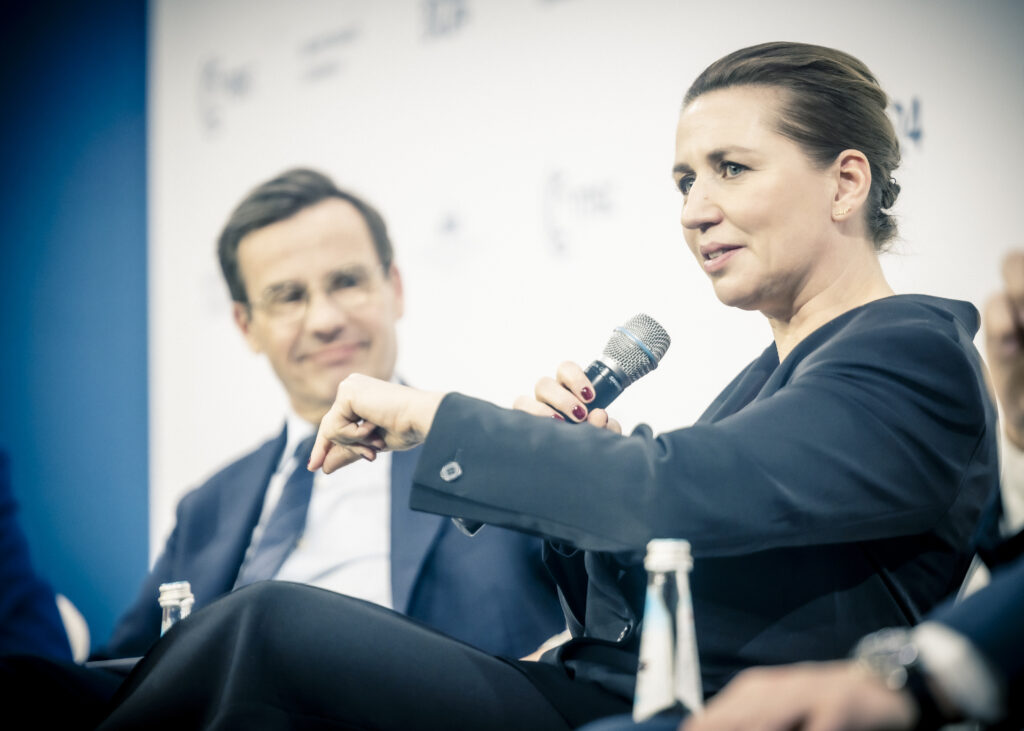
For Denmark, Greenland has become the litmus test of whether alliance language still means mutual recognition of sovereignty. At the conference, Denmark’s prime minister, Mette Frederiksen, said: “The pressure on Greenland is totally unacceptable,” while stressing Denmark’s willingness to cooperate with allies without compromising territorial integrity.
Diplomatically, Copenhagen has tried to contain the crisis without conceding its premise. Frederiksen and Greenland’s leader, Jens-Frederik Nielsen, described a “constructive” meeting with Rubio and agreed to continue work through a “high-level working group”, a sign of managed escalation rather than resolution.
Norway’s approach was quieter but equally instructive. Norway attended in force, with five ministers present, and Prime Minister Jonas Gahr Støre was reserved about Rubio’s outreach even as the meeting was described as positive.
The most concrete Norwegian signal was a signature: The Norwegian government confirmed that Norway and Germany signed a defence arrangement during the conference, aimed at tightening bilateral cooperation across domains from maritime security to space-based capabilities, explicitly framed as necessary amid “heightened uncertainty in Europe”.
Britain to Deploy Carrier Group to Atlantic and High North
Shifting toward more visible European military posturing, Keir Starmer announced in Munich that the United Kingdom will send its Carrier Strike Group, led by aircraft carrier HMS Prince of Wales, across the North Atlantic and High North this year in a major demonstration of commitment to Euro-Atlantic security. The operation, dubbed Operation Firecrest, will involve warships, F-35 jets and helicopters operating alongside the United States, Canada and other NATO allies in exercises designed to bolster deterrence against Russian activity and protect vital undersea infrastructure.
Starmer framed the move as part of a broader push for stronger European defence cooperation, stressing that the deployment will help “make Britain warfighting ready, boost our contribution to NATO, and strengthen our operations with key allies” amid ongoing strategic uncertainty.
What the NATO Stress Test is Really Measuring
In public, almost every leader still treats NATO as essential. In practice, Munich 2026 exposed that alliance cohesion is no longer assumed as a constant. It is treated as a variable that must be hedged.
Merz’s framing pushes Europe toward a “European pillar” inside NATO: not symbolic autonomy, but capability that changes the balance of dependence. That is why he paired the obituary for the old order with the insistence that NATO remains a mutual advantage, and why he called for a “new transatlantic partnership” grounded in “new strength” and “self-respect”.
Rubio’s framing points toward a more transactional alliance in which security guarantees are blurred into ideological alignment and domestic political narratives. Even when he reassured Europeans that America does not wish to end the transatlantic era, he made clear that the price is a course correction on migration, climate, and sovereignty as he defines them.
Europe, meanwhile, is trying to convert this stress test into policy, and the results are mixed. European leaders pledging to accelerate defence efforts and “rely less on the U.S.” after Trump’s Greenland push intensified doubts about Washington’s commitments. NATO members agreed to raise core defence spending targets to 3.5% of GDP, with an additional 1.5% for other security investments, and that European defence spending has risen nearly 80% since before the war in Ukraine began.
Yet capability is not built by speeches. The same reporting underlined persistent obstacles: industrial rivalry, stalled flagship projects, and fights over whether “buy European” rules should dominate procurement.
The most revealing moment may be that, for the first time in years, serious people discussed nuclear architecture not as a taboo but as contingency planning. Merz’s talks with Macron about deterrence were treated as compatible with NATO, not a break from it. In Reuters’ words, Europe is openly preparing for the possibility that a future American leader could decide Europe is a bad bargain.
Read More:
- Federal Government of Germany: Rede von Bundeskanzler Merz bei der Münchner Sicherheitskonferenz „Unsere Freiheit behaupten wir mit unseren Nachbarn“
- STERN.de: Merz bei Sicherheitskonferenz: Durch Großmächte ist unsere Freiheit gefährdet
- DIE ZEIT: Münchner Sicherheitskonferenz: Bundeskanzler Merz will transatlantische Beziehung neu ausrichten
- Süddeutsche Zeitung: Wankende Weltordnung: Fünf Lehren aus der Münchner Sicherheitskonferenz
- Euronews Deutsch: “Führungsanspruch der USA vielleicht schon verspielt” , So Merz auf Münchner Sicherheitskonferenz
- Le Parisien: Europe et États-Unis sont « faits pour être ensemble », assure Marco Rubio depuis Munich
- Le Parisien: Groenland : les dirigeants danois vont rencontrer Marco Rubio à Munich
- Le Parisien: Le Royaume-Uni annonce le déploiement « cette année » de son porte-avions HMS Prince of Wales, pour sécuriser l’Atlantique aux côtés de l’Otan
- SVT Nyheter: Malmer Stenergard: Rubio sträcker ut en hand
- SVT Nyheter: Ny Münchenkonferens , kärnvapenavskräckning i Europa en av frågorna
- SVT Nyheter: Analys: ”USA har tappat förtroendet i Europa efter Vance-smockan”
- SVT Nyheter: Senaste nytt om säkerhetskonferensen i München
- KNR: Jens-Frederik Nielsen: Møde med USA i Tyskland er positivt fremskridt
- KNR: Planlægning af Nato-mission i Arktis er gået i gang
- Ritzau via Udenrigsministeriet: Udenrigsminister Lars Løkke Rasmussen deltager ved sikkerhedskonferencen i München
- KNR: Budskabet er klart, når Motzfeldt skal mødes med amerikansk udenrigsminister
- Reuters: Europe aims to rely less on US defence after Trump’s Greenland push
- Reuters: European reaction to Rubio’s speech on transatlantic ties at Munich Security Conference
- Reuters: Rubio tells Munich security forum that US and Europe belong together
- Reuters: Rubio strikes constructive tone but persists in US criticism of European allies
- Reuters: Merz eyes European nuclear shield in call for new relationship with U.S.
- Foreign Policy: Rubio to Europe: ‘We Care Deeply’
- European External Action Service: Keynote speech by HR/VP Kaja Kallas at the MSC: Europeans Assemble! Reclaiming Agency in a Rougher World
- Euronews: Merz warns Munich Security Conference freedom ‘is no longer a given’ in stark remarks
- Euronews: Kallas says ‘Europe is not facing civilisational erasure’ in rebuke to US bashing
- Yle: Finland welcomes Marco Rubio’s comments on transatlantic unity
- Chatham House: The West vs the West at the Munich Security Conference
- Sweden Herald: Malmer Stenergard: Rubio extends a hand to Europe
- Reuters: Sweden ‘highly critical’ of US rhetoric on Greenland and Denmark, says PM
- Reuters: Denmark’s Frederiksen says she and Greenland’s Nielsen had constructive meeting with Rubio
- Government of Norway: Norway and Germany sign defence arrangement
- Aftenposten: Den store usikkerhets-konferansen
- High North News: UK Signals Carrier Deployment to Arctic as Europe Doubles Down on High North Security
- Project Syndicate: Eve of Destruction
- NATO: Doorstep statement by the NATO Secretary General Mark Rutte at the Munich Security Conference
- The Defense Post: UK to Deploy Aircraft Carrier Group to Arctic This Year: PM
- AA News: UK says it will deploy Carrier Strike Group to North Atlantic, High North this year