Science

The Battle for the Spectrum: Inside the Invisible War for the Airwaves

The electromagnetic spectrum has become one of the most fiercely contested resources on the modern battlefield. Drones, sensors, radars, jammers and tactical networks increasingly compete for usable frequencies, while every transmission risks revealing its source. Ukraine has turned this into a rapid contest of adaptation. For tactical communications companies such as Finland’s Bittium, the challenge

The Battle for the Spectrum: Inside the Invisible War for the Airwaves Read More »

Camera turret 3D printed from Armox® 500 AM Powder, requiring no post-print heat treatment or machining before deployment. (Image: SSAB)

Swedish Breakthrough Aims to Reshape Military Armour with 3D-Printed Protection

For more than four decades, armour design has revolved around cutting, machining and welding hardened steel plate. Swedish steelmaker SSAB believes that paradigm is about to change. Its launch of Armox 500 AM Powder marks what the company says is the world’s first armour steel powder specifically engineered for additive manufacturing, opening the door to

Swedish Breakthrough Aims to Reshape Military Armour with 3D-Printed Protection Read More »

The Algorithmic Battlespace: How AI Is Rewriting the Rules of Influence

As leaders and security officials gathered in Munich, the most consequential shift in the information war was about the systems that decide what any of us sees in the first place. The latest analysis from NATO’s Strategic Communications Centre of Excellence argues that power is draining from narratives and pooling instead in algorithms, recommendation engines

The Algorithmic Battlespace: How AI Is Rewriting the Rules of Influence Read More »

AI in War.

Who’s Pulling the Trigger? Why the West Can’t Afford to Fall Behind in AI Warfare

The rise of artificial intelligence in military decision-making is transforming modern warfare, from battlefield operations to strategic planning. One fact stands clear: the West must adapt and advance its AI capabilities to stay ahead of competing, challenging state powers like China and Russia, as well as the threat posed by rogue states and non-state actors,

Who’s Pulling the Trigger? Why the West Can’t Afford to Fall Behind in AI Warfare Read More »

Integrating Industrial Metaverse and Tangible XR Simulators

Tangible XR simulators are a combination of a digital simulation and haptic elements. The latest advances in XR, especially metaverse and AI, further increase the potential of such tangible XR simulators as networked collaborative training and exploration methods. In this paper, we will introduce Fraunhofer FKIE’s tangible XR simulator integrated into the industrial metaverse technology

Integrating Industrial Metaverse and Tangible XR Simulators Read More »

HMS Sheffield in 1982

Electro Magnetic Spectrum is Present Everywhere

Despite of the importance of the electromagnetic spectrum (EMS) in modern operations and the obvious need to coordinate spectrum activities with air, space, land, sea and cyber activities, most Western nations, and NATO, have failed to recognize EMS as one environment in modern warfare. This might be the Achille’s heel of the Western military forces.

Electro Magnetic Spectrum is Present Everywhere Read More »

Organizations planning to utilize artificial intelligence should start by thinking about the benefit and cost aspects - which is relevant from a business perspective.

The future of artificial intelligence: Autonomous systems that the other party cannot prepare for

Routine tasks will also be transferred to artificial intelligence in defense technology. The rules of ethics must be taken into account when designing autonomous defense systems. In order for the machine to learn, there must be plenty of reliable data – and cybersecurity expertise. The use of artificial intelligence has become democratized. Anyone can use

The future of artificial intelligence: Autonomous systems that the other party cannot prepare for Read More »

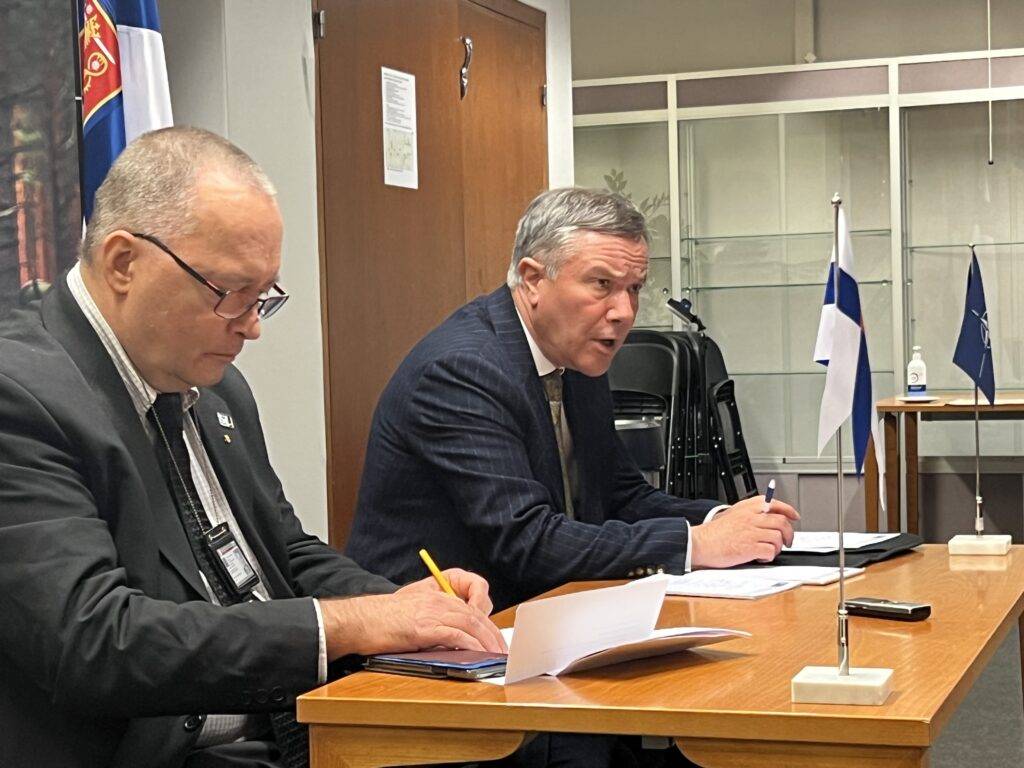
”It's very important for NATO to ensure that AI is used ethically,” Bryan Wells remarked.

5000 Scientists Are Helping NATO To Evolve

Armed forces need to evolve like science, continuously. We are constantly reassessing, Bryan Wells, the Chief Scientist at NATO reminded in Helsinki. NATO has 400 scientific projects underway with a global network of about 5000 scientists. ”From a scientific and technical perspective, a key lesson learned from the Russian-Ukrainian war is the range of capabilities

5000 Scientists Are Helping NATO To Evolve Read More »

×