
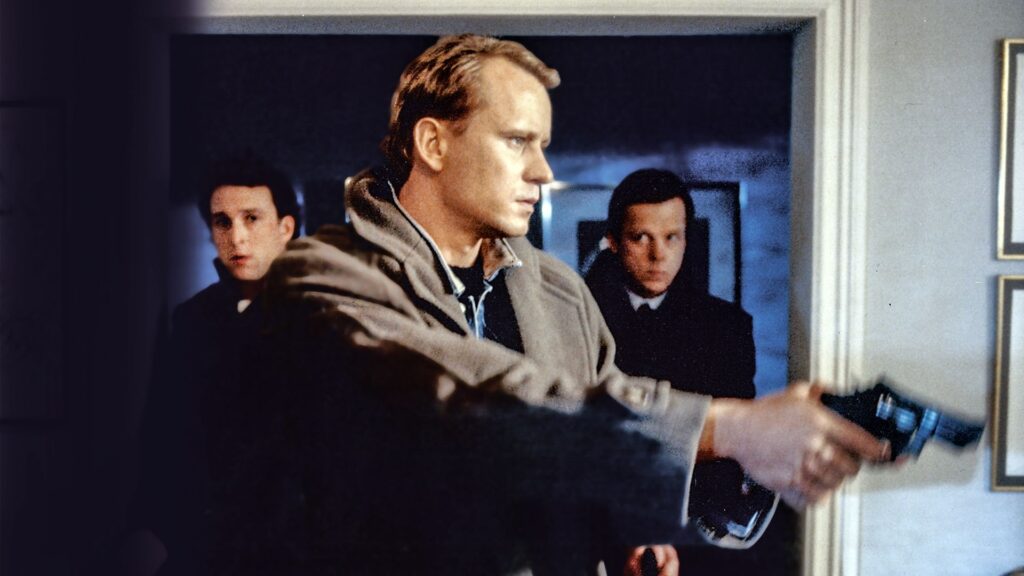
Pelle Berglund’s 1989 spy thriller Täcknamn Coq Rouge is a treat for anyone interested in intelligence, military history and Nordic security policy. Beneath the assassinations and secret agents lies a picture of a Sweden that publicly stood outside NATO while quietly preparing for a much less neutral war.
When Täcknamn Coq Rouge reached Swedish cinemas in August 1989, the Cold War had only months left in its familiar form. The Berlin Wall was still standing and the Soviet Union still existed. Sweden remained formally non-aligned and its political leaders continued to present neutrality as the foundation of national security policy.
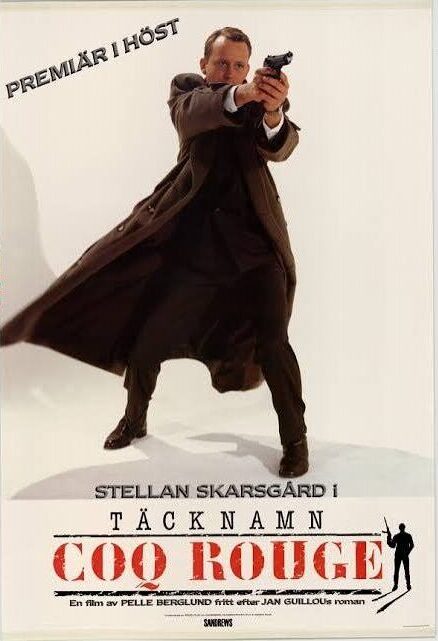
The protagonist in Täcknamn Coq Rouge is Carl Hamilton, a Swedish anti-Bond character, created by the author Jan Guillou. His Hamilton novels always contain an ideological tension that distinguishes them from straightforward military adventure stories. The hero is an exceptionally effective servant of the Swedish state who remains deeply suspicious of parts of that state.
In Guillou’s world, the man trained to conduct secret operations is also a vehicle for examining whether democratic governments can be trusted with secret power. This gives the films considerably more political content than their action-thriller packaging initially suggests.
Played by Stellan Skarsgård, Hamilton is an aristocratic Swedish naval officer and intelligence operative who has received highly specialised training in the United States. He belongs to a world of military intelligence that sits awkwardly beside Sweden’s carefully cultivated image of neutrality.Täcknamn Coq Rouge is an interesting cultural artefact from the closing stages of the Cold War, made when Swedes knew considerably less than they do today about the extent of their country’s covert military relationship with the West.
A Terrorist Threat Reaches Sweden
The story begins with the Swedish security authorities investigating what becomes known as Plan Dalet, an apparent terrorist operation connected to the Middle East. A Swedish security officer is murdered and Hamilton is brought into the investigation.
The trail moves beyond Sweden to Israel and Lebanon, taking the film into the tangled security politics of the Middle East. Hamilton operates across the boundaries separating conventional policing, counter-terrorism, intelligence gathering and military action.
Hamilton has the extraordinary abilities required of a fictional secret agent, but much of the drama comes from institutions: police officers, security officials, intelligence organisations, diplomatic complications and disagreements over jurisdiction.
The threat is international, while Sweden’s response remains constrained by laws, bureaucracy and politics.
The distinction between military and civilian security has become increasingly blurred during the decades since the film was made. Terrorism, sabotage, intelligence operations, organised proxy activity and attacks on critical infrastructure regularly cross the grey area, the traditional boundary between internal and external security.
Hamilton is a Very Swedish Anti-Bond
Stellan Skarsgård is the film’s greatest asset. Hamilton possesses many characteristics of the international spy hero. He is highly educated, physically capable, multilingual, trained in the United States and considerably more competent than most of the officials surrounding him.
Yet Skarsgård avoids playing him as a Swedish James Bond. Hamilton can be arrogant, impatient and politically awkward. He belongs simultaneously to the Swedish establishment and outside it. His aristocratic background gives him access to one world, while his political attitudes complicate his relationship with it. The result is a protagonist particularly suited to Jan Guillou. Skarsgård won a Guldbagge for the performance, and it remains one of the most interesting screen versions of Hamilton. He returned to the character in Förhöret and Den demokratiske terroristen.
The Real Drama Was Swedish Neutrality
Cold War Sweden officially pursued what was commonly summarised as non-alignment in peacetime intended to make neutrality possible in war.
Geography made that policy complicated. Norway and Denmark were NATO members. Finland’s foreign and security policy was heavily constrained by its relationship with the Soviet Union. Sweden occupied the enormous strategic space between NATO’s North Atlantic positions and Soviet territory around the Baltic.
A major war in northern Europe would therefore have made Swedish territory, airspace and waters extremely important. Swedish neutrality consequently contained a remarkable contradiction.
The political doctrine remained non-alignment, while Swedish defence planning increasingly assumed that the principal military danger came from the Soviet Union and Warsaw Pact. Preparations were also quietly made for Sweden to receive assistance from Western countries if neutrality collapsed.
In its account of Sweden’s security-policy history following NATO accession, Swedish government has stated that during the Cold War preparations were secretly undertaken to make Western military assistance possible.
That historical knowledge changes the way Coq Rouge looks today. Hamilton’s American connections may appear like standard thriller machinery. In the actual Swedish Cold War, cooperation with Western intelligence and defence organisations was far less fictional than many contemporary viewers realised.
Sweden exchanged intelligence with Western powers. Military contacts existed behind the public doctrine of non-alignment. Contingency preparations considered circumstances in which Western assistance would become necessary. Sweden was neutral in formal alliance politics, while strategically belonging firmly to the Western side of the European divide. Hamilton lives inside that contradiction.
1980s Sweden Had Reasons to be Nervous
The film also appeared after an unusually turbulent decade in Swedish security history. The grounding of the Soviet submarine U 137, known internationally as the Whiskey on the Rocks incident, inside the restricted military area near Karlskrona in October 1981 profoundly affected Swedish perceptions of the Soviet threat. Further suspected submarine incursions followed.
The Swedish government appointed commissions, conducted anti-submarine operations and repeatedly confronted the uncomfortable possibility that a foreign power was testing Sweden’s coastal defences in peacetime.
Swedish government investigations subsequently documented how seriously the submarine question affected relations with Moscow during the 1980s. Prime Minister Olof Palme raised continuing underwater activity directly with Soviet foreign minister Andrei Gromyko in 1984.
Then Palme was murdered in Stockholm in February 1986. The assassination was not a military event, yet its psychological effect on Swedish society was enormous. A prime minister had been shot dead on a Stockholm street while walking home from the cinema without bodyguards.
By 1989, therefore, the idea that international violence could penetrate apparently secure Swedish society hardly belonged entirely to fantasy.Täcknamn Coq Rouge appeared in a country that still projected stability, neutrality and institutional confidence, but which had experienced submarines, espionage scandals, political assassination and growing concern about international terrorism.
Guillou’s Complicated Relationship with Swedish Intelligence
There is another layer in film that the contemporary Swedish audiences would immediately have recognised: Jan Guillou was hardly an establishment propagandist.
Together with journalist Peter Bratt, Guillou exposed the secret Swedish intelligence organisation IB in Folket i Bild/Kulturfront in 1973. Their reporting revealed an intelligence structure whose activities, including domestic surveillance and foreign operations, generated one of Sweden’s great post-war political scandals.
Guillou was subsequently convicted of espionage offences arising from the publication.
The Hamilton fantasy is certainly that of the extraordinarily capable intelligence officer. Yet the books repeatedly ask another question: who controls intelligence officers once democratic governments grant them extraordinary powers?
Sweden Between Morality and Realpolitik
The film also belongs to the political world of Sweden before its post-Cold War transformation.
Swedish governments frequently pursued an assertive international identity during the decades associated with Social Democratic foreign policy. Stockholm presented itself as an advocate of disarmament, international law, anti-colonial movements and mediation.
At the same time, the Swedish state maintained formidable armed forces, prepared for a major European war and exported arms abroad.
Sweden wanted sufficient military strength to remain outside great-power alliances while preserving enough political independence to pursue its own foreign policy.
By the 1980s, however, the gap between the public narrative and secret strategic realities had become increasingly striking.
Hamilton’s Sweden insists on formal separation from military alliances while its elite operative is American-trained and operates within a recognisably Western security universe. What once functioned as thriller fiction now resembles a compressed version of Sweden’s actual strategic ambiguity.
Behind Hamilton stands the enormous unresolved question of Swedish neutrality. How neutral could Sweden really have remained during a Soviet-NATO war? How far should a democratic state go in creating clandestine capabilities? How should intelligence agencies operate when the danger lies somewhere between crime, terrorism and war? And what happens when a country’s public security doctrine differs from the contingency plans being developed behind closed doors?