
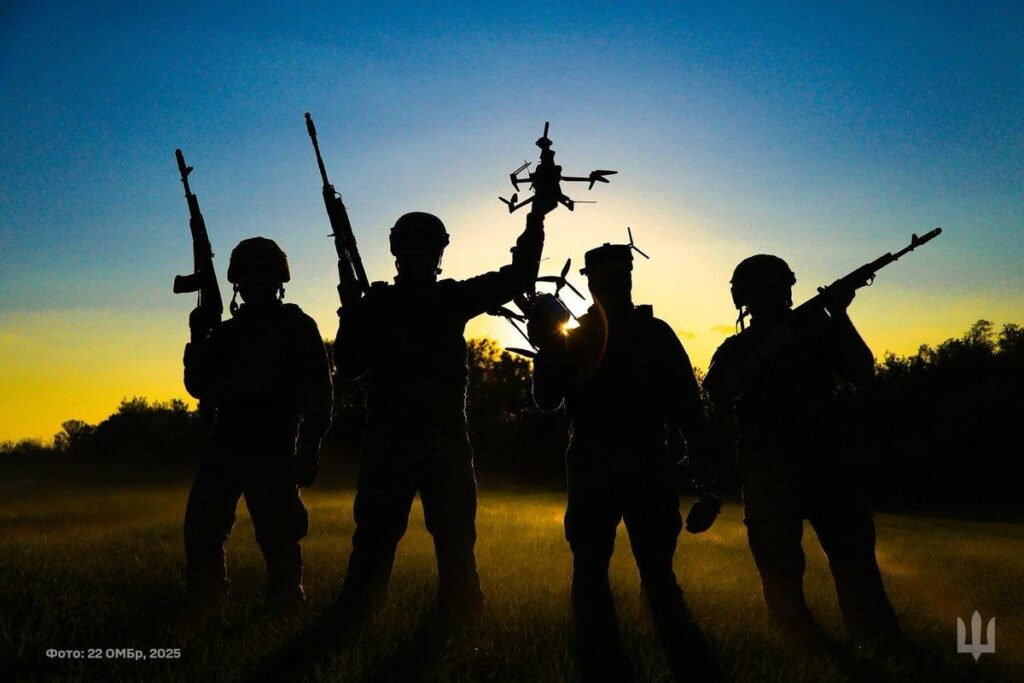
Dr Oleksandra Molloy offers strategic insight on how Ukraine’s battlefield innovations are forcing Western defence planners to rethink military force design, institutional agility, and command structures for the era of autonomous systems.
The proliferation of uncrewed and autonomous systems across the air, land, and maritime domains is fundamentally altering the logic of contemporary combat. Yet, as Russia’s full-scale invasion of Ukraine continuously illustrates, technological sophistication alone does not guarantee a decisive advantage. The true determinant of battlefield success lies in institutional agility—the speed with which an armed force can adapt its operational structures, integrate novel capabilities, and convert raw frontline experience into systemic advantage. Introducing cutting-edge technology without accompanying organizational reform merely risks generating internal friction and leaving costly platforms underutilized. Traditional military organizations remain predominantly structured around legacy, single-domain service branches such as infantry, armor, artillery, surface fleets, and tactical aviation. Historically, these institutions have treated uncrewed systems as minor technological attachments to existing structures. However, given the vast volume and diversity of uncrewed systems operating in current conflict zones—ranging from commercial micro-quadcopters to autonomous loitering munitions and heavy ground robotics—this incremental approach is no longer viable. Strategic adaptation must be initiated well before crisis operations commence, actively shaping force design, command philosophy, and mobilization reserves during peacetime.
The Four Pressures Demanding Structural Reform
The mandate for structural military reform is driven by four key operational pressures observed in high-intensity modern warfare. The first is the severe compression of decision-making timelines. The combination of persistent aerial reconnaissance and real-time target acquisition has dramatically narrowed the window between detection and strike. Simultaneously, pervasive electronic warfare continuously threatens command networks. Hierarchical structures reliant on multi-tiered approval chains cannot operate effectively at this operational pace; forces require streamlined command relationships, decentralized authority, and resilient command-and-control architectures.
The second driver is the altering economics of combat power, caused by high attrition rates and low-cost uncrewed platforms. Inexpensive, commercial-off-the-shelf systems regularly inflict asymmetric damage on heavy armor, logistics nodes, and critical infrastructure. Consequently, modern defence planners can no longer base strategic deterrence solely on small fleets of exquisite, high-cost weapons platforms. Modern force design must balance advanced technical capabilities with mass, structural resilience, and robust industrial replenishment pipelines capable of sustaining high-attrition conflict.
Third, effective employment of uncrewed systems demands cross-domain integration across traditional service boundaries. A tactical drone operated by a land unit frequently identifies targets residing in another sector’s area of operations, requiring fire support controlled by an entirely separate command. Seamlessly linking sensors, decision-makers, and effectors across rigid organizational lines is an operational necessity.
Finally, lessons learned at the tactical edge must translate into formal doctrine, training protocols, and procurement pipelines at rapid operational speeds, sustained by direct feedback channels connecting combat operators, technology developers, and defense manufacturers.
Ukraine’s Evolutionary Dual-Track Model
Since 2022, the Armed Forces of Ukraine have undergone a rapid organizational transformation, evolving from decentralized, soldier-led drone initiatives into fully institutionalized military structures. A major milestone occurred in June 2024 with the establishment of the Unmanned Systems Forces as a distinct military branch dedicated exclusively to uncrewed operations. Spanning air, land, and sea domains, this specialized branch rapidly expanded to encompass dedicated strike brigades, training centers, analytical units, and research facilities, scaling toward tens of thousands of personnel to form a dedicated pillar of modern force structure.
However, the creation of a specialized, standalone branch did not replace the need for organic uncrewed systems within conventional combat units. Frontline tactical commanders require immediate, organic situational awareness and organic firepower; they cannot depend entirely on centralized external assets that may be reassigned during fluid battle conditions. Consequently, Ukraine established a complementary, dual-track force model. Standard infantry and mechanized formations retain internal drone elements for immediate tactical support, while specialized strike formations—such as deep-strike units, specialized counter-air drone brigades, and dedicated robotics elements—concentrate high-end technical expertise for complex, sector-wide operations.
This dual-track structural evolution has extended across domains. Ukraine pioneered dedicated uncrewed ground vehicle units integrated into tactical maneuver formations to conduct assault and resupply roles. Furthermore, advanced command structures were established to synchronize long-range deep-strike capabilities with joint maneuver and traditional fires, establishing a coherent operational framework for uncrewed warfare across strategic depths.
Designing the Future Force Structure
As defense establishments globally analyze various organizational models—ranging from fully integrated tactical elements to specialized joint task forces or independent service branches—Ukraine’s operational model provides clear guidance rather than a rigid blueprint. Establishing an independent uncrewed service branch is a radical structural shift that brings risks of administrative overlap, competing operational authorities, or isolating specialized technical talent from the conventional units relying on their direct support.
In alignment with modern NATO strategic studies, force design options should be treated as testable hypotheses validated through wargaming, field exercises, and dedicated defense experimentation units. For the majority of allied nations, a layered hybrid model offers an effective framework. This approach preserves organic tactical responsiveness at the unit level while building specialized depth and joint command synchronization for high-end operational tasks.
Ultimately, future force design requires managing trade-offs between force protection and dispersed tactical agility, centralized intent and autonomous decentralized execution in degraded electronic environments, and platform-centric procurement versus flexible system architectures. Cultivating tactical initiative and institutionalizing rapid organizational learning are essential requirements; in modern conflict, institutional inertia directly translates to lost operational advantage on the battlefield.
Dr Oleksandra Molloy is an expert on uncrewed and autonomous systems in modern warfare, serving as a Senior Lecturer in Aviation and Lead of the Human Factors Research Lab at the University of New South Wales in Canberra, Australia. Awarded “Academic of the Year,” her multidisciplinary research examines autonomous technologies, artificial intelligence, human-machine integration, and defense safety. She serves as an advisor to military institutions, NATO policy forums, government bodies, and defense industry partners worldwide.