
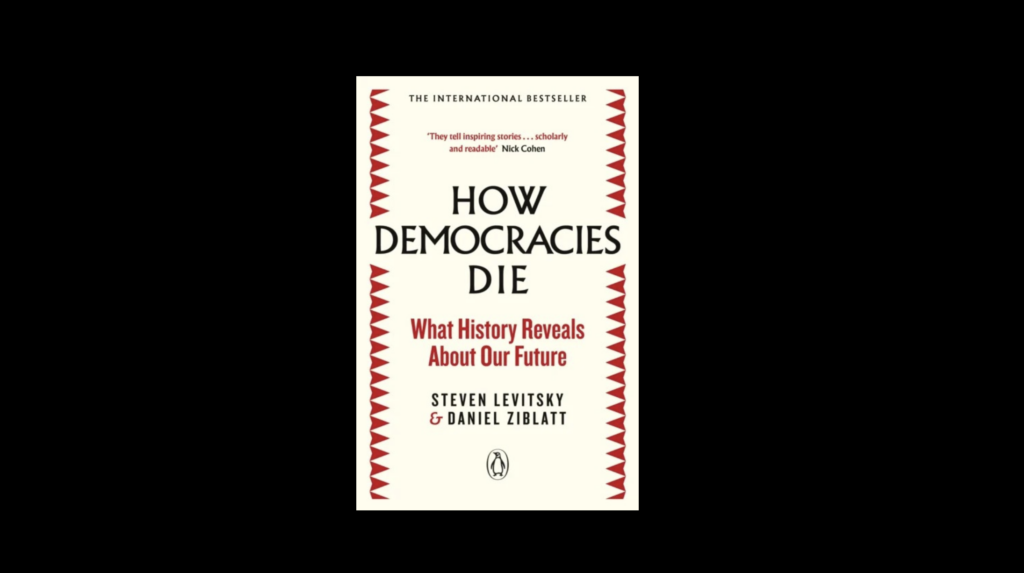
Steven Levitsky and Daniel Ziblatt’s How Democracies Die shows how democracies are dismantled legally, incrementally, and often with public approval, by leaders who come to power through elections and then hollow the system out from within.
The authors’ central argument is that since the end of the Cold War, most democratic breakdowns have not been caused by generals but by elected leaders who exploit crises, polarisation, and institutional loopholes to weaken checks and balances. Democracies, they argue, now tend to die “with a whimper, not a bang”.
“Some of history’s most tragic democratic breakdowns were preceded by the degrading of basic norms.”
Constitutions, courts, and elections matter, but they are insufficient on their own. What truly sustains democracy are informal guardrails: restraint, good faith, and a shared acceptance that political opponents are legitimate rivals, not enemies.
“Senator Joseph McCarthy, who used the Cold War fear of communist subversion to promote blacklisting, censorship, and book banning, enjoyed wide backing among the American public.”
The book has an operational “litmus test” for spotting authoritarian behaviour early. Levitsky and Ziblatt argue we should worry when political leaders:
- Reject democratic rules of the game
- Deny the legitimacy of opponents
- Tolerate or encourage political violence
- Signal willingness to curtail civil liberties, including press freedom
This framework cuts through wishful thinking. It shifts the debate from intentions and ideology to observable conduct and exposes how often elites normalise extremism as mere “hardball politics” until it is too late.
“Authoritarian politicians cast their rivals as criminal, subversive, unpatriotic, or a threat to national security or the existing way of life.”
Parties as Gatekeepers
A core thesis is that political parties are democracy’s first line of defence. When parties stop filtering out demagogues because they want to win at any cost, democracies become vulnerable. The book shows how extremists from Adolf Hitler in Germany, Getulio Vargas in Brazil, Alberto Fujimori in Peru, and Hugo Chavez in Venezuela, reached power not despite elites, but because elites believed they could control them. That miscalculation recurs across continents and decades.
“Those who denounce government abuse may be dismissed as exaggerating or crying wolf. Democracy’s erosion is, for many, almost imperceptible.”
Levitsky and Ziblatt identify two unwritten norms that historically stabilised democratic systems. The first is mutual toleration, accepting rivals as legitimate contenders for power. The second is institutional forbearance, resisting the temptation to use every legal weapon simply because it is available.
“There is another way to break a democracy. It is less dramatic but equally destructive. Democracies may die at the hands not of generals but of elected leaders—presidents or prime ministers who subvert the very process that brought them to power. Some of these leaders dismantle democracy quickly, as Hitler did in the wake of the 1933 Reichstag fire in Germany. More often, though, democracies erode slowly, in barely visible steps.”
When these norms erode, politics becomes warfare. Institutions turn into weapons, and each escalation is justified as retaliation. Democratic decay then feels normal, procedural, incremental and almost boring, until the substance is gone.
“The third criterion is toleration or encouragement of violence. Partisan violence is very often a precursor of democratic breakdown.”
The book’s emphasis on norms can underplay material drivers such as inequality, media fragmentation, and identity politics. Its US-focused conclusions do not transfer mechanically to parliamentary systems or newer democracies. But the analytical lens travels well if adapted, not copied.
“Finally, whenever extremists emerge as serious electoral contenders, mainstream parties must forge a united front to defeat them. To quote Linz, they must be willing to “join with opponents ideologically distant but committed to the survival of the democratic political order.”
How Democracies Die reminds us that democracies often die slowly, and for a long time, most people insist they are still alive.