
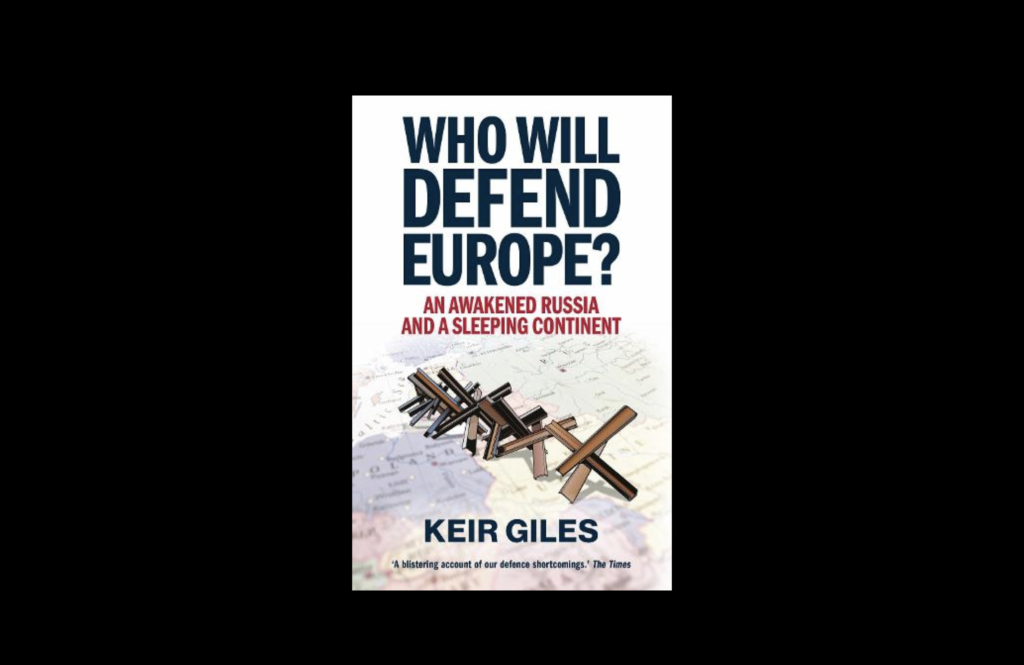
Keir Giles’s Who Will Defend Europe? An Awakened Russia and a Sleeping Continent argues that Europe has spent three decades behaving as if history had ended, while Russia did the opposite. The Sleeping Continent is a verdict on political leadership, procurement culture, and the strategic habit of assuming the United States will keep turning up with the heavy kit.
Russia is intent on attacking beyond Ukraine. Can Europe defend itself? Keir Giles asks. His core claim is that Russia is understood and still discounted. Europe’s repeated pattern is to accept the threat in rhetoric, then respond in fragments, late, and often with the wrong tools. One of the most useful aspects of the book, as reflected in detailed reviews, is its relentless linking of political psychology to material readiness. Europe is not short of speeches. Europe is short of stockpiles, surge capacity, and the boring administrative stamina required to keep a military machine fed.
“Keir Giles has been right about Russia for 20 years. In Central and Eastern Europe we read his work, comforted that at least some Western scholars understood what Russia was doing. Western leaders, though, refused to listen. For alla our sakes I hope they listen now.”
– Toomas Hendrik Ilves, former president of Estonia
Giles argues deterrence is not a mood. It is a demonstrable capability in place. Russia’s next war will be enabled by a lack of demonstrable will in Western capitals and by a United States that might refuse to get involved or withdraw support altogether.
The book also has a second target: Europe’s own myth of the Peace Dividend. Giles returns again and again to the idea that Europe treated defence as an optional subscription and now finds itself renegotiating the contract at the worst possible moment.
Arson Attacks and Bomb Threat Campaigns
The book describes in considerable detail the expanding pattern of Russian hybrid operations across Europe. The author presents a wide picture of sabotage, intimidation campaigns, reconnaissance of critical infrastructure, and attempts to disrupt military logistics supporting Ukraine. The cases show a pattern of operations designed to generate uncertainty, fear, and disruption inside European societies.
One set of incidents involves arson attacks and sabotage operations targeting civilian or logistical facilities. Several attacks have been linked to Russian-directed or Russian-inspired activity. These include arson attempts against Ukrainian-owned warehouses in the United Kingdom, which are believed to have been intended to disrupt supplies destined for Ukraine. Similar attacks have taken place elsewhere in Europe. The author cites a paint factory in Poland that was targeted in an arson attack, as well as private homes in Latvia that were struck in suspicious incidents. One particularly unusual case involved an IKEA store in Lithuania, which appears to have been targeted not for military value but for its psychological impact, signalling that everyday civilian spaces could become targets. In Poland, the book also notes a major arson attack that destroyed Warsaw’s largest shopping mall, part of a broader series of suspicious fires that Polish authorities have attributed to Russian sabotage activities.
Another tactic involves large-scale bomb threat campaigns aimed at schools. Estonia experienced a wave of bomb threats sent to schools across the country, with security services concluding that the goal was not necessarily to carry out real attacks but to create psychological pressure and fear within society by targeting children and families. The tactic was later replicated in Slovakia. In May 2024, more than 1,000 Slovak schools received bomb threats, forcing evacuations and significant disruption. The book argues that this kind of campaign fits squarely within Russia’s broader hybrid warfare doctrine, which aims to weaken societal resilience rather than simply damage physical infrastructure.
The author also describes intelligence and reconnaissance operations against critical infrastructure and military logistics. In Poland, authorities disrupted a network of agents conducting reconnaissance on the country’s rail network, which plays a key role in transporting military equipment and aid to Ukraine. Another suspect was reportedly surveying security arrangements at Rzeszów airport, the main logistical hub through which Western military assistance flows into Ukraine. German authorities have also arrested individuals suspected of planning attacks on US military facilities, including the Grafenwöhr training base, which is used to train Ukrainian troops on Western equipment.
Hybrid activity has extended even to the defence industry itself. One intercepted plot mentioned in the text involved a plan to assassinate the chief executive of the German defence company Rheinmetall, one of Europe’s most prominent suppliers of weapons and ammunition to Ukraine. Hybrid warfare increasingly blurs the line between military and civilian domains.
Energy infrastructure and other critical systems are also under scrutiny from Russian intelligence services. In Norway, the domestic security service PST has reported that Russian operatives have been reconnoitring power plants, energy networks, and other vulnerable infrastructure, seeking to understand emergency preparedness procedures and potential weaknesses. The Norwegian energy company Eviny has monitored suspicious activity around power lines and dozens of power facilities in western Norway, often with the help of reports from local residents. Meanwhile, in Germany, investigators discovered a cache of explosives and detonators deliberately buried near a NATO oil pipeline close to Heidelberg in May 2024, suggesting preparations for sabotage against energy infrastructure supporting allied military operations.
The book also highlights the use of criminal intermediaries and proxy networks. In Lithuania, Moscow is described as having used organised crime networks to arrange attacks against Russian opposition figures, demonstrating how hybrid operations can rely on local actors rather than official intelligence operatives.
Hybrid activity is not limited to physical sabotage. The author also points to electronic and information warfare methods. In some parts of Europe, interference with satellite broadcast systems has caused ordinary television programming to be replaced by Russian propaganda, illustrating how civilian communications systems can be manipulated during periods of geopolitical tension.
Another form of electronic interference involves GPS jamming. The book notes that Russian electronic warfare has already caused regular disruption of GPS signals in northern Norwayand eastern Finland, affecting aircraft navigation and complicating operations for police and emergency services. The authors warn that if this tactic were expanded to more densely populated regions of Europe, the consequences could be severe. Millions of vehicles and logistics systems depend on satellite navigation. Large-scale GPS disruption could therefore create widespread traffic chaos and disruption to emergency response services, particularly in central Europe’s densely populated transport corridors.
Keir Giles raises the possibility of a more serious escalation. One potential line of action would be the revival of Cold War–era tactics in which Moscow supported violent extremist groups in Western Europe. During the Cold War, organisations such as Germany’s Red Army Factions, one of which was the Baader–Meinhof Group, conducted bombings, assassinations and kidnappings across Europe. These groups maintained connections with Eastern Bloc intelligence services, particularly the Stasi in East Germany, and indirectly with the Soviet KGB, which saw such movements as tools for destabilising Western societies. These German radicals also took part in international terrorist operations, including the 1976 hijacking of an Air France aircraft that was diverted to Entebbe, Uganda, carried out in cooperation with Palestinian militants.
Russia could once again attempt to exploit disaffected populations within Europe, whether immigrant communities or domestic extremists, sponsoring or facilitating attacks in European capitals as a form of strategic pressure.
Europe’s Timing Problem
The most persuasive thread in the book is the insistence that Europe is in a timing problem. Giles describes the build-up of European deterrence as a race against time. Military capability cannot be conjured by summits. Ammunition lines, air defence, trained crews, sustainment, and the industrial ecosystem behind them do not respond like a smartphone update.
“Keri Giles has been warning us for many years of Russia’s determinations to re-arm, remilitarise and rebuild an empire. Noe he offers a stark warning for Europe and the world: the only alternative to planning for a war is planning to lose it.”
– Anne Applebaum, author of Autocracy, Inc: The Dictators Who Want to Run the World
Since the book’s publication, European defence spending has climbed sharply. The EU Council’s own Defence in Numbers page puts 2024 EU member state defence expenditure at €343bn, with 2025 estimated at €381bn, and the share of GDP rising to an estimated 2.1%. The European Commission’s SAFE instrument now offers up to €150bn in long-maturity loans for defence procurement, a structural attempt to turn political urgency into industrial orders.
These are precisely the kinds of moves Giles wants. They also underline his argument that Europe’s real struggle is converting declarations into output. SAFE exists because the previous model did not scale.
“A powerful and urgent analysis of Europe’s looming security challenges – this book is a wake-up call for anyone who cares about the future of the continent.”
– Elliot Higgins, founder of Bellingcat
Parts of the book are time-stamped. Giles wrote with the US political trajectory as an open question, and reviewers note his focus on American distraction and potential disengagement, including assumptions about a second Trump administration resetting priorities. By 2026, the shape of US pressure on Europe is no longer hypothetical, and the European response is more visible, if still uneven.
There is also a second way the book risks dating. The war economy dynamics are moving fast. Russia’s defence and security spending has surged in ways that make rebuilding for the next war less like a warning and more like a description of the present tense. The Bank of Finland notes Russian military spending rising from 3.6% of GDP in 2021 to 7.2% of GDP in the 2025 budget. If anything, that makes Giles look less alarmist than some of his critics would like.
Where the book can feel slightly behind the curve is on the emerging European machinery now taking shape. SAFE is one example. The broader EU defence-industrial toolkit is expanding, with debates around the European Defence Industry Programme and longer-term Projects of Common Interest to avoid fragmented buying. Giles is right to demand speed, but the institutional landscape is evolving, and a reader in 2026 will want an updated chapter on what the new instruments can and cannot do.
Pre-WW2: Ten-Year Rule and Model Cajander
Giles mentions pre-Winter War Finland as an example of insufficient funding of defence in time.
using the sarcastic expression Model Cajander, which referred to the situation of the Finnish Army in 1939. Named after Prime Minister A. K. Cajander, the term described soldiers arriving at the front wearing civilian clothes, sometimes with only a cockade in their caps and a rifle issued to them.
The historical data suggest a more nuanced picture. Finland’s defence spending in the late 1930s was not exceptionally low by international standards, either as a share of national income or of the state budget. The real problem lay in how the money was spent and how late key investments were made.
Economic historians estimate that Finland’s military expenditure rose during the 1930s to roughly 3–4 per cent of GDP, with one estimate placing it at about 3.8 per cent of GDP on the eve of the Winter War. For a small peacetime democracy, this level was not trivial. It exceeded the peacetime defence burden of many Western European countries during the same period.
Sweden’s major rearmament programme in the mid-1930s raised its defence spending to around 1.5 per cent of GDP, significantly lower than Finland’s share. Large powers such as Britain and France eventually increased military spending sharply, but they did so mainly in the late 1930s after the German threat became unmistakable.
Measured as part of the government budget, the Finnish pre-Winter War defence spending was about 15–20 %. The share only approached one-third or more after the war began, when emergency mobilisation and wartime spending radically increased defence expenditure. The perception that Finland spent very little comes from three main factors:
1) Allocation problems. A notable share of funds went into naval projects, especially the coastal defence ships Ilmarinen and Väinämöinen and other naval programmes
2) Late rearmament. Major purchases of modern aircraft and anti-tank weapons accelerated only shortly before the Winter War, leaving too little time.
3) Equipment shortages despite spending. Even with 15–20 % of the budget, Finland was a small and relatively poor economy, which meant the absolute sums remained limited.
After the Winter War began, the share rose dramatically, reaching about 45 per cent of the state budget in 1940, illustrating how strongly the Finnish state prioritised defence once war had started.
In the early 1930s, Britain followed a defence policy known informally as the Ten Year Rule, the assumption that the country would not face a major war for at least a decade. This doctrine justified deep cuts in military spending after the First World War. By the time the rule was abandoned in 1932, Britain’s armed forces were severely underprepared. The Royal Air Force had to rearm in haste during the late 1930s, and the British Army entered the Second World War with limited modern equipment, contributing to the disastrous campaign in France in 1940.
France possessed one of the largest armies in Europe in 1940, but political paralysis during the interwar period left key areas neglected. Investment focused heavily on the Maginot Line, while mobile forces and modern communications were underdeveloped. Many tanks lacked radios and were dispersed among infantry formations rather than concentrated for manoeuvre warfare. When Germany launched its offensive through the Ardennes, the French army’s structural weaknesses, partly the result of political indecision over defence reforms, proved catastrophic.
During the interwar years, the United States maintained only a small standing army. Political isolationism and budgetary restraint kept military spending low throughout the 1920s and much of the 1930s. In 193,9 the U.S. Army ranked seventeenth in the world by size, smaller than that of Portugal. When global war expanded, the United States had to mobilise and equip millions of soldiers almost from scratch. Although American industrial power ultimately overcame this gap, the initial lack of preparedness reflected years of political reluctance to invest in defence.
Denmark entered the Second World War with a deliberately minimal defence posture. Successive governments had prioritised neutrality and economic stability over military investment. Defence budgets remained low throughout the 1930s, and the Danish armed forces were small, poorly equipped, and largely designed for internal security rather than national defence. When Germany invaded on 9 April 1940, Danish resistance lasted only a few hours before the government surrendered, recognising that meaningful military defence was impossible.
The Netherlands maintained neutrality during the interwar period and limited defence spending accordingly. Although some rearmament began in the late 1930s, the Dutch military remained under-equipped and lacked modern aircraft, armour, and anti-aircraft systems. The Dutch relied heavily on defensive flooding lines and static fortifications rather than modern manoeuvre forces. When Germany attacked in May 1940, the Dutch army was quickly overwhelmed, and the bombing of Rotterdam forced a surrender after five days of fighting.
Italy entered the Second World War with a large army but inadequate equipment and industrial support. Political prestige projects and colonial wars had strained resources, while Mussolini’s regime exaggerated military readiness. Many Italian units lacked modern tanks, trucks, radios, and artillery. Industrial production could not sustain a modern war effort. The result was a series of early disasters in North Africa and Greece, where Italian forces were defeated despite numerical advantages.
A modern example occurred when Russia annexed Crimea in 2014. After decades of underfunding and corruption, Ukraine’s armed forces were in poor condition. Many units lacked operational equipment, training, and even basic supplies. Only about 6,000 soldiers were considered combat-ready when the crisis began. The experience forced Ukraine into an urgent military reform and rearmament programme, which became crucial when Russia launched its full-scale invasion in 2022.
Blind Spot is Social Realism
Giles is very good at capability and governance. He is less persuasive when he leans into a civilisational register about comfort and complacency. Europe’s defence problem is now openly a political economy problem. You cannot rearm at scale without a story voters will tolerate, and without a credible account of who pays, who benefits, and how quickly risk declines. Giles is strongest when he sticks to the mechanics, procurement, readiness, and industrial capacity. He is weaker when he treats public opinion mainly as an obstacle to be overcome.
Giles also interprets a remark by British Prime Minister Keir Starmer as revealing a misplaced priority in the debate on national security. Starmer said, “There is no institution more important for the security of our country than the National Health Service.” According to Giles, framing security primarily through the health system risks diluting the case for direct investment in defence and hard security capabilities.
At the same time, Giles describes the expanding scope of Russia’s hybrid operations, including cyber attacks and other forms of digital disruption. These two issues are closely connected.
In Finland, for example, Cyber Security Director Rauli Paananen recently stressed how essential it is for national resilience that overall control of cyber security services in regional and local administration, including the health-care system, remains in publicly owned entities. The cybersecurity director warned that the proposed public procurement legislation could expose Finnish municipalities and healthcare services to increased cybersecurity threats.
Keir Giles presents the reader with a disturbing catalogue of Europe’s weaknesses, and how Russia is planning to exploit them. As regards Europe and the West in general, Russia is a hostile actor, has always been, and will always be; and, collectively, not just the vulnerabilities it can create, but the vulnerabilities Europe has created for itself.”
– Gen John R. Allen, US Marine Corps (Retd), former commander, NATO International Security Assistance Force (ISAF)
A second limitation is the book’s gravitational pull towards the UK’s role. That is understandable, Giles is a British analyst with deep experience of London’s institutional failures. It is also a constraint. The centre of gravity in European rearmament has shifted east and north in both will and urgency, and Europe’s future deterrence posture will be shaped by Germany, France, Poland, the Nordics, and other frontline states as much as by the UK.
Can Europe do the unglamorous work of building the supply chains, skills pipelines, and production depth that make deterrence credible, without waiting for the next shock to provide political permission? These questions remain, making Who will defend Europe uncomfortable and largely relevant.
Read More:
- European Council, Consilium: EU defence in numbers
- European Commission: SAFE | Security Action for Europe
- European Parliament: Security Action for Europe (SAFE) through the reinforcement of European defence industry
- Bank of Finland, BOF Bulletin: Rough times for the Russian economy
- IAI: The European Defence Industry Programme
- University of Helsinki / Jari Eloranta: Professor Jari Eloranta: Military spending accounts for an ever smaller proportion of the world economy
- Wikipedia: Interim Peace
- Wikipedia: Defence Act of 1936 (Sweden)
- Suomenmaa: Talvisodan myytti kiehtoo tutkijoita (in Finnish)
- Keskisuomalainen: Suomi varustautui hyvin talvisotaan – historiankirjoitus kumoaa myyttejä (in Finnish)
- Yle: Putinin pakkomielle tulee Suomelle kalliiksi (in Finnish)