
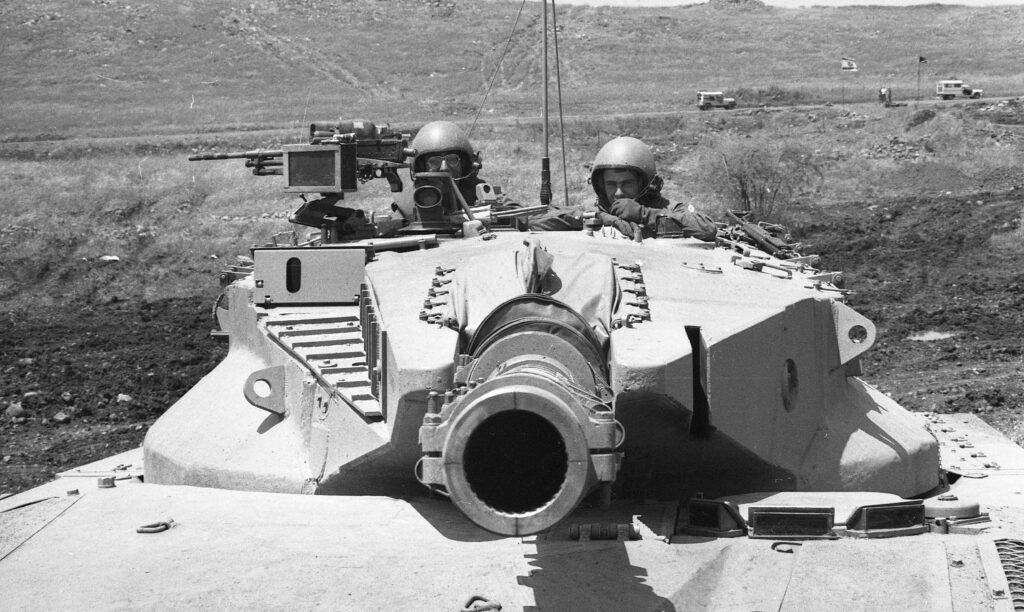
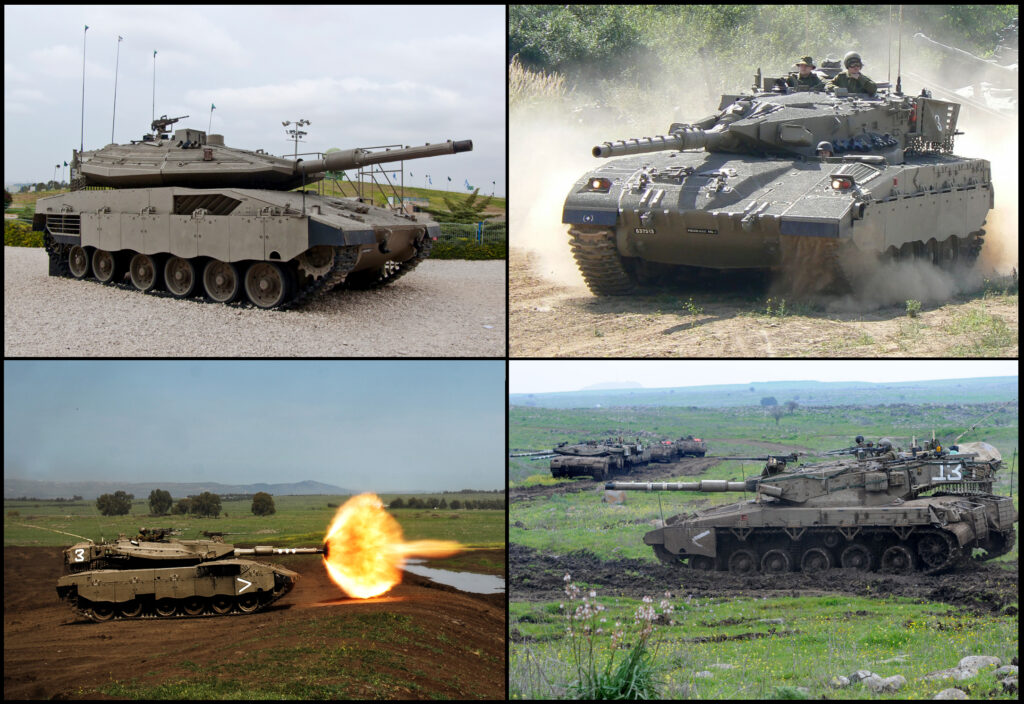
The Israeli Merkava main battle tank has consistently been one of the best-protected tanks in the world. Israelis have learned the hard way that a small nation cannot afford to lose any of its well-trained tank soldiers. That is why Israelis have always emphasised tank armour protection.
A main battle tank can be evaluated by three properties: firepower, armour, and mobility. If you change one of the properties, it influences the other two. Different countries have put different importance on how to balance a tank design. Some emphasise firepower and some mobility. In the Merkava tank, armour protection comes first, firepower and mobility second. This delicate balance of properties might change due to experiences gained in the War in Ukraine. At the present time, it is too early to predict how a modern main battle tank will look, say 10–20 years in the future. New generation main battle tanks do not exist yet, even though concepts have been presented at various military exhibitions
Beefed Up Armour
A main battle tank is built out of armour-grade steel, in other words, rolled homogeneous armour steel (RHA). This provides structural integrity and carries the loads associated in the tank’s daily use. The hardness of RHA depends on the thickness of the plate and the location where it is used.
To achieve the required level of armour protection, the RHA plates must be reinforced with additional armour. One can call it by many names: special armour, composite armour, or laminate armour. You just cannot build a tank out of solid steel blocks. That would require over a meter of steel to stop modern anti-tank weapons.
What you need is armour solutions that exploit the weaknesses of different kinds of anti-tank weapons, be it kinetic energy (KE) projectiles or metal jets produced by shaped charges (HEAT = High Explosive Anti-Tank). Both penetrators are long and elongated and can be disrupted in the lateral direction.
Kinetic and Chemical Energy – Armor-piercing Ammunition

Armour piercing ammunition can be divided into two categories: kinetic energy and chemical energy weapons. Long rod penetrators and hard-core bullets belong into the kinetic energy category.

Long rod penetrators are high density metal darts that are fired from tank cannons and smaller calibre autocannons. They are manufactured from dense metals like depleted uranium or tungsten-based alloys. Lond rod penetrators or “sabot” rounds penetrate armor by erosion mechanisms. They lose their own length to displace a certain depth of armor material.

Chemical energy ammunition, like shaped charge warheads, produce a penetrating metal jet using chemical energy of an explosive. The explosion deforms a metal cone into a long-elongated jet that displaces tank armor. The jet loses its length during the penetration process to displace a certain depth of armor material.
Four Generations of Add-on Armour
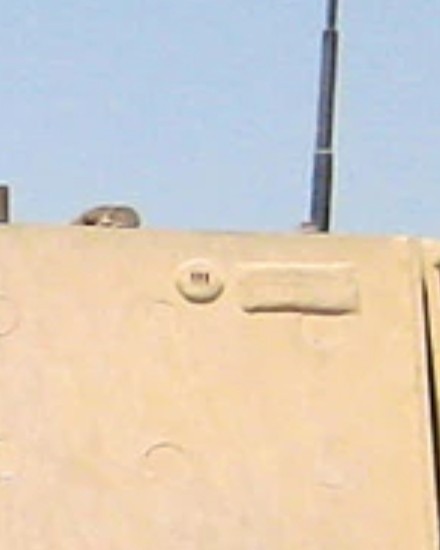
The Israelis have developed at least four generations of add-on armour to beef up the basic RHA armour plates. The generation of this special armour plate can be seen from a round coin-shaped plate attached to its surface. The small round plate contains vertical lines that indicate the generation. Two lines means second generation, and three lines means third generation armour.
The first-generation add-on armour is the Blazer reactive armor. This was never use on the Merkava tank. Blazer was used instead on Israeli Magach (M48 & M60 based) and Shot’s (Centurion based) main battle tanks.
Second-generation laminates are, by all understanding, passive laminates, containing metals and ceramics. They have several bolts appearing on the surface of these armour modules. The bolts are used to attach armour plates together that cannot be joined by other methods. The attached armour plates are always perpendicular to the bolts.
Second-generation laminate armour is used on the Merkava Mk2 and Mk3 tanks. This can be seen from the small round plates attached to the special armour modules. They contain two lines. One could easily assume that Merkava Mk3 must use third-generation special armour, but that is only found on the spaced hull side skirts.
The third-generation armour is used on Merkava Mk3 hull side skirts and on Magach 7C tanks, so-called “Envelope armour”. This armour is effective against kinetic and shaped charge threats and is most likely a passive laminate.
Fourth-generation special armour, found on Merkava Mk4 tanks, contains cassette armour solutions. These armour plates are attached at an oblique angle to meet the incoming threat. Cassette armour is very effective against shaped charge jets and against kinetic energy projectiles if a so-called KE-plate is attached to the cassette. KE-plate is a metal plate, approximately the thickness of the diameter of the kinetic energy penetrator. At an oblique angle, the KE-plate bends and cuts the nose of a long rod penetrator using asymmetrical loading conditions.
Asymmetrical Cassette Armour
Cassette armour in its simplest form consists of two plates of metals, ceramics, or composites – surrounding a material layer that propels the plates outwards. This material can be inert, energetic, or explosive. The idea is that the plates will start moving during projectile impact to increase protection.
NERA or Non-Energetic Reactive Armor is one of the oldest forms of cassette armour. It consists of two metallic plates over an inert material, like rubber or polymer fibre composite. When shaped charge jet penetrates NERA armour the inert material breaks down due to immense shock pressures and produces gas. This gas propels the metallic plates outwards.
One of the NERA plates moves into the same direction as the shaped charge jet and is therefore called the F-plate or forward plate. The other plate is called the B-plate or backwards plate. The F-plate is more effective in producing armor protection than the B-plate. This is because the contact time with the shaped chare jet is larger with the F-plate. The F-plate and the jet are moving in the same direction.
The inert layer can be energized by small amounts of explosive particles. This does not make it a high explosive layer undergoing detonation but more like enhances the movement of the metal plates by rapid burning reaction. This kind of cassette armour is called NxRA (Non-Explosive Reactive Armour) or SERA (Semi-Energetic Reactive Armour).
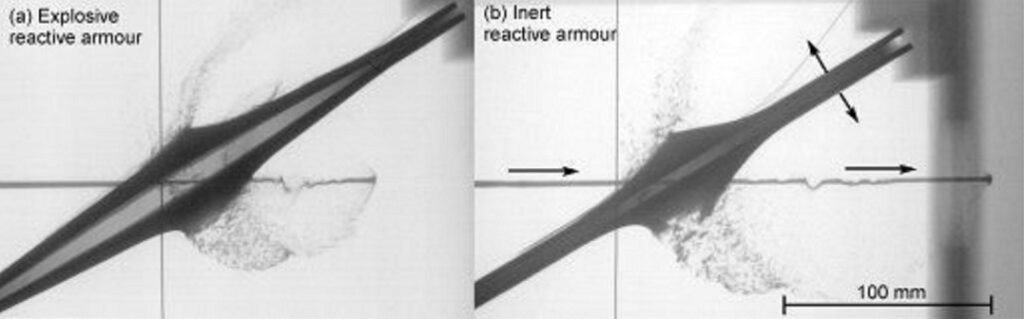
The third kind of cassette armour is ERA, or Explosive Reactive Armor. This cassette armour has a high explosive layer surrounded by moving plates that are propelled by the detonation of the explosive. ERA is the most effective cassette armour type since the moving plates achieve the highest possible velocity.
Other forms of cassette armour also exist. One version worth mentioning is cassette armour developed by Dynamit Nobel Defence (DND). It is called CLARA (Composite Lightweight Adaptable Reactive Armour). This armour has composite moving plates instead of metallic plates. This makes it less harmful to the surrounding infantry because the plates disintegrate rapidly.
The moving plates in cassette armour are of varying thickness. Thicker plates are required for protection against long rod penetrators. Usually, asymmetrical cassettes work the best.
Rolled and Cast Armour Steel
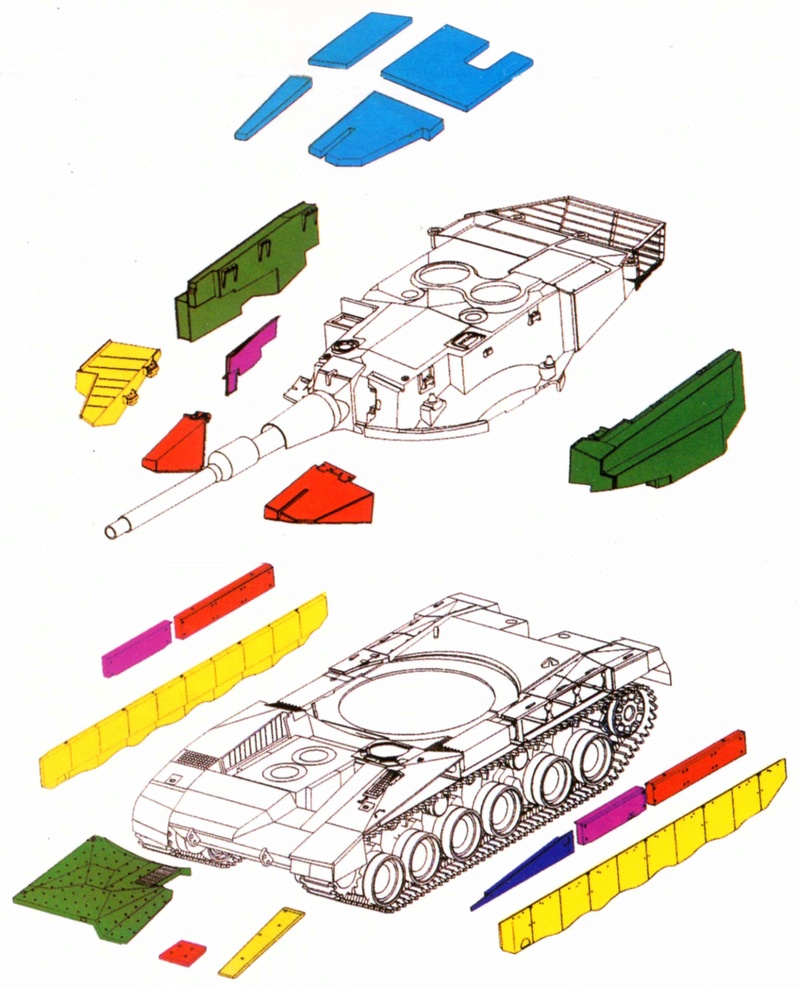
The Merkava Mk1 armour consists of rolled and cast armor steel win spaced plate configuration. Merkava’s layout is unconventional, the engine being situated at the front. The engine acts as extra protection and allows installation of a rear hull door. This was designed to allow the Merkava to stay in fighting position, while ammunition replenishment is taking place simultaneously.
Merkava Mk2 and Mk3 use both second generation add-on armor on their turrets. These are passive laminates, consisting probably of metals and ceramics. One could easily assume that the Merkava Mk3 uses third generation armor. This is true, but only for the side skirts. Third generation add-on armor is also used on Magach 7 tanks. The Merkava Mk3 tank has two vertical lines in the coin like round plate on its laminate armor modules. This means the armor is of second generation. The same technology as on Merkava Mk2.
However, the Merkava Mk2 Dor Dalet and Merkava Mk3 Dor Dalet uses fourth generation add-on armour developed specifically for the Merkava Mk4. By all evidence, the fourth-generation armour is of cassette type, not passive laminate consisting of metals and ceramics.
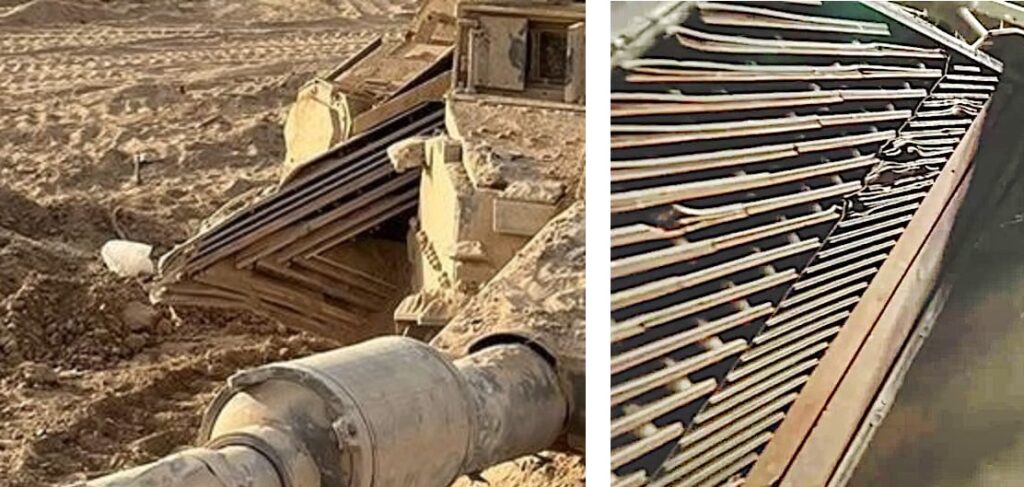
The newest Merkava Mk4 Barak (“Lightning”) was destroyed on November 15, 2024, during the Gaza War, and its armour configuration was revealed. One can clearly see that the turret add-on modular side armour contains cassette armour solutions. So does the hull side skirts. Also, photos can be found on the internet where armour modules of Merkava Mk4 are being removed. On the armour modules, one can see stencilling of explosives being use. This indicates that the cassette elements use energetic materials to enhance the movement of the plates.
The add-on roof armour found on Merkava tanks are of fourth generation. This can be seen by observing the number of vertical lines in the round plate on the modules. So, the roof armour has cassette armour solutions inside, which are very effective against shaped charge jets.
Threat of Drones
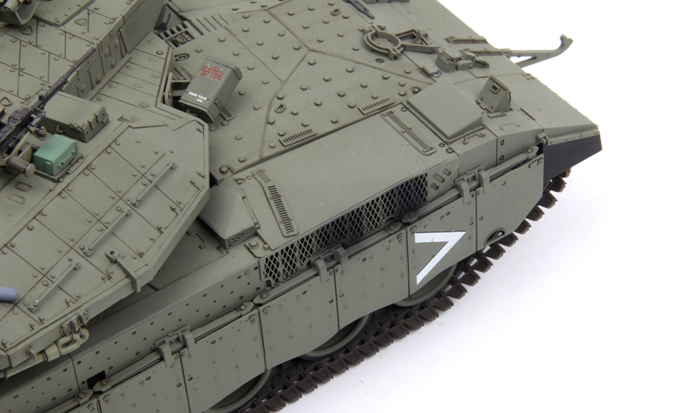
The Israelis face nowadays primarily a shaped charge in their operations rather than kinetic threat. It’s hard to imagine a situation where Israeli would be attacked by large armor echelons. Syrians don’t have the hardware, and Jordan and Egypt have no need for such an attack due to stable political relations.
This clearly dictates what kind of armor solutions their main battle tanks utilise and must utilise in the near future. The Merkava Mk4 is extremely well protected from shaped charge jets from a wide sector due to thick layers of cassette armour over the base, rolled homogeneous armour steel.
Drones are a major concern to tanks nowadays. This has been well noted in Israel. Rafael Advanced Defense Systems manufactures Trophy active protection system for armored vehicles. Latest versions of Trophy can engage targets approaching from high elevation angles. This makes it effective against drones.
The armor protection of Merkava tank continues to evolve to more effective and lighter weight solutions. How the Merkava tank will look after Merkava Mk4 Barak version is yet to be seen, but one thing is sure, Merkava and tanks overall are not going anywhere.
Read More:
- Wikipedia: Merkava
- Army Recognition: Merkava 4
- Army Recognition: First Best-Protected Israeli Merkava Mk 4 Barak Tank Destroyed by IED in Gaza Strip
- Militarnyi: Israel Lost Latest Version Merkava Tank