
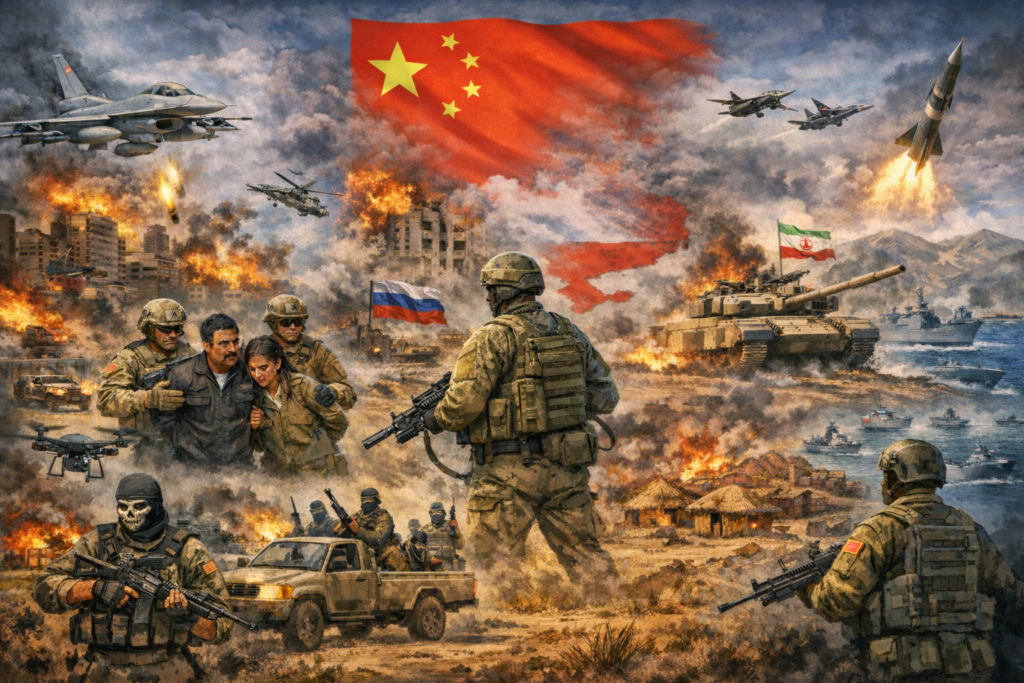
Major powers are behaving as if enforcement is optional. The US operation in Venezuela is the most dramatic illustration so far this year. China’s Taiwan drills are the most consequential rehearsal. Russia’s Ukraine campaign is the costliest grind. Together, they create a world where risk is not a forecast. Risk is a policy choice. Analysts emphasise that prevention and diplomacy will be crucial.
The year 2026 began with a jolt: the United States carried out strikes in Venezuela, has captured and extradited President Nicolás Maduro and his wife to face US charges. Here is a global tour of the likeliest hotspots in 2026, where miscalculation, domestic politics, or opportunism could turn tension into open conflict.
The crisis in Venezuela adds an immediate Latin American flashpoint with real escalation paths, such as insurgency, regional spillover, and sanctions-to-shooting dynamics. It weakens the already-fraying taboo against using force for political outcomes, an accelerant in a world where other powers are itching to test boundaries. The International Committee of the Red Cross notes that the number of wars has more than doubled since 2008, reaching some 130 conflicts by 2024. In every region, simmering tensions could boil over or spread.
The Americas: Venezuela is Not the Only Hotspot
The Americas face more disorder at the margins. Regardless the acute situation in Venezuela in early January 2026, full-scale wars are not yet foreseen.
- Latin America – Militarisation: Governments from Brazil to Chile are expanding their security forces amid soaring crime. Analysts note a regional trend toward a “war on crime” approach, with armies deployed in cities and tough new anti-gang laws. This raises the danger of abuses or insurgency by armed gangs.
- Venezuela: Caracas remains the region’s most volatile spot after the U.S. intervention to oust Maduro. This may escalate to Venezuelan crackdowns or even a military response.
- Mexico and the Caribbean: Drug cartels are becoming better armed and more technologically savvy. Security reports predict cartels will deploy drones, AI deepfakes and cyber tools to evade police and attack rivals. The U.S. is considering direct strikes on cartel bases in Mexico under a new law, which would shatter Mexican sovereignty and risk retaliation. Haiti also looms: gang violence and a failed government make Haiti a tinderbox, and any collapse could trigger refugee flows into the region.
- Colombia–Venezuela nexus: Weakening Colombian peace efforts and chaos in Venezuela threaten to reinvigorate conflict. Analysts warn that armed guerrillas and criminal bands could renew war if the Colombian state weakens and Venezuelan chaos spills over.
- United States – Domestic unrest: U.S. intelligence warns of rising political violence at home. Bitter polarisation could lead to armed confrontations between extremist groups or between militias and security forces. FBI sources have reported more politically motivated bomb plots and armed clashes in 2025. While the U.S. still ranks low for interstate war, analysts flag domestic instability, from elections or social strife, as a significant crisis risk in 2026.
According to Crisis24, organised crime in Latin America will “enter a new technological phase” in 2026. For businesses and governments, this means the security environment will be shaped by drones, AI scams, cyber intrusions and brazen violence. The Western Hemisphere faces no foreign invaders, but its internal and transnational conflicts, such as drugs, gangs and politics, are likely to intensify.
Most Plausible Escalation Tracks
- State fragmentation and armed backlash: If parts of the security apparatus splinter, you get a messy, multi-actor fight rather than a neat transition.
- Regional political blowback: Neighbours, like Brazil and Mexico, have already condemned the operation; you can expect diplomatic retaliation, border volatility, and proxy meddling.
- Energy and maritime insecurity: Anything that disrupts oil flows or shipping routes becomes a global economic irritant and a motive for further coercion.
- Legal and legitimacy warfare: The loudest international-law criticism is that this violates the UN Charter’s prohibition on the use of force absent self-defence or Security Council authority. That argument will shape whether partners distance themselves or quietly cooperate.
Beyond Latin America
The Venezuela intervention hands every ambitious power a rhetorical template: “narco-terror”, “criminal regime”, “humanitarian necessity”, “self-defence”, choose your label, launch your strike.
Europe: The War That Refuses to Freeze
European security is thus expected to remain fragile. Ukraine’s battlefield outcomes will drive much of the discourse. Moscow’s goals remain maximalist, and Kyiv’s allies are weary; the default expectation is a grinding war. Meanwhile, NATO patrols and exercises in Eastern Europe will likely continue to deter, but also irritate, Russia. By early January 2026, reporting indicates Russia’s territorial gains in 2025 were the biggest since the war’s first year, while Ukraine faces sustained pressure and evacuations near the front.
Smaller trouble spots like Transnistria in Moldova, the Balkans and frozen Caucasus disputes, could ignite, but Ukraine and Russia-NATO friction are the dominant European concerns.
The 2026 Danger Zones
- Ukraine war intensifies: The four-year war is likely to grind on. Russian forces have pressed offensives in Donetsk and stepped up missile strikes on Ukrainian cities and power plants. Western experts judge a decisive phase may be approaching, but see no quick end. Both sides are dug in, and all signs point to continued attritional fighting well into 2026. Neither Russia nor Ukraine appears ready to de-escalate under the current balance of power.
- Russia-NATO confrontations: Airspace violations, drones, sabotage attribution, or a misread exercise can create the sort of “single night” crisis leaders struggle to control. With tensions high, even a small incident on the Russian frontier could spark a wider clash. Forecasters warn of border skirmishes or deliberate provocations between Russian and NATO forces in the Baltics or elsewhere. U.S. and European analysts rank a Russia-NATO flare-up as plausible, though unlikely, this year.
- Caucasus flare-up: The unresolved Armenia–Azerbaijan dispute looms. After Azerbaijan’s 2020 gains, renewed fighting around Nagorno-Karabakh could draw in Turkey and Russia. Experts have flagged this as a regional contagion risk: a fresh Azeri offensive might trigger Turkish support and Russian intervention.
- Infrastructure escalation: deeper strikes on energy, ports, rail, and command nodes, raising the odds of spillover into NATO-adjacent spaces.
- Black Sea and grain corridors: any attack cycle that collides with international shipping invites “escort” logic and accidental clashes.
Middle East: Ceasefires That Don’t Feel Like Peace
The Middle East enters 2026 under severe strain. Israel’s wars have broadened: after Gaza and West Bank operations, the Israel Defense Forces (IDF) struck targets in Lebanon, Syria, Yemen, Iran and even Qatar during 2025. Observers warn that fresh Israeli Palestinian fighting is highly probable. A breakdown of the Gaza ceasefire, already very fragile, could draw in Hezbollah or regional militias. Experts list renewed Gaza war and intensified West Bank clashes as among the most likely crises. In Gaza alone, over 70,000 have died since late 2023, 80% of buildings are wrecked, and about 90% of residents are displaced. Even a partial breakdown of the October 2025 ceasefire would further devastate Gaza and risk wider war.
Even with ceasefire language in circulation, humanitarian conditions remain brutal, with winter exposure and aid restrictions becoming the story of the “after” phase.
Possible Sliding Back into War
- Gaza and West Bank: Israeli–Palestinian violence remains the region’s flashpoint. U.S. and Arab-mediated ceasefires have so far held only tenuously. Any break could see Israel resume mass strikes in Gaza or harsh crackdowns in the West Bank. Short-term calm hides deep grievances: Gaza’s humanitarian collapse is acute, and settler attacks in the West Bank are eroding stability.
- Iranian unrest: Iran’s regime faces its most serious internal challenge in years. December 2025 protests over economic collapse have turned violent in some cities, and opposition figures like exiled prince Reza Pahlavi declared the regime “at its most fragile”. Tehran is wary: officials have reportedly used restraint and indirect tactics, like cancelling classes, to avoid provoking foreign powers. Still, Iran’s clerics are under unprecedented pressure from sanctions, inflation and sporadic bombings of nuclear sites by Israel and the U.S.. If unrest broadens, it could invite covert intervention or regional power plays. Analysts also warn that Israel and Iran could re-engage directly: an expansion of Israel’s 2025 attacks on Iran’s proxies or nuclear infrastructure might trigger an Iran–Israel clash.
- Lebanon and Syria: Post-October 2023, Lebanon was relatively quiet but could flare again. Hezbollah’s losses and Israeli strikes in 2025 have weakened militant groups, yet a new Lebanese government is fragile. Any collapse of UN or U.S.-brokered ceasefire lines in Lebanon or renewed Israeli raids on Hezbollah could reignite that front. Syria remains simmering: regime instability, Islamic State cells, and Turkish concerns, especially around Kurdish areas, make flare-ups possible even after recent ceasefires.
- Yemen/Red Sea corridor: The war in Yemen is a growing Middle East wildcard. The Houthis continue to wage a stealthy naval and drone campaign across the Red Sea. Though a late-2025 pause in Houthi strikes offered hope, analysts caution the lull is fragile. Houthis have long-range missiles and ties to Al-Qaeda and ISIS in the region. Proxy rivalries around the Red Sea, such as Ethiopia–Eritrea and Gulf states jockeying for influence, leave the shipping routes highly vulnerable to sudden escalation. Another cycle of Houthi attacks on shipping or Israel could quickly draw in U.S. or UK forces, further destabilising the region.
Aid and governance remain choke points: restrictions, bans, or administrative strangulation of relief groups create predictable disorder, and disorder breeds armed regrouping. Crossings, inspection regimes, and buffer zones are classic ignition switches. There are also the regional echo conflicts: The Israel–Iran shadow layer never went away. A renewed Iran–Israel direct fighting remains as a meaningful contingency. Even when attacks dip, the underlying logic, like deterrence, signalling, revenue, and ideology, remains. UN-focused briefings still treat Yemen and Red Sea security as active variables into 2026.
Africa’s Crisis Belt Widens
Africa’s outlook is grim: entrenched wars in Sudan, Sahel and eastern Congo are expected to deepen, driving unprecedented humanitarian crises. There are also insurgencies in Mozambique’s north and recurring crises in Cameroon’s Anglophone regions. Internationalised proxy fights, like Russian influence in Sahel and East African rivalries, mean local conflicts could have wider repercussions. The risk isn’t only battlefield lines. It’s regional spillovers, arms markets, and mass displacement hardening into permanent instability.
- Sudan: The brutal civil war between the army (SAF) and the Rapid Support Forces (RSF) shows no signs of abating. IRC and CFR analysts both rank Sudan as the continent’s top crisis. Millions are displaced, and famine is deepening. Each side is bolstered by foreign backers, regional powers and shadowy networks, who profit from the war by smuggling gold and supplying drones. With neither faction ready to negotiate, advisers warn of continual siege warfare and civilian catastrophe through 2026. The flow of advanced weapons into Sudan and foreign interference make peace very elusive.
- Sahel insurgency (Mali–Burkina–Niger): The Mali and Burkina Faso juntas, and now Niger, remain in vicious standoffs with jihadist groups. AQIM, ISIS affiliates (ISGS, JNIM) and local militias have expanded control toward coastal West Africa. The region is becoming one large conflict zone: attacks on highways and villages are cutting off fuel and food routes. Crisis monitors warn that violence will intensify in 2026, spilling into neighbouring countries, like coastal Benin or Côte d’Ivoire, unless governments curb corruption and supply shortages. International forces are stretched thin, so militant networks will likely exploit these transitions.
- Democratic Republic of the Congo: The eastern DRC is deteriorating despite a 2025 peace deal. Rwandan-backed M23 rebels and dozens of other militias, supported by Uganda, Burundi or Rwanda, are carving up territory. Clashes around gold and rare-earth mines fund the fighters, and smuggling has surged to unprecedented levels. As humanitarian groups warn, expect more civilian massacres, displacement and even disease outbreaks in eastern Congo in 2026. Foreign powers, like Uganda and Rwanda, have yet to fully disengage, prolonging the chaos.
- Nigeria: The Islamist insurgency in the north (Boko Haram/ISWAP) remains potent. 2026 elections could be flashpoints, as militants sometimes boycott voting and escalate attacks. Separately, the Biafra revival movement in the southeast is pushing for secession, leading to sporadic clashes with security forces. CFR flags rising jihadist violence and weak governance as destabilising factors. In short, Nigeria’s manifold security threats are converging, threatening a broader breakdown.
- Horn of Africa: Ethiopia’s fragile peace is at risk. Federal forces continue skirmishes with former Tigray rebels and other militias. There is also a renewed threat along the Eritrea border: analysts caution that if Addis seeks Red Sea access, like through Sudan, it could provoke Eritrean-led militias into conflict. The continuing famine and coup remnants in neighbouring countries keep the entire Horn jittery. Any misstep could rekindle wider war.
Asia-Pacific: the Taiwan Strait is the World’s Most Dangerous Theatre
Asia-Pacific is projected to see major power brinkmanship. The biggest worry is a cross-strait crisis. China’s PLA staged large-scale “Justice Mission 2025” drills encircling Taiwan and explicitly practising a blockade of its ports. Observers note these war games simulated cutting off Taiwan’s access to the world, a direct threat to U.S. allies Japan and the Philippines, which showed China’s advanced anti-access capabilities. U.S. analysts warn that Beijing’s continuing military pressure on Taiwan could precipitate a serious crisis involving other countries. Crisis24 similarly predicts flare-ups in the South China Sea and Taiwan Strait, such as aggressive patrols and ship rammings, that, while not likely to start a full war, will cause frequent confrontations in critical shipping lanes.
Uniquely Risky Year Ahead
- Taiwan Strait: As above, nearly all forecasts flag Taiwan. Beyond the war games, China has accelerated island-building and weapons deployments. Experts say Beijing could try to intimidate Taipei with more naval exercises or even limited blockades in 2026. The risk of miscalculation is high if China underestimates U.S. or allied responses. Following a blockade logic, China doesn’t need an invasion to start a war. It needs a quarantine, an “inspection zone”, or a sudden “exclusion area”. The US arms packages and contracting announcements are treated by Beijing as triggers, not background noise. The Venezuela episode strengthens the idea that great powers can act first and litigate later, exactly the mentality that makes a Taiwan crisis harder to defuse.
- North Korea: The Korean Peninsula remains tense. North Korea paused nuclear tests, but experts caution Pyongyang could resume testing or carry out high-profile missile launches. Any move would spike regional tensions: South Korea, Japan and the U.S. would likely respond with joint military exercises or sanctions, risking further escalation. A large-scale clash is unlikely, but even small provocations (artillery shelling, naval skirmishes) could test the fragile armistice.
- South Asia (India–Pakistan): Longstanding Kashmir tensions could flare. CFR warns that delays or manipulation of elections in Pakistan or India might be blamed on cross-border militants, potentially leading to a new round of artillery duels in Kashmir. Neither side seems keen on outright war, but proxy attacks or local clashes along the Line of Control could spike if political rhetoric turns hawkish.
- Myanmar and ASEAN: In Southeast Asia, Myanmar’s junta remains locked in civil war with ethnic militias. A controversial December 2025 election, with heavy Chinese backing, is unlikely to stabilise the country. Analysts predict the military’s crackdown will continue, stirring ethnic resistance and spilling refugees into Thailand and beyond. Elsewhere in Asia, other low-intensity conflicts could resurge, such as disputed borders like Cambodia, Thailand, or South China Sea claims involving Vietnam, the Philippines and others remain flashpoints that could erupt if nationalists prevail.
Australia itself sees no war on its doorstep, but strategic competition looms. Canberra warns Pacific islands against over-dependence on China, and the ANZUS treaty means Australia could be drawn into any Taiwan Strait showdown. The Asia-Pacific security environment will be dominated by China’s advances and North Korea’s unpredictability. Most analysts do not foresee a major Asia war in 2026 but expect constant smaller incidents and the risk of miscalculation.
Technological and Environmental Threats
Beyond classical warfare, analysts highlight hybrid and emerging threats globally. AI and drones are multiplying crisis vectors. Conflict researchers note that drones, artificial intelligence and cyber-operations are now integral to modern battles. Terror groups and cartels are adopting these fast: Crisis24 predicts cartel use of surveillance drones, deepfake voice scams, and encrypted communications to evade police. Governments fear a “highly disruptive AI-enabled cyberattack” on critical infrastructure is a real possibility in 2026.
According to the Global Risk Forecast 2026 report by Crisis24, the “2026 threat environment will be shaped by … AI-enabled scams, cyber intrusions, and physical violence” alongside traditional crime. The Internet itself may become a battlefield: major cyber-espionage or sabotage campaigns against power grids, water systems or financial systems could occur, especially between the US, China and Russia as tensions rise.
Global power rivalry is another cross-cutting factor. Observers note that the U.S., Chinese and Russian militaries have all shown provocative behaviour. CNAS argues that while each power publicly downplays war, all are likely to engage in military showmanship in 2026. For example, Chinese exercises near Taiwan and Russian patrols near NATO borders are as much political signals as combat readiness. Even space and cyber domains are contested: incidents like anti-satellite tests or attributed hacking could spark international crises.
Environmental security cannot be ignored. According to a Council on Foreign Relations (CFR) report, melting Arctic ice has unleashed a new scramble: increased Chinese and Russian naval activity in the Arctic Ocean could provoke a clash with U.S. and NATO forces safeguarding transatlantic routes. While no direct war is forecast in the High North, accidents, such as ship collisions and misfired missiles, in the polar region could trigger incidents. More broadly, climate shocks, from Sahel droughts to Middle East water scarcity, are feeding instability. For instance, famines and floods in Africa are exacerbating displacement and communal strife. Although climate change itself isn’t a “crisis” like war, its indirect effects, such as mass migration and competition over resources, are noted as accelerants to conflict, especially in fragile states.
The year 2026 is projected as a year of heightened global friction. Well-known wars, such as Ukraine, Israel-Hamas and Sudan, are expected to continue or even escalate. But analysts also point to “dark horse” risks: a sudden Chinese blockade of Taiwan, a spike in Iran unrest, Africa’s spreading wars and new US–Russia or China–US flashpoints. Every region has multiple powder kegs, from gang warfare in Latin America to ethnic insurgencies in Asia. Technology, such as AI, cyber and drones, will amplify threats across the board. In this volatile forecast, analysts emphasise that prevention and diplomacy will be crucial. Failing that, 2026 could see conflicts deepen and expand beyond current battlefields.
Read More:
- Axios: World leaders denounce U.S. operation to capture Maduro
- Reuters: Venezuela says it rejects “military aggression” by the US
- The Guardian: Is there any legal justification for the US attack on Venezuela?
- Council on Foreign Relations: Conflicts to Watch in 2026
- International Crisis Group: 10 Conflicts to Watch in 2026
- Reuters: China stages record drills designed to encircle Taiwan
- Reuters: China encircles Taiwan in massive military display
- Reuters: Taiwan stays on high alert as Chinese ships pull back after massive drills
- Reuters: Taiwan vows to defend sovereignty after China’s military drill
- Reuters: Pentagon says Lockheed Martin gets $328.5 million Taiwan military sale contract
- The Guardian: Ukraine war briefing: Russia makes biggest battleground gains since first year of war, analysis shows
- Institute for the Study of War: Russian Offensive Campaign Assessment (updates)
- The Guardian: Tents supplied to displaced Palestinians ‘inadequate for Gaza winter’
- The New Yorker: Gaza After the Ceasefire
- Norwegian Refugee Council: 53 International NGOs warn Israel’s recent registration measures will impede critical humanitarian action
- America Magazine: Israel bans dozens of aid groups from Gaza, including Caritas
- UN Security Council Report: Yemen, January 2026 Monthly Forecast
- Al Jazeera: War in Sudan: Humanitarian collapse, fighting, deadlock
- ReliefWeb: Sudan Crisis Situation Analysis: Period 15/12/25 – 21/12/25
- ACLED: Conflict Watchlist 2026
- ACLED: Conflict intensifies and instability spreads beyond Burkina Faso, Mali, and Niger
- International Crisis Group: On the Horizon (Nov 2025–Apr 2026)
- Al Jazeera: Philippines says fishermen hurt, boat damaged in China coastguard skirmish
- The Diplomat: Philippines Claims Three Fishermen Injured in Skirmish With Chinese Coast Guard
- Reuters: Military-backed party in Myanmar takes lead in first phase of polls
- AP News: Military-backed party leads in early election results in Myanmar
- ACLED: Israel recalibrates its military campaigns in a region still on edge
- CNAS: Eight Things to Watch for in 2026
- Newsweek: World Map Shows Top Conflict Hot Spots in 2026
- ASIS/Security Management: Global Risk Forecast Warns of More Geopolitical and Technological Strife in 2026
- ICRC: Humanitarian Outlook 2026: A world succumbing to war
- International Rescue Committee: The top 10 crises the world can’t ignore in 2026