

Since 2022, Russia has opened a new front in Europe’s political system: sabotage, cyber‑attacks, disinformation campaigns and clandestine financing designed to fracture alliances, weaken democratic institutions and polarise electorates. At the same time, traditional parties on both the centre‑left and centre‑right are seeing their support eroded by insurgent movements. Nigel Farage’s Reform UK now leads national opinion polls, Germany’s far‑right AfD is the country’s second party, and the Nordic populists remain strong.
The Kremlin has expanded its toolkit far beyond tanks and artillery. In the Baltic Sea, Russia’s shadow fleet of civilian oil tankers has been implicated in cutting undersea power and telecommunications cables; Finnish authorities arrested the Eagle S tanker in December 2024 after it allegedly dragged its anchor across a key electricity cable, and investigators reportedly found spy equipment on board. Research from Leiden University counted 44 documented Russian hybrid operations in 2024, up from 13 in 2023, including sabotage, arson and assassination attempts. Danish and Norwegian airports have had to close repeatedly after unexplained drone incursions; Denmark’s defence minister described the flights as “systematic” and said they resembled a hybrid attack. Danish intelligence officials openly warn that Russian espionage and sabotage are a high risk at home, even though definitive evidence of who launched the drones is hard to collect.
Europe’s leaders are taking these incidents seriously. At the October 2025 Copenhagen summit, the French president, Emmanuel Macron, urged EU countries to adopt strategic ambiguity and warned that any drone violating national airspace should be shot down. Danish Prime Minister Mette Frederiksen told her peers that Russia’s hybrid campaign is a war against Europe itself. The European Parliament’s 2024 resolution on foreign interference echoes this, describing Russia’s use of intelligence services, diplomatic networks, state‑sponsored NGOs and affiliated individuals as part of a broad strategy to undermine EU unity. The resolution notes that these influence networks target anti‑EU, extreme‑right and populist candidates and that recent allegations about the Voice of Europe platform paying MEPs to parrot pro‑Kremlin narratives show how money and propaganda converge.
Hybrid operations extend to cyberspace and election meddling. The same European Parliament resolution lists hacking of candidates’ devices and cyber‑attacks on election infrastructure among the forms of interference. It highlights that Russia uses disinformation to exploit the migrant crisis and spread false narratives about migrants causing crime, thereby sowing social division. In Moldova’s 2025 election campaign, deepfake videos depicting President Maia Sandu were circulated to erode trust in democratic institutions. The Lithuanian, Estonian and German governments have all suffered repeated cyber‑attacks attributed to Russian actors.
Grey‑zone Warning
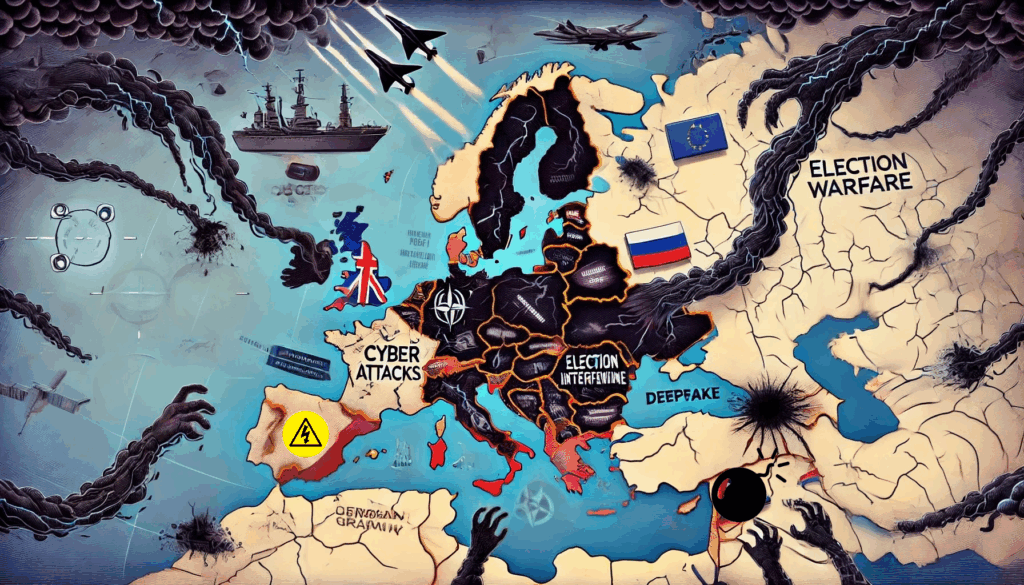
Recent reporting by The Economist adds further context to these trends. Its leader column published on 2 October 2025 describes how drones over Poland, MiG fighters in Estonian airspace, damaged undersea cables, cyber‑attacks and assassination attempts form part of what it calls a “grey‑zone campaign” against NATO, a deliberate effort by Vladimir Putin to unsettle Europe without triggering open war. The magazine argues that these incidents are not isolated; taken together, they represent a calibrated strategy designed to make Europeans doubt NATO’s commitment and to encourage suspicion between allies. Putin has three aims, says the article: to break NATO unity by undermining belief in Article 5, to raise the costs for countries supplying Ukraine, and to discredit liberal democracies so that populist nationalists gain ground. It warns that ignoring such micro‑aggressions risks normalising them, and that exposing and attributing each attack is essential to strip Russia of plausible deniability. The Economist therefore calls on European governments to publicise sabotage, cyber‑attacks and election interference, strengthen resilience with spare parts and rapid‑response teams, develop cheap interceptors to counter Russia’s low‑cost drones, and consider using frozen Russian assets to pay for Ukraine’s defence.
An accompanying briefing on the same issue widens the focus beyond NATO’s eastern flank. It notes that incidents of confirmed Russian sabotage against European infrastructure more than tripled between 2023 and 2024, and cites examples such as drones flying precise grids over German power plants, airports and arms factories; the hacking of a Norwegian dam; and explosive parcels planted on cargo planes in Lithuania. These so‑called “micro‑aggressions” create a “defender’s dilemma”, notes one analyst: respond too forcefully and you look like an escalator, respond too weakly and you embolden the perpetrator. The briefing also highlights blurring between Russian and Chinese grey‑zone operations – for example, Chinese ships have damaged Baltic pipelines and cables, while Beijing’s increasingly frequent incursions into Taiwan’s air‑defence zone mirror Moscow’s probing of NATO borders. Western officials quoted by the magazine disagree on how to respond: Poland and Estonia favour shooting down intruding aircraft, whereas Germany and Sweden counsel prudence to avoid an “escalation trap”. Regardless of the tactical debate, the articles conclude that the surge in provocations is designed to force Europe to divert resources from helping Ukraine and to test the cohesion of both NATO and the transatlantic relationship, especially given former president Donald Trump’s mixed signals about defending allies. These reports reinforce the broader thesis of this article: hybrid warfare is evolving into a sustained campaign of low‑level aggression whose aim is political – to weaken European solidarity, distract attention from Ukraine and empower populist forces.
Emerging Hybrid Partnership Between Russia and China
While Moscow is Europe’s primary threat, Beijing is increasingly part of the same ecosystem. The European Policy Centre notes that Russia and China synchronise cyber operations, disinformation and sabotage, with Chinese state‑sponsored hacking groups expanding into Europe and Russian hackers targeting Asian democracies. The European External Action Service’s Foreign Information Manipulation and Interference report found that Russian and Chinese disinformation campaigns now amplify each other; their media and diplomatic accounts reinforce common narratives blaming NATO and the West for the war in Ukraine. China’s Spamouflage network impersonates human rights groups and aligns with Russia’s propaganda to fracture social cohesion. The EPC analysis details how both regimes use third‑party proxies and “information laundering” tactics to hide state origins. Recent sabotage of undersea cables in the Baltic Sea and the Taiwan Strait involved Chinese vessels with Russian captains, showing that hybrid threats are being executed collaboratively.
Populist surge on the right: Reform UK, AfD and the Nordics

Nigel Farage’s Reform UK has emerged as Britain’s most popular party in late‑2025 polls. Ipsos surveys show Reform on 34 %, ahead of Labour and the Conservatives. Voter analysis indicates that around 40 % of 2024 Conservative voters now support Reform, with defectors largely older, non‑graduate and former Brexit supporters. Seat‑projection models demonstrate how Britain’s first‑past‑the‑post (FPTP) system magnifies this surge: YouGov’s MRP modelling suggests Reform could win nearly half the seats with less than 30 % of the vote. Vote splitting on both left and right is crucial; Labour voters are drifting to the Greens and Liberal Democrats, while Tory voters flock to Reform. Under FPTP, a four‑way split allows a party with a low plurality to take a seat, so fragmentation itself becomes a strategic weapon.
Farage’s personal stance on Russia has come under scrutiny. During the Ukraine invasion he argued that Western policies had provoked Russia, a claim he later moderated. Labour and the SNP now frame Reform as soft on Putin; Keir Starmer labelled Farage “fawning over Putin”, citing his remark that Vladimir Putin was the world leader he most admired. The Guardian notes that Farage made 17 appearances on the Russian state broadcaster RT between 2010 and 2014. However, there is no evidence of direct Russian financing of Reform. The European Parliament’s resolution acknowledges that Russian actors have funded far‑right parties – such as France’s National Front loan and alleged oil‑for‑Lega deal in Italy – but no similar case has been proven for Reform. A DeSmog investigation reported that a major Reform donor owns agricultural land in Russia but does not claim that his donation was directed by the Kremlin. Thus, while Farage’s rhetoric aligns at times with Kremlin talking points, any claim of financial backing remains speculative.
Germany: AfD and the implosion of mainstream parties
Germany’s early federal election in February 2025 produced a historic realignment. The centre‑right CDU/CSU topped the poll with 28.6 %, but the far‑right AfD surged to 20.8 %, doubling its 2021 result and becoming the second‑largest party. The centre‑left SPD slumped to 16.4 %, its worst post‑war share, while the Greens and the far‑left Die Linke both cleared the threshold with 11.6 % and 8.8 % respectively. Analyses show that AfD captured votes from non‑voters and disillusioned conservatives; it also benefits from online echo chambers where anti‑immigration and anti‑Ukraine narratives spread unchecked. The Voice of Europe scandal demonstrates tangible Russian outreach to German politicians: the platform allegedly paid AfD MP Petr Bystron €25,000, prompting AfD leaders to demand he clarify the accusations. Germany’s intelligence services view the AfD as vulnerable to being Moscow’s “fifth column”.
The Nordic Scene: Finns Party and Sweden Democrats
In Sweden, the Sweden Democrats have become a permanent fixture, polling above 20 % and providing parliamentary support for the centre‑right government. A Radio Sweden poll in early 2025 found them at 21.6 %, ahead of the Moderates. In Finland, the Finns Party regained support in late‑2025 polls after a slump, reaching nearly 15 % as it attracts voters from the National Coalition Party and formerly undecided voters. Despite scandals, the Finns Party remains part of a right‑wing coalition and pressures government policy on migration and climate. Crucially, both Nordic countries use proportional representation, so populist surges translate into kingmaker roles rather than outright power; the Sweden Democrats influence policy through a support agreement rather than governing alone.
Populist Surge on the Left and the Green Wave
Fragmentation is not limited to the right. Germany’s Die Linke won its best result in years with 8.8 % of the vote. In Finland’s 2024 European Parliament election, a red‑green tide swept the country: the Left Alliance, a far‑left party, won 17.3 % and overtook the Social Democrats, while the far‑right Finns Party collapsed to 7.6 %. Low turnout and a charismatic left‑wing figure (Li Andersson) mobilised younger urban voters who normally oscillate between the Greens, Left Alliance and Social Democrats. Such shifts show that mainstream social democratic parties are bleeding votes both to the radical left and to green parties, complicating coalition arithmetic. In the UK, Labour has lost voters to the Greens and Liberal Democrats; a YouGov poll found only 54 % of 2024 Labour voters would stay with Labour, with 6 % moving to the Greens and 7 % to the Liberal Democrats. Under FPTP, those defections lower Labour’s local vote ceilings and can hand seats to Reform or the Conservatives.
Financial Networks and Political Proxies: Evidence of Russian Funding
Credible evidence of Russian funding has emerged for several European parties, but not for all populists. The First Czech Russian Bank provided a €9.4 million loan to France’s National Front in 2014 – a structure that analysts say was sanctioned by the Kremlin to maintain deniability. Italian prosecutors investigated claims that Matteo Salvini’s Lega sought tens of millions of dollars via a Russian oil deal; an audio recording captured negotiations to funnel money to the party. Austria’s FPÖ collapsed after the Ibiza video showed its leader offering public contracts to a woman posing as a Russian oligarch’s niece, in exchange for support. These cases illustrate the range of methods: formal loans, covert oil deals and cash payments for influence. The European Parliament’s 2024 resolution reminds readers that non‑EU funding of political parties remains a loophole and highlights examples of foreign bank loans, purchase agreements and financial facilitation – including media reports linking British pro‑Brexit campaign Leave.eu to Russian assistance.
Social Media Manipulation and Election Interference
Beyond direct financing, Russia leverages social media to amplify fringe candidates and erode trust. Romanian regulators in November 2024 called for TikTok to be suspended after far‑right, pro‑Moscow candidate Călin Georgescu surged from 5 % to win the first round of the presidential election. Georgescu’s campaign relied on viral TikTok videos that were boosted by bot‑likeactivity, prompting fears of external interference. In 2024 Romanian intelligence agencies concluded that a sophisticated social media campaign, particularly on TikTok, had been orchestrated by Russia to bolster Georgescu and weaken pro‑European opponents. The case underscores how digital ecosystems can be weaponised; even when attribution is difficult, the pattern matches Russia’s practice of elevating anti‑EU narratives and candidates.
Germany has faced similar tactics. The federal domestic intelligence service reported campaigns named “Storm‑1516” and “R‑FBI” that targeted the 2025 federal election, spreading conspiracy theories and anti‑immigration memes amplified by AfD‑linked accounts. European Commission reports note that the Kremlin’s doppelganger campaign creates fake news websites and social media accounts impersonating European outlets to disseminate disinformation; these mirrored sites then feed extremist circles on both left and right. As the European Parliament observed, the ultimate goal of Russian interference is to divide and weaken the EU, with subverting support for Ukraine as an explicit aim.
Russia’s Objectives: Weaken, Divide and Distract
The overarching pattern is clear. Russia uses a spectrum of means – sabotage, cyber‑attacks, clandestine financing and information operations – to weaken and divide Western democracies. Populist parties, both right and left, are often ideologically aligned with Russian geopolitical objectives: opposition to immigration, scepticism toward the EU and NATO, and calls to end support for Ukraine. By elevating these forces, Moscow hopes to fragment established parties and complicate coalition formation. However, the success of populists does not always rely on Russian backing. Economic insecurity, migration pressures and distrust of elites are powerful domestic drivers. The proliferation of social media and FPTP electoral systems can magnify small shifts into big seat changes. In Finland, the far right collapsed when voters defected to a charismatic left candidate, illustrating that populist fortunes are volatile and not always reliant on foreign interference.
Resilience and Transparency
European governments are slowly adapting. The European Parliament has called for closing loopholes in party financing laws, stepping up cyber defences and monitoring all potential vectors of Russian influence. NATO is establishing a Maritime Centre for Security of Critical Undersea Infrastructure and a Cyber Defence Centre to counter hybrid threats. The EU’s forthcoming Defence of Democracy package aims to regulate interest representation on behalf of third countries. Nationally, Denmark, Poland and Estonia are discussing whether hybrid attacks should trigger NATO’s Article 4 or even Article 5 commitments. Meanwhile, civil society groups are mapping disinformation networks and pressing tech platforms to detect and remove coordinated inauthentic behaviour.
Ultimately, the resilience of Europe’s democracies will depend on transparency and public awareness. Populist parties will continue to prosper when mainstream parties fail to address voters’ grievances. Hybrid warfare – from drones over airports to TikTok bots – exploits those fractures. Recognising the pattern is the first step in countering it. The challenge for policymakers is to protect electoral integrity without stifling legitimate dissent and to craft policies that address the economic and social anxieties that populists exploit.
Read More:
- European Parliament: Motion for a resolution on allegations of Russian interference
- The Parliament Magazine: Hybrid threats: Russia’s shadow war escalates across Europe
- The Parliament Magazine: Hybrid threats: Russia’s shadow war escalates across Europe
- Reuters: Denmark links drone sorties to state actor, Latvia says; Russia denies involvement
- AP News: European positions on Russia harden as drone incidents, cyber-attacks and sabotage mount
- Rosa Luxemburg Foundation: The 2025 German Election: First Impressions and Implications
- Al Jazeera: German election: Who won, who lost and what’s next?
- Ipsos Political Monitor: Reform UK leads by 12 pts over Labour as both PM and Chancellor hit historic low satisfaction ratings
- The Guardian: Romania regulator calls for TikTok suspension amid vote interference fears
- Electoral Reform Society: First Past the Post could catapult Reform UK into government
- Guardian: Labour steps up attacks on Farage and Reform over pro-Russia stance
- DeSmog: Major Donor to Nigel Farage’s Reform Party Owns Russian Assets
- YouTube: Nigel Farage is knighted on Russia Today by a small child who hates him
- Reuters: Denmark links drone sorties to state actor, Latvia says; Russia denies involvement
- Reuters: Germany’s AfD says lawmaker accused of taking Russian cash denies wrongdoing
- EPD: Hybrid storm rising: Russia and China’s axis against democracy
- Reuters: Austria’s Kurz says email hoax tried to link him to Ibiza video scandal
- Securing Democracy: First Czech Russian Bank
- Reuters: Germany’s AfD asks its lawmaker to ‘clarify’ Russian cash report
- LabourList: Labour losing more votes to Greens and Lib Dems than Reform – YouGov
- Al Jazeera: German election: Who won, who lost and what’s next?
- FEPS: Finland: a red-green tide has washed away the far right
- Time: French National Front Secures Funding From Russian Bank
- BBC: Marine Le Pen: Who’s funding France’s far right?
- The Guardian: Italian prosecutors investigate League over alleged Russian oil deal claims
- FEPS: Finland: a red-green tide has washed away the far right
- Radio Sweden: Sweden Democrats bounce back above the Moderates in new poll
- YLE: Yle party poll: SDP still boasts commanding lead, Finns Party regains support
- SVT: Sweden Democrats bounce back above the Moderates in new poll
- DeSmog: Major Donor to Nigel Farage’s Reform Party Owns Russian Assets
- The Economist: Vladimir Putin is testing the West—and its unity
- The Economist: Why Russia’s micro-aggressions against Europe are proliferating

