
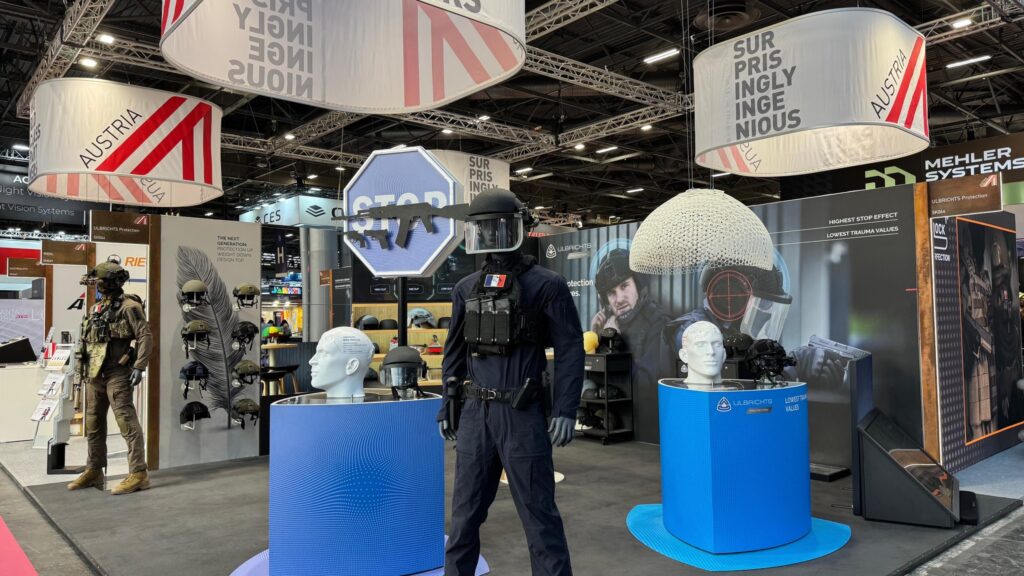
Ulbrichts Protection, the Austrian pioneer in titanium and titanium-hybrid ballistic helmets, has introduced a new generation of screwless helmets at Milipol Paris 2025. The company’s latest lineup highlights rifle-capable designs for both everyday police patrol and specialised tactical teams, signalling a shift towards routine protection against rifle threats as law enforcement agencies confront a rise in long-gun attacks in urban areas.
At the Milipol exhibition on 18 November 2025, the Austrian specialist unveiled three flagship products: the ZENTURIO First Responder helmet, the FORTIS VPAM 8 modular shield, an add-on armour shield, and the OPTIO Superlight high-cut helmet. The common thread across all three is rifle-rated protection with controlled trauma and lower weight—aimed at equipping patrol officers and special forces who increasingly face long-gun threats in dense urban environments
Patrol Rifle Protection: Zenturio First Responder
Ulbrichts is a recognised specialist in ballistic head protection. Over the past decade, its titanium and Polytanium helmets have become a standard for many German police forces; according to official documentation, a large share of newly procured patrol helmets in several key states have come from the company.
Polytanium is a combination of ultra-high molecular weight polyethylene and titanium. Titanium reduces trauma, and polyethylene stops the projectiles.
“There are still customers using and purchasing Titanium helmets, but the driven innovations by Ulbricht already show the new generation is ready and deployed to our customers based on the new weight-agility-protection benefits. Polytanium now also has us in position for the next generation of first responder helmets with rifle protection, to give people the protection against rifle threats they need and the security for the upcoming years,” stated Thomas Poandl, Vice President Marketing & Communications at Ulbrichts GmbH.
At the core of the new helmet line is the ZENTURIO First Responder, a patrol helmet that integrates rifle protection into an everyday-duty format rather than a niche heavy alternative. ZENTURIO is rather heavy, 3.3 kilograms. The shell uses Polytanium hybrid construction with reinforced rifle-resistant inserts in the frontal, forehead and upper-temple areas – not inserts, the helmet shell front, sides and back is VPAM 6 rated, but not the upper head so-called crown area – providing protection up to VPAM 6 against 7.62×39 mm mild steel core rounds whilst retaining the weight of a conventional patrol helmet. Ulbrichts reports that the protective coverage extends to roughly 15–20 mm from the helmet’s rim, dramatically reducing the unprotected edge area, long a weak point of traditional bolted designs.
Ergonomically, the ZENTURIO First Responder is configured to feel almost identical to legacy gear. The suspension and centre of gravity are tuned to minimise forward pull when visors, thermal cameras or night-vision devices are attached, and the helmet’s profile remains compatible with active hearing protection, radios and riot visors. Ulbrichts is explicitly pitching the design as a single-helmet solution: the same helmet worn for routine traffic duty can also defeat long-gun threats, eliminating the delay and complexity of issuing specialised rifle helmets from an armoury during an active-shooter incident. ZENTURIO First Responder is a quite heavy helmet, and is not worn for a long time.
Ulbrichts draws a direct line between this approach and Europe’s recent history of armed assaults, from the Bataclan attack in Paris to the Vienna attack, where first responders often arrived under-protected against rifles. In a Milipol briefing, the firm argued that long-barrel gun attacks are no longer aberrations but a core threat in European cities, and that sending patrol officers into such situations without rifle-rated head protection is no longer acceptable. The implication is that rifle-proof duty helmets will increasingly be seen as a baseline requirement in law enforcement.
Kalashnikov Calibre Threats
The Russian 7.62×39mm Kalashnikov round remains one of the most prevalent rifle threats in the hands of organised crime. As with other small arms calibres, there is considerable variation in the types of ammunition available – ranging from soft lead core bullets to mild steel core rounds, often referred to as “iron core”, and up to hard steel core armour-piercing variants. Different manufacturers also temper steel cores to varying degrees of hardness.

But is mild steel core ammunition the most widespread?
“I would say yes, but you never know where the calibres are produced, and which material is used for the penetrator. If the producer of the ammo is under pressure, they might use steel, which is available. This ammo is used on the battlefield, but what’s coming next when the war in front of our doors is over,” stated Thomas Poandl, Vice President Marketing & Communications at Ulbrichts GmbH.
FORTIS VPAM 8 Shield – Clip-on Rifle Protection
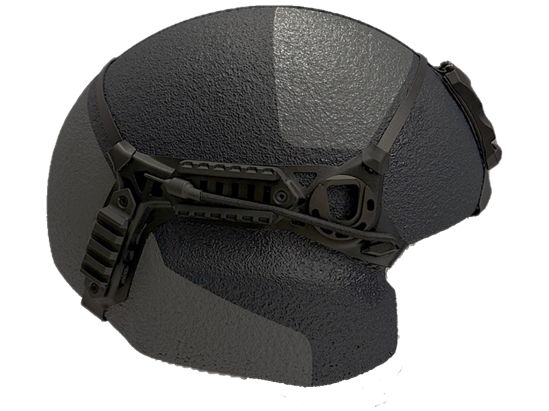
For higher-threat missions, Ulbrichts offers the FORTIS VPAM 8 add-on – a modular forehead, FORTIS can be worn at the forehead and back, shield that clips onto compatible ZENTURIO or OPTIO helmets in seconds via velcro. In testing, a helmet equipped with FORTIS achieves VPAM 8 protection, defeating 7.62×39 mm hard-steel-core armour-piercing rounds at realistic urban engagement distances. Importantly, the residual impact energy transmitted to the wearer’s head stays below the critical 25-joule trauma threshold defined by the VPAM HVN standard.
Operationally, this gives special units like SWAT teams and German MEK/SEK units, as well as military special forces, a way to approach rifle-plate levels of head protection without burdening every operator with a full ballistic shield. A breacher or first-in officer can wear a FORTIS-equipped helmet to maintain a normal shooting stance and full mobility in tight spaces, while other team members rely on the standard helmet shell. For regular patrol units, a small inventory of FORTIS modules could be kept on hand as an overlay capability when intelligence indicates a threat from armour-piercing ammunition—leveraging the same base helmet fleet already in service.
Ultra-Lightweight High-Cut Helmet: OPTIO Superlight
Rounding out Ulbrichts’ Milipol showcase is the OPTIO Superlight high-cut helmet, touted as the world’s lightest VPAM Level 3 helmet at approximately 1 kg including its inner lining and straps. The screwless shell is built from POLYTANIUM, a titanium-aramid composite, trimming about 20% off the weight of comparable composite helmets without reducing coverage. Ballistic protection and trauma performance remain consistent across nearly the entire helmet surface: testing verified protection to within about 15 mm of the rim, with residual blunt impact energy kept under the 25-joule safety threshold.
The high-cut profile is clearly aimed at modern, networked tactical units. The cut above the ears accommodates over-ear communication headsets and radio systems, while accessory rails and a front shroud enable mounting of cameras, strobes or night-vision devices via standard NATO interfaces. As with other OPTIO models, the Superlight can be upgraded with FORTIS shields up to VPAM 8, allowing units to scale from routine patrol to counter-terror operations using the same helmet platform.
Trauma Standards and Procurement
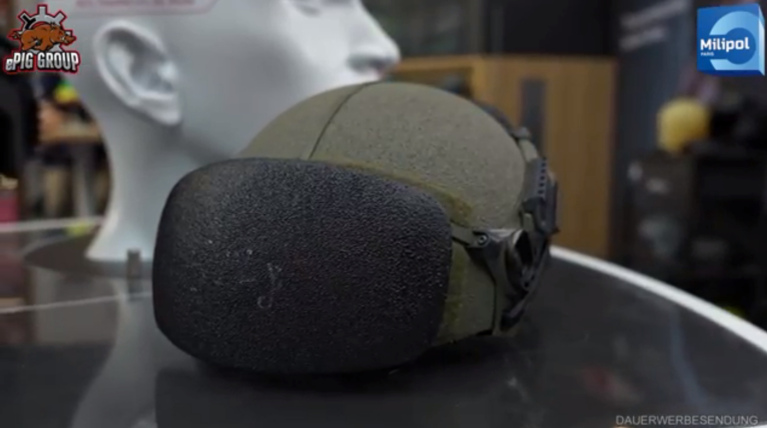
Ulbrichts also offers an implicit critique of older helmet standards that only measure bullet penetration. The company points out that the VPAM HVN 2009 standard not only evaluates whether a projectile is stopped, but also measures the energy imparted to the head form, with 25 joules defined as the upper limit for survivable head trauma. Titanium-based hybrid constructions like Polytanium help keep this back face energy low while maintaining the helmet’s rigidity. It is one reason several European police technical guidelines now cite VPAM HVN as the preferred benchmark for rifle-threat helmets.
On the procurement side, Ulbrichts is recommending that agencies conduct pilot trials to validate comfort, integration and upgrade procedures before a full rollout. The firm argues that adopting a unified screwless helmet platform across both patrol and special units will simplify spare parts, training and long-term maintenance. In a white paper released at Milipol, Ulbrichts strikes a blunt tone by citing a decade of deadly shootings across Europe, warning that failing to invest in adequate head protection today is effectively deciding how vulnerable emergency responders will be in the future. As one police union representative noted, ‘this isn’t about equipment but about survivability.’
Ballistic Helmet Standards (VPAM HVN 2009)
The VPAM testing guideline for helmets (HVN 2009) not only examines whether a helmet stops a projectile, but also limits the energy transferred to the head. A maximum of 25 joules of residual impact energy is permitted, reflecting the threshold for survivable head trauma. For context, VPAM 6 corresponds to protection against 7.62×39 mm mild steel core rifle rounds, while VPAM 8 covers the more penetrating 7.62×39 mm hard-steel-core armour-piercing rounds, both within the 25 J trauma limit.