
In the early 1980s, Nokia emerged as a key player in Finland’s defence communications. Its rugged messaging devices—tested in snowdrifts, sauna kettles, and artillery camps—became legendary for their durability and reliability. Today, Nokia returns to the military electronics sector with a radically new vision: not just devices, but a digital ecosystem for modern warfare.
Finnish technology giant Nokia is once again stepping into the defence arena. Its return to military electronics is not simply a technical move—it is a symbolic continuation of a legacy that began more than four decades ago.
In the 1980s, Nokia became a key supplier to the Finnish Defence Forces with its SANLA communication system, a breakthrough that transformed battlefield communications. Today, after a long absence, the company is unveiling a new vision: the Enhanced Defence Connectivity Platform (EDCP), a digital backbone designed to support future multi-domain operations across land, sea, air, cyber, and space.
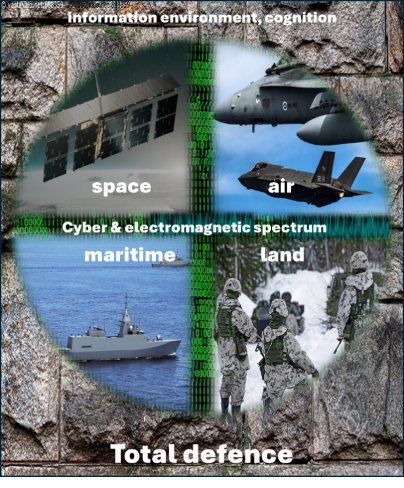
From Sauna Kettles to Battlefield Networks
The story begins in the late 1970s, when the Field Artillery Office of the Finnish General Staff sought to automate fire control communications and replace analogue methods with encrypted burst transmissions. Short digital bursts would protect against hostile electronic jamming. After evaluating different foreign and domestic prototypes, the General Staff chose Nokia’s message terminals.
1983: The Message Terminal Sanomalaite m/83 “SANLA” was approved and quickly became a mass product for the defence forces.
- Legendary durability: Field tests became folklore—devices were thrown on floors, stamped on, kept in a sauna at 90 degrees Celsius, then immersed one meter deep sauna kettles, and buried in snow overnight with temperatures as low as -40 degrees Celsius, yet they continued to function.
- Expansion: The SANLA family grew with light long-range patrol versions, and message switches creating a digital burst communication network overlay on top of analogue radio and landline networks. The portfolio was further expanded with air defence and field artillery versions, providing the units with a reliable, real-time recognised air picture and allowing artillery to concentrate fire on any single point in the battlespace. The ecosystem evolved into thousands of devices by the early 1990s. This digital battlefield network laid the foundation for Finland’s domestic IT and communications industry.
World Transformed in Nokia’s Absence
While Nokia stepped away from the military market, the global landscape changed dramatically:
- Geopolitics: From post-Cold War peace to asymmetric conflicts in Afghanistan and Iraq, and later Russia’s brutal attack in Ukraine.
- Cyber threats: State and non-state actors weaponised digital tools to disrupt critical infrastructure.
- Strategic doctrine: NATO and the EU shifted toward Multidomain Operations (MDO), integrating land, sea, air, cyber, and space.
Technology Leaps Forward
During Nokia’s absence, military technology underwent seismic shifts:
- Communications: Analogue VHF/UHF systems gave way to IP-based, distributed digital networks. 5G and satellite links now enable real-time situational awareness.
- Network slicing: Nokia and Telia pioneered the world’s first 5G slicing trial with the Finnish Defence Forces, ensuring secure and prioritised data flows.
- Sensors & Intelligence: Every device became a sensor. AI and machine learning fused data into actionable intelligence.
- Electromagnetic spectrum: A constrained, confined, contested battlefield where detection and jamming define survival.
- Cyber defence: Now embedded into every system by design.
From Devices to Ecosystems
Modern defence technology no longer revolves around single devices—it thrives on ecosystems of systems. The EDCP embodies this shift:
- A backbone for the digital battlefield.
- A connector of sensors, command systems, and communications.
- A bridge between civilian and military domains, serving defence, crisis management, and rescue operations.
- A platform for innovation, enabling future solutions beyond today’s needs.
Nokia Returns at the Right Time
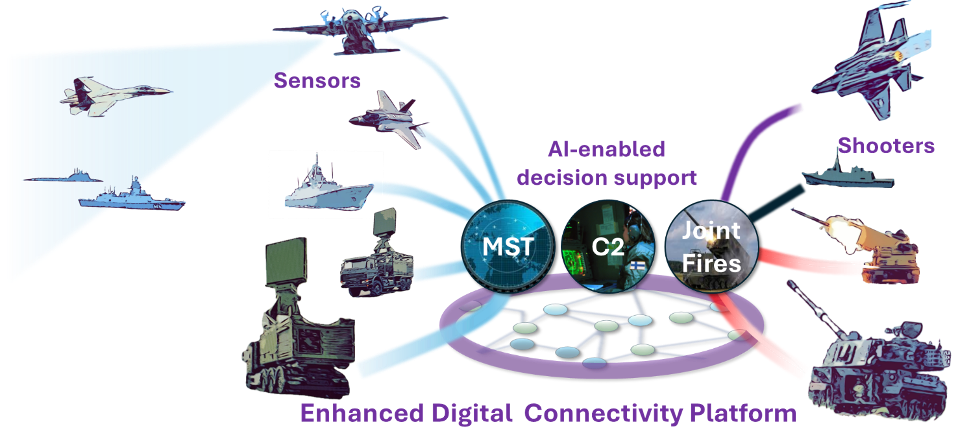
Digital superiority now determines operational success. Nokia’s EDCP directly addresses the challenges that emerged during its absence:
Multi-sectoral integration
- Spectrum management
- Cyber resilience
- Sensor fusion
No longer just a provider of rugged devices, Nokia is building a comprehensive digital battlespace where intelligence, decision-making, and communications converge into a unified operational network.
Key Features of EDCP
- Enabler of battlefield digitalisation
- Seamless multidisciplinary integration (MDO)
- Sensor-to-shooter linkages
- Distributed command and control
- Resilient infrastructure and cyber defence
- Space-based resources for long-range communication and surveillance
Continuity of Vision
- 1980s: Digital encrypted burst transmission with message terminal m/83 brought Finnish expertise to the field on how to build and maintain digital connectivity that works in a hostile electromagnetic environment. Short digital burst transmission provided protection against hostile eavesdropping and jamming.
- 1990s: The SANLA family became a mass material for the defence forces. This ecosystem allowed the Finnish Defence Forces to apply novel tactics to outmanoeuvre, outpace and outgun the bigger adversary; Air defence terminals provided early warnings and proactive targeting that enabled troops to drive to cover and aim their guns in the direction of incoming threats. The ballistic calculators enabled the field artillery to deploy gun by gun in dispersed formation, denying the enemy any high-value target. The system incorporated even deceptive methods with a cheap standard terminal pretending to be an important headquarters, emulating their spectral fingerprints.
- 2020s: EDCP builds the digital backbone for multidomain operations, allowing any sensor to any shooter -linkages and providing the necessary connectivity required in the highly dynamic mobile battlespace.
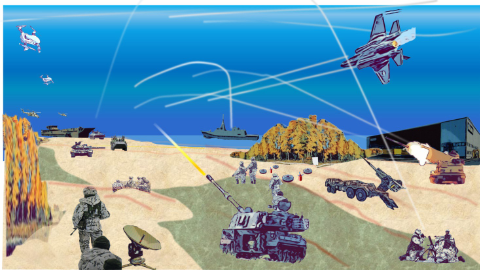
From the durability of a handset tested in sauna kettles to the resilience of a digital ecosystem spanning land. air, sea, space, and cyberspace, Nokia’s journey reflects both technological evolution and Finland’s enduring role in shaping the future of defence against a peer enemy.
By Jyri Kosola, Pathfinder Solutions