
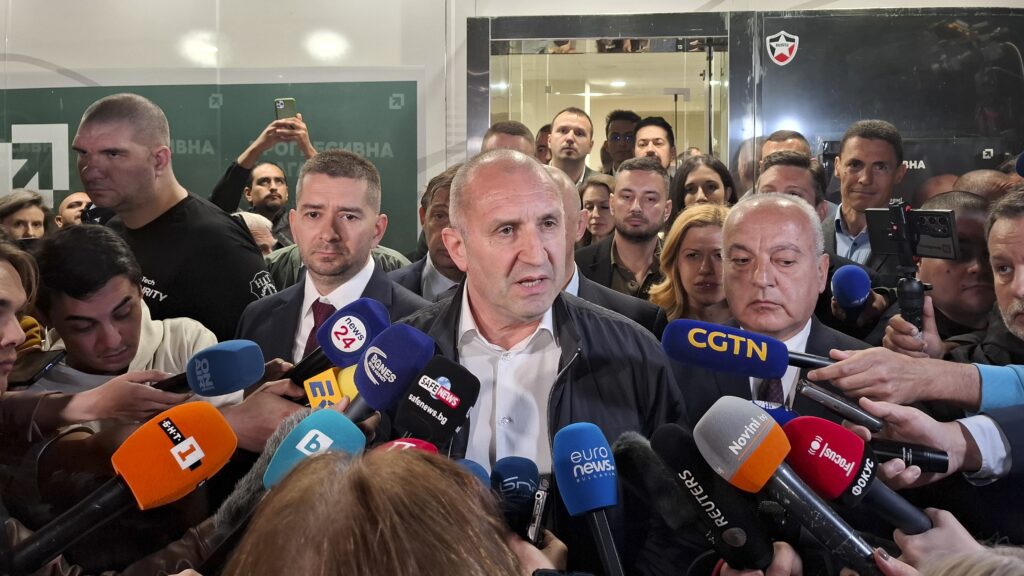
Rumen Radev’s Progressive Bulgaria won the Bulgarian elections by campaigning against corruption and promising a more transactional, less confrontational approach to Russia, framed as “Bulgarian realism”. Radev has opposed Bulgarian military aid to Ukraine and has been described as Moscow’s man.
While Hungarian voters turned away from the increasingly Moscow-aligned Viktor Orbán, the Bulgarian electorate appears to have moved in the opposite direction in the latest parliamentary elections.
The final seat distribution gives the scale of the shock. Progressive Bulgaria won 131 of the 240 seats, crossing the 121-seat majority threshold alone. GERB-SDS fell to 39 seats, PP-DB took 37, Delyan Peevski’s DPS won 21, and Vazrazhdane was reduced to 12. The result gives Radev something Bulgaria has lacked for years: a single-party parliamentary majority. It also removes the usual Bulgarian excuse of coalition paralysis. From now on, policy failure belongs to him.
Politically, the parliament is now lopsided. The pro-European centre is split between GERB-SDS and PP-DB, with 76 seats between them. DPS remains useful but weakened. Vazrazhdane survives as a pro-Russian protest party, yet Radev has absorbed much of its oxygen by making Moscow-friendly pragmatism respectable in governing language. The immediate question is therefore institutional: whether Radev uses his majority for anti-corruption reform, or to replace the old networks with a presidential party-state.
While promising friendlier relations with Moscow, Rumen Radev did not campaign for EU or NATO exit, nor did he not advocate strategic disengagement from the West.
This was also Bulgaria’s eighth parliamentary election in five years. The result, therefore, represents both a shift in political power and an attempt to end a prolonged period of institutional paralysis.
A single-party result of this magnitude has not been seen in Bulgaria for decades. Rumen Radev stepped down as president in January 2026 and moved directly into the race for prime minister, a role with far stronger executive authority than the largely ceremonial presidency. His position has shifted from national mediator to direct wielder of power.
Campaign Against “Oligarchic Governance Model”
Radev’s victory was rooted above all in Bulgaria’s domestic crisis. Instead of a fully formed ideology, he offered voters order, an assault on corruption, and a narrative that the old party cartel had exhausted itself. His campaign centred on dismantling what he described as an “oligarchic governance model”, ending corrupt practices, and restoring a stable parliamentary government.
This message resonated in a country where governments have repeatedly collapsed, parliaments have fragmented, and protests have regularly spilled onto the streets.
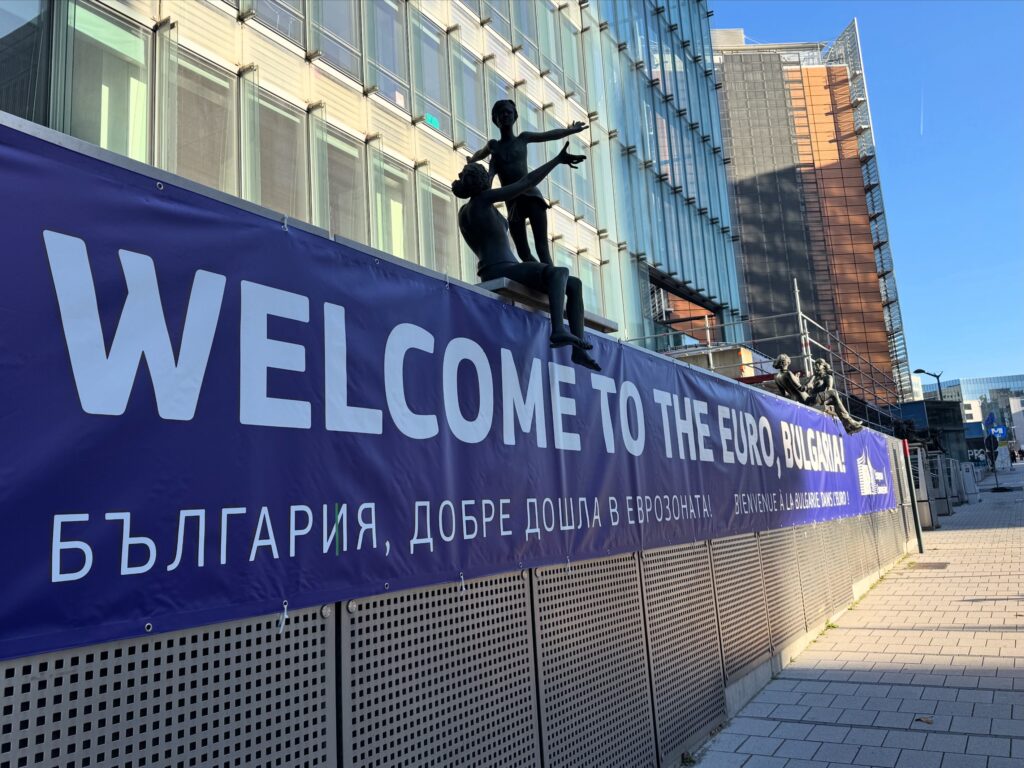
Yet Bulgaria joined the euro currency in January 2026, the European Commission judged in December 2025 that Bulgaria had failed to meet a key milestone tied to recovery funding, the establishment of an effective anti-corruption body. Its 2025 convergence report similarly assessed that Bulgaria lagged clearly behind even the weakest eurozone comparators in rule of law, anti-corruption performance, and regulatory quality.
Combined with years of political fragmentation, the election resembled a referendum on the credibility of the system rather than a conventional party contest.
The information environment formed a second layer. Sofia’s Centre for the Study of Democracy warned before the vote that Bulgaria was under sustained Russian-origin information pressure, amplified domestically in the run-up to April 2026. Monitoring by BFMI and Sensika, published by Mediapool, showed that some older pro-Russian Facebook groups were rebranded to support Radev. His rise occurred in an environment where Kremlin narratives were already embedded in parts of public debate.
Radev’s Documented Russia Line
Radev is often described as Moscow’s man. His line is consistently more accommodating towards Russia than that of most EU leaders.
In 2021, Radec described Crimea as “currently Russian”, prompting public concern from the United States. In April 2026, he reiterated to Mediapool that he considered the position “realistic”.
He has opposed Bulgarian military aid to Ukraine, argued that arms deliveries prolong the war, and questioned why Bulgaria should contribute to EU ammunition packages.
At the same time, he keeps a channel open to the West. On election night, he stated that Bulgaria would continue on its “European path”, while calling for more “critical thinking” and “pragmatism” in Europe, rather than moralising rhetoric. He linked Europe’s strategic autonomy to resources, competitiveness, and energy, effectively signalling a desire to reopen discussion on relations with Vladimir Putin’s Russia. This sits at the core of his political identity.
Radev did not campaign for EU or NATO exit. He did not advocate strategic disengagement from the West. He campaigned on a more transactional, less confrontational approach to Russia, framed as “Bulgarian realism”. That framing makes him difficult for Brussels, because it remains compatible with EU membership.
From Soviet MiG-29s to F-16s
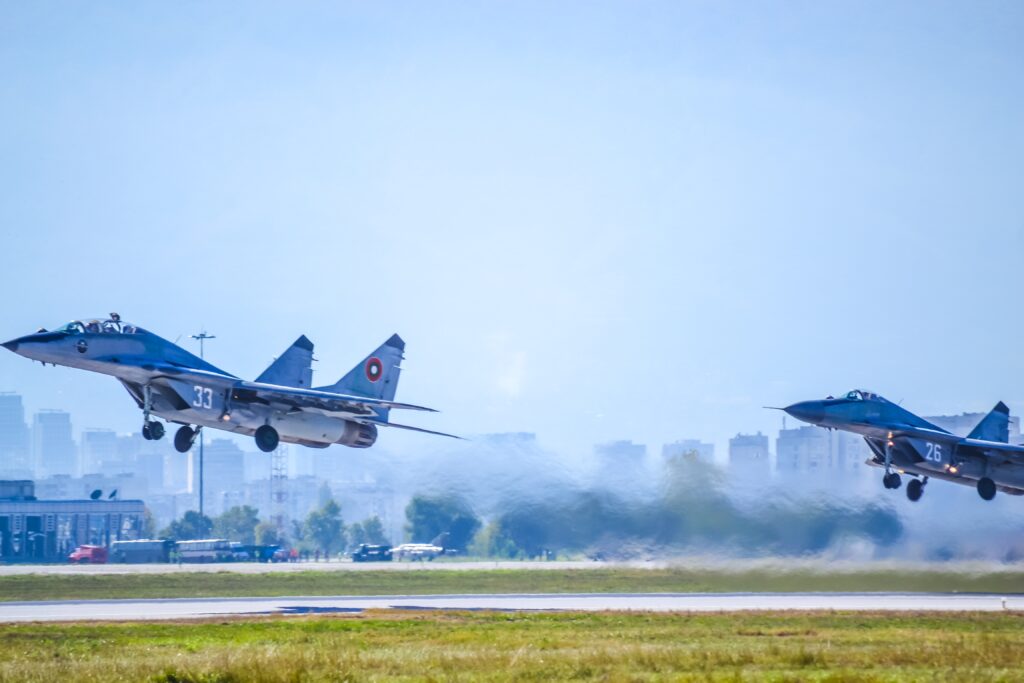
Bulgaria has been one of the paradoxes of the Ukraine war. Politically, Sofia has often sounded hesitant, divided and sometimes openly obstructionist. Militarily and industrially, it has been far more important than its rhetoric suggested.
Since 2014, Bulgaria’s strategic relevance has rested on three assets: geography on the Black Sea, deep Warsaw Pact-era ammunition stocks, and a defence industry still able to produce Soviet-standard ammunition needed by Ukraine. After Russia’s full-scale invasion in 2022, Bulgarian shells, small arms ammunition, rockets and legacy equipment reached Ukraine directly, indirectly, or through third-country purchases. That included 152mm and 122mm ammunition, 122mm rockets, anti-tank weapons, mortars, diesel fuel, helmets and vests, as well as later packages including defective S-300 missiles and BTR-60 armoured personnel carriers.
The contradiction was political. Radev opposed military aid to Ukraine and repeatedly argued that arms deliveries prolong the war. Yet Bulgaria’s arms industry became a quiet pillar of Ukraine’s survival because Ukraine’s army still needed Soviet-calibre ammunition at scale. Euractiv reported in 2023 that Bulgaria had supplied more than $1 billion worth of arms to Ukraine through third countries in the previous year.
Bulgaria’s own armed forces remain a NATO force in transition. The air force has been the clearest weakness. Bulgaria long relied on Soviet MiG-29s for air policing while waiting for F-16 Block 70 aircraft from Lockheed Martin. By 2025–26, Bulgaria was among the last NATO members still trying to keep MiG-29s operational, with maintenance made harder by the war and the collapse of Russian and Belarusian support channels. Sofia budgeted just over 114 million leva for operating Soviet-era MiG-29 and Su-25 aircraft in 2026, while a separate MiG-29 engine repair tender worth just over €21 million failed because no bidders came forward.
The F-16 programme is the centrepiece of modernisation. Bulgaria ordered eight F-16 Block 70 aircraft in 2019 for about $1.3 billion, and a second batch of eight in 2022, reported at about $1.3 billion. The supplier is Lockheed Martin, through the US Foreign Military Sales system. The first aircraft arrived in Bulgaria in April 2025, with the full fleet intended to replace the ageing MiG-29s.
On land, the biggest acquisition is the Stryker programme. Bulgaria approved the purchase of 183 Stryker combat vehicles and related equipment, estimated at $1.5 billion, supplied through the United States, with General Dynamics Land Systems as the prime vehicle manufacturer. Sofia then approved Javelin anti-tank missiles worth $82.7 million, again from the United States, partly to arm the Stryker force.
Air defence is moving from Soviet legacy systems towards German technology. Bulgaria approved the purchase of an IRIS-T SLM fire unit from Diehl Defence, worth about €182 million, with options for additional IRIS-T SLM units and a longer-range IRIS-T SLX unit.
The Black Sea is now the other major axis. Bulgaria’s navy is receiving two MMPV 90 patrol vessels from Germany’s NVL Group, formerly Lürssen, under a €420 million contract excluding weapons and ammunition. The wider project is estimated at about €500 million. Bulgaria has also moved towards buying a Naval Strike Missile Coastal Defence System, based on Norway’s Kongsberg NSM, through the US FMS route. The DSCA placed the potential NSM package at about $620 million.
Radar modernisation is also tied directly to the F-16 transition. Bulgaria’s government sought approval for a €195 million deal with Thales for seven GM400 three-coordinate radars, after earlier procurement turbulence around the same requirement.
In October 2025, Bulgaria and Rheinmetall sealed a €1 billion joint-venture deal to produce gunpowder and 155mm artillery shells, with Rheinmetall holding 51 per cent and Bulgaria’s state-owned VMZ 49 per cent. This turns Bulgaria from a legacy ammunition source into part of Europe’s future artillery supply chain.
Bulgaria is strategically useful, industrially relevant and militarily under-modernised. Its armed forces are still shedding Soviet dependencies, especially in combat aviation and air defence. Its defence industry, however, has become more important because Ukraine and NATO need exactly what Bulgaria can produce: ammunition, repair capacity and Black Sea geography. Radev’s majority, therefore matters beyond Sofia. It could decide whether Bulgaria becomes a stronger NATO flank state or a transactional weak hinge inside the alliance.
Brussels Reacted with Caution
The European Commission initially declined to comment pending the final count. Its spokesperson emphasised that the Commission works with all EU governments for the benefit of European citizens. It was a restrained, institutional signal.
At the same time, the tone quickly shifted to engagement. European Council President Antonio Costa congratulated Radev on a “clear victory” and welcomed him back to the Council. Ursula von der Leyen described Bulgaria as a “proud member of the European family” and expressed readiness to work together on prosperity and security.
Brussels has no interest in turning Radev into a political martyr. It is moving to bind him into the structures of responsibility.
Moscow read the result differently. Kremlin spokesperson Dmitry Peskov said he was encouraged by Radev’s willingness to resolve issues with Russia through pragmatic dialogue.
The dual reception captures the essence of the moment. Sofia is now pulled simultaneously towards European responsibility and Russian expectation.
Power Lies in the European Council Meeting
The Radev government’s real leverage lies in negotiation rooms. EU sanctions are adopted and renewed unanimously in the Council. The same applies to many key decisions in the Common Foreign and Security Policy. Sofia can therefore slow, dilute, or reshape outcomes at precisely the points where unity matters most, sanctions renewals, conclusions on Russia, and disputes over energy dependency.
Analysts do not expect Radev to reverse Bulgaria’s eurozone membership or immediately block broad EU Ukraine packages. Much of the military support to Ukraine is delivered bilaterally by member states or through NATO frameworks. NATO decisions are also taken by consensus, but allies have already provided the overwhelming majority of military assistance.
Sofia’s immediate influence is greater at the European Council table than in the logistical reality of the war.
Energy policy presents a similar constraint. The European Commission’s REPowerEU roadmap already sets out the phase-out of Russian oil, gas, and nuclear energy. Agreements reached in 2025 envisage the end of Russian LNG imports by the end of 2026 and pipeline gas from 2028.
The Commission has also designed specific diversification plans for Bulgaria and Slovakia. Radev may seek to reopen the political debate. He would be doing so within a framework that is already legally and structurally advanced.
More Dependent on EU than Hungary
Viktor Orbán spent more than a decade building a disciplined political machine, reshaping media and institutions, and mastering veto politics as a negotiating tool within the EU. Radev enters office without that infrastructure. Bulgaria is more dependent on EU funding, its state capacity is weaker, and its political instinct has generally been to avoid theatrical confrontation with Brussels.
The domestic context also differs. Hungarian politics has centred on the concentration of power. Bulgarian politics has been defined by instability. Radev rose by promising to restore functionality to a fragmented system.
The immediate risk for the EU is not a sudden illiberal takeover. It is a slower pattern, selective divergence framed as realism, energy pragmatism, and peace-oriented policy.
Diplomatic assessments in European and Nordic reporting converge on this point. Radev is not in Orbán’s league in terms of his capacity to obstruct the EU system.
A final constraint is economic. Bulgaria joined the eurozone on 1 January 2026. According to European Central Bank analysis, public support for the euro rose to 54 per cent in early 2026, a clear majority. Radev criticised euro adoption, yet he now governs a country already inside the system. Reversing that position would be politically and institutionally far more complex than campaign rhetoric suggests. Sofia can become Europe’s next pressure point without becoming a replica of Budapest.
Read More:
- Централна избирателна комисия: Избори за народни представители 19 април 2026, Сумарни данни (in Bulgarian)
- Българска телеграфна агенция: UPDATED Progressive Bulgaria Is Clear Winner in Apr. 19 Vote, Four or Five Parties and Coalitions in Next Parliament According to Parallel Count
- Българска телеграфна агенция: Rumen Radev: “We Defeated Apathy but Mistrust in Politicians Remains”
- Reuters: Bulgaria’s Kremlin-friendly ex-president wins election in landslide
- Reuters: Rumen Radev, Russia-friendly ex-fighter pilot, sweeps Bulgaria’s election
- Reuters: Kremlin encouraged by Bulgarian Radev’s desire to resolve issues with Russia via talks
- Associated Press: Ex-president Rumen Radev’s coalition triumphs in Bulgaria vote
- Associated Press: Ukraine rejects Bulgarian president’s claims that Kyiv is to be blamed for Russia’s ongoing war
- Associated Press: Bulgarian parliament approves military aid to Ukraine
- Reuters: U.S. ‘deeply concerned’ by Bulgarian president’s Crimea comments
- Mediapool.bg: Радев смята “Крим е руски” за реалистична позиция
- Mediapool.bg: Експерти: Руска пропаганда е заляла България след активирането на ЕС (in Bulgarian)
- European Commission: European Commission Refrains from Comment on Bulgaria’s Election Results Pending Final Count
- Българска телеграфна агенция: European Council President Antonio Costa Congratulates Rumen Radev on Election Victory
- Българска телеграфна агенция: Ursula von der Leyen Congratulates Rumen Radev on Election Victory
- Council of the European Union: How the EU adopts and reviews sanctions
- NATO: Consensus decision-making at NATO
- NATO: Marking four years since Russia’s full-scale invasion, NATO stands with Ukraine
- European Commission: REPowerEU – 3 years on
- European Commission: Affordable energy
- European Central Bank: Euro adoption and price increases in Bulgaria
- European Central Bank: Bulgaria and the euro
- European Council on Foreign Relations: Hanging in the balance: How to save Bulgaria’s foreign policy from political turmoil
- Center for the Study of Democracy: Defending the Vote: Policy Responses to Information Warfare in Bulgaria
- Yle: Orbán äänestettiin kumoon, mutta nyt Bulgariaan vaihtuu Venäjä-mielinen johto (in Finnish)
- Europaportalen: Jordskredsseger för nytt parti i Bulgarien
- Robert Schuman Foundation: Rumen Radev wins the Bulgarian parliamentary elections
- The Guardian: Moscow-friendly Rumen Radev wins absolute majority in Bulgarian elections
- Reuters: Bulgaria’s Kremlin-friendly ex-president set for landslide election win
- AP: The first of 16 new F-16 fighter jets from the US land in Bulgaria
- AP: Bulgaria to purchase US Stryker combat vehicles and related equipment
- Reuters: Bulgarian lawmakers approve purchase of U.S. Javelin missiles
- Reuters: Bulgaria, Rheinmetall seal 1 billion euro deal to produce gunpowder and ammunition
- The Sofia Globe: Bulgaria’s Defence Minister: Operating costs of Soviet-era MiG-29s and Su-25s in 2026 to be 114M leva
- Naval News: Bulgaria’s First MMPV 90 Corvette Begins Sea Trials
- DSCA: Bulgaria – Naval Strike Missile Coastal Defense System