
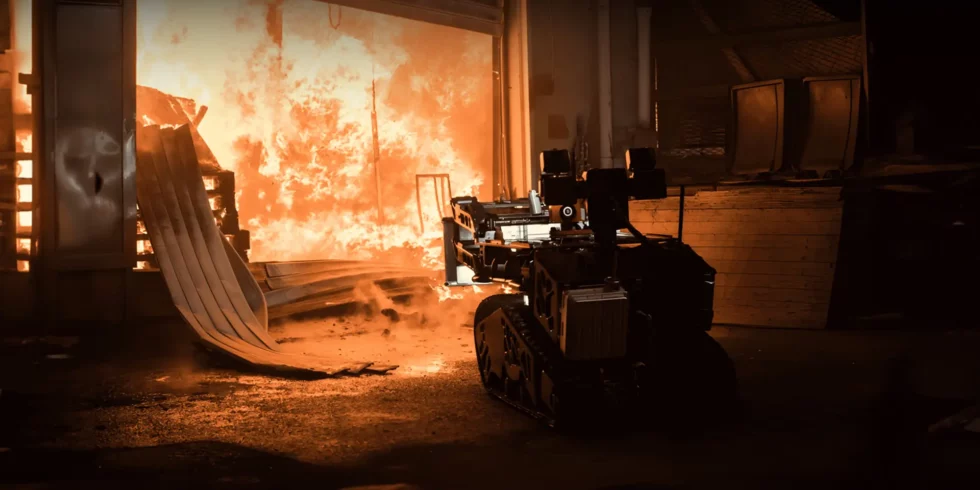
A French robotics company best known for helping firefighters battle the 2019 blaze at Notre-Dame Cathedral is now emerging as part of Europe’s broader effort to strengthen civil security and resilience in an era of war and hybrid threats. If Europe really wants to build its own self-reliant defence industry with innovative startups, it needs to speed up procurement, and it needs to do it very soon. Otherwise, it will be too late.
Shark Robotics is a French deep-tech company specialising in unmanned ground systems designed for hazardous environments, including fires, disaster zones and combat-affected areas.
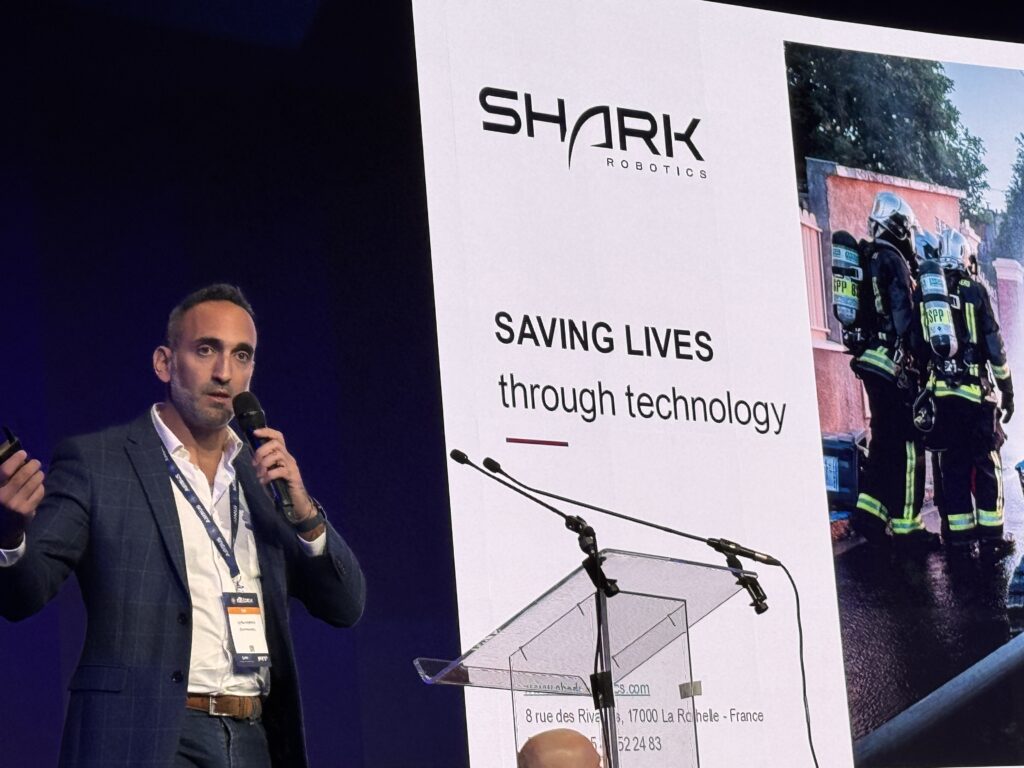
“We have delivered more than 350 robots in 25 countries, especially after Notre Dame”, the CEO of Shark Robotics, Cyrille Kabbara, a former French Army officer, explained at the BEDEX2026 defence and security exhibition in Brussels. Shark Robotics was also present at EUROSATORY2026 in Paris.
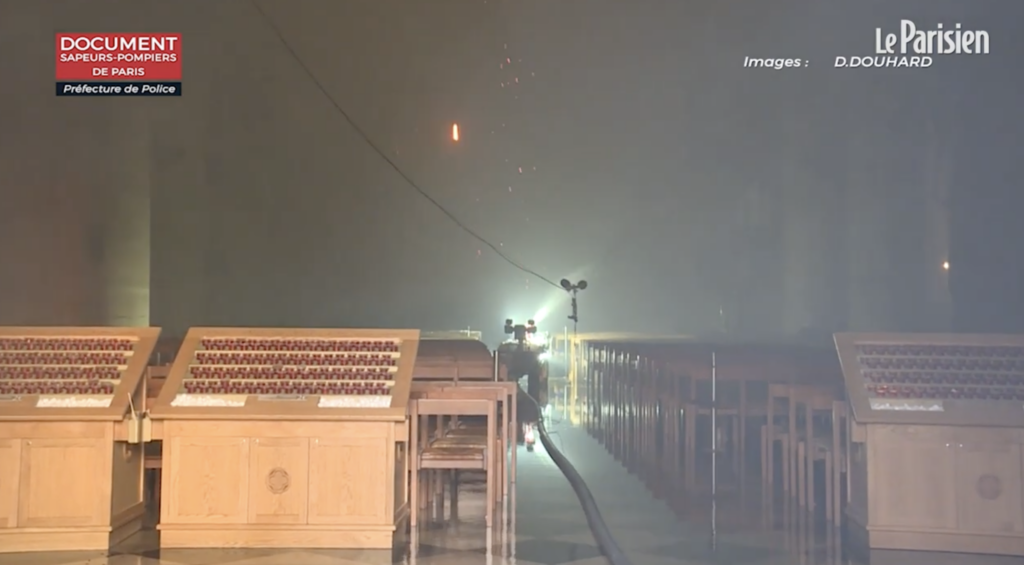
The company gained international recognition in the wide media coverage of the April 2019 fire at Notre-Dame Cathedral in Paris. As temperatures inside the cathedral rose beyond safe limits for firefighters, the Paris Fire Brigade deployed the remotely operated Colossus robot. The tracked vehicle operated for hours inside the burning structure, cooling the interior and providing thermal imaging, while significantly reducing the risk to frontline crews. Operating in environments where there is no oxygen, the robots’ engines have to be electric instead of internal combustion.

“We started developing this product with the Paris Fire Brigade in 2016. Seven months later, we deployed it, and after successful trials they purchased ten robots,” Kabbara recounts to NDR, reflecting on the company’s early years. Before the Notre-Dame fire, emergency response robots were widely regarded as experimental technology. The operation demonstrated their practical value in real-world emergencies and accelerated their adoption by fire and rescue services. Since then, they have increasingly been recognised as force multipliers, enabling responders to operate in environments too dangerous for humans, including active combat zones.
Warehouse fires are the most common incidents requiring robotic firefighting systems in both Europe and North America. The US National Fire Protection Association estimates that fire departments respond to around 1,500 warehouse fires each year in the US alone, more than four every day. The combination of large floor areas, high fire loads and the risk of structural collapse make warehouses one of the environments where firefighting robots can provide the greatest operational advantage. Globally, there are more than ten warehouse fires every day, Cyrille Kabbara summarised. “Our robots are designed for indoor operations, extinguishing fires in environments such as warehouses, tunnels, multi-storey car parks and industrial facilities.”
Firefighting in War Zones
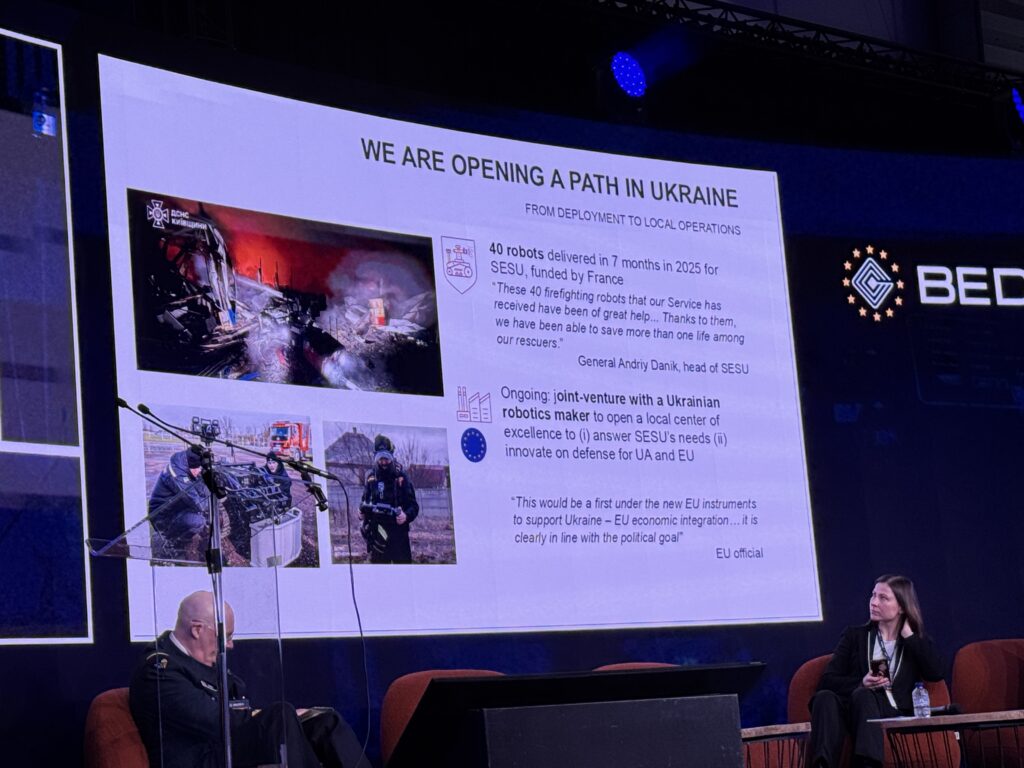
The same technology is now finding new applications in Ukraine. Shark Robotics recently delivered more than 40 Colossus firefighting robots to Ukraine’s State Emergency Service (SESU). These machines are intended to help Ukrainian responders tackle fires and hazards created by missile strikes and drone attacks, especially in the country’s southern regions. “Now, they need 160 more. So, we are delivering a total of 200 units to Ukraine,” Kabbara explained.
The Ukrainians first encountered Shark Robotics’ equipment during firefighter training in Poland in 2023. Poland had previously purchased 15 firefighting robots from the company.
“They had already lost more than a hundred firefighters, with eight times as many injured, because of double strikes on the field,” Kabbara said.
The tactic involves launching a second strike against a site after firefighters and other emergency responders have arrived. As these attacks often target critical infrastructure, such as energy facilities, the risk of secondary explosions is too high for firefighters to enter the danger zone safely. In such situations, remotely operated robots can be deployed to begin firefighting operations without exposing crews to immediate risk.
Robotics companies have responded by adapting systems for environments described as “degraded”, meaning locations affected by destruction, toxic smoke, structural collapse or unexploded ordnance. Since the latest war involving Iran began, several Persian Gulf countries have expressed interest in Shark Robotics’ expertise in firefighting under extreme conditions.
The Critical First Five Minutes
In Europe, firefighters typically arrive at the scene around 15 minutes after an emergency call is made. However, according to Kabbara, numerous studies show that the critical window for saving a building rather than losing it to the fire is just two to five minutes.
“This means you need to have your own robotic solutions on the site to go immediately in and contain the fire sufficiently to wait for the cavalry,” Kabbara said.
Oil and gas installations, pharmaceutical plants and other critical sites typically maintain their own industrial fire brigades, allowing them to deploy robotic firefighting systems within minutes.
Colossus, the heavy firefighting robot of Shark Robotics, can perform extended missions without recharge, up to 12-hour autonomy. It has 8 tool-free modules, with quick reconfiguration – no tools needed. It can flow 3,000 litres of water per minute for rapid and efficient suppression. Colossus has precise control from a safe distance, up to 1,000 meters remote control. According to Shark, Colossus has all-terrain mobility, both indoor and outdoor. It is protected for extreme environments: dust, water, and heat.
Robotic Mules in Combat
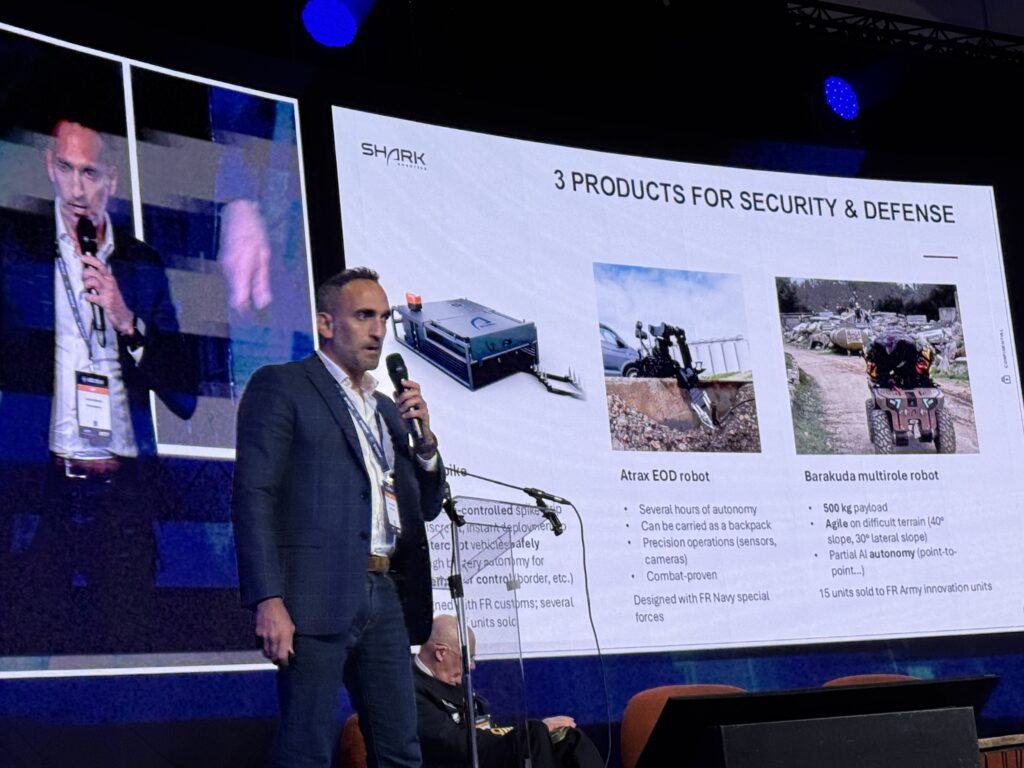
Beyond firefighting, Shark Robotics develops a range of unmanned ground vehicles for security and defence missions. These include robotic mules capable of transporting heavy loads, reconnaissance robots and systems designed to operate in contaminated or high-risk areas.
Such platforms can support military units by carrying equipment, evacuating casualties or entering hazardous zones before human troops. The concept is similar to developments already underway in NATO armies that are experimenting with robotic logistics and autonomous support systems. “Unfortunately, Ukraine has become the laboratory of R&D for unmanned aerial and ground vehicles, UAV and UGV systems,” Kabbara explained.
“Europe must invest more heavily in civil protection and resilience alongside traditional defence capabilities,” Cyrille Kabbara, argued. In his view, disasters, hybrid attacks and infrastructure strikes require technology that protects emergency responders as much as soldiers.
After Russia’s full-scale invasion of Ukraine in 2022, European governments increasingly treat civil protection, energy security and disaster response as elements of national defence.
Russian ballistic missiles can reach Paris and even Spain, Kabbara reminded.
This opens a huge market for dual-use companies like Shark Robotics. Excluding the military and security usage, “the civilian market for this kind of firefighting robots is globally around two billion for the public sector, plus at least three billion in private,” Kabbara estimated.
Robots need to be maintained locally. That opens a continuous revenue path for robotics companies.
Slow European Procurement Holds Back Home-grown Defence Companies
Like many start-ups and scale-ups, Shark Robotics is now focused on expanding its manufacturing capacity. The company has signed memoranda of understanding covering around ten times more robots than it can currently produce. At present, its annual production capacity is about 200 units, meaning it needs to scale up rapidly to meet demand.
Kabbara believes Europe excels at supporting early-stage innovation through research and development grants. “It works when you have ten guys in a garage building an idea and turning it into a prototype. But after that, there is a lack of funding for Series B and Series C.”
He argues that the biggest gap lies in financing companies as they move from promising technology to industrial-scale production. “Late-stage funding is very important. And there is a lack of late-stage funding in Europe. That’s why European companies are acquired by American venture capital players.” According to Kabbara, securing customer orders is the single most important factor in attracting investment. “The most important thing, if you want funding, is to have orders. Otherwise, your value is nothing.”
He argues that Europe’s lengthy defence procurement processes place innovative companies at a significant disadvantage compared with competitors elsewhere. While procurement programmes in Europe can take years, Ukraine’s wartime requirements demand a far faster approach. When the Ukrainian armed forces require a capability such as an unmanned ground vehicle (UGV), they can open the market, select the most suitable system and receive the first deliveries within a week.
Kabbara acknowledges that countries at peace cannot simply replicate Ukraine’s wartime procurement model. However, he argues that Europe must dramatically accelerate its own procurement processes if it is serious about building a resilient and self-reliant defence industrial base.
Read More:
- Kyiv Independent: I build robots to save lives. Here’s why Europe must invest in Ukraine’s civil security
- Shark Robotics: Notre-Dame fire – how technology helped preserve a global icon
- Shark Robotics: About Shark Robotics
- ASME: Robot Firefighter That Saved Lives
- National Fire Protection Association (NFPA): Warehouse Structure Fires
- CTIF – International Association of Fire & Rescue Services: The CTIF World Fire Statistics Report No. 27
- ChurchPop: The Robot that Saved Notre Dame
- Independent: Notre Dame firefighters’ lives saved by robot called ‘Colossus’, fire chief says
- New York Post: Meet the firefighting robot that helped save Notre Dame
- The Standard: Notre Dame fire: How french firefighters used drones and robot called ‘Colossus’ to tackle blaze, as restoration fund nears one billion euros
- Le Parisien: Notre-Dame : Colossus, le robot qui a aidé les pompiers
- Mashable: This Robot Helped Firefighters Extinguish the Notre-Dame Fire
- Shark Robotics: COLOSSUS – Best modular firefighting robot