

Control of AI models, software and battlefield networks is becoming a central determinant of military power. As access to advanced AI becomes subject to export controls and political decisions, sovereign digital capabilities are acquiring the same strategic importance as ammunition, air defence and artillery. Europe already has much of the technology needed to achieve them.
US export-control powers have demonstrated the ability to restrict access to advanced AI models to cloud services, operating systems, identity systems and cyber-security products, creating what many European policymakers describe as a de facto ‘kill switch’ risk for critical digital dependencies. A service may sit physically in Europe, but an American company remains subject to American law.
A risk that had long been discussed in theory became reality when Anthropic announced that the US government had ordered it to suspend access to two advanced AI models, Fable 5 and Mythos 5, for foreign nationals. For European defence planners, the lesson was clear: access to frontier AI can become a strategic nationality issue overnight.
Modern defence increasingly depends on the digital layer. A tank, drone, command vehicle or air-defence launcher becomes vulnerable if its data, updates, sensor libraries or AI-assisted decision tools are controlled elsewhere. The critical question is who controls the software, data rights, model weights, update pipeline and export licence.
Europe’s defence sovereignty debate has long centred on shells, missiles, satellites, shipyards and armoured vehicles. That debate has now expanded to the decisive layer of military power: secure data infrastructure, AI models, tactical IP networks, edge computing, electronic warfare resilience and the ability to update battlefield systems without asking permission from a foreign capital.
Securing Tactical Communications

The battlefield has become a data contest. Ukraine has shown how quickly drones, electronic warfare, optical recognition, acoustic sensing and software-defined networks can change battlefield tempo. Military advantage increasingly depends on the speed with which forces can detect, classify, transmit, decide and strike. AI acts as an accelerant across the kill chain and the protection chain.
Finland’s Bittium has a European solution for one of the most important layers: the secure tactical communications backbone.
At Eurosatory 2026, Bittium chief executive Petri Toljamo described the company’s vision as “a secure and resilient tactical communications network capable of operating in a heavily contested electronic warfare environment”. He said the system is designed to withstand “jamming, electromagnetic interference and other forms of disruption while ensuring secure data transmission”. The core idea is a battlefield network rather than a standalone radio. Toljamo said commanders can coordinate “even hundreds of connected assets simultaneously”, including troops, vehicles, sensors and unmanned systems. The aim is a continuous operational picture across the battlefield.
Shared Real-time Operational Picture
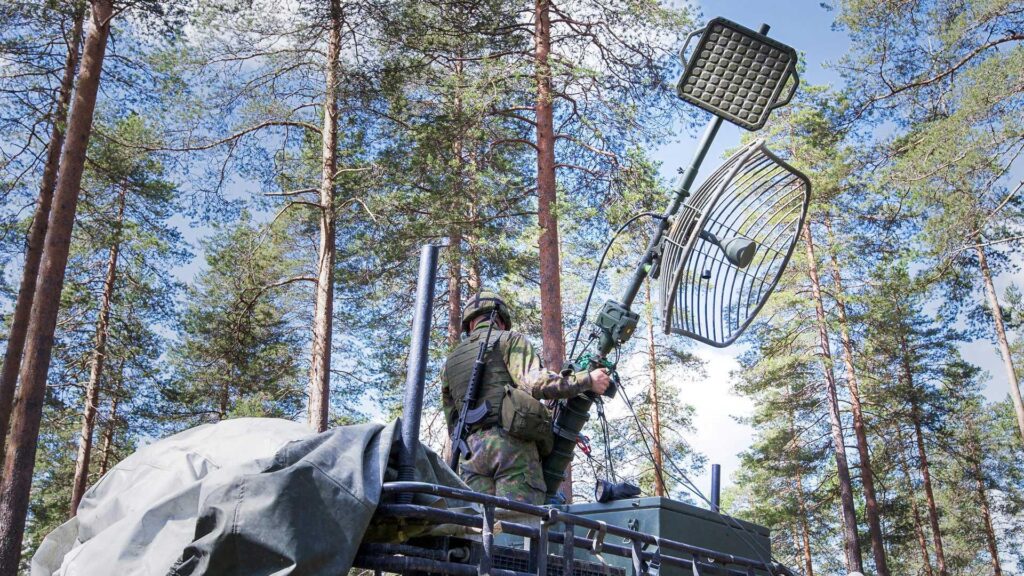
Bittium’s TAC WIN is described by the company as a mobile backbone network for command, control and sensor-to-shooter wideband data transmission. Its Tough SDR radios extend that network to vehicles and tactical users. Tough SDR Unmanned brings drones and autonomous platforms into the same battlefield IP network as soldiers and commanders. Bittium calls it a “fully European sovereign solution”.
Toljamo frames this as a practical military capability. “The network effectively creates a local tactical communications bubble capable of transmitting voice, data, video and sensor feeds, including information from infrared cameras and other battlefield sensors,” he says. “The objective is to provide all users with a shared real-time operational picture.”
The significance lies in software-defined warfare. “Thanks to software-defined radio technology, the system can be upgraded through software rather than hardware replacement,” Toljamo says. “This allows continuous development and rapid adaptation to emerging threats.”
Bittium’s Tactical Device Management product language stresses “sovereign control and ownership over tactical devices”, including software updates, key management and device configuration in the field. In modern warfare, sovereignty means controlling the update pipeline, cryptographic keys, device fleet and integration layer.
Bittium’s architecture also points towards hybrid connectivity. Toljamo says the system can use 5G networks, satellite links and other available transmission systems, selecting the best connection available at a given moment. That matters for future European defence AI because a model, sensor or drone-detection algorithm has limited operational value if its warning cannot move securely across the battlefield.
The Finnish Defence Forces have been central to this development. Toljamo says they have worked with Bittium “for already decades” and that the network forms “a key component of Finland’s tactical communications capability”. This gives Bittium a domestic reference customer in a country whose defence model is built around territorial resilience, mobilisation and electronic-warfare realism.
The company is now seeking international growth. Toljamo says European NATO countries are the most promising markets. “We are currently engaged in serious commercial discussions with around ten European countries,” he says.
Spain has already provided the breakthrough. Bittium and Indra have agreed on cooperation on a European military tactical radio solution, with local production in Spain under licence. Toljamo says the Spanish programme has exceeded €120 million in value and has helped establish Bittium as one of the leading companies in its field.
The company’s financial position also gives it room to grow. Toljamo says Bittium’s EBITDA in 2025 was approximately €32 million. Since 2022, he says, the company has achieved profitable annual revenue growth of around 20 per cent. Its partner network allows production to scale without building every manufacturing facility in-house.
Europeanising Sovereign Control Points
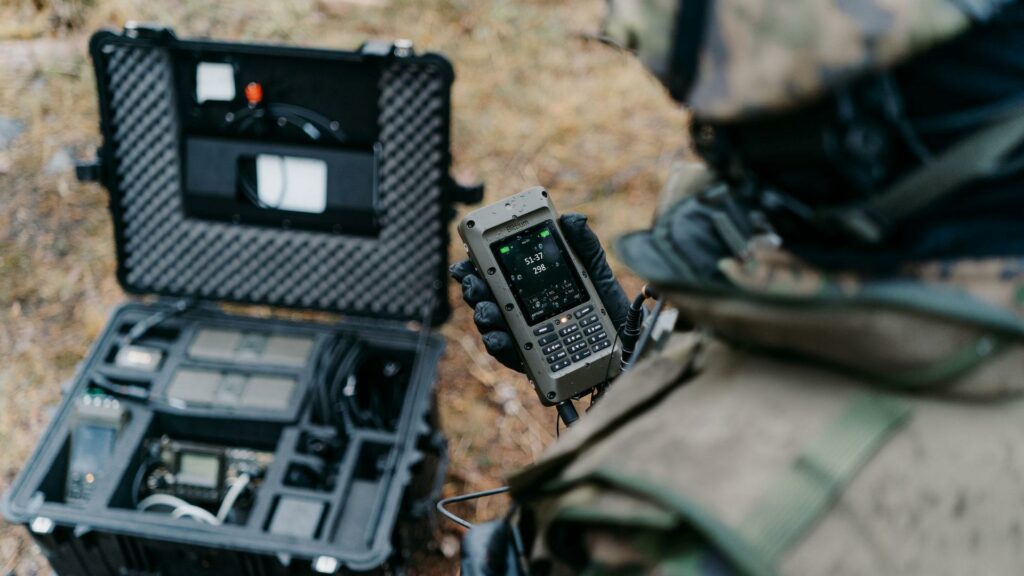
The war in Ukraine has sharpened Bittium’s engineering logic. “The lessons learned from Ukraine have been extremely valuable,” Toljamo says. “We have been able to incorporate them extensively into the design and development of our products and systems.”
Toljamo says many countries are looking for European alternatives to American and Israeli systems. “Europe possesses world-class expertise, from Nokia and Ericsson in telecommunications to Bittium in tactical communications networks,” he says. “This is the moment to strengthen Europe’s technological autonomy and strategic resilience.”
The comparison with American and Israeli systems is sensitive, but unavoidable. The United States remains Europe’s most important military ally and the dominant supplier of advanced AI models, cloud infrastructure, chips, tactical data links and high-end defence software. Israel offers combat-proven systems in battle management, radios, drones and counter-UAS technology. Both remain valuable partners. But both operate under national export-control regimes outside European political authority.
American defence and technology products remain subject to US export-control laws and regulatory authorities, even after they have been sold to foreign customers. There are several legal exposures related to American systems, such as ITAR (International Traffic in Arms Regulations), DDTC (Directorate of Defense Trade Controls), and EAR (Export Administration Regulations). Israeli systems sit under Israel’s defence export-control regime and bring domestic political risks for governments, especially in some European countries. European systems are safer for European autonomy, although foreign components and national export rules can still create restrictions. The EU’s SAFE principle, requiring advanced systems to be modifiable without third-country restrictions, should become the rule for software-driven defence.
When the public sector commits to a foreign vendor for decades, it creates a strategic dependency. That dependency can affect resilience, security of supply and democratic control. Digital sovereignty is therefore not only a technological issue but also an ethical one, because societies need trust, transparency and control over the critical systems on which they depend.
The same applies to defence AI. Europe needs its own AI layer: models, infrastructure, standards, test regimes and decision authority. It needs classified defence data spaces, sovereign model repositories, European inference capacity, auditable update pipelines and battlefield networks that remain under European control.
Europe needs an interoperable stack of its own digital defence technology. Bittium can anchor secure tactical networking, collaborating already with MarshallAI ja NestAI. Thales can contribute large-scale C4ISR, acoustic detection and air-defence integration. Saab, Indra, Hensoldt, Leonardo, Patria, Rohde & Schwarz, VTT and others can bring sensors, radar, electronic warfare, optronics, testing and integration.
Anduril’s Lattice, L3Harris tactical radios, and the combat-proven systems of e.g. Rafael offer useful benchmarks. Europe should learn from them and build sovereign alternatives where it matters most. For example, Spain ended its cooperation with the Israeli radio technology company Elbit Systems and selected Finland’s Bittium as the technology partner for its domestic radio production programme.
Europe needs interoperability with NATO and the United States. It also needs leverage. In defence AI and battlefield communications, dependency creates strategic risk.
Europe can buy equipment from allies. It cannot outsource the digital nervous system of its future armed forces.
Read More:
- Reuters: US saw risk of Anthropic models being diverted to foreign military intelligence
- The Guardian: EU aims to ensure foreign governments or firms cannot disrupt vital tech services
- BIS, U.S. Department of Commerce: Policy Statement on Controls That May Apply to Advanced Computing Integrated Circuits and Other Commodities Used to Train AI Models
- Anthropic: Statement on the US government directive to suspend access to Fable 5 and Mythos 5
- Federal Register: Framework for Artificial Intelligence Diffusion
- BIS, U.S. Department of Commerce: Department of Commerce Announces Rescission of Biden-Era Artificial Intelligence Diffusion Rule, Strengthens Chip-Related Export Controls
- BIS, U.S. Department of Commerce: Biden-Harris Administration Announces Regulatory Framework for Responsible Diffusion of Advanced Artificial Intelligence Technology
- BIS, U.S. Department of Commerce: Policy Statement on Controls That May Apply to Advanced Computing and Semiconductor Manufacturing Items Used to Train AI Models
- European Commission: Strengthening Europe’s tech sovereignty
- European Commission and High Representative: Joint White Paper for European Defence Readiness 2030
- European Commission, DG DEFIS: EDIS, Our Common Defence Industrial Strategy
- European Commission, DG DEFIS: SAFE, Security Action for Europe
- European Defence Agency: Trustworthiness for AI in Defence
- NATO: Data Strategy for the Alliance
- Bittium: Bittium Tactical Wireless IP Network
- Bittium: Bittium Tough SDR Vehicular
- Bittium: Bittium Tough SDR Unmanned
- Bittium: Tactical Radio Module for Unmanned Systems
- Bittium: Bittium MissionNet
- Bittium: Bittium Tactical Device Management
- Bittium: Bittium FUSOR
- Bittium: Bittium and VTT Deepen Their Cooperation to Deliver Field-Ready Defense Solutions
- Bittium: Bittium turns software-defined radios into AI-powered situational awareness sensors
- Bittium: Bittium and Sensofusion Collaborate to Develop Interoperability in Tactical Communications and Anti-Drone Systems
- Bittium: Inside information, Bittium Wireless received a significant order from the Finnish Defence Forces
- Indra Group: Indra Group and Bittium sign agreement of intent to collaborate on fully European military tactical radio
- Puolustusministeriö: Puolustusvoimille hankitaan uusia kenttäradioita (in Finnish)
- VTT: Defence and Security Industry
- VTT: Situational Awareness
- VTT: Counter-UAS capabilities in high demand, detection sensors, 5G/6G connectivity, cameras and autonomy
- Thales: FireSonic
- Thales: Thales launches STORM 2 to protect soldiers from drone threats
- Thales: Thales launches SkyDefender
- Elbit Systems: E-LynX SR
- Elbit Systems: Hermes 900 UAV
- Rafael: Drone Dome Family
- DECA, Israel Ministry of Defense: Israel Defense Export Controls Agency
- Anduril: Lattice Command and Control
- L3Harris: Falcon Radio Product Line
- U.S. State Department, DDTC: International Traffic in Arms Regulations
- Reuters: EU Commission looking at practical consequences of Anthropic decision, spokesperson says
- Saab: Working to fill the gaps in drone defence
- Squarehead Technology: Defence acoustic systems
- CEN-CENELEC: New CWA for monitoring the misuse of drones
- NATO Communications and Information Agency: NATO tests counter-drone technology during interoperability exercise
- TiVi: USA:n päätös herätti pelon ”tappokytkimestä” – Asiantuntija varoittaa Suomen digitaalisesta riippuvuudesta (in Finnish)