
Europe has launched its first dedicated anti-ballistic missile coalition with Ukraine at its centre, marking the continent’s most ambitious attempt yet to build a sovereign shield against Russia’s growing missile threat. Turning declarations into production lines, interoperable systems and credible deterrence will prove the coalition’s defining challenge.
On 13 July 2026, Ukraine and nine European partners — Denmark, France, Germany, Italy, the Netherlands, Norway, Spain, Sweden and the United Kingdom — announced the start of an Integrated Anti-Ballistic Missile Coalition in Paris. In the coalition’s own language, this is a purely defensive effort intended to develop a shared European anti-ballistic capability and to complement, rather than replace, existing missile-defence systems already fielded or planned by participating states. The declaration explicitly links the effort to collective industrial cooperation, research and operational lessons from Ukraine’s war with Russia. [1]
The coalition matters politically immediately, but militarily it is best understood as an acceleration mechanism, not a near-term substitute for today’s missile shield. In the short term, Europe’s effective ballistic-missile defence still rests heavily on NATO command-and-control, US-led Aegis Ashore, Patriot, and a smaller number of Franco-Italian SAMP/T systems. Even Germany’s new Arrow 3 upper-tier layer is Israeli-US in origin rather than indigenous European. The Paris initiative therefore opens a path towards greater European autonomy, but does not remove today’s dependence on US systems, software, approvals and industrial throughput. [2]
The operational problem the coalition seeks to address is real and worsening. Russia now attacks Ukraine with a mix of Iskander-M short-range ballistic missiles, Kinzhal air-launched ballistic missiles, imported North Korean KN-23 missiles, and, more episodically, the Oreshnik intermediate-range ballistic missile. These systems are difficult to defeat because they combine high speed with depressed or quasi-ballistic trajectories, manoeuvring terminal phases, decoys, multiple warheads in the case of Oreshnik, and coordinated saturation attacks with drones and cruise missiles. RUSI’s analysis of Ukrainian data indicates that interception rates against Iskander/Kinzhal-class strikes have been inconsistent and have deteriorated in defended areas as Russian tactics evolved. [3]
The coalition’s strategic significance lies in four areas. First, it puts Ukraine’s battlefield experience at the centre of European force design. Secondly, it aligns with wider NATO and EU initiatives already underway: NATO launched a separate multinational ballistic missile defence capability project in February 2026, while the European Commission is pushing a European Air Shield, SAFE loans, EDIP grants and defence projects of common interest in air and missile defence. Thirdly, it may accelerate industrial localisation in Ukraine, especially after France agreed to license Aster missile production there and President Volodymyr Zelenskyy said Patriot interceptor licensing had been agreed with Washington at the political level. Fourthly, it raises the pressure for faster, more standardised European procurement. [4]
The constraints are equally clear. Public technical detail about the coalition’s FREYJA flagship project remains sparse. The ambition — a lower-cost, mass-produced anti-ballistic system within roughly a year — is bold, but should be treated as an aspirational programme target, not a mature acquisition schedule. Europe also still faces hard bottlenecks in solid rocket motors, seekers, radars, software integration, tactical control systems and export-control politics. The legal setting remains fragmented: Article 346 TFEU still allows national bypass of EU procurement rules, while national arms-export controls remain misaligned for jointly produced systems. [5]
The central judgement is therefore this: the Paris coalition is strategically important because it can shift Europe from ad hoc donations towards a layered, industrially-backed anti-ballistic architecture — but only if it is tied tightly to NATO command-and-control, backed by multi-year demand signals, and protected from the fragmentation that has undermined previous European armaments efforts. [6]
Purely Defensive Anti-Ballistic Missile Coalition
The Élysée declaration of 13 July 2026 states that the ten signatories are initiating “the establishment of a purely defensive Anti-Ballistic Missile Coalition” and support a flagship project to develop anti-ballistic capability “at pace”. The declaration also says the coalition is meant tocomplement existing ballistic-missile defence systems, including sovereign European solutions already bought or due to be bought by participants. It explicitly says the project should bring together “our defence industrial base, our research, and our operational experience”, while acknowledging the “unique experience of Ukraine” in defending itself against Russia’s aggression. [7]
The Paris declaration sits on top of at least three pre-existing tracks. The first is NATO’s BMD architecture, which has been expanding since 2010 and reached Enhanced Operational Capability in 2024. The second is the European Sky Shield Initiative launched in 2022 for joint procurement of layered air and missile defence. The third is a newer NATO multinational capability cooperation project on ballistic missile defence, launched in February 2026 by Belgium, Denmark, Estonia, France, the Netherlands, Norway, Türkiye and the United Kingdom to develop sensors, interceptors and tactical control systems. The Paris coalition overlaps with that NATO effort but broadens it by bringing in Germany, Italy, Spain, Sweden and, critically, Ukraine. [8]
The anti-ballistic meeting was held alongside the broader Coalition of the Willing summit in Paris, co-chaired by France, Germany and the UK, with NATO Secretary General Mark Rutte present. NATO said Allies had already pledged €70 billion in military equipment, assistance and training for Ukraine for 2026, and at least as much for 2027, while Rutte specifically urged further donations for Ukrainian air and missile defence and deeper cooperation with Ukraine’s defence industry. [9]
The coalition is tied to a programme called FREYJA, envisioned as a modular anti-ballistic system and presented as a more affordable complement or alternative to Patriot. The proposal emphasises low-cost, mass-produced capability and could, in principle, be operational within a year. Those reports show serious political intent, but they do not yet amount to a fully public technical baseline, funded acquisition plan or certified timetable. [10] An important precursor came in April and June 2026. Germany and Ukraine agreed in April to strengthen cooperation in air defence, increase German and Ukrainian missile manufacturing, and “focus efforts on accelerating the development of anti-ballistic missile air defence”. In June, HENSOLDT announced a memorandum with the Ukrainian company Fire Point, whose anti-ballistic programme was already being framed around the FREYJA concept. [11]
Coalition Members and National Assets
| Member | Coalition role | Relevant assets or announced measures | Assessment of likely value to the coalition | Sources |
| Ukraine | Operational lead and end-user | Battlefield experience against Russian ballistic strikes; Fire Point/FREYJA programme; discussions on Aster and Patriot local production | Operational data, test environment, rapid iteration, future production base | [12] |
| France | Co-host and political driver | SAMP/T and SAMP/T NG; Aster missile licence for Ukraine; radar support discussions; strong EU “Air Shield” alignment | European upper-layer industrial anchor and political integrator | [13] |
| Germany | Co-chair and industrial anchor | Patriot, IRIS-T SLM, Arrow 3 IOC; anti-ballistic cooperation with Ukraine; HENSOLDT-Fire Point link | Sensors, industrial scale, upper-tier territorial BMD experience | [14] |
| United Kingdom | Co-chair and financier | Access for UK firms to EU-funded Ukraine contracts; naval Aster/Sea Viper tradition; participant in NATO BMD HVP | Financing, integration know-how, naval BMD experience | [15] |
| Italy | Signatory and Eurosam partner | SAMP/T operator; Eurosam/MBDA/Leonardo industrial base | Key Aster/SAMP-T industrial contribution | [16] |
| Netherlands | Signatory, Patriot operator, NATO BMD HVP participant | Patriot operator; NATO ballistic BMD initiative participant | Mature operator experience and interoperability contribution | [17] |
| Norway | Signatory and supplier to Ukraine | NASAMS supply chain; missiles delivered to Ukraine; Kongsberg Ukraine industrial agreements | Lower/mid-layer air defence, missile supply, industrial resilience | [18] |
| Denmark | Signatory and NATO BMD HVP participant | ESSI member; participant in NATO ballistic BMD capability project | Political support and regional integration | [19] |
| Spain | Signatory | Patriot/PAC-3 integration path; NATO IAMD and multinational lower-level air threat work | Southern-flank operator perspective and future interoperability | [17] |
| Sweden | Signatory | Patriot operator; IRIS-T SLM procurement | Northern operator perspective and medium-layer integration | [20] |
As of 13 July 2026, the coalition has not publicly allocated formal national workshares. The table above therefore distinguishes between publicly visible assets and announced measures rather than claiming that each country has already committed a specific hardware package to FREYJA. [21]
The Russian Ballistic Missile Problem
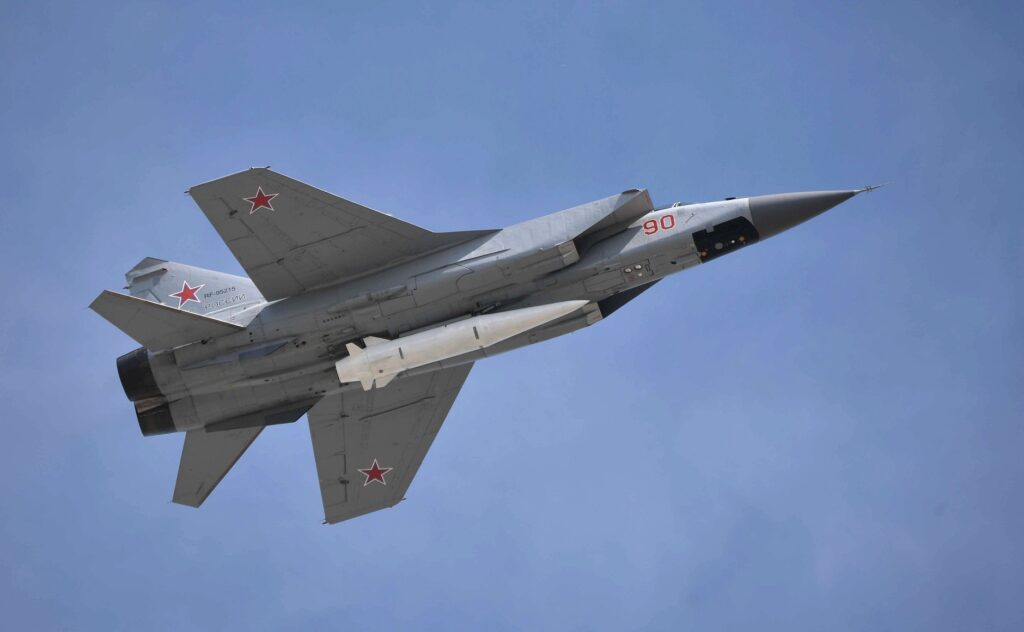
Russia’s ballistic missile threat to Ukraine, and increasingly to wider Europe, is not a single system but a family of attack options. At the lower end sit Iskander-M and KN-23, which are tactically useful, mobile and harder to intercept than classical ballistic missiles because of their depressed trajectories and manoeuvres. At the higher end sits Kinzhal, which extends the engagement envelope through air launch. Above that sits Oreshnik, whose range and MIRV capability make it strategically coercive, even if used only occasionally. [22]
The urgency is real. In early July Russian attacks on Kyiv had reportedly exposed Ukraine’s shortage of upper-tier interceptors, and in one large strike Ukraine was unable to bring down any of the ballistic missiles launched. Ukrainian intelligence said in June that Russia could launch up to 100 ballistic missiles per month while sustaining stockpiles, with monthly Iskander output around 55–60 missiles. Even if those figures are treated cautiously, they imply a sustained production-and-launch rhythm that stresses any defender’s inventory planning. [23]
RUSI’s 2025 analysis adds the operational texture that matters most: interception success against Iskander/Kinzhal-class attacks has been highly uneven, with evidence of worsening performance in defended areas as Russia altered trajectories, manoeuvring behaviour and perhaps the sophistication of decoys. CSIS notes more generally that missile countermeasures include decoys, manoeuvring or multiple warheads, and attacks on missile-defence assets themselves. In practice, Russia combines these missile characteristics with saturation packages involving drones, cruise missiles and repeated strikes intended to compress the defender’s decision time and deplete expensive interceptors. [24]
Russian Ballistic Missile Threat Matrix
| System | Class | Open-source range | Warhead / payload | Features that stress defence | Sources |
| 9K720 Iskander-M | SRBM | 400–500 km | 480–700 kg; HE, submunition, earth-penetrator, thermobaric | Depressed trajectory; manoeuvres up to 30g; mobile TEL; short warning time from Kaliningrad or forward launch areas | [25] |
| Kh-47M2 Kinzhal | Air-launched ballistic missile | 1,500–2,000 km | 480 kg; conventional or nuclear | Air launch expands azimuth and range; high-speed terminal approach; derived from Iskander family | [26] |
| KN-23 | SRBM | 450 km with 500 kg warhead; up to 690 km with reduced payload | ~500 kg | Quasi-ballistic, lower flight path, terminal “pull-up” manoeuvre, complicates prediction and engagement | [27] |
| Oreshnik | IRBM | 3,500–5,470 km | Single or MIRV; six MIRV warheads reported in open-source estimates | MIRV capability, possible lofted trajectory, strategic reach to most European capitals | [28] |
A further point is strategic geography. CSIS notes that Iskander has been permanently deployed in Kaliningrad since 2018, directly tying the Ukrainian experience to NATO’s north-eastern flank. On the long-range side, the Bundeswehr has explicitly justified Germany’s Arrow 3 procurement by reference to the threat from high-flying ballistic systems such as Oreshnik. The anti-ballistic coalition is therefore about defending Ukrainian cities, and also about building a European answer to a coercive tool Russia can use against NATO territory. [29]
Europe and Ukraine’s Current and Future Missile-defence Architecture
The most useful way to understand Europe’s architecture is as a layered stack. NATO’s IAMD policy describes four functional areas: air surveillance, battle management / C3I, active air and missile defence, and passive air and missile defence. It emphasises the seamless integration of sensors, effectors and decision-making across national and Alliance structures, including space-based data and distributed C2 nodes. NATO’s current BMD mission combines common NATO command-and-control with national contributions such as the command centre at Ramstein, the radar at Kürecik, the Aegis Ashore sites in Romania and Poland, and Aegis ships based in Rota. [30]
For Ukraine, the architecture is more improvised but also more battle-tested. At the ballistic-defence end, the key current systems are Patriot and SAMP/T, backed by radars and a constrained number of interceptors. At the lower layers, IRIS-T SLM/SLS and NASAMS are essential for cruise missiles, drones and aircraft, but they do not solve the upper-layer ballistic problem on their own. Ukraine’s own priority talks with France on radars, Aster-30 missiles and possible SAMP/T NG deliveries underline this distinction. [31]
Current and Planned Missile-defence Systems in Europe and Ukraine
| System | Layer and indicative envelope | Ballistic-missile role | Sensors / C2 notes | Status in Europe / Ukraine | Lead suppliers | Sources |
| Patriot PAC-3 family | Terminal, long-range air and missile defence | Defeats tactical ballistic missiles as well as cruise missiles, drones and aircraft | Integrated radar, C2 and multiple interceptor families; central to NATO IAMD | Operational across several European states and Ukraine; still heavily supply-constrained | Raytheon, Lockheed Martin | [32] |
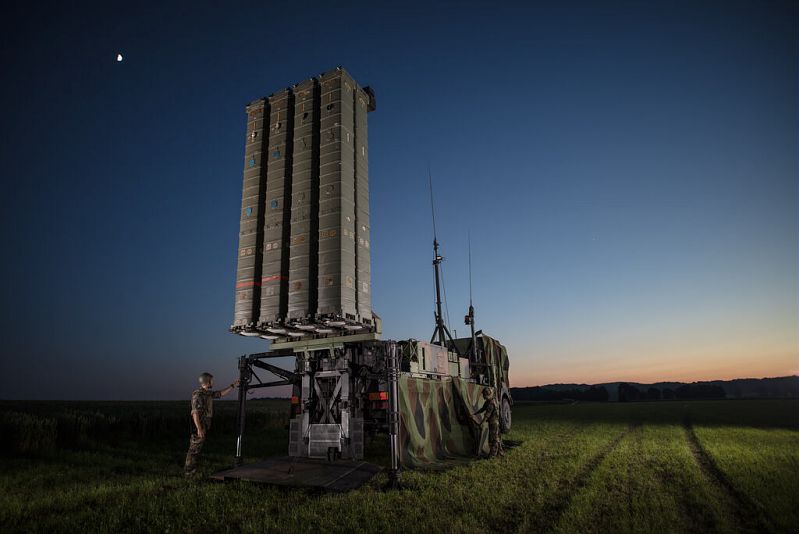
| SAMP/T | Long-range / terminal European layer | Europe’s only indigenous fielded missile with terminal BMD capability; IISS assesses SRBM defence up to 600 km threat class | Ground engagement module; radar; NATO/coalition interoperability | In service with France, Italy and Ukraine | Eurosam, MBDA, Thales, Leonardo | [33] |
| SAMP/T NG with Aster 30 B1NT | Extended >150 km engagement; improved anti-missile performance | Improved interception capability against higher-end and hypersonic-class threats | Radar detection beyond 350 km; mobile within 30 minutes | First system scheduled for late 2027; Denmark export deliveries from 2028; Ukraine discussing acquisition | Eurosam, MBDA, Thales, Leonardo | [34] |
| IRIS-T SLM | Medium layer, 40 km range / 20 km altitude | Not an upper-tier ballistic interceptor; critical for lower/mid-layer air defence and inventory preservation | HENSOLDT TRML-4D radar; Airbus IBMS-FC in command post | Combat-proven in Ukraine; increasingly procured across ESSI members | Diehl, HENSOLDT, Airbus | [35] |
| IRIS-T SLX | Long-range future layer, up to 80 km / 30 km altitude | Greater reach; relevant to wider layered defence but not yet a replacement for Patriot/Arrow BMD | Minor radar/C2 adaptations claimed from SLM baseline | Under development; series production target reported for 2029 | Diehl | [36] |
| NASAMS | Short-to-medium layer, multi-missile architecture | Not a primary ballistic interceptor; valuable against cruise missiles, drones, aircraft | Sentinel radar, EO/IR sensor, FDC, networked architecture and multi-missile options | Operational in Ukraine and widely used by NATO states | Kongsberg, Raytheon | [37] |
| Arrow 3 | Exo-atmospheric upper layer; intercept above 100 km | Defeats long-range ballistic missiles beyond atmosphere | Israeli radar, launchers and trained crews; connected into NATO-linked architecture in Germany | Germany IOC declared in Dec 2025; full protection planned by 2030 | Israel Aerospace Industries with US MDA involvement | [38] |
| Aegis Ashore | Land-based BMD against short-, medium- and intermediate-range ballistic missiles | Core NATO territorial BMD element | Aegis sensors, interceptors and C2; integrated with EPAA | Operational in Romania, mission-ready in Poland from 2024 | Lockheed Martin / US MDA ecosystem | [39] |
| ODIN’s EYE | Space-based early warning | Early detection and tracking of ballistic / hypersonic launches | Space-based missile early warning architecture | Under implementation by France and Germany | OHB-led consortium and EU partners | [40] |
| HYDIS / HYDEF / TWISTER family | Future counter-hypersonic / upper-layer projects | Intended to counter hypersonic glide vehicles and medium-range ballistic threats; likely post-2030 fielding | Concept-phase interceptors under PESCO/OCCAR/EDF umbrellas | Developmental, not near-term operational | OCCAR / EDF consortia led by MBDA and others | [41] |
The clearest analytical insight is the gap between today’s lower and middle layers and the still thin European upper layer. IISS’s 2025 assessment showed that current European terminal missile-defence capabilities rely heavily on the US, chiefly through Patriot, while Arrow 3 and Aster 30 B1NT represent different paths to a broader European upper layer. The European Commission’s 2025 white paper and 2026 roadmap respond directly to this by calling for a European Air Shield fully interoperable with NATO. [42]
The coalition’s best near-term contribution, therefore, is likely not a wholly new continent-wide architecture in twelve months, but rather a faster integration of existing layers: more radars, more Aster and Patriot interceptors, more distributed battle management, tighter NATO interoperability, and better links between national systems. Even the most ambitious FREYJA path would still need to plug into NATO-style data fusion and battle management if it is to matter operationally. [43]
Sensors, Command-and-control, and the Place of UAV and UGV Systems
Missile defence is ultimately about time. NATO’s IAMD policy stresses that air surveillance must provide persistent coverage across the full 360-degree battlespace, using active and passive, civilian and military, static and deployable sensors, with data fusion and increasingly AI-supported analysis. The NATO Air Command and Control System and associated Air C2 evolution are designed to provide the common operational picture that lets a layered defence work at all. [44]
That is why the future European effort cannot be reduced to a missile competition. The European Commission’s Air Shield concept explicitly includes the necessary sensors, while ODIN’s EYE is designed to provide Europe with a more sovereign space-based early-warning layer. The coalition’s success will therefore depend as much on radar coverage, passive sensors, data links, software assurance and battle-management logic as on the interceptor itself. [45]
UAV and UGV systems fit into this architecture mostly as enablers, not as the anti-ballistic core. On the UAV side, both NATO and the Commission increasingly treat drones and counter-drone systems as adjacent to broader IAMD, because the same command networks, sensors and battlefield transparency shape response times. On the UGV side, Ukraine is rapidly expanding robotic ground logistics; that matters less for intercept geometry than for sustaining dispersed air-defence sites, reload operations, local security and casualty reduction around high-value missile-defence nodes. In other words, UAV/UGV systems are likely to matter to a European anti-ballistic architecture mainly by protecting, networking and sustaining it. [46]
Procurement, Industry and Strategic Autonomy
The anti-ballistic coalition arrives at a moment when Europe has more money and more legal instruments for defence than at any point in the post-Cold War era, but still lacks a truly unified procurement culture. The European Commission’s SAFE instrument offers up to €150 billion in long-maturity loans for urgent defence capability investment. EDIP adds €1.5 billion in EU funding, including a €300 million Ukraine Support Instrument, and larger industrial reinforcement actions for capacity growth in Europe and Ukraine. The broader Defence Readiness 2030 logic now treats air and missile defence as one of the continent’s priority capability gaps. [47]
The problem is fragmentation. The European Parliament’s research service notes that EU Member States are expected to have reached about €381 billion in combined defence spending in 2025, but collaborative procurement remains weak. The European Defence Agency’s most recent available figure is only 18% of defence programme investment conducted collaboratively. Another EPRS brief adds that the EU wants at least 40% of procurement conducted jointly by the end of 2027, with SAFE-funded procurements delivered by 2030. [48]
The legal explanation is well known but still unresolved. The EPRS notes that Article 346 TFEU continues to let governments bypass EU procurement rules when essential security interests are invoked, which is one reason major defence contracts still sit largely inside national political bargains. SIPRI’s work on arms supplies to Ukraine adds a second obstacle: export-control harmonisation for jointly produced systems remains unsatisfactory, with national approaches diverging and creating recurring problems for co-produced equipment. [49]
For missile defence, those legal and political problems sit on top of hard industrial bottlenecks. IISS points to shortages in PAC-3 subcomponents such as rocket motors, even as demand rises across Ukraine and NATO. CSIS’s June 2026 report on solid rocket motors generalises the lesson: missile supply chains are unusually exposed to cyclical demand, difficult supplier management, and misaligned government-industry incentives. The same report argues that multi-year procurement, direct-to-supplier investment and allied industrial cooperation are essential if production is to scale at speed. [50]
That is precisely why the Paris coalition matters industrially. France is now licensing Aster production to Ukraine. In early July 2026, US President Donald Trump’s announced that he will approve a license for Ukraine to produce its own Patriot missile interceptors. Norway’s Kongsberg has moved to develop missiles and uncrewed systems in Ukraine. Germany and Ukraine are explicitly pursuing closer anti-ballistic missile cooperation. Diehl is expanding IRIS-T output, while US and European partners are discussing European PAC-3 support facilities and greater co-production. This is the beginnings of a distributed European-Ukrainian production base, even if it remains dependent on US approvals and non-European technologies in critical segments. [51]
The Paris coalition is best seen as an attempt to reduce strategic exposure to US scarcity, not as a declaration of separation from NATO. [52]
Scenario: Hybrid Reinforcement
The most plausible short-term scenario is hybrid reinforcement, not strategic transformation. Over the next 6–18 months, Europe is more likely to reinforce Ukraine and exposed NATO states with additional radars, Aster inventories, Patriot sustainment, IRIS-T/NASAMS expansion and tighter Command and Control (C2) integration than to field a completely new indigenous anti-ballistic shield. The coalition can still add real value in this window if it acts as a political vehicle for fast industrial contracting and data-sharing. [54]
The medium-term scenario, roughly 18 months to five years, is one of layer consolidation. By that point, SAMP/T NG should begin entering service, Denmark’s export delivery path should open, Germany should extend Arrow 3 deployment, IRIS-T production should expand further, and EU/NATO projects in sensors, passive surveillance and early warning should begin to narrow the readiness gap. This is also the period in which a credible FREYJA demonstrator could matter, if the programme survives the transition from political announcement to contracted workshare. [55]
The long-term scenario, from around 2030 onwards, is where genuine European strategic autonomy might become visible. That would require Europe to field not just more launchers but also more sovereign sensors, seekers, data links, tactical C2, and perhaps space-based early warning. That point was made both by the European Air Shield concept and by German and European strategic analyses of capability dependence. HYDIS, HYDEF and related programmes are relevant here, but they are not short-war answers. [56]
Deployment and Decision Milestones
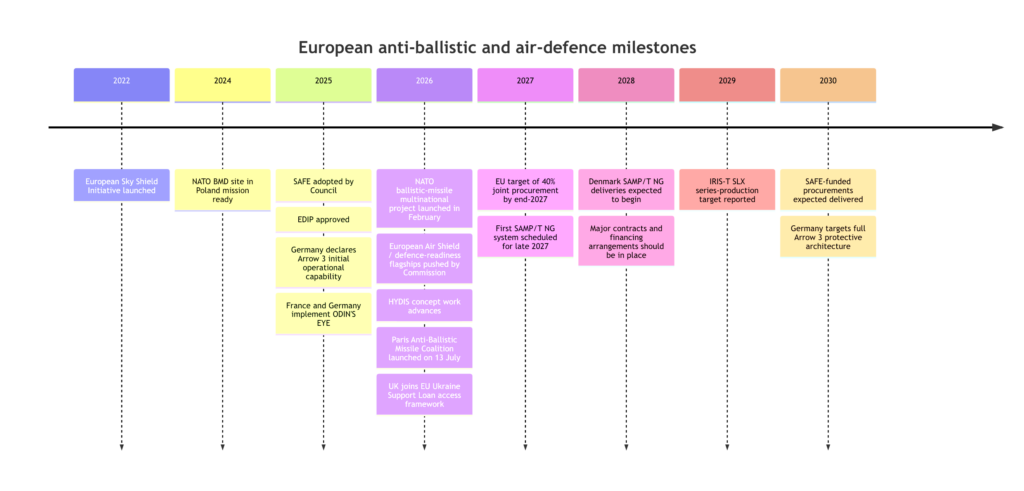
The timeline above combines official NATO, EU, Bundeswehr, Eurosam and company milestones. It should be read as an indicative policy and industrial map, not as a guarantee that all programmes will stay on schedule. [57]
The main risks are straightforward. The first is programme inflation without production scale, a classic European failure mode in which political ambition outruns funded manufacturing. The second is interoperability failure: a coalition-built system that cannot plug smoothly into NATO Air C2 would create duplication rather than deterrence. The third is export-control veto risk, especially for systems relying on US components, Israeli-US co-development chains or nationally sensitive European sub-systems. The fourth is inventory economics: even a good interceptor loses strategic value if it costs too much, arrives too slowly or cannot be produced in depth. The fifth is political fragmentation, illustrated by the collapse of FCAS and by long-running disputes over what counts as “European” in European defence procurement. [58]
Policy Recommendations
1. Put radars, battle management and early warning ahead of prestige interceptors. Europe’s biggest near-term returns lie in more sensors, passive surveillance, data fusion and interoperable Air C2, because even the best interceptor fails if it is cued too late. ODIN’s EYE, passive air-surveillance projects, tactical control systems and national radar procurement should be treated as first-order ABM spending, not enablers to be funded later. [59]
2. Use the coalition to aggregate demand around existing layers immediately. The fastest gains come from more Aster, Patriot sustainment, IRIS-T and NASAMS, tied to a common inventory and maintenance picture. The coalition should publish a rolling joint demand plan for sensors, reloads, launchers and spare missiles. [60]
3. Ringfence SAFE and EDIP money for air and missile-defence industrial bottlenecks. Solid rocket motors, seekers, radar modules, fuze electronics and tactical-control software are the real constraints. Multi-year EU-backed contracting should be directed at those choke points, not merely final assembly. [61]
4. Create a European “ASAP for Air Defence”. CSIS is right that Europe needs a crash programme for air defence. The Commission should convert that logic into a dedicated production-scaling instrument for interceptors and sensor subcomponents, including Ukrainian industrial participation. [62]
5. Harmonise export-control rules for jointly developed systems. The coalition will not scale if every future export, re-export or wartime transfer can be slowed by conflicting national procedures. The minimum practical step is a coalition-specific framework for pre-cleared transfers of jointly developed defensive systems to Ukraine and participating states. [63]
6. Use Ukraine as a structured test-and-integration partner, not merely as a recipient. Ukraine’s value is not only battlefield urgency but also operational data, rapid feedback and combat-realistic experimentation. The coalition should institutionalise a secure mechanism for lessons-learned exchange, telemetry sharing and validation of new sensors and C2 concepts. [64]
7. Keep the coalition explicitly inside NATO interoperability standards. A more sovereign European missile-defence industry is compatible with NATO; a parallel and incompatible architecture is not. Every coalition demonstrator should have a published pathway into NATO-compatible battle management and communications standards. [65]
Sources
- [1] [6] [7] [12] [19] [21] [64] [66] Joint Declaration on the Establishment of the Integrated Ant
- [2] [8] [39] Ballistic missile defence | NATO Topic
- [3] [22] [25] [29] [67] 9K720 Iskander (SS-26) | Missile Threat
- [4] [46] Delivering capabilities through multinational cooperation | NATO Topic
- [5] [10] [68] Ukraine and allies set up coalition to tackle Russia ballistic missile threat
- [9] NATO Secretary General attends meeting of the Coalition of the Willing in Paris | NATO News
- [11] [14] Declaration on a strategic partnership between Germany and …
- [13] [51] Ukraine to produce French missiles, orders war planes, Macron says
- [15] Prime Minister secures Ukraine defence deal backing British jobs and industry: 13 July 2026
- [16] [34] [55] France orders the multi-layered version of the SAMP/T NG air and missile defence system – Eurosam
- [17] [20] [33] [42] [50] IISS: Progress and shortfalls in Europe’s defence
- [18] Norway secures air defence missiles for Ukraine – regjeringen.no
- [23] Russia attacks Kyiv for third time in a week, kills three
- [24] Iskander: An Improved Russian Missile Tests Ukraine’s Air Defence | Royal United Services Institute
- [26] Kh-47M2 Kinzhal | Missile Threat
- [27] KN-23 | Missile Threat
- [28] Oreshnik | Missile Threat
- [30] [43] [44] [59] NATO Integrated Air and Missile Defence Policy | NATO Official text
- [31] [54] Ukraine and France step up efforts to strengthen air defence with radars and Aster-30 missiles | MoD News
- [32] Global Patriot | Raytheon
- [35] Denmark procures additional IRIS-T SLM fire units
- [36] Second IRIS-T SLM fire unit delivered to Ukraine | Diehl Defence
- [37] NASAMS Air Defence System – KONGSBERG – an international technology group
- [38] Arrow stärkt Deutschlands Schutz vor ballistischen Raketen
- [40] ODIN’S EYE II – Defence Industry and Space – European Union
- [41] HYDIS Programme – Hypersonic Defence Interceptor System
- [45] [56] [65] commission.europa.eu
- [47] [53] [61] SAFE | Security Action for Europe – European Commission
- [48] EU joint defence capability development
- [49] EU joint defence procurement
- [52] Ohjusjärjestelmät ja -puolustus (in Finnish)
- [57] 14 NATO Allies and Finland agree to boost European air …
- [58] Solid Rocket Motors for Missile Defense: Challenges and Opportunities for Expanding the Industrial Base
- [60] [62] Europe Needs an ASAP Program for Air Defense
- [63] Arms supplies to Ukraine: Does the European arms export control system need revision?
- Wikipedia: Aster (missile family)
- Wikipedia: Kh-47M2 Kinzhal
- France24: Patriot missile license a ‘long-term’ investment for Ukraine – but can it afford the wait?