
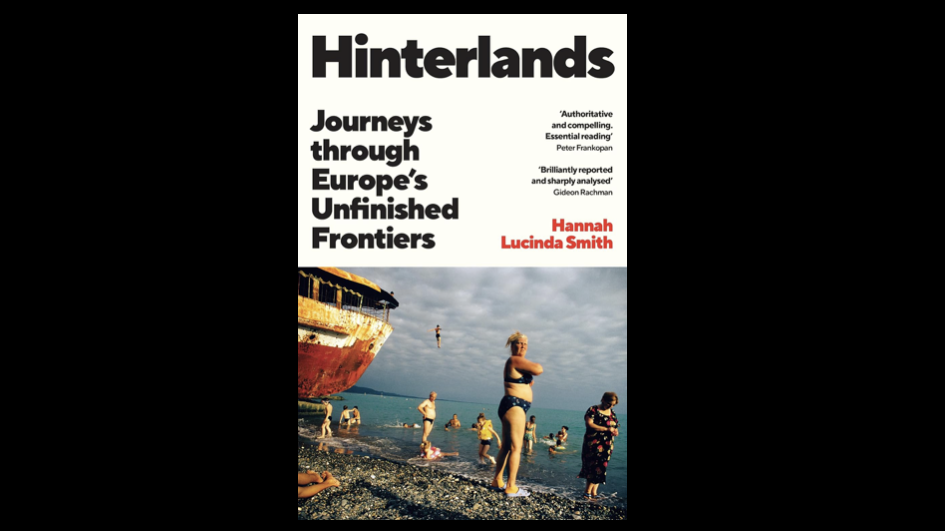
Europe’s forgotten frontiers are where the next crisis is already beginning. Hannah Lucinda Smith’s Hinterlands (Profile Books, 2026, 288 pages) begins from a proposition that western European governments have spent decades trying to avoid: Europe’s periphery is central to Europe’s security.
The continent’s most dangerous political spaces frequently lie beyond the metropolitan centres where European strategy is formulated. They are found in partially recognised states, disputed territories, ethnic enclaves, frozen conflicts and regions left suspended between empires. Bosnia, Kosovo, Transnistria, Crimea, Cyprus, Syria and Nagorno-Karabakh appear different on a conventional political map. Smith treats them as parts of the same strategic landscape.
These are Europe’s unfinished frontiers, territories whose borders and political identities remain contested long after diplomats declared their conflicts settled.
Published by Profile Books in June 2026, Hinterlands combines travel writing, foreign correspondence, political reportage and strategic analysis. Smith draws on more than 14 years of reporting from the Middle East, Turkey and the Balkans. Her central concern is the relationship between local political fractures and the wider contest involving Russia, Turkey, the European Union, NATO and the United States. The result is a persuasive account of a Europe whose security order is being tested from its edges inwards.
The Map Beneath the Map
The conventional map of Europe offers reassuring certainties. Borders appear as clean lines. States are coloured as coherent political units. NATO and EU membership suggest clear strategic alignment. Smith explores the map beneath that map.
Her Europe contains de facto states, unrecognised administrations, autonomous territories, abandoned peace processes and communities divided between competing national histories. Sovereignty exists in degrees. Authority may be exercised by an internationally recognised government, a regional strongman, an occupying army, a criminal network or an external patron.
Smith identifies 34 disputed territories in Europe, many concentrated around Turkey and the Black Sea, where Russian, Ottoman, Persian and British imperial interests historically collided.
Those imperial encounters remain politically active. They survive in language laws, religious divisions, property disputes, military bases, citizenship rules and arguments over whose ancestors arrived first. They also provide opportunities for contemporary powers.
Russia can issue passports, support separatist administrations, finance political allies, spread disinformation or deploy troops as supposed peacekeepers. Turkey can use trade, construction, religious institutions, historical ties and military support to deepen its influence. The EU offers regulation, money and the distant prospect of membership, although that prospect has lost credibility in several parts of the continent.
Smith’s achievement lies in showing how these instruments overlap. Contemporary geopolitical competition operates through armies and missiles, alongside banks, building projects, television channels, patronage networks and passports.
She compresses this emerging arsenal into one memorable phrase: “misinformation, cryptocurrency and construction”. That formulation captures one of the book’s strongest ideas. Hybrid warfare is often discussed as a specialist category of cyberattacks, sabotage and propaganda. Smith presents it as a broader political economy. Influence grows through control of money, infrastructure, information and local elites. The boundary between foreign policy and organised corruption becomes difficult to identify.
Reporting From the Grey Zones
Smith originally conceived the project under the title The Grey Zone. She intended to examine misinformation, espionage, diplomacy and journalism as overlapping practices. Publishers found the concept difficult to contain. Profile Books encouraged her to organise the story geographically, moving from territory to territory and allowing the wider argument to emerge through reporting.
Smith later acknowledged that she had initially been “over-intellectualising” the project. The country-by-country structure gave it the narrative shape it needed.
That decision appears crucial to the book’s success. Rather than constructing an abstract theory of hybrid conflict, Smith introduces the reader to people who live inside it. Her cast includes politicians, bartenders, oligarchs, spies, separatists, refugees, soldiers and opportunists. Major geopolitical arguments emerge through individual encounters.
In Republika Srpska, the Serb entity within Bosnia and Herzegovina, a bartender defends the political strongman Milorad Dodik as a protector of local interests. The same man is preparing to emigrate to Germany because he sees little future at home.
The episode demonstrates how patronal politics survives. Citizens may understand that their leaders have impoverished their societies and still regard those leaders as defenders against an external threat. Identity can outweigh economic performance. Political failure strengthens the insecurity on which nationalist power depends.
This pattern recurs across the borderlands. Governments and separatist authorities preserve legitimacy by maintaining a permanent sense of danger. Every concession becomes betrayal. Every reform threatens the group. Every foreign critic confirms the narrative of siege. Smith’s journalism is at its best when it captures these contradictions without forcing them into a neat ideological framework.
The Unfinished Business of Empire
The title Hinterlands carries a deliberate ambiguity. A hinterland can be peripheral territory, an area lying behind a coast or border, or a place considered remote from the centre of power.
Smith reverses the perspective. What appears peripheral from Brussels, Berlin, London or Paris may occupy the centre of another power’s strategic imagination. Crimea is peripheral to many western Europeans. It is central to Russian imperial mythology, Black Sea strategy and Ukrainian sovereignty. Northern Cyprus receives little sustained attention in most European capitals. It has become a strategic and financial extension of Turkey, while providing opportunities for individuals and capital seeking weak oversight.
Smith describes the Turkish Republic of Northern Cyprus as “politically and financially part of nowhere at all”. The phrase is incisive because political ambiguity creates commercial value. Partial isolation can attract money that depends on secrecy. Sanctions, corruption and geopolitical rivalry thrive in jurisdictions whose status is unresolved and whose institutions operate outside robust international scrutiny.
Transnistria performs a similar function. It is simultaneously a separatist territory, a Russian strategic foothold, a Soviet-themed political curiosity and a commercial zone whose survival depends on complicated relations with Moldova, Ukraine and the European Union.
These places endure because uncertainty serves powerful interests. Final settlements would require political leaders to surrender leverage, income or ideological purpose. Frozen conflicts therefore remain deliberately refrigerated rather than genuinely dormant.
Russia and Turkey at Europe’s Edges
Vladimir Putin and Recep Tayyip Erdoğan are the book’s most important external protagonists. Smith has written extensively about Erdoğan and is alert to Turkey’s ability to combine formal state power with informal networks. Ankara’s influence extends through military operations, religious foundations, television, property investment, infrastructure and personal relationships with local leaders.
Russia uses a related repertoire, reinforced by greater military force and a more explicit revisionist ideology. Moscow has repeatedly presented itself as the guardian of threatened populations, then used that role to constrain neighbouring states.
The two powers compete, bargain and cooperate. Their relationship resists the simple categories of alliance and hostility. Russia and Turkey can back opposing forces in one theatre, trade extensively in another and coordinate political arrangements elsewhere.
This flexibility contrasts with the institutional rigidity of the EU. European policy requires agreement among numerous governments, legal processes and budgetary structures. Russia and Turkey can often act through individuals, intelligence services, commercial intermediaries or executive decisions.
Smith’s borderlands expose the strategic consequences. Europe’s adversaries and rivals often move faster because they accept ambiguity as an instrument of policy.
Crimea and the Corrosion of Loyalty
One of the book’s most revealing encounters occurs in Russian-occupied Crimea. Smith meets Ataman Akimov, a Cossack leader who assisted the unidentified Russian soldiers who seized the peninsula in 2014. Akimov had once supported Putin. He later became disillusioned with the Russian system and its failure to improve ordinary life.
His judgement is devastating: “It boasts of its missiles, but what does it do for ordinary people?”
The remark captures the central weakness of militarised authoritarianism. Regimes can manufacture grandeur more easily than prosperity. Missiles offer visible proof of national power. Public services, accountable government and economic opportunity require institutions that authoritarian rulers frequently weaken.
Akimov’s disillusionment also complicates comfortable assumptions about political loyalty in occupied territories. Support for annexation, separatism or an authoritarian patron may be transactional, emotional or temporary. It can weaken when promised stability fails to produce a better life.
Smith avoids treating residents of disputed territories as passive pieces in a strategic game. Their loyalties shift. They accommodate power, exploit opportunities, repeat propaganda, resist quietly or leave.
Emigration becomes one of the defining political acts in these regions. Young and educated people respond to institutional failure by moving west. Their departure weakens the societies they leave behind and strengthens the political machines responsible for their departure.
Syria as Europe’s Wider Frontier
Syria sits awkwardly within a book about European frontiers. Smith appears to include it deliberately, arguing through geography rather than adhering to a narrow continental definition.
The Syrian war affected European politics through refugee movements, jihadist networks, Russian intervention, Turkish military operations and the collapse of western confidence. It demonstrated how a conflict beyond the EU’s formal boundaries could reshape elections, border policy and public attitudes across Europe.
Smith characterises Damascus in 2011 as “the equivalent of Sarajevo in 1914”.
The analogy is provocative and arguably overextended. Sarajevo produced a chain of alliance mobilisation that led rapidly to a general European war. Syria generated a long, internationalised conflict whose consequences spread through intervention, displacement and political radicalisation.
The comparison still reveals Smith’s larger argument. Peripheral conflicts become systemic when external powers enter them, alliance structures harden and local violence activates wider rivalries.
Syria became a battlefield for Russia, Turkey, Iran, the United States, Gulf states and European powers. Its war tested red lines, exposed western hesitation and gave Russia an opportunity to display military commitment before its full-scale invasion of Ukraine.
The chapter therefore belongs within the book. Europe’s strategic hinterland extends beyond its cartographic border.
NATO’s Crisis of Credibility
Some of the book’s bleakest passages concern NATO. A European diplomat tells Smith that Article 5, the alliance’s mutual-defence guarantee, is effectively dead. When Smith asks what remains, the diplomat answers: “There is nothing left.”
The statement should be treated as one individual’s judgement rather than the book’s final verdict. NATO expanded after Russia’s 2022 invasion of Ukraine, while Finland and Sweden brought substantial military capability and strategic territory into the alliance. European defence spending has also risen markedly.
The quotation nevertheless expresses an anxiety that statistics cannot settle. Deterrence depends on an adversary believing that political leaders will act.
Alliance credibility rests on capability, readiness and political will. Borderland conflicts are attractive to revisionist powers because they can be calibrated below the threshold that guarantees a unified response. A separatist provocation, cyberattack, sabotage operation or political coup creates uncertainty over whether the alliance’s strongest commitments apply.
Smith’s reporting therefore points towards the decisive strategic question facing Europe. The danger may arrive as an ambiguous crisis rather than a conventional invasion.
Carrying History Into the Present
The book’s principal strength is its fusion of character-driven journalism with geopolitical analysis.
Smith understands that borders become comprehensible through the lives of people who cross them, police them, profit from them and die over them. Her subjects carry history into the present. A bartender’s plans, a Cossack’s disillusionment or a banker’s opportunities can reveal more about political systems than a catalogue of official declarations.
She also has an eye for political absurdity. In Kosovo, Smith encounters young men named Tonibler, an Albanianised tribute to Tony Blair. Bill Clinton has received a boulevard and a statue. These details offer comic relief, while revealing the persistence of gratitude towards the Western leaders associated with Kosovo’s liberation.
Such episodes prevent the book from becoming an austere strategic survey. It is an eyewitness account, and published assessments have praised its combination of colourful reporting and sharp analysis.
The geographical breadth is another asset. Bosnia, Kosovo, Cyprus, Crimea and the Caucasus are often analysed within separate specialist fields. Smith places them within a shared environment shaped by imperial succession, weak sovereignty and external manipulation.
The Limits of the Journey
The book’s journalistic form also imposes limitations. Travel reportage privileges vivid encounters. A memorable character can acquire disproportionate explanatory weight. Individual testimony illuminates a political reality, although it cannot establish how widely a view is shared.
The breadth of the itinerary creates a second problem. Every region covered has its own language, historiography, constitutional disputes and contested memories. Compressing them into a single narrative risks smoothing away important differences.
Bosnia’s post-Dayton constitutional paralysis, the internationally unrecognised government of Northern Cyprus, Russia’s occupation of Crimea and the former separatist system of Nagorno-Karabakh belong to distinct legal and political categories. Their similarities are real. So are their differences.
Smith’s emphasis on Russia and Turkey may also leave less room for the agency of local political actors. Moscow and Ankara exploit divisions, but they rarely create those divisions from nothing. Domestic elites often invite external involvement because it protects their own power.
Hinterlands ultimately argues that Europe pays attention to peripheral conflicts only after they become major emergencies. The Balkans were treated as a secondary concern until Yugoslavia collapsed into war. Ukraine’s territorial integrity received inadequate protection after Russia annexed Crimea in 2014. Nagorno-Karabakh remained a frozen conflict until Azerbaijan changed the facts by force. Cyprus has remained divided for more than half a century while negotiations repeat familiar formulas.
This pattern encourages revisionist powers. Neglect signals that borders can be tested incrementally. A local proxy can create facts that diplomacy later struggles to reverse.
Smith’s solution is implied rather than presented as a formal policy programme. Western governments must understand contested territories before crises erupt. That requires diplomats, intelligence officers and journalists who know local languages, histories and networks. It also requires sustained political attention, economic scrutiny and credible security commitments.
The borderlands cannot be managed through occasional summits and statements of concern.