
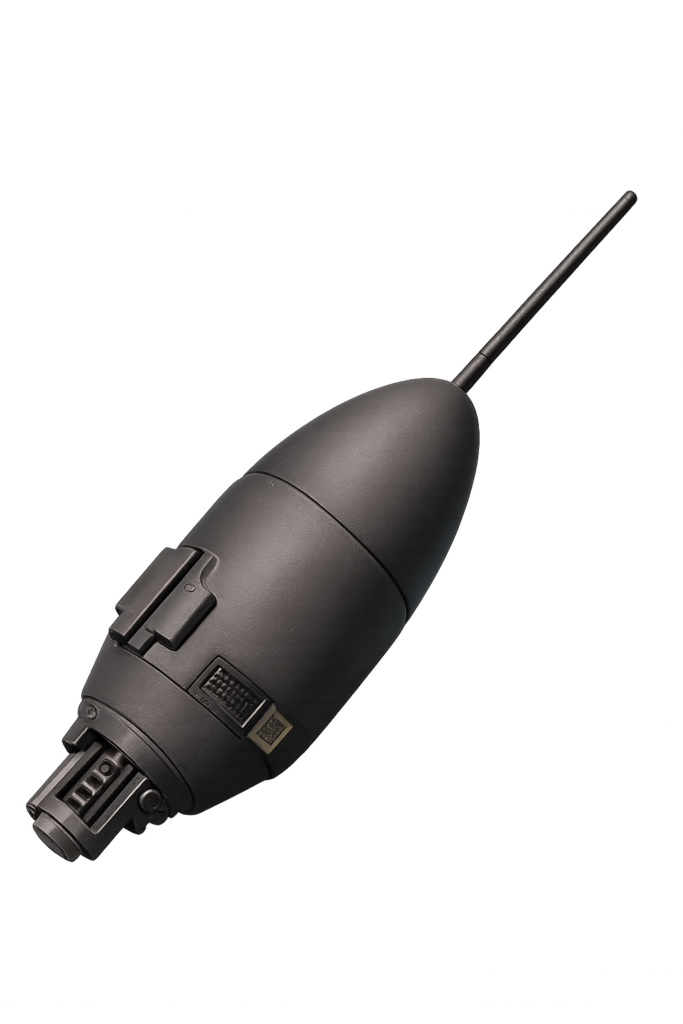
Instead of designing an entirely new missile, Norwegian defence manufacturer Nammo has taken a combat-proven anti-armour warhead already used extensively in Ukraine and integrated it with a modular unmanned aerial vehicle, creating a precision strike weapon aimed at one of the fastest-growing segments of modern warfare.
The Nammo Modular Strike System (NMSS), unveiled at Eurosatory 2026 in Paris, may appear modest compared with Europe’s latest long-range missiles or loitering munitions. Strategically, however, it represents one of the defence industry’s most significant shifts: adapting existing munitions for inexpensive drones rather than developing entirely new weapon families.
The NMSS combines a Croatian-built Orqa MRM2-10 unmanned aerial vehicle with Nammo’s N7 66 mm high-explosive anti-tank (HEAT) warhead.
The warhead weighs approximately 1.5 kg yet is capable of penetrating more than 450 mm of rolled homogeneous armour, making it effective against armoured vehicles when striking vulnerable upper surfaces. According to Nammo, operators can configure the UAV with fibre-optic guidance, digital communications or analogue control depending on mission requirements.
Rather than inventing a completely new effect, Nammo has concentrated on integrating a mature munition with a flexible delivery platform.
That approach dramatically reduces development time, technical risk and production costs.
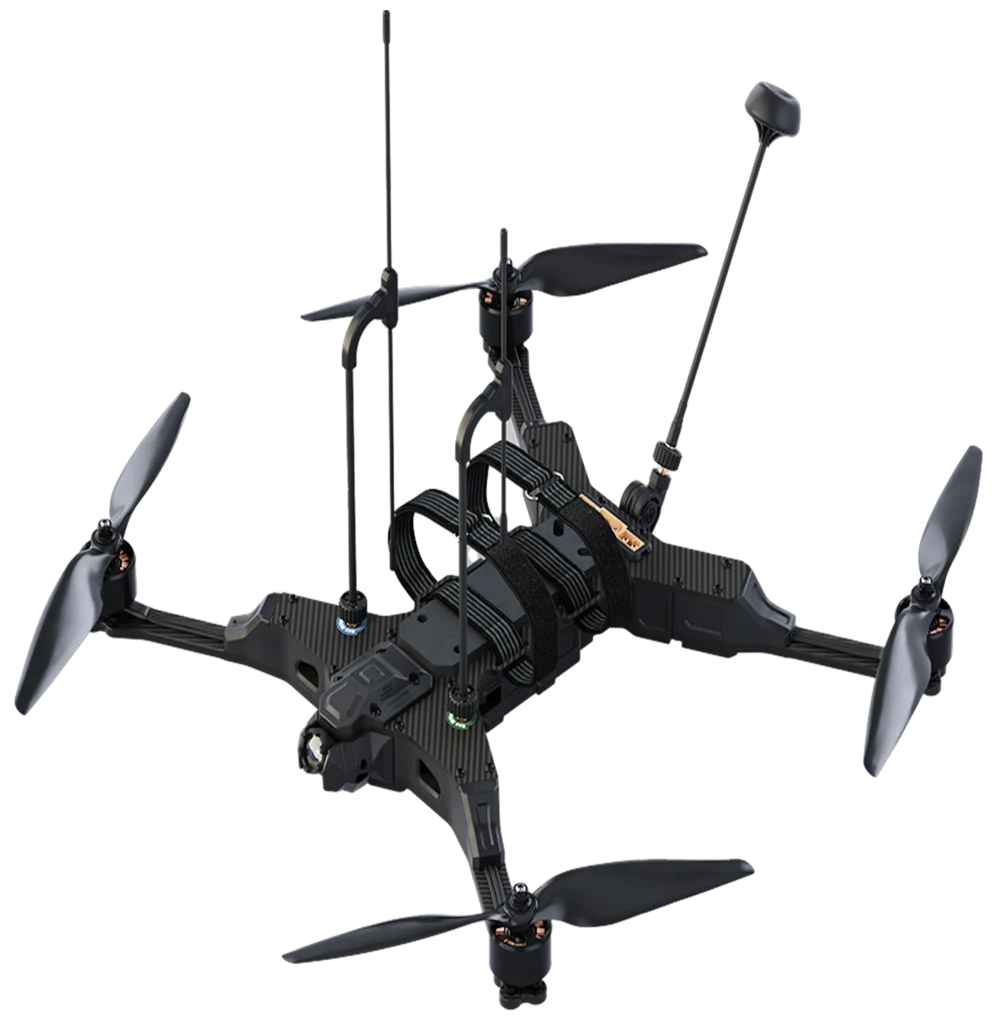
Croatian drone manufacturer Orqa used Eurosatory 2026 to unveil the MRM2-10AI (above), a tactical multirotor designed specifically for electronically contested battlefields. The system combines resilient hybrid communications, including radio and fibre-optic control with automatic failover, AI-ready onboard computing, vision-based terminal guidance for GNSS-denied operations, and an open architecture for third-party autonomy software, enabling the drone to continue operating in environments where jamming and electronic warfare would disable conventional systems.
Lessons From Ukraine
Nammo told Janes that the N7 warhead has already been supplied to Ukraine in six-figure quantities and that Ukrainian forces have been adapting it for use with various UAVs “for some time”. Company representatives also presented combat footage reportedly showing a drone dropping an N7 warhead into the rocket pack of a Russian multiple-launch rocket system, igniting its ammunition and destroying the vehicle.
Ukraine has become the world’s largest laboratory for drone warfare. Military innovations that once required years of government-funded development are increasingly emerging from battlefield improvisation before being refined into commercial products.
Nammo’s system is one of the clearest examples yet of this process.
The Changing Economics of Drone Warfare
The NMSS illustrates a broader trend reshaping defence procurement. For decades, anti-armour capability largely depended on increasingly sophisticated guided missiles costing tens or even hundreds of thousands of euros per shot.
Today’s battlefield increasingly favours a different equation. A relatively inexpensive UAV carrying an existing warhead can destroy vehicles worth millions of euros.
Nammo’s soltion to problem offers several advantages: existing production lines, known ballistic performance, established logistics chains, lower certification costs, and significantly shorter development cycles. It reflects the urgent requirement to expand production volumes while controlling costs.
Modular Approach: Mass Matters
Nammo deliberately describes the NMSS as a modular strike system, not simply another drone. The architecture allows different UAVs, guidance methods and warheads to be combined according to operational requirements. That flexibility mirrors a wider defence industry trend visible throughout Eurosatory 2026.
Manufacturers increasingly favour open architectures that allow sensors, effectors and communications systems to evolve independently rather than locking customers into fixed configurations. Similar thinking can be seen in Rheinmetall’s new loitering munition family and containerised launcher concepts, both designed around scalable, networked architectures rather than individual platforms.
European defence companies have spent decades optimising increasingly sophisticated precision weapons. Ukraine has demonstrated that mass matters almost as much as precision.
Thousands of relatively inexpensive strike drones now shape tactical operations daily. This creates strong commercial incentives to reuse existing technologies rather than pursuing expensive clean-sheet developments.
Nammo already manufactures a broad family of anti-armour munitions. Integrating one into a drone requires far less investment than developing a completely new missile while still creating an entirely new product category.
It also shortens the path from development to production, a priority across NATO as governments seek to replenish stockpiles while preparing for prolonged high-intensity conflict.
Competition is Accelerating
Eurosatory 2026 demonstrated how rapidly Europe’s defence industry is moving into drone-delivered precision effects. Rheinmetall introduced both the FV-014 loitering munition and a containerised multi-launch system capable of deploying multiple drones simultaneously. The emphasis across the exhibition shifted towards modular strike systems, open architectures and scalable production rather than increasingly specialised single-purpose missiles.
This competitive landscape benefits Nammo. The Norwegian company already possesses what many new entrants lack: established warhead technology, mature production facilities and decades of expertise in energetic materials.
Rather than competing directly with drone manufacturers, Nammo can concentrate on the lethal payload while partnering with UAV specialists.
Industrial Logic Favours Partnerships
The NMSS also reflects a broader transformation in Europe’s defence industry. Few companies now attempt to design every component themselves. Instead, specialist manufacturers increasingly combine proven technologies. Orqa contributes the aircraft. Nammo supplies the warhead.
Different communications systems can be integrated according to customer requirements. The result is a modular ecosystem rather than a vertically integrated weapon. This reduces technical risk while allowing individual components to evolve independently as battlefield requirements change.
Military innovation is increasingly driven by software, modular integration and rapid adaptation rather than entirely new platforms. Instead of designing completely new missiles, manufacturers are adapting proven warheads for inexpensive drones.
That philosophy reduces development costs, accelerates production and enables armed forces to field precision strike capability at unprecedented scale.
Nammo is positioning itself as a supplier of modular effects for Europe’s rapidly expanding unmanned systems market, combining decades of munitions expertise with the battlefield lessons emerging from Ukraine.
The most valuable part of tomorrow’s drone is not the aircraft itself, but the warhead it carries.
Read More:
- Janes: Eurosatory 2026: Norway’s Nammo unveils vehicle attack munition for UAVs
- Janes: Norway’s Nammo unveils vehicle attack munition for UAVs
- Eurosatory: Eurosatory 2026: new and improved vehicles and counter-drone technology foreshadowed
- Rheinmetall: Eurosatory 2026: FV-014 loitering munition system
- Rheinmetall: World premiere at Eurosatory 2026: Rheinmetall presents the CML multi launcher for the FV-014 loitering munition
- Nammo: Newsroom