
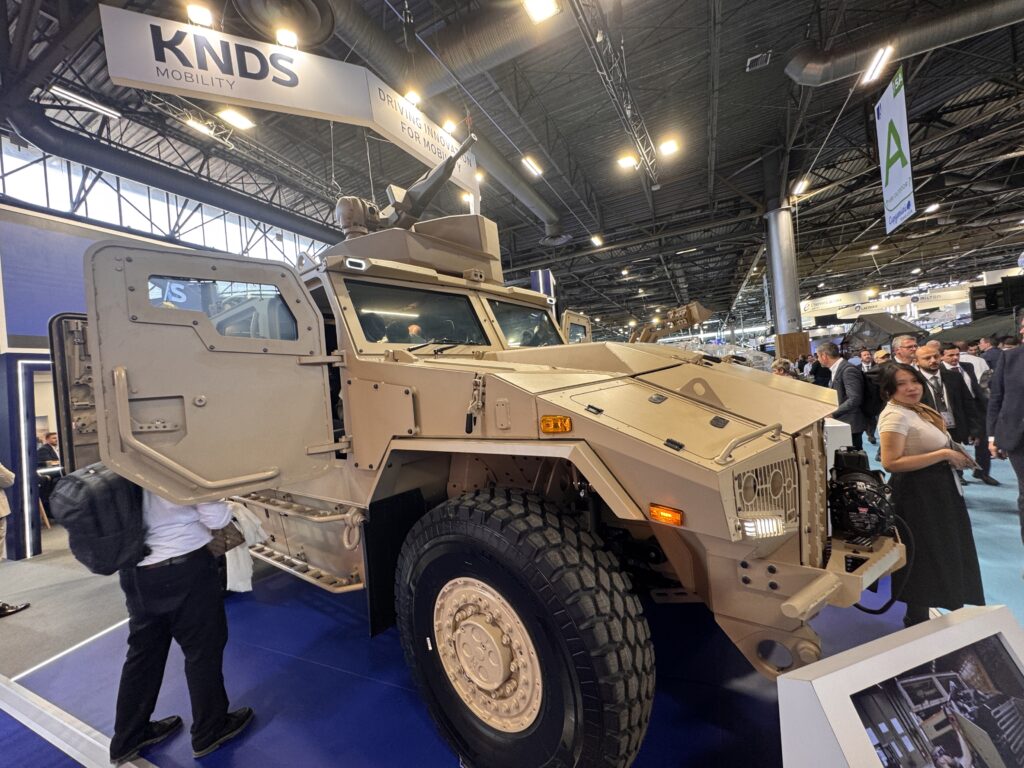
A Finnish start-up has entered one of the defence industry’s most unforgiving markets with an 18-tonne armoured vehicle, a French drivetrain and no disclosed customers. Scata unveiled its MK1 at Eurosatory in Paris in June.
The company says the modular four-wheel-drive platform can carry troops, command systems, counter-drone equipment, logistics loads and weapons. Production is due to begin in Pietarsaari, or Jakobstad, with the first vehicles expected in 2027.
The MK1 was on open display at Scata’s exhibition stand in Paris. The industrial partners are credible, and the market is growing. The commercial claims remain largely untested. Scata has disclosed no firm orders, contract values, investors or named government customers.
That makes the MK1 both a serious industrial project and a high-risk start-up proposition.
Industrial Network Provides Capacity to Scale
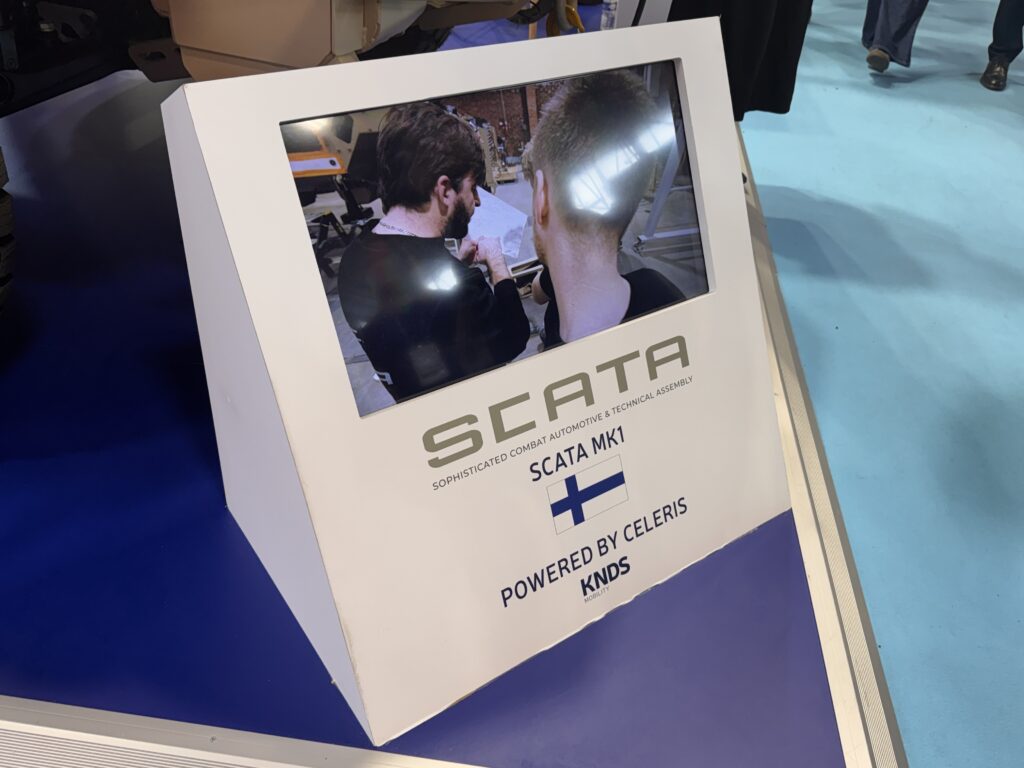
Scata is based in Pietarsaari, on Finland’s west coast. Scata designs, integrates and markets the vehicle. Parkano Defence contributes engineering and production capability from Parkano in western Finland. Scata’s prospects depend heavily on industrial capacity that sits outside the start-up itself.
Parkano Defence says its industrial network employs 197 people, including 68 welding specialists, 45 machining professionals and nine design engineers. It has about 29,000 square metres of production space and more than 50 machine tools. That gives Scata access to a deeper manufacturing base than its own headcount would suggest.
Scata says assembly will take place in Pietarsaari. Its model appears to combine local final assembly and body production with specialised manufacturing from Parkano and major imported subsystems.
Building an armoured vehicle factory from scratch would consume capital long before meaningful revenues arrived. Using an established industrial network keeps fixed costs lower and allows capacity to rise with orders.
It also creates dependencies. Quality control, production scheduling, intellectual-property ownership and responsibility for warranty failures must work across several companies. Such arrangements often look efficient at the prototype stage and become harder once customers demand dozens of identical vehicles on fixed delivery schedules.
KNDS is Building an Ecosystem Around Celeris
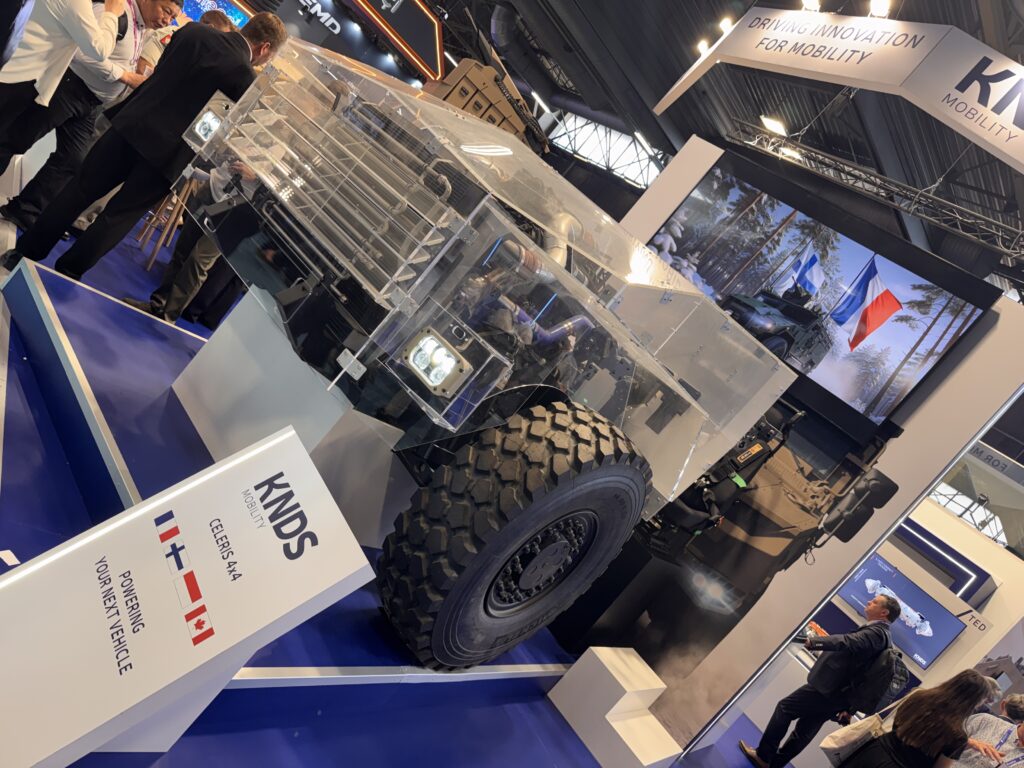
The MK1 rests on the Celeris mobility platform developed by KNDS Mobility, previously known as Texelis Defence. Celeris combines the chassis, axles, steering, suspension, braking, drivetrain and vehicle-control systems needed to create a military vehicle. Scata adds its own armoured body, internal architecture, mission systems and customer-specific equipment. Jane’s described the arrangement as a licensed KNDS chassis design combined with Scata’s own vehicle body design and production.
This removes the most dangerous technical risk facing a new vehicle company. Designing an armoured body is difficult. Developing a reliable military drivetrain, validating it across extreme temperatures and terrain, building a spare-parts system and sustaining it for decades is harder.
Celeris already underpins France’s Serval vehicle, part of the French Army’s SCORPION modernisation programme. KNDS says Celeris-based vehicles are also appearing through partners in Canada, Indonesia and Finland.
Scata says more than 400 vehicles using the mobility foundation are already in service. Its Cummins ISL9 engine and Allison 3200SP transmission are also widely used components rather than experimental systems.
This gives Scata a bankable argument: the complete MK1 lacks operational history, while its most important mechanical components have established service records.
However, armed forces assess the vehicle as a system. Proven axles and engines will not compensate for weaknesses in armour construction, weight distribution, cooling, electromagnetic compatibility, mine protection, software integration or maintainability.
KNDS gains more from the arrangement than sales of chassis kits. The company is turning Celeris into a common mobility architecture that other manufacturers can use to develop their own vehicles. KNDS Mobility told Shephard that it already had three Celeris partners and expected at least two more to join within a year. Each existing partner had received ten pre-series systems.
In this platform strategy, KNDS supplies the difficult, capital-intensive foundation. National partners design bodies, integrate equipment, secure local political support and pursue customers that might prefer a domestically assembled vehicle.
For KNDS, every Scata sale increases Celeris production volumes and spreads support costs across a larger fleet. It can enter markets without buying factories, employing large local sales teams or taking full responsibility for every vehicle programme.
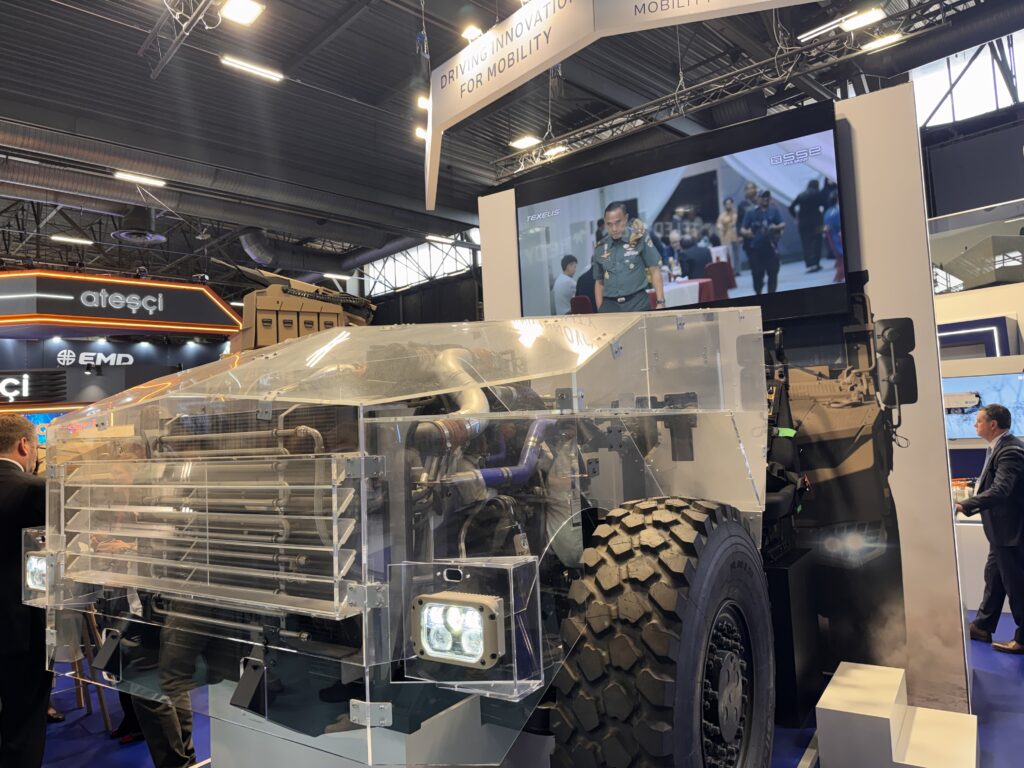
The model also helps KNDS answer sovereignty requirements. Governments increasingly demand local production, technology transfer and domestic maintenance when buying military vehicles. A French-branded complete vehicle can face political resistance. A Finnish vehicle built around French mobility technology can be presented as a national industrial product.
Scata’s marketing makes this point openly. It offers local content and manufacturing transfer to prospective customers, telling them that the programme can develop their sovereign industrial capability. That proposition is likely to matter far beyond Finland.
KNDS also gains access to Scata’s vehicle architecture and market feedback. A small company can adapt a body, cabin or mission module faster than a large prime contractor. KNDS can observe which configurations attract demand without financing every design itself. The risk for KNDS is limited. If Scata fails, Celeris remains available to other manufacturers. If Scata succeeds, KNDS becomes the indispensable drivetrain supplier beneath a new vehicle family.
The MK1 Occupies a Crowded Middle Ground
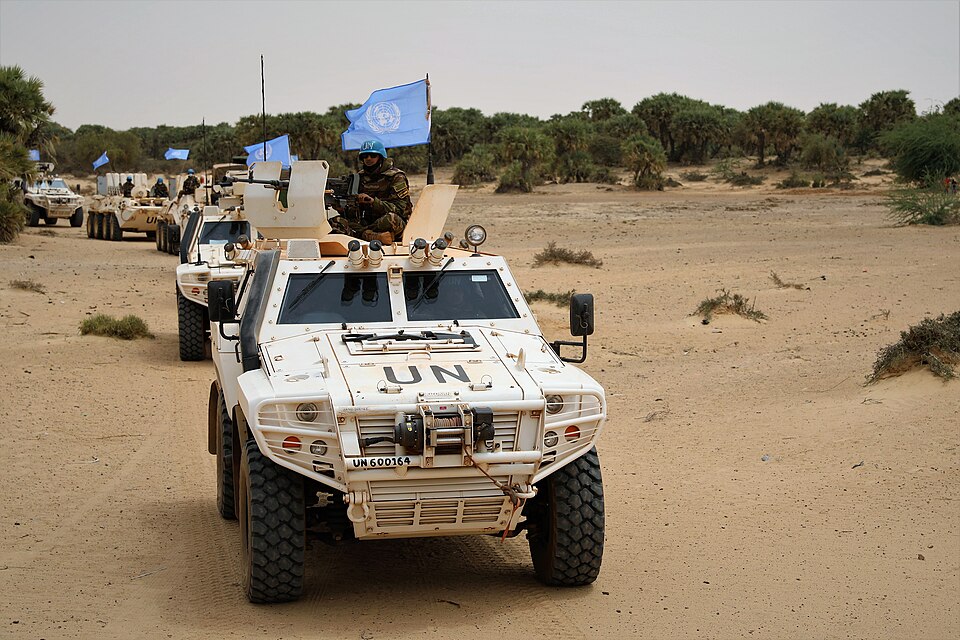
Scata describes the MK1 as filling the space between light tactical vehicles and heavier armoured personnel carriers. Its listed combat weight is 18 tonnes, with a 4.5-tonne payload, a 375-horsepower engine, a maximum road speed of 90 kilometres per hour and a standard range of around 700 kilometres. The company lists baseline ballistic protection at STANAG 4569 Level 2, with higher levels available depending on configuration.
The size gives it room for more payload and protection than many light patrol vehicles. It remains smaller and potentially cheaper than six-wheel and eight-wheel armoured personnel carriers.
That niche exists, but the market is far from empty.
Finland alone already has Sisu Auto’s GTP in roughly the same broad weight category and Patria’s highly successful 6×6 above it. European and international competitors offer dozens of protected 4×4 vehicles, including Arquus, Iveco Defence Vehicles, Otokar, Nurol Makina, Paramount, NIMR, Streit, INKAS, General Dynamics and Rheinmetall.
Many have operational references, established export networks and government backing.
The MK1’s weight also places pressure on its stated mobility advantage. At 18 tonnes and 375 horsepower, its power-to-weight ratio is about 20.8 horsepower per tonne. That is adequate for a protected vehicle, although it does not make the MK1 exceptionally powerful.
Its practical value will depend on suspension travel, tyre size, ground pressure, turning radius, cooling capacity, braking, cross-country behaviour and reliability under full payload. Those results require independent trials.
Scata’s strongest feature may be configurability rather than raw mobility.
The company is proposing four initial versions:
- MK1-ICS for infantry combat and tank support
- MK1-C2 for command and control
- MK1-CUAS for counter-drone and infrastructure protection
- MK1-LOG for protected logistics and combat support
A common base can reduce training, maintenance and spare-parts costs when a customer buys several variants. This principle has helped larger vehicle families succeed.
The commercial benefit emerges only at fleet scale. A customer buying ten highly customised vehicles gains little from theoretical commonality across variants it does not operate.
The Drone Claim Needs Closer Examination
Scata has promoted drone integration, remote operation and active protection as defining features. These terms cover a wide range of capability.
A vehicle carrying a small reconnaissance drone is useful, although no longer unusual. Armoured and tactical vehicles are increasingly being designed as drone carriers, counter-drone platforms and mobile sensor nodes. KNDS itself displayed broader drone and counter-drone concepts at Eurosatory2026, including protected vehicles with open interfaces for unmanned systems.
Native integration can still offer an advantage. The vehicle can provide charging, protected storage, data links, launch systems and displays as part of its original design. Retrofitted drones often create loose cables, extra screens, improvised storage and electromagnetic problems.
Scata has yet to publish enough detail to establish how deep the integration runs. It has not identified the drone, datalink, autonomy level, sensor payload or electronic-warfare resilience.
The company also uses the phrase “active protection system” in a way that risks confusion. In armoured vehicle terminology, active protection usually means sensors and countermeasures designed to detect and defeat incoming rockets or missiles. Vehicle-to-vehicle communication and shared situational awareness are different capabilities.
Until Scata names the system and explains what it does, buyers should treat the phrase cautiously. The same applies to remote operation. Remote driving can reduce risk during resupply, casualty evacuation or engineering tasks. It also creates challenges involving communications latency, electronic warfare, cyber security and loss of control when links fail.
These are solvable problems, but they require much more than installing cameras and a radio-control unit.
The Yellow Paint Points South
Scata displayed the MK1 in a sand-yellow finish rather than the forest green or camouflage colours commonly associated with European military equipment.
Paint is a marketing choice and fits a likely commercial direction. The colour gives the vehicle a visual identity and photographs well on an exhibition floor. Scata says the vehicle draws on lessons from Ukraine, Afghanistan and North Africa. It has mentioned oil, gas, mining and critical-infrastructure operators alongside military and police customers. These references align closely with Middle Eastern and North African requirements.
The company has said enquiries came from several countries, including states outside NATO. It has declined to identify them or confirm firm orders.
The Gulf is an obvious target. Saudi Arabia, the United Arab Emirates, Qatar and other regional states spend heavily on armoured vehicles, border security, special forces, infrastructure protection and counter-drone systems.
An International Institute for Strategic Studies assessment found that armoured vehicles were leading the Gulf’s expanding domestic defence-production effort. Regional governments have been adding local manufacturing capacity and seeking technology transfer rather than relying solely on imported finished vehicles.
European Security & Defence reported continued Gulf demand for main battle tanks, 6×6 and 8×8 vehicles and protected patrol vehicles. It also noted the gradual growth of domestic producers.
This creates an opportunity for Scata’s partnership model. It can offer an established European drivetrain, a configurable Finnish design and local assembly in the customer country.
It also creates a formidable obstacle. The UAE already has NIMR, a state-backed manufacturer with a broad family of 4×4 and 6×6 vehicles. Saudi Arabia is pushing localisation through its national industrial strategy. Turkey, South Africa and the UAE supply proven vehicles tailored to hot climates and regional conditions.
A new Finnish entrant will need a strong local partner, a government sponsor or a sharply priced niche configuration. Yellow paint will not open the market, but its technology transfer might.
Possible Gulf Investors
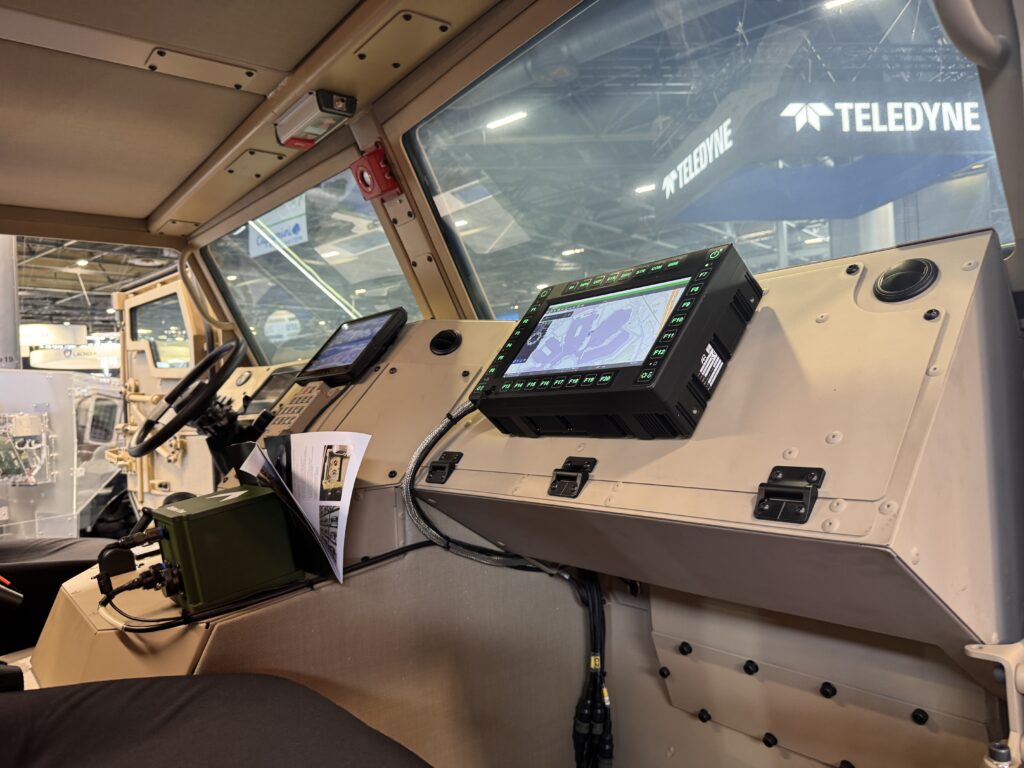
Scata has not publicly identified its investors or disclosed how much capital it has raised. Finnish company records show Scata-related corporate structures and company officers, while publicly available financial information remains sparse. SCATA Holding Ab is active, although published databases contain no meaningful financial accounts for assessing its capital base.
This lack of disclosure is normal for a young privately owned defence company. It also prevents any reliable assessment of whether Scata has enough money to industrialise the MK1.
Developing a prototype and showing it at Eurosatory is expensive. Serial production, warranty reserves, spare parts, testing, certifications, sales campaigns and working capital require far more.
A military vehicle company can spend years financing inventory before receiving the final customer payment. A single delayed government contract can strain a small balance sheet.
The Gulf could supply both customers and capital. Sovereign funds, family offices and defence groups in the region have shown an appetite for industrial partnerships that bring technology and manufacturing into their countries.
Scata’s offer is well suited to such an investor. A Gulf partner could finance production, secure political access and establish local assembly. Scata could provide the design and European supplier chain. KNDS could supply mobility kits.
There is currently no public evidence that such an investment has been made.
Defence Investors are Chasing Growth
European defence technology attracted record investment in 2025. Funding for defence, security and resilience companies reached an estimated €8 billion, up sharply from the previous year. Much of the capital went to software, surveillance, space and autonomous systems rather than heavy manufacturing.
Finnish defence and dual-use companies reportedly captured a large share of Nordic investment in 2025, helped by NATO membership, Ukraine and Finland’s engineering base.
Armoured vehicles are a harder venture-capital proposition than drones or software. They require factories, inventory, testing and long procurement cycles. Growth comes in large, irregular contracts rather than recurring software revenues. Export licences and political decisions can stop a sale after years of work.
The potential returns can still be substantial. A single order for several hundred vehicles can transform a company. Support, upgrades and spare parts can generate revenue for decades.
Scata’s likely financing route would combine founder capital, industrial investors, customer prepayments, government-backed development funding and eventually a strategic equity partner. KNDS itself would be an obvious potential investor or acquirer if the vehicle gained traction. There is no evidence that it intends to take equity. Its current platform-supply model gives it many of the commercial benefits without the risk of owning the start-up.
The Manufacturing Challenge Begins
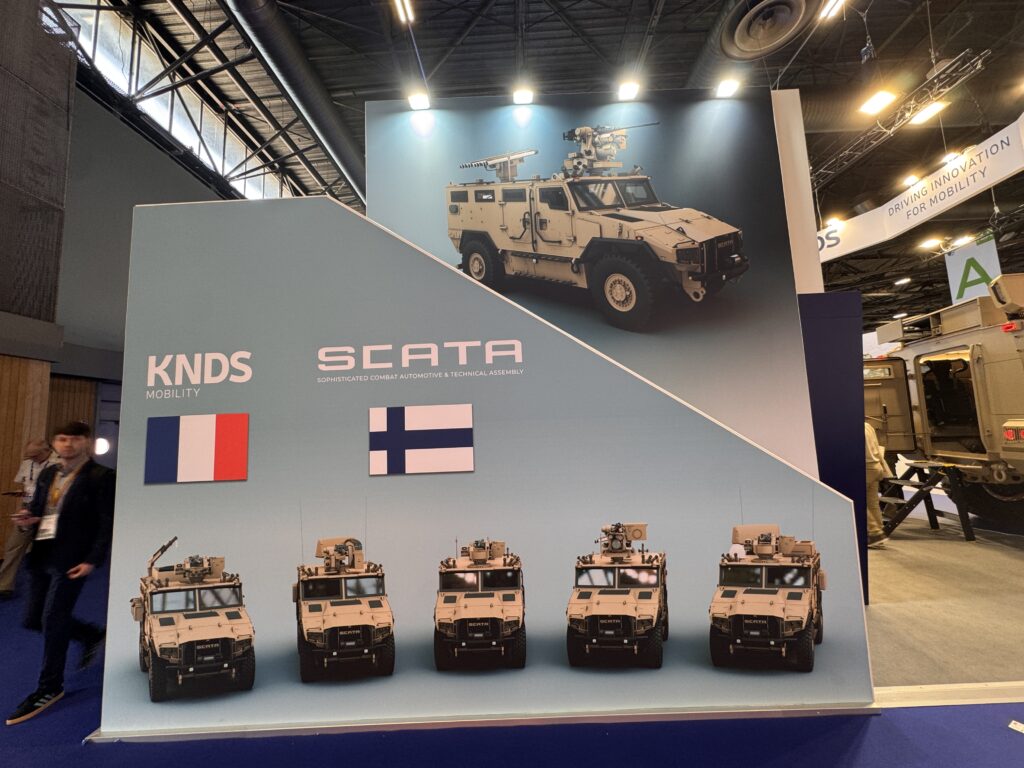
Scata’s rapid development timetable is impressive. Moving from concept to an exhibition-ready vehicle in roughly 18 months demonstrates organisational speed. Serial production demands another level of discipline.
EDR Magazine reported an early estimate suggesting capacity could begin at around 60 vehicles a year and rise later. Even that initial rate would require a meaningful order backlog.
A credible commercial breakthrough would include at least one of the following:
- a named launch customer
- a paid prototype or evaluation contract
- an official government trial
- a production framework agreement
- disclosed financing for serial manufacture
- a local assembly agreement in an export market
Until then, the MK1 remains available to order rather than demonstrably ordered. Modular armoured vehicles are common. Cummins engines and Allison transmissions are widely available. Central tyre-inflation systems, run-flat inserts, remote-control options and configurable armour are standard offerings in the sector.
Scata’s claim of a 30 per cent lifecycle saving over a mixed fleet is commercially important and currently unsupported by published methodology. The same applies to its “30-year open architecture upgrade path”. Both should be considered marketing claims until a customer or independent authority validates them.
Customers will require repeatable armour quality, certified welding, traceability of materials, configuration control, blast testing, ballistic testing, environmental testing, electromagnetic compatibility and documentation in several languages.
They will also ask who repairs the vehicle in year ten, who stocks spare parts in theatre and who pays when a supplier stops making a component. The company’s distributed model could support annual production in the dozens relatively quickly. Production in the hundreds would require major working capital, tighter supplier contracts, expanded testing facilities and a larger service organisation.
Read More:
- SCATA: SCATA MK1
- SCATA: A New Generation of Modular Mission Platforms Developed Through Strategic Partnership and Nordic Innovation
- Jane’s: Eurosatory 2026: Finnish startup SCATA declares Mk1 4×4 vehicle ready to order
- National Defense Magazine: Finnish, French Partnership Debuts Multi-Role Tactical Vehicle
- Shephard Media: Eurosatory 2026: KNDS Mobility outlines Celeris progress and work with Milrem Robotics
- Defence Redefined: Eurosatory 2026: KNDS Mobility showcases CELERIS 4×4 and launches Finland’s SCATA MK1
- Eurosatory: Eurosatory 2026: New and improved vehicles and counter-drone technology foreshadowed
- European Defence Review: SCATA, a new Finnish player in the armoured vehicles field, presents its SCATA Mk1
- European Security & Defence: Finland Offers New 4×4 Armour Option
- European Security & Defence: Desert tracks: The Gulf AFV market
- International Institute for Strategic Studies: Tracking Gulf defence production: armoured vehicles lead the way
- Parkano Defence: Behind the success
- KNDS: Eurosatory 2026
- KNDS: KNDS showcases complete set of C-UAV solutions at Eurosatory 2026
- Yle: Pietarsaarelainen startup rakensi pikavauhtia sotilasajoneuvon, jonka myynti alkoi tänään – tällainen se on (in Finnish)
- Yle: Svenska Yle: Pietarsaarelainen panssariauto haluaa haastaa puolustusteollisuuden jätit – asiantuntijat eivät tyrmää
- Iltalehti: 13–18 tonnia painava panssariauto valmistui Suomessa – Nämä ominaisuudet hätkähdyttävät
- Kauppalehti: SCATA Holding Ab – yritys- ja taloustiedot (in Finnish)
- Finnish Centre for Artificial Intelligence and Digital Innovation: Finnish startups raise record €1.5bn as defence technology attracts investors
- EU Perspectives: Defence startups draw €8bn to Europe’s hottest tech sector