
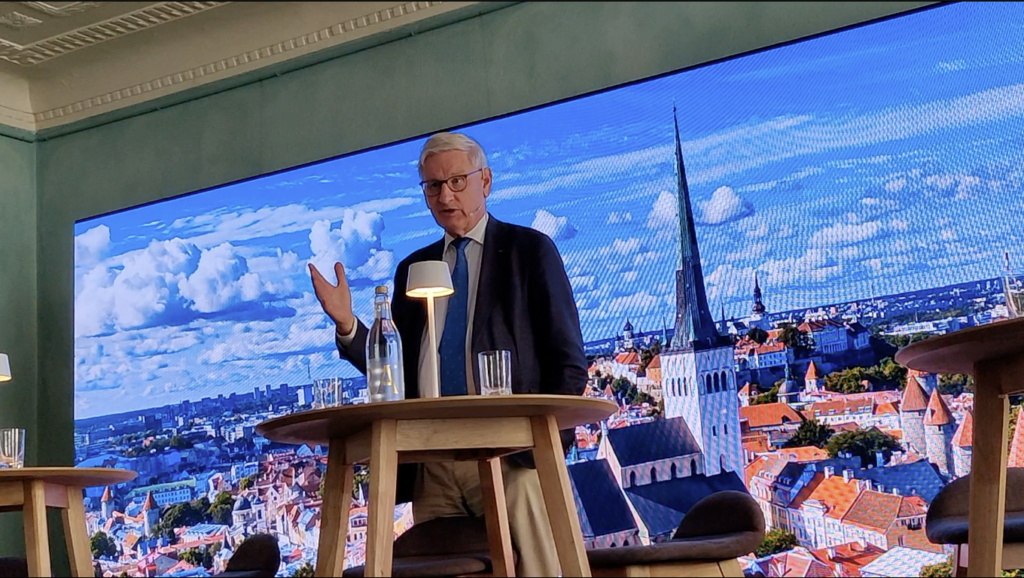
Former Swedish prime minister Carl Bildt has warned that Russia is using against Armenia “exactly the same” pressure tactics it employed against Ukraine before the 2014 conflict, as Moscow seeks to prevent another former Soviet republic from moving closer to the European Union.
TALLINN — Russian President Vladimir Putin is repeating against Armenia the threats and arguments Moscow used against Ukraine in 2013, former Swedish prime minister and foreign minister Carl Bildt told a security and defence audience at the Swedish Embassy in Tallinn in early June, 2026.
Bildt said the pressure being exerted on Armenia ahead of its parliamentary election should be viewed as part of Russia’s broader ambition to preserve or reconstruct elements of its former empire.
“I can see that he has taken the speaking points of 2013 that were then directed at threatening Ukraine if it moved closer to the EU,” Bildt said. “He is taking exactly the same speaking points and using them now against Armenia.”
The comparison was the sharpest new political warning in Bildt’s opening address, which otherwise concentrated on Ukraine, NATO’s changing northern flank and Europe’s need for a stronger regional defence industry.
Russia had already increased economic and political pressure on Armenia before its 7 June 2026 parliamentary election. Moscow threatened consequences if Yerevan continued pursuing closer integration with the EU, imposed restrictions on Armenian exports and warned that Armenia could face what Putin termed a “Ukrainian scenario”.
Reuters also reported allegations by Western intelligence and government officials that Russia had supported covert efforts to impede Prime Minister Nikol Pashinyan’s re-election and Armenia’s westward realignment.
Bildt said developments in the South Caucasus should not be treated as separate from northern European security.
“The way he succeeds or fails in the southern Caucasus does influence his way of behaving in Ukraine, and that does influence us as well,” he said.
No Immediate Attack Expected
Despite the warning, Bildt said he did not believe Russia posed an immediate conventional military threat to the Nordic or Baltic states.
“I don’t think our countries face any immediate threat of any aggression,” he said.
Russia remained heavily committed in Ukraine, where Bildt described its military campaign as a “strategic debacle of the first order”. He contrasted the limited territorial gains made by Russia since its full-scale invasion with the speed of the Soviet advance from Moscow to Berlin during the Second World War.
The former Swedish leader nevertheless warned against interpreting Russia’s difficulties in Ukraine as a guarantee of long-term security.
Russia remained “unpredictable” and “volatile”, he said, while the eventual political direction of the country could have consequences for Europe for decades.
Bildt identified the Kola Peninsula, St Petersburg, the Baltic Sea and Kaliningrad as Russia’s principal strategic interests in northern Europe.
The Kola Peninsula is central to Russia’s nuclear deterrent because it hosts much of the Northern Fleet and its ballistic-missile submarine infrastructure. St Petersburg remains one of Russia’s most important economic, industrial and military centres, while Baltic access has become increasingly valuable as Russia’s freedom of action through other maritime routes has narrowed.
Ukraine Remains Europe’s First Line of Defence
Bildt argued that the outcome of Russia’s war would determine far more than the future of Ukraine.
“The outcome of that particular war will obviously decide the future of Ukraine,” he said. “It will decide the future of European security, and it will also decide the future of Russia.”
Europe’s first security priority must therefore remain military and political support for Kyiv.
“The defence of Ukraine is the defence of Europe,” Bildt said.
He argued that preventing Russia from achieving its objectives in Ukraine was also the most effective available means of influencing Russia’s future behaviour.
“It is by demonstrating to the Kremlin that they can’t do what they want to do that we can defend Ukraine but could also initiate change that might be important for the future.”
His conclusion was more cautious than an expectation of imminent peace. Bildt said a genuine political settlement remained distant and suggested that even a ceasefire could still be some way away.
Northern Europe Must Prepare for Less America
Bildt placed the changing regional security environment within a wider shift away from uncontested American global dominance.
“The age of American dominance is over,” he said, pointing to the rise of China, other regional powers, technological disruption and the transformation of global energy systems.
For Europe, the immediate consequence was that reliance on the United States had become less secure.
The change was especially significant for Norway and the Baltic countries, which have traditionally depended heavily on American military power and reinforcement plans. Sweden and Finland, Bildt argued, were somewhat more accustomed to organising national defence with greater autonomy, although NATO membership had fundamentally altered their strategic geography.
Sweden could no longer think about defence solely in terms of protecting its own beaches, rivers and archipelagos.
“The defence of Sweden is to a large extent outside Sweden when it comes to meeting the threat,” Bildt said.
He described a northern European operational area extending from the Ukrainian and Polish regions in the south to Svalbard in the north, and from areas close to Russia in the east to Nuuk in Greenland in the west.
Forces operating across that space would need shared situational awareness, compatible command arrangements and the ability to deploy jointly.
Bildt said Nordic and Baltic countries must go further in integrating their military structures, whether through NATO, the UK-led Joint Expeditionary Force (JEF) or bilateral and regional arrangements.
Bildt Backs the 3.5 per cent Target
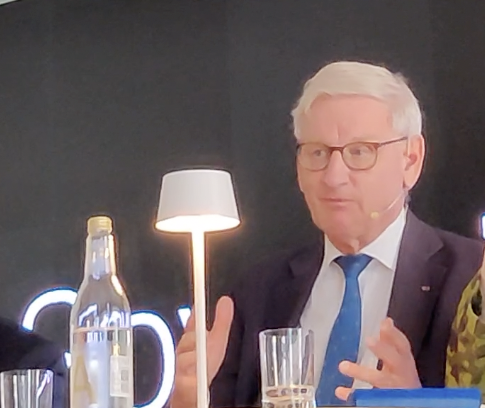
Bildt predicted that Northern Europe would largely meet NATO’s commitment to spend at least 3.5 per cent of gross domestic product on core defence by 2035.
“All of the Nordic countries, the Baltic countries, Poland and Germany will be 3.5 or above that,” he said.
He was more sceptical about NATO’s additional 1.5 per cent category for wider security-related investment, describing that element of the alliance’s five per cent commitment as “somewhat more fluffy”.
NATO agreed at its 2025 Hague summit that members should allocate at least 3.5 per cent of GDP to core military requirements and up to 1.5 per cent to areas such as resilience, infrastructure, networks and civil preparedness.
Bildt said the expected growth in northern European military spending would significantly change the regional balance, even if some southern European countries failed to reach the same level.
The money would have to produce equipment, trained personnel, functioning forces and improved intelligence and surveillance rather than simply meet an accounting target.
The Industrial Base Must be Agile and Nearby
For the defence industry, Bildt’s most consequential message concerned the location and structure of production.
The war in Ukraine had demonstrated that equipment and technology could change far more rapidly than traditional procurement systems anticipated. Armed forces could no longer purchase a platform and assume it would remain essentially unchanged for 25 years.
Drones, electronic warfare and space-based capabilities were developing particularly quickly.
Bildt argued that Europe therefore needed an industrial base capable of continuously modifying systems in close cooperation with military users.
“Agility—and I would say nearby,” he said. “When you are nearby, then you can interact between the forces and the industry and the technological development people far more easily.”
Dependence on distant manufacturers and long supply lines created risks, particularly when suppliers might have competing political or military priorities.
“It makes it very imperative that we in Northern Europe develop the defence industrial base better than we have done so far,” Bildt said.
The statement amounts to an argument for expanding Nordic and Baltic production capacity, shortening supply chains and creating closer links between armed forces, technology companies and manufacturers.
It also suggests that governments should judge procurement programmes partly by whether they preserve the capacity to update, repair and manufacture systems within the region.
A Speech with Two Warnings
Bildt’s address contained two connected warnings. The first was political. Russia’s pressure on Armenia showed that Moscow continued to treat its neighbours’ European ambitions as a strategic threat. The confrontation that began around Ukraine’s rejected EU agreement in 2013 was therefore not a historical episode. It remained a model Russia could use elsewhere.
The second was industrial. Europe’s ability to deter such behaviour increasingly depended on its capacity to defend itself with less automatic American support and with technology that changes faster than conventional procurement cycles.
Bildt did not predict an imminent Russian attack on NATO territory. His argument was that preparedness, industrial capacity and deeper northern European integration were the best means of ensuring that such an attack never became an attractive option.
“The more we do to build defence, to build deterrence and to build integration,” he said, “the less there are the risks and the possibility that we will have to use them.”
Bildt: No Sign of Ukraine War Fatigue in Northern Europe
Support for Ukraine remains unexpectedly resilient across Northern Europe, despite the war entering its fifth year, former Swedish prime minister Carl Bildt told Nordic Defence Review in a one-on-one interview following the Tallinn panel.
Asked whether political leaders were beginning to encounter war fatigue among voters, Bildt said there was little evidence of it in Northern Europe.
“Not in the Nordic countries,” he said. “If you go to Italy or Spain, it could be different. But in the Nordic countries, not yet. Even Germany and Poland are basically on board.”
Bildt acknowledged that the durability of European support had exceeded his own expectations.
“When the war started more than four years ago, had I believed that support for Ukraine was going to remain strong four years into the future, I was uncertain of that,” he said. “But it works. It seems to work.”
His assessment suggests that the political foundations of northern European assistance to Ukraine remain firmer than often assumed. However, he also drew a distinction between Northern Europe and countries further from Russia, where the war may appear less immediate and domestic economic concerns can weigh more heavily.
Stray Drones Should Not Be Treated as Deliberate Attacks
Bildt also urged that governments in the Eastern border of NATO to respond calmly and honestly when drones connected to the war in Ukraine enter their airspace.
The issue has caused political concern in Finland, the Baltics and Poland, particularly when governments face pressure to demonstrate that national borders and airspace remain secure.
Bildt said politicians should explain clearly that such incidents did not necessarily represent intentional attacks.
“These are drones that have gone astray,” he said. “They could have been diverted by the Russians, or they might have been diverted because of failure. Things go wrong.”
“We should not be too agitated, because they are clearly not a deliberate threat against our countries. They are more accidents of war.”
The comments reinforce Bildt’s earlier distinction between an immediate Russian military threat to NATO territory and the wider risks created by a prolonged war close to the Alliance’s borders.
His position does not remove the need for better air surveillance and counter-drone systems.
Procurement Can Move Quickly – When Governments Decide it Must
Asked how European governments could accelerate defence procurement, Bildt said there was no single technical solution. The central requirement was political willingness to simplify procedures and accept more equipment directly from existing production lines.
“You speed it up,” he said. “I’m not an expert in exactly how you do it, but there are different measures.”
Bildt cited Sweden’s recent decision to procure four new frigates. Instead of beginning a lengthy process to design a uniquely Swedish vessel, the government had moved towards purchasing an existing foreign design with comparatively limited national modifications.
“We decided essentially to buy off the shelf,” he said. “There will be an element of Swedish adaptation, needless to say, but far less than there would have been some years ago.”
He recalled a similar decision during Sweden’s deployment in Afghanistan, when the armed forces urgently required helicopters.
The Swedish Defence Materiel Administration initially began its customary procurement and evaluation procedures. The government instead ordered aircraft already used by the United States Army.
“The government said: no, we buy off the shelf, whatever the US Army has,” Bildt said. “You can speed up if you want.”
His remarks point to one of the central tensions in European defence acquisition. Governments frequently call for faster procurement while continuing to demand national modifications, lengthy competitions and extensive administrative safeguards. Buying established systems can reduce delivery times, but it may also limit domestic industrial participation and national control over technology.
Industry Needs Confidence that Orders will Continue
Bildt agreed that defence companies could not be expected to expand production without credible and sustained demand. Factories, skilled workers and supply chains require investment years before the finished equipment is delivered. Yet governments often remain reluctant to place long-term orders because they fear that demand may fall if the war in Ukraine ends.
Bildt said Europe nevertheless had substantial requirements even if the war were to conclude.
Asked whether factories might continue producing missiles, drones and other equipment for years after a ceasefire—just as military production continued after the Second World War—he replied that Europe would still have “lots and lots” of demand.
Europe’s stockpiles are depleted, armed forces are expanding, and new technologies are changing rapidly. An end to active fighting in Ukraine would therefore not immediately remove the need for higher production.
The more difficult question is whether governments will provide industry with sufficiently clear and long-term orders to justify investing in additional capacity before the next crisis emerges.
Read More:
- Baltic Defence Weekly / Supply, Security & Defence Expo — “Baltic Defence Weekly – No. 85 (1–7 June 2026): SSD 2026 Set to Open in Tallinn, NORDSEC Builds Nordic-Baltic Defence Industrial Area, and Carl Bildt Says No Direct Russian Threat
- Reuters: Russia’s covert efforts to stop Armenia’s pivot West
- Reuters: Russia ups the pressure on Armenia ahead of Sunday’s election
- The Guardian (Pjotr Sauer): Armenia heads to polls amid Russian pressure and threat of ‘Ukrainian scenario’
- The Guardian (Pjotr Sauer): It’s time to move forward’: Armenians vote in election closely watched by Russia and EU
- European Policy Centre (Richard Giragosian): Armenia votes West, but cannot quit Russia
- Swedish Centre for Eastern European Studies: No Going Back Now? Armenia–EU Relations After the 2026 Parliamentary Elections
- International Centre for Defence and Security : Armenia After the Election: Diversification Without Decoupling from Russia
- NATO: The Hague Summit Declaration
- NATO: Defence Investment and NATO’s 5% Commitment
- The Barents Observer: Fears Grow That Russia Will Deploy More Nukes in the Arctic as New START Treaty Expires
- Center for Strategic and International Studies (Heather A. Conley and Matthew Melino ): The Ice Curtain: Modernization on the Kola Peninsula