
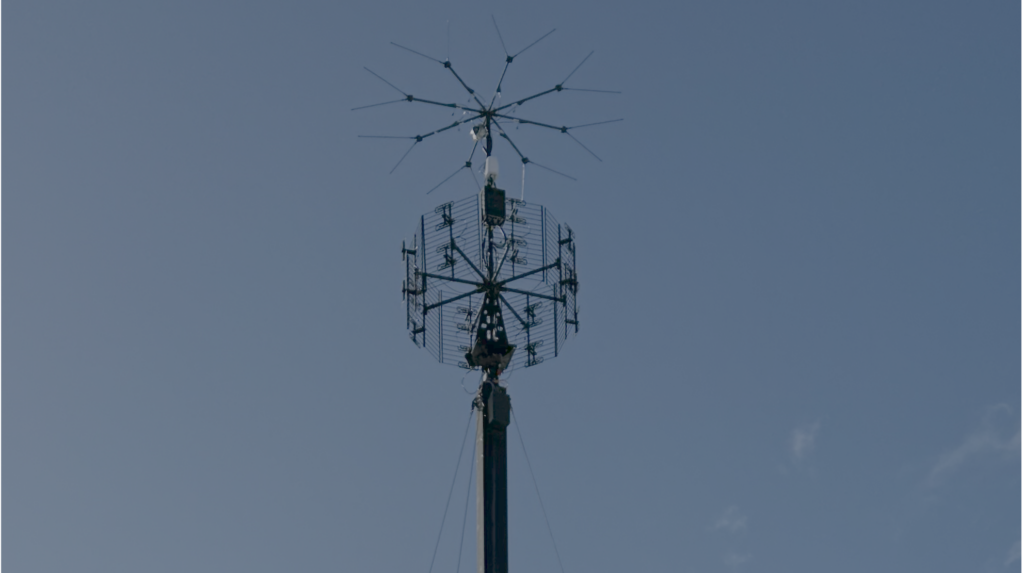
Combining mobile networks with radar and other sensors for drone detection could become a major Nordic export success in dual-use technology. Yet EU and national bureaucracy could hinder its development. With more than nine billion mobile subscriptions worldwide, the commercial potential is vast, as are the risks of misuse by authoritarian regimes.
Integrated Sensing and Communication (ISAC) is a major technological shift, enabling the same radio-frequency hardware and spectrum to transmit data and detect objects in the surrounding environment, much like radar. By deploying ISAC across commercial and critical communications networks, Nordic countries, especially Finland has an opportunity to develop commercially viable, dual-use 5G infrastructure that can evolve towards 6G while transforming low-altitude drone surveillance.
The Future of Dual-Use Infrastructure: Monetising and Securing Airspace with ISAC and PCL
Integrated Sensing and Communication (ISAC) represents a major technological shift, enabling the same radio-frequency hardware and spectrum to transmit data and detect objects in the surrounding environment, much like radar. By deploying ISAC across commercial and critical communications networks, Finland has an opportunity to develop commercially viable, dual-use 5G infrastructure that can evolve towards 6G while transforming low-altitude drone surveillance.
The 5G Business Case: Airspace Monitoring as a Service
Hardware and software upgrades from telecommunications companies such as Ericsson, combined with the secure infrastructure operated by Finland’s critical communications provider Erillisverkot, could create new revenue streams.
Mobile network operators (MNOs) could offer Sensing-as-a-Service (SaaS) to businesses, critical infrastructure operators and logistics companies. Rather than investing in expensive, dedicated radar networks to track assets or monitor restricted areas, customers could subscribe to localised sensing services using existing mobile network infrastructure.
Integrating these commercial services with Erillisverkot’s secure network infrastructure could create a hybrid business model, with commercial revenue helping to offset the cost of building and maintaining a highly resilient network that authorities could also rely on during crises.
In certain circumstances, information gathered by the system could also be used to issue emergency alerts to mobile subscribers within an affected area.
With appropriate authorisation, subscribers could also contribute to a distributed observation network, providing reports and immediate alerts to complement the situational picture generated by combining data from multiple sensors.
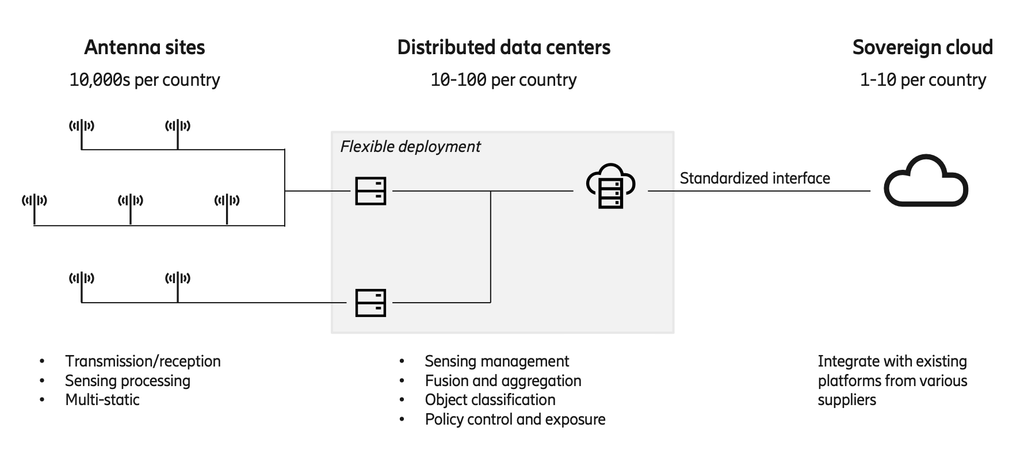
| Commercial ISAC Services |
| Drone Delivery Corridors | Safe routing & geo-fencing |
| Critical Infrastructure | Intruders & object tracking |
| Smart City Logistics | Traffic & crowd management |
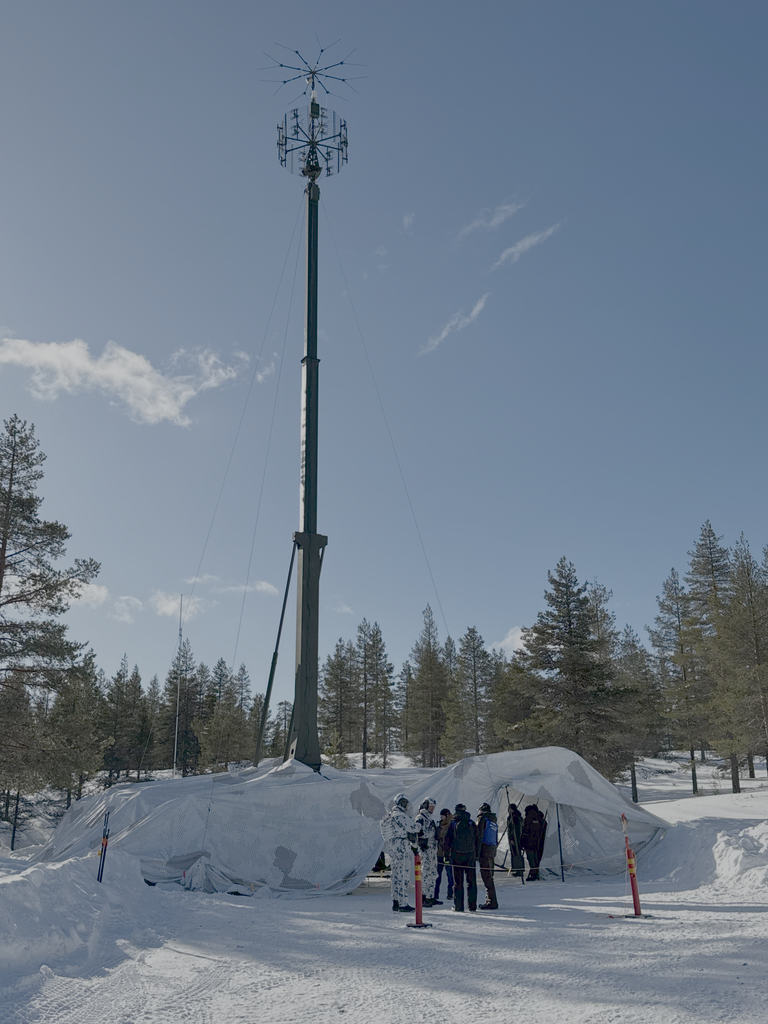
In late September 2026, the Finnish Federation for Communications and Teleinformatics (FiCom) held a ISAC field demonstration at the Port of Vuosaari in Helsinki. FiCom is also known as the Finnish ICT Association, the trade and advocacy organisation representing Finland’s digital and ICT industries.
But what would be the main benefits of deploying this technology? “The greatest benefit would be the ability to put existing mobile network infrastructure to a new use: improving situational awareness and security,” Elina Ussa, Managing Director of FiCom answered at the event. “Network-based sensing could complement other technologies, helping to provide a more comprehensive, real-time picture of low-altitude airspace.”

According to Ms Ussa, there is also a significant economic opportunity. “Finland has extensive mobile networks, advanced technological expertise and a well-established tradition of cooperation between businesses and public authorities,” she said. “Developing these capabilities could strengthen national security while improving Finland’s position in the emerging international market for sensing technologies and 6G solutions.”
But significant obstacles remain before the system can become operational. “The technology is advancing rapidly,” Ussa reminded. “The priority now is to ensure that the regulatory framework keeps pace, so that deployment is not held up by unresolved legal questions or unnecessary regulatory barriers once the technology is ready,” she said.
“We need clear rules on what information mobile network operators may process for sensing purposes, under what circumstances that information may be used, and how relevant data can be shared with the competent authorities. These questions must be addressed while the technology is being developed, rather than afterwards,” she said.
According to Ussa, regulation and technological development should proceed in parallel. By the time the technology is ready for deployment, the legal framework should also be in place. “This would allow Finland to move from development to operational use without unnecessary delays, while fully safeguarding privacy, the confidentiality of communications and other fundamental rights,” Ussa emphasised.
Multi-Sensor Drone Detection: Combining ISAC with Sensor Fusion
Creating a comprehensive air defence and surveillance picture requires integrating ISAC with other detection technologies. One promising approach is to combine 5G/6G-based ISAC with Passive Coherent Location (PCL) radar systems, such as Finland’s Patria MUSCL.
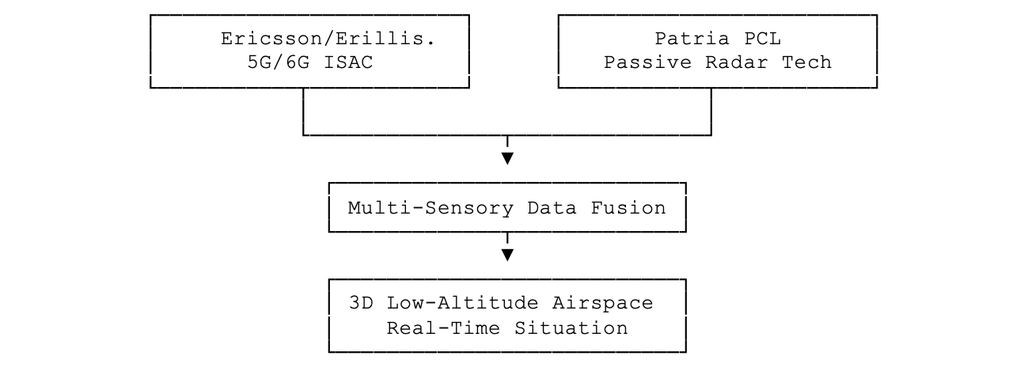
- 1. Active Sensing (ISAC): Ericsson’s 5G base stations can use mobile network signals to detect and track objects through their radio reflections, potentially extending surveillance coverage across urban areas, transport corridors and critical infrastructure sites. The technology could turn existing telecommunications infrastructure into a distributed sensing network, reducing the need for dedicated surveillance installations.
- 2. Passive Radar (Patria MUSCL): Patria’s MUSCL system uses Passive Coherent Location (PCL) technology to detect airborne targets by analysing reflections from existing FM radio and digital television transmissions. As it has no transmitter of its own, the system leaves no active radar signature, making it particularly valuable for covert surveillance and operations in contested electromagnetic environments.
- 3. Multi-Sensor Data Fusion: Combining ISAC and PCL could provide a significantly more comprehensive picture of low-altitude airspace. ISAC could offer localised, high-resolution sensing, while passive radar systems such as Patria’s MUSCL provide wider-area surveillance without additional transmissions.
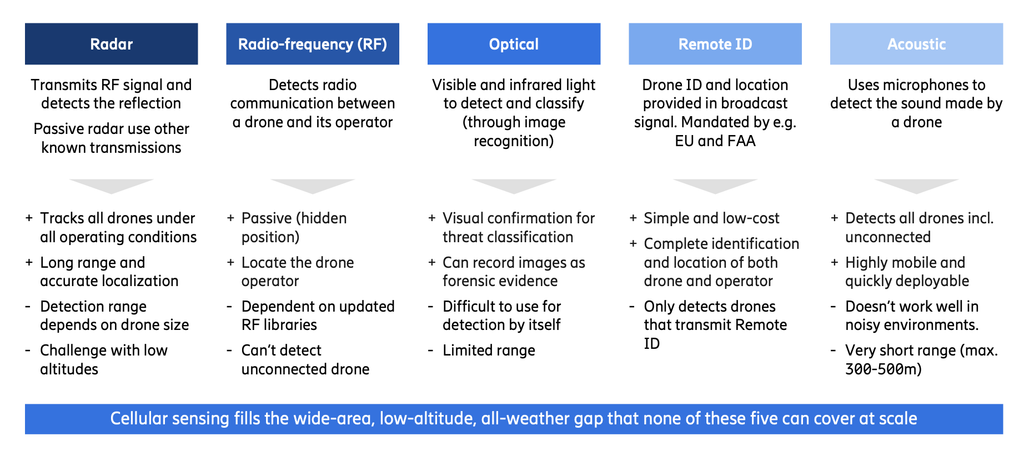
Integrating these technologies with conventional radar, acoustic detectors, electro-optical cameras and infrared sensors would further improve detection, tracking and target classification.
Such a network could be particularly effective against dark drones, unmanned aircraft operating without transponders or detectable radio-control transmissions. These aircraft can evade monitoring systems that depend on identifying their electronic emissions.
The complementary characteristics of ISAC and PCL could also make the combined network more resilient to electronic warfare.
ISAC uses the same frequency bands and, potentially, the same transmissions as ordinary mobile communications. This can make sensing activity less conspicuous to an adversary monitoring the electromagnetic spectrum. Patria’s MUSCL, meanwhile, operates entirely as a receiver, exploiting radio signals already present in the environment.
These characteristics can make the systems harder to locate and target than conventional active radar installations. However, ISAC remains dependent on transmitted radio signals, while passive radar relies on external transmitters. Both technologies remain vulnerable to interference, jamming and other countermeasures.
Their combined value lies in the diversity of detection methods and the ability to maintain surveillance even when individual sensors are degraded or disrupted.
The 6G Evolution: What Will Change?

Current 5G-based ISAC systems are at an early stage of development, relying on experimental implementations and adaptations to existing network infrastructure. Even so, they are already demonstrating the potential of advanced antenna arrays, multiple-input multiple-output (MIMO) processing and local computing to detect and track objects.
The arrival of 6G could bring sensing capabilities into the architecture of mobile networks from the outset, allowing communications, environmental monitoring and artificial intelligence to operate as integrated network functions.
These three developments could prove particularly revelant.
- 1. Higher Resolution and More Accurate Identification
The use of wider bandwidths and higher radio frequencies, potentially extending into the sub-terahertz range, could significantly improve spatial resolution.
Under suitable conditions, centimetre-level resolution may become possible, allowing networks to distinguish smaller objects and potentially identify characteristic features of drones, including their dimensions and movement patterns.
More sophisticated analysis of reflected signals could also help distinguish between different types of aircraft or detect characteristics associated with rotating propellers.
However, determining a drone’s exact payload or reliably identifying its type from radio reflections alone would remain technically challenging and dependent on the available bandwidth, signal quality, sensor geometry and classification algorithms. - 2. Denser Networks and Collaborative Sensing
Future 6G networks are expected to support more sophisticated coordination between base stations and other sensing devices.
Multiple network nodes could observe the same target from different angles, combining their measurements to improve tracking accuracy and reduce blind spots caused by buildings, terrain and other obstacles.
This could be particularly valuable in urban environments, ports, airports and critical infrastructure sites, where conventional radar coverage is often restricted by physical obstructions. - 3. Edge Computing and AI-Assisted Classification
More advanced edge computing would allow sensing data to be processed closer to where it is collected, reducing the time needed to identify and assess potential threats.
Machine-learning systems could combine radio reflections with information from acoustic, optical and conventional radar sensors to distinguish drones from birds, aircraft and other moving objects.
The objective would be faster and more reliable threat identification, with fewer false alarms and less dependence on centralised processing facilities.
Together, these developments could transform telecommunications networks into a distributed sensing infrastructure capable of supporting both commercial applications and national security.
Regulatory Obstacles: EU and National Legal Barriers
The technological development of ISAC is advancing faster than the regulatory frameworks governing its potential applications.
European and the Finnish national legislation already regulates telecommunications, data protection, surveillance and national security, but the convergence of communications networks and environmental sensing raises new questions about how these rules should apply.
These areas require particular attention:
- 1. EU Data Protection and the Confidentiality of Communications
ISAC relies on analysing radio signals and their reflections to detect objects and movements within the surrounding environment.
Depending on how the technology is deployed, the resulting information could reveal the presence, location or movements of individuals, vehicles or other identifiable objects.
Such data may fall within the scope of the EU General Data Protection Regulation (GDPR) when it relates to identifiable individuals. Communications confidentiality rules may also apply where sensing involves protected communications data.
The regulatory challenge is to establish clear distinctions between environmental sensing, the processing of communications-related information and the collection of personal data.
Systems designed to detect drones and other airborne objects should minimise the collection of information about individuals. Where personal data is involved, processing must have an appropriate legal basis and comply with applicable safeguards. - 2. The EU AI Act
The EU AI Act introduces additional requirements for certain artificial intelligence systems, particularly those used in sensitive areas such as critical infrastructure, law enforcement and biometric identification.
AI-assisted drone detection does not automatically fall into the Act’s prohibited or high-risk categories. Its classification depends on the system’s intended purpose, operating environment and specific functions.
However, applications involving critical infrastructure safety, law enforcement or the identification and tracking of individuals could trigger additional regulatory obligations.
Nordic countries like Finland should clarify how these requirements apply to ISAC-based airspace monitoring, particularly when commercial network infrastructure is used to support public authorities. - 3. Dual-Use Technology and Export Controls
Combining commercial telecommunications infrastructure with military-grade surveillance capabilities raises questions about dual-use technology, information security and export controls.
Systems integrating civilian mobile networks with defence-related sensors, including e.g. Patria’s PCL technology, may involve equipment, software or technical information subject to specific licensing requirements.
The applicable restrictions depend on the technology, its classification, intended use and export destination.
EU countries will need their national regulatory frameworks that enables commercial telecommunications operators and security authorities to cooperate while maintaining appropriate safeguards for sensitive information and controlled technologies.
National Legislative Priorities
The Nordic countries, especially Finland has an opportunity to become an early adopter of ISAC-based security systems. Achieving this will require the legal framework to develop alongside the technology.
These legislative areas deserve particular scrutiny.
- 1. Act on Electronic Communications Services (Laki sähköisen viestinnän palveluista, 917/2014)
The challenge: Finnish communications legislation protects the confidentiality of electronic communications and regulates the processing of communications-related information.
ISAC introduces sensing applications that were not the primary focus of the existing regulatory framework. The legal treatment of radio-channel measurements and reflected-signal data may depend on whether they reveal protected communications information or personal data.
Uncertainty over these distinctions could complicate commercial deployment.
The proposed solution: Establish explicit rules governing the use of radio signal reflections and channel-state information for environmental sensing, public safety and national security.
The legislation should clarify which types of sensing data operators may process, the purposes for which they may be used and the circumstances in which information may be shared with public authorities.
Privacy-preserving sensing that does not identify individuals should be distinguished clearly from applications involving personal data or protected communications.
Any additional processing powers should be defined precisely and accompanied by appropriate safeguards. - 2. Police Act and Territorial Surveillance Act (Poliisilaki and Aluevalvontalaki)
The challenge: Finnish legislation assigns surveillance powers and responsibilities to designated public authorities. Commercial telecommunications operators cannot simply assume these functions.
ISAC nevertheless creates opportunities for private network operators to provide technically valuable information to authorities responsible for policing, territorial surveillance and national security.
Clear rules are needed to govern these arrangements, particularly when rapid access to sensing data could be critical.
The proposed solution: Develop a legally defined joint operating model under which commercial mobile network operators and Erillisverkot could provide authorised sensing information to the Finnish Defence Forces, the police, the Border Guard and other competent authorities
The framework should establish who may request information, what information may be supplied, how it is protected and under what circumstances accelerated procedures may apply.
Pre-authorised technical interfaces and clearly defined emergency procedures could allow critical information to reach the relevant authorities without unnecessary administrative delays.
Oversight, accountability and the protection of fundamental rights would remain essential elements of the system. - 3. Data Protection Act (Tietosuojalaki) and GDPR Implementation
The challenge: The continuous monitoring of physical environments through radio-frequency sensing raises questions about the distinction between environmental data and personal information.
Even where the primary objective is to detect drones or other inanimate objects, the system may collect information that could, under certain circumstances, be associated with identifiable individuals.
The legal treatment of such information needs to be clear before large-scale deployment.
The proposed solution: Establish national guidance and, where necessary, specific legislation for privacy-preserving spatial sensing.
Systems should be designed to minimise the collection of personal data, process information locally wherever practical and disclose only the information necessary for the intended purpose.
Truly anonymised sensing data falls outside the GDPR when individuals can no longer be identified. Finnish legislation cannot redefine the scope of personal data under EU law, but it can clarify lawful processing arrangements within the discretion permitted by European legislation.
A clear, technology-neutral framework would help operators develop commercial services while respecting privacy, communications confidentiality and other fundamental rights.
The Nordics Could Lead the Development of Dual-Use Sensing Networks
The Nordics are well placed to exploit the convergence of telecommunications and surveillance technologies. Ericsson’s expertise in mobile network infrastructure, Erillisverkot’s experience in secure critical communications and Patria’s defence technology capabilities provide a strong foundation for developing commercially viable, dual-use sensing systems.
Integrating ISAC with passive radar and other sensors could strengthen national security while creating new commercial services and export opportunities. The wider economic potential extends beyond drone detection. The same infrastructure could support industrial monitoring, transport management, infrastructure protection and other applications requiring real-time awareness of the physical environment.
The key challenge is to establish a commercially and legally workable framework before these technologies reach widespread deployment. According to FiCom, especially Finland already has the industrial expertise, network infrastructure and institutional relationships needed to pursue this opportunity. Clear rules for sensing, data processing and cooperation between network operators and public authorities could help turn that potential into operational systems and exportable technology.
Regulatory Challenges Extend Across the Nordic Countries
| Regulatory question | Finland | Sweden | Norway |
|---|---|---|---|
| Communications confidentiality | Yes | Yes | Yes |
| GDPR applies to identifiable personal data | Yes | Yes | Yes |
| ISAC-specific legislation established | No identified comprehensive framework | No identified comprehensive framework | No identified comprehensive framework |
| Official guidance on radar-sensor privacy | General data-protection framework | Explicit IMY guidance | General data-protection framework |
| EU AI Act | EU member | EU member | National implementation pending |
| Documented national ISAC activity | Ericsson–Erillisverkot demonstration | University research, including drone detection | No equivalent deployment established in this research |
Position based on legislation and publicly documented projects identified by 9 October 2026.
Finland is hardly alone in facing legal uncertainty over the deployment of Integrated Sensing and Communication (ISAC). Sweden and Norway have comparable telecommunications confidentiality and privacy requirements, while Sweden’s privacy regulator has explicitly acknowledged that radar sensors could fall under camera surveillance legislation if individuals can be identified from the data collected.
Norway’s Electronic Communications Act, which entered into force in January 2025, also imposes strict confidentiality requirements on telecommunications operators.
Yet European policy is moving in favour of ISAC. In February 2026, the European Commission proposed trials and deployment of 5G-based drone detection, including the use of mobile network antennas as radar sensors.
The challenge for Finland, Sweden and Norway is to establish clear rules governing sensing data, privacy and information-sharing between commercial operators and security authorities. A common Nordic approach could accelerate deployment and give the region a significant advantage in the emerging market for dual-use telecommunications infrastructure.
Read More:
- European Union: European Commission: Action Plan on Drone and Counter Drone Security (11 February 2026)
- Integritetsskyddsmyndigheten (IMY): Frågor och svar om trygghetsmätning i offentliga miljöer med hjälp av IoT-teknik
- Sveriges riksdag: Kamerabevakningslag (2018:1200)
- Sveriges riksdag: Lag (2022:482) om elektronisk kommunikation
- Integritetsskyddsmyndigheten (IMY): Nya kameraregler från den 1 april
- Linköpings universitet: Integrerad avkänning och kommunikation (ISAC)
- Chalmers tekniska högskola: Multi-View Intelligent Collaborative Communication and Sensing for 6G Networks (MICCAS-6G)
- Lovdata: Lov om elektronisk kommunikasjon (ekomloven), LOV-2024-12-13-76
- Regjeringen: Prop. 141 L (2024–2025), Chapter 7, including telecommunications confidentiality
- Regjeringen: Tung vil sende KI-loven med endringer på høring (4 August 2026)
- Ericsson: Ericsson and Erillisverkot Demonstrate 5G ISAC Drone Detection for Finnish Authorities (18 September 2026)
- Finlex: Laki sähköisen viestinnän palveluista (917/2014) (Act on Electronic Communications Services)
- Finlex: Poliisilaki (872/2011) (Police Act)
- Finlex: Aluevalvontalaki (755/2000) (Territorial Surveillance Act)
- Finlex: Tietosuojalaki (1050/2018), Data Protection Act