
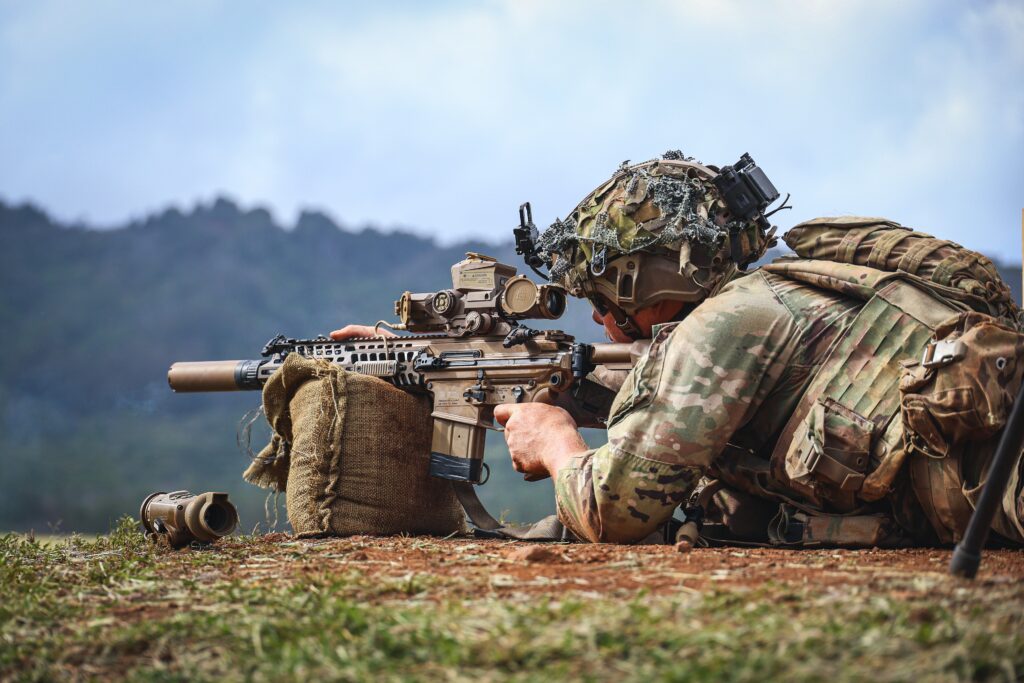
The US Army’s decision to adopt the new 6.8×51mm cartridge has sharply divided opinion, with experts making strong arguments both for and against the choice. Are the claims of superior armour penetration supported by terminal ballistic modelling?
The US Army’s adoption of SIG Sauer’s 6.8×51mm calibre was driven by two main objectives: improving penetration against enemy ballistic protection and extending the effective engagement range of infantry weapons.
During operations in Afghanistan, US forces encountered difficulties with the relatively limited effective range of the 5.56×45mm cartridge. One particular challenge was engaging Taliban fighters firing PKM machine guns from mountainsides at distances of around 800 metres.
The 5.56×45mm cartridge also struggles against modern body armour. Even the M995 armour-piercing round, which incorporates a tungsten carbide penetrator, cannot penetrate a high-quality NIJ Level IV ceramic armour plate.
The M995 is a specialised round designed for maximum penetration, rather than standard-issue ammunition. Its inability to defeat such protection illustrates the limitations of the calibre.
However, the war in Ukraine presents a different battlefield environment. Engagement ranges are generally much shorter than those encountered in Afghanistan, and assault rifles are far from the principal cause of casualties. Most casualties result from fragmentation, whether from artillery shells or grenades dropped by drones.
This raises an important question: how well suited is the 6.8×51mm calibre to European battlefields? Would a lighter weapon with less recoil, allowing soldiers to carry more ammunition, offer greater practical advantages? Ultimately, wounding an enemy combatant may make more military sense than killing them with a cartridge specifically designed to penetrate body armour.
Modelling the Penetration Performance
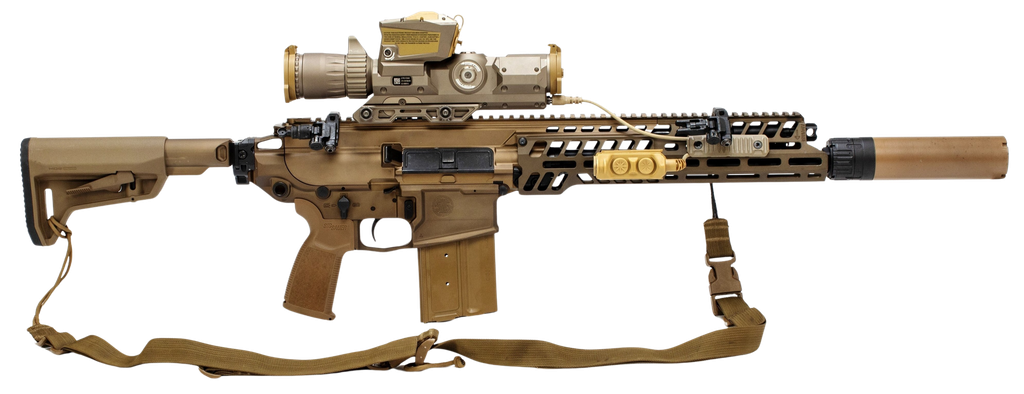
For this test article, the penetration performance of a 6.8×51mm armour-piercing projectile was modelled using established analytical methods in terminal ballistics.
The projectile under examination incorporates a tungsten carbide penetrator. The reference target material was rolled homogeneous armour (RHA) steel with a Brinell hardness of 300 HB. This allows the results to be compared with those of other calibres.
Armour steel with a Brinell hardness of 300 behaves in a ductile manner, making it unnecessary to account for various forms of plastic instability in the analytical calculations.
A significant challenge was the lack of publicly available information about the physical construction of the 6.8×51mm armour-piercing projectile. These details are classified, as are those of the hardened steel-core armour-piercing projectile.
By contrast, the construction of the standard XM1186 projectile has been made public. Several generations of this ammunition exist.
For the modelling, equivalent 7.62×51mm projectiles were adapted by making them longer and slimmer to approximate the likely dimensions of their 6.8×51mm counterparts.
This cannot provide an exact representation of the actual projectile geometry, but I believe the resulting estimates are reasonably close to the real values. The terminal ballistic penetration estimates were calculated using analytical models developed by the Israeli researchers Zvi Rosenberg and Erez Dekel. These are presented in their book Terminal Ballistics, which I consider one of the best publications in the field. It is comprehensive and exceptionally accessible.
Tungsten Carbide
Cemented carbide meets the definition of a composite material. It consists of a reinforcing phase, made up of hard ceramic particles, and a matrix phase that binds those particles together.
Such materials can also be described as metal-matrix composites.
A typical cemented carbide used in armour-piercing projectiles consists of tungsten carbide particles embedded in a cobalt matrix.
There are, however, reasons to replace cobalt. It is carcinogenic, and the overwhelming majority of global cobalt mining takes place in the Democratic Republic of the Congo, where child labour remains widespread. This raises serious ethical concerns, including the health risks faced by children exposed to cobalt.
One alternative is a nickel-iron alloy, which has already been used for many years.
A pointed tungsten carbide penetrator can penetrate softer armour materials through a mechanism known as rigid-body penetration. In this mode, the penetrator retains its shape throughout the penetration process. It continues travelling through the target until its kinetic energy has been exhausted.
Projectile Dimensions
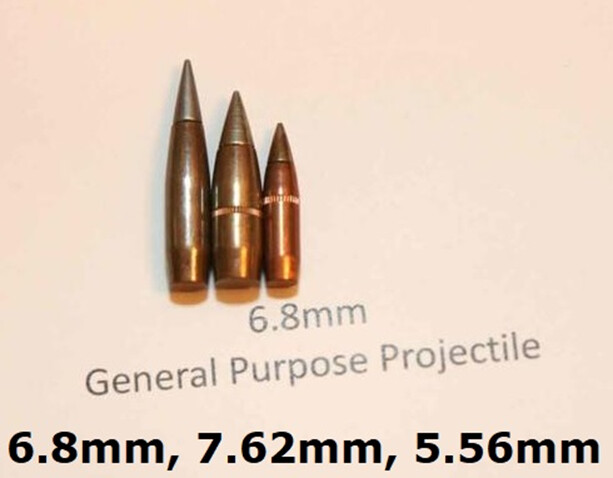
These are hardened steel penetrators, rather than tungsten carbide armour-piercing projectiles. (Image: International Ammunition Association Forum, user bdgreen, IAA Secretary.)
Before examining penetration performance, it is worth considering the estimated dimensions of the 6.8×51mm tungsten carbide penetrator used in the modelling.
As noted, the actual dimensions are classified. The figures presented here are therefore estimates, although I believe they provide a reasonable indication of the likely geometry.
For comparison, Table 1 also includes the tungsten carbide penetrator used in the 7.62×51mm M993 armour-piercing cartridge.
Table 1. Estimated dimensions of tungsten carbide penetrators
| Calibre / Cartridge | Core diameter | Core length | Effective core length | Core mass |
| 6.8×51mm / unspecified | ~4.94 mm* | Not available | 21.1 mm* | 6.05 g* |
| 7.62×51mm / M993 | 5.59 mm | ~20.7 mm | 16.2 mm | 5.93 g |
Figures marked with an asterisk are the author’s estimates.
Table 1 presents the key parameters: penetrator diameter, physical length, effective length and mass.
The concept of effective length may require some explanation, particularly as it is shorter than the penetrator’s actual physical length.
In the Rosenberg and Dekel models, effective length is calculated by considering the length of a cylindrical penetrator of the same mass, assuming the pointed nose is replaced by a flat-ended cylindrical geometry. Effective length is therefore a modelling parameter used in the analytical calculations.
Penetration Performance
The penetration performance of the 6.8×51mm cartridge was calculated using the analytical models presented in Rosenberg and Dekel’s Terminal Ballistics.
Three other calibres were included for comparison: the NATO 5.56×45mm, the Russian 6.02×41mm and the NATO 7.62×51mm.
All four projectiles were assumed to contain tungsten carbide penetrators.
The engagement distance was set at 100 metres for every calibre, with rolled homogeneous armour steel of 300 Brinell hardness serving as the target material.
Using identical boundary conditions allows the calculated penetration performance to be compared directly.
The results are presented in Table 2.
Table 2. Penetration performance of tungsten carbide armour-piercing projectiles
| Calibre / Cartridge | Penetrator material | Target material and hardness | Penetration | Range | Impact velocity |
| 5.56×45mm / M995 | Tungsten carbide (WC-Co) | RHA / 300 HB | 12 mm** | 100 m | ~880 m/s |
| 6.02×41mm / unspecified | Tungsten carbide | RHA / 300 HB | 16 mm*** | 100 m | ~835 m/s |
| 6.8×51mm / unspecified | Tungsten carbide | RHA / 300 HB | ~25 mm*** | 100 m | ~935 m/s |
| 7.62×51mm / M993 | Tungsten carbide (WC-Co) | RHA / 300 HB | 18 mm** | 100 m | ~830 m/s |
RHA = Rolled Homogeneous Armour.
** Manufacturer’s official data (Nammo).
***Calculated by the author.
< performance.
It has the highest impact energy of the four projectiles, the greatest effective penetrator length and the highest length-to-diameter ratio.
Together, these characteristics produce the greatest calculated penetration depth among the calibres examined.
A Powerful Armour Penetrator
If improved armour penetration was one of the main objectives behind adopting the 6.8×51mm calibre, the modelling suggests that this objective has been achieved.
It is important, however, to remember that the characteristics of the calibre’s armour-piercing projectiles remain classified.
The dimensions and other parameters used in this analysis are estimates. The actual performance may therefore differ from the calculated figures, although I believe the results are within a realistic range.
There is another aspect of the 6.8×51mm cartridge that deserves attention: its hybrid, dual-metal cartridge case.
The use of two different metals could create a risk of galvanic corrosion if ammunition is stored in humid conditions or if moisture condenses as temperatures fluctuate.
SIG Sauer has almost certainly considered this issue during development, although there appears to be very little publicly available discussion of it.
Ultimately, we have to trust that the manufacturer understands the design and its implications.
A cartridge case rupturing during firing would be a particularly unwelcome outcome.
Read More:
- Wikipedia: M7 rifle
- National Defense Magazine: Army Introduces New XM8 Carbine for Close Combat Ops
- SOFREP: SIG Sauer’s 6.8×51mm Cartridge Explained