
The electromagnetic spectrum has become one of the most fiercely contested resources on the modern battlefield. Drones, sensors, radars, jammers and tactical networks increasingly compete for usable frequencies, while every transmission risks revealing its source. Ukraine has turned this into a rapid contest of adaptation. For tactical communications companies such as Finland’s Bittium, the challenge is increasingly clear: keep information moving when frequencies are jammed and networks are disrupted. Unlike with the Bittium solution, the satellite navigation disappears, and the enemy is listening.
The most congested piece of terrain in Ukraine cannot be seen on a map. It surrounds every soldier, drone, radar, jammer, command post and vehicle.
Military and civilian transmitters crowd the airwaves. Both Russia and Ukraine continually search for frequencies they can use before the other side detects, exploits or suppresses them. The battlefield is running out of spectrum.
Radio spectrum itself is not consumed. What becomes scarce is usable spectrum at a particular place and time, with enough signal quality and an acceptable level of interference and risk. A technically available frequency may be useless because it is jammed, monitored or overwhelmed by other transmissions.
Moving to another frequency may work until the opponent follows. More transmitters increase congestion. More power can improve a radio link while making it easier to detect from farther away. Friendly jamming can disrupt friendly radios and drones.
The contest is therefore about much more than jamming. It is about knowing what is happening across the spectrum, controlling the force’s own electromagnetic behaviour and keeping information moving when the preferred route disappears.
Ukraine’s Battle for the Spectrum
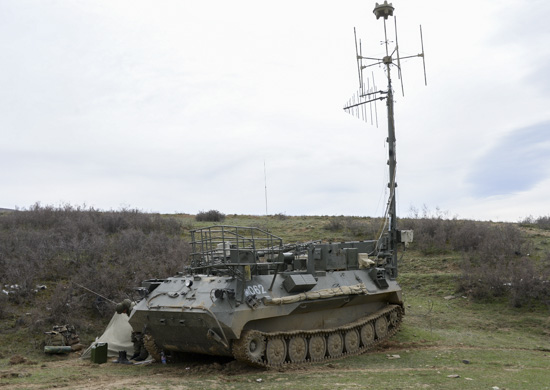
The Russian Borisoglebsk 2, MT-LBu ground vehicle mounted, multi-functional electronic warfare (EW) weapon system. (Photo: CC BY 4.0)
Sweden’s Defence Research Agency, FOI, describes an electronic-warfare cycle in Ukraine that is moving at remarkable speed. Drone operators shift control links after their frequencies are jammed. Counter-drone equipment is modified to cover the new bands. Operators move again.
FOI researcher Hampus Thorell writes that there are now few frequencies on which drones are not controlled and few frequencies untouched by jamming. With enormous numbers of radios, radars, drones and electronic-warfare systems operating along the front, FOI describes an “immensely congested spectrum”.
Norway’s Defence Research Establishment, FFI, reaches a broader conclusion. Its 2026 review of lessons from Ukraine argues that digitisation, autonomous systems and networked weapons are making armed forces increasingly dependent on electromagnetic access. Electromagnetic superiority may become as important as superiority in more familiar warfighting domains.
Russia entered the full-scale invasion with substantial electronic-warfare capabilities developed over two decades. Systems used in Ukraine included Borisoglebsk-2 equipment for radio geolocation and jamming and the R-330Zh Zhitel global navigation satellite system (GNSS) jammer.
FOI notes that many larger Russian EW systems were expensive, complex and mounted on trucks or armoured vehicles. Losses and battlefield vulnerability helped drive a wider move towards smaller, distributed systems.
Drones accelerated the process. Jamming of control links, video feeds and satellite navigation initially proved highly effective. Operators responded by moving into less conventional frequencies. Countermeasures followed.
This competition is increasingly fast and decentralised. It also creates problems for friendly forces. RUSI research with Ukrainian units has shown that electronic intelligence is an important passive means of tracking enemy activity and UAVs, while jamming is vital for protecting troops from drones and precision weapons. Yet the same jamming can interfere with friendly systems.
Poor coordination can cause electromagnetic fratricide serious enough to disrupt operations. RUSI reports that deconfliction may be required down to platoon level. Even observing the spectrum becomes harder as it grows more crowded.
Modern communications-intelligence and direction-finding systems often use wideband receivers to watch large sections of spectrum at once. In an extremely dense electromagnetic environment, powerful nearby emissions can saturate receivers or obscure weaker signals.
Modern electromagnetic warfare is therefore as much an exercise in managing receivers, networks and friendly transmissions as in generating more jamming power.
Western Forces Are Constrained by Peacetime Restrictions

FOI also points to a peacetime problem. Western militaries operate within regulated spectrum environments. Frequencies have to be shared with aviation, emergency services, telecommunications, broadcasting and industry. Exercises consequently use carefully allocated bands and restrictions designed to prevent harmful interference.
Ukraine is almost the opposite. Communications, drones, radars, electronic-warfare equipment and civilian systems operate simultaneously. Frequencies migrate rapidly. A band that works today may be jammed or monitored tomorrow.
FOI argues that Western forces have too little experience of operating under these conditions. Peacetime restrictions can constrain realistic frequency hopping, wide-band signals and more agile spectrum behaviour. They may also encourage procurement around relatively comfortable spectrum assumptions.
Every sensor and transmitter contributes to the electromagnetic signature of a force. According to FFI, future multi-domain operations simultaneously require more data exchange. Communications resilience and signature management therefore have to be designed together.
For Finland, Norway and the Baltic states, Russian interference with satellite navigation is already a peacetime reality. GNSS jamming has repeatedly affected the Nordic and Baltic region. In Norway’s Eastern Finnmark, interference originating from Russia has become an almost daily occurrence, and authorities are now also recording GPS spoofing and disruption at increasingly low altitudes.
Between 6 and 9 July 2026, NATO’s Communications and Information Agency worked with the Finnish Defence Forces and Border Guard in the GANDALF-4 trials. Equipment aboard the Border Guard vessel Turva and an H215 Super Puma helicopter was used to detect, classify and locate satellite-navigation interference. The tests also included controlled-reception-pattern antenna technology intended to preserve navigation under jamming.
A conflict on NATO’s north-eastern flank would begin in an electromagnetic environment where hostile interference is already familiar.
Preserving Mission-Critical Communication
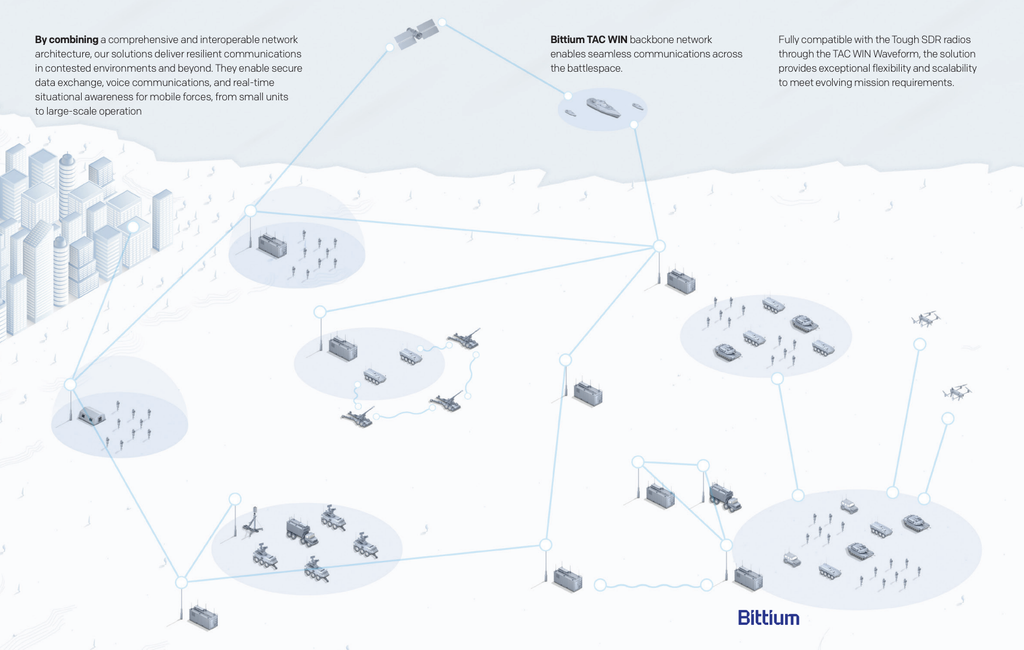
For a commander, the key question is not the exact technical congestion point at which a tactical radio network stops working. The real question is whether the network can continue to support the mission when conditions degrade. Terrain, interference, distance, antennas, bandwidth, traffic load and available neighbouring nodes all affect performance, but the operational requirement is the same: keep essential communications available for as long as possible.
This is why the more useful measure of resilience is how the network operates under pressure. Bittium’s approach is designed to preserve the traffic that matters most when capacity, routes or spectrum access are reduced.
Its TAC WIN Waveform supports this by combining frequency hopping, adaptive modulation, interference cancellation and mobile ad-hoc network, or IP MANET, routing. These are technical mechanisms, but their value is operational: they give the network more ways to continue carrying priority information when the environment changes.
The practical consequence is straightforward. When capacity falls, the network can protect essential command traffic before higher-bandwidth services.
Bittium describes and supports Quality of Service classes. In practical terms, this means the network can make better use of limited capacity by prioritising what matters most to the mission, rather than treating all traffic as equal. For example, a high-definition video stream may disappear while voice, positions and critical battle-management information continue to move.
The second defence is routing.
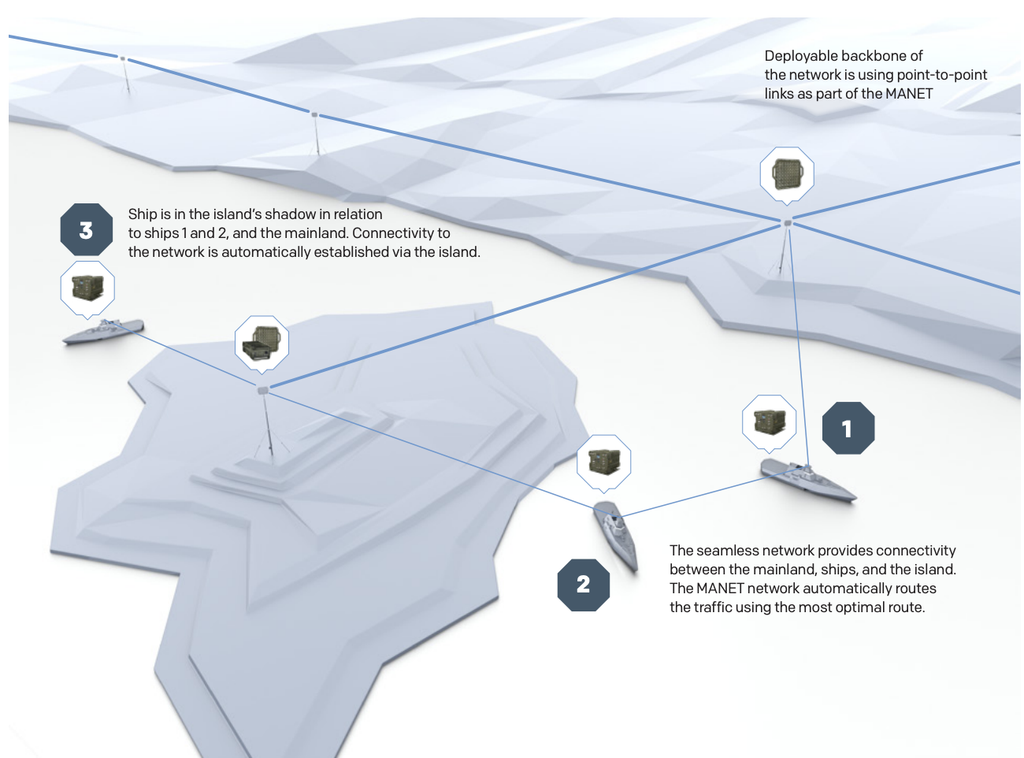
A MANET creates routes dynamically between participating radios. If one node or link becomes unusable, traffic can move through another route where one exists. Bittium’s network-management system can also indicate nodes affected by jamming, helping operators understand where the network is under pressure.
This does not create unlimited capacity. If enough links disappear, parts of the network can still become isolated. Each additional relay hop consumes resources and adds latency. The value is in extending operational options and avoiding a single point of failure for as long as conditions allow.
Bittium also offers a lower-bandwidth fallback. Its Narrowband Waveform operates between 30 and 512 MHz using 50 kHz channels and is designed for long-range voice and messaging in hostile and jammed conditions. The value is continuity: when wideband services are no longer realistic, the force can still preserve essential command communications.
This allows communications to contract towards essential services as conditions deteriorate. Video and large sensor streams can disappear well before the force loses basic command communications.
Bittium’s Tough SDR radios cover 30 to 2,500 MHz without gaps, according to the company, and can host several waveforms. National and legacy waveforms can also be ported to the software-defined platform, giving armed forces more freedom to adapt capability without replacing the radio fleet.
The architecture matters because congestion and deliberate jamming create different operational risks. Congestion requires coordination, prioritisation and disciplined us of capacity. Jamming requires adaptation, alternative routes and the ability to keep critical traffic moving under attack. An adaptive adversary can search for useful communications, concentrate energy against particular frequencies and alter tactics when countermeasures appear. Ukraine combines both problems.
Every Emitter Can Become a Target
Communications resilience has another dimension: surviving detection. FOI argues that awareness of electronic warfare has moved down the military hierarchy in Ukraine. Soldiers increasingly understand that activating a radio, radar or jammer may expose their location. Once an emission is associated with a sufficiently important target, it can become the beginning of a kill chain.
A well-camouflaged command post can still reveal itself electronically. Encryption protects the contents of a transmission. It cannot remove the electromagnetic energy that may reveal where a radio is operating.
Bittium addresses parts of this problem inside its waveforms. TAC WIN combines slow and fast frequency hopping, adaptive modulation, interference cancellation and MANET routing.
For the user, these mechanisms perform different jobs. Encryption protects information. Frequency hopping and transmission-security techniques make exploitation and continuous jamming harder. Adaptive modulation helps keep a deteriorating link useful. Interference cancellation helps the receiver distinguish wanted signals from unwanted energy. Routing can move traffic away from a jammed link.
TAC WIN also uses Bittium’s Air Interface Synchronization, distributing network timing without relying on Global Navigation Satellite System GNSS.
That becomes important when satellite navigation is being jammed. These capabilities do not make a radio invisible, and a capable opponent may still detect energy, analyse patterns and attempt geolocation. Their value is in making communications harder to exploit, harder to suppress and easier to sustain under pressure. Technology therefore must be matched with operational discipline: when to transmit, how much to transmit, which traffic to prioritise and when radio silence is more valuable than connectivity.
The Radio Becomes a Sensor
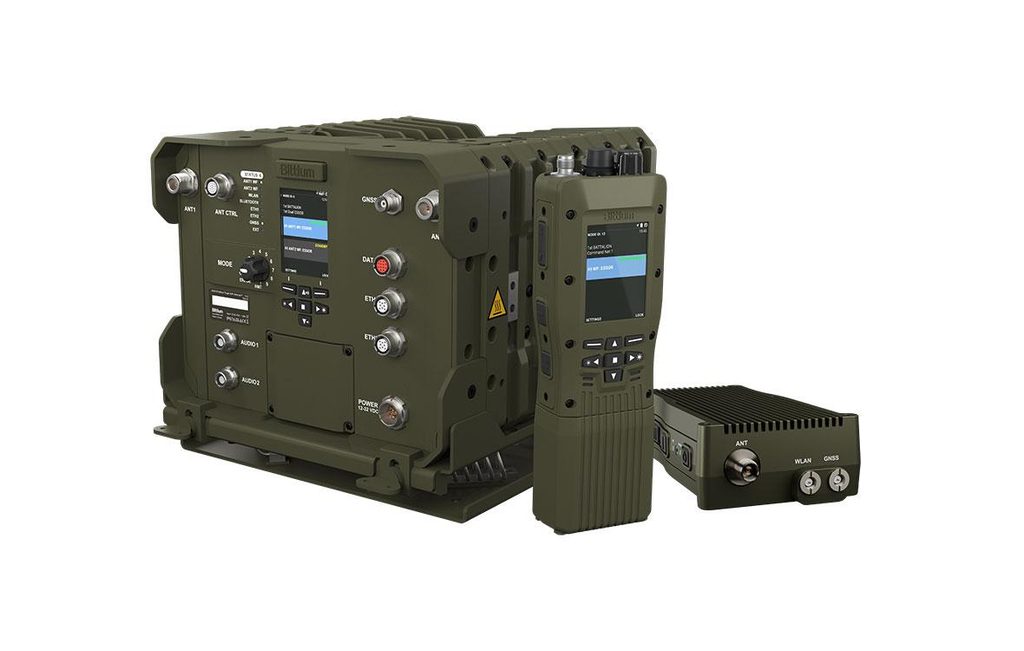
The same radio infrastructure that carries communications can also help the force understand the electromagnetic environment. In June 2026, Bittium announced a collaboration with Finnish MarshallAI aimed at turning deployed tactical radios into distributed sensors of the electromagnetic environment.
According to Bittium, a software upgrade allows radios to scan a broad radio frequency (RF) range, identify unfamiliar signals, characterise anomalies and provide an approximate indication of direction. Processing takes place locally, and sensing can operate alongside communications.
The company describes the system as a situational-awareness and force-protection capability. The directional information is not intended for target designation. Observations can instead be fed into command-and-control systems as another part of the operational picture.
The attraction is density. A dedicated EW or signals-intelligence system remains essential for specialised missions, but tactical radios are spread across the battlespace in large numbers.
If dozens or hundreds of those radios can also observe their local electromagnetic environment, the communications network becomes a distributed sensor network and a source of early warning and situational awareness.
Edge processing is important because raw radio-frequency data is enormous. Sending all of it through an already congested tactical network would defeat much of the purpose. Local processing allows a radio to transmit an alert or analysis rather than a continuous stream of raw samples.
There are still hardware limits. Software cannot remove constraints imposed by antennas, filters, RF front ends, converters and processing capacity. Dedicated EW and SIGINT systems will retain advantages in sensitivity, precise direction finding, geolocation and specialist signal analysis. The value of distributed radio sensing comes from having many observations from many positions.
The Network Starts Making Decisions
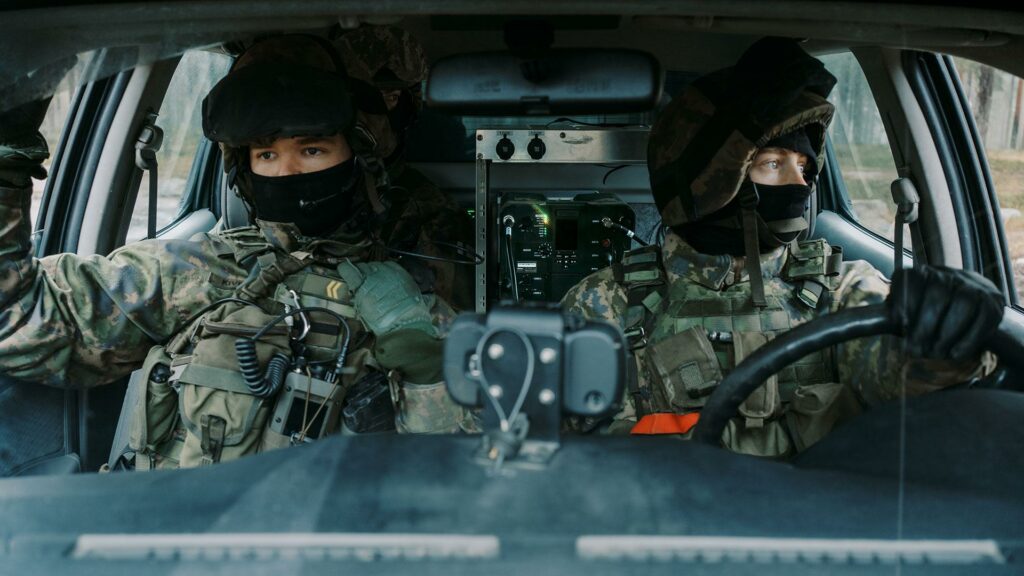
The electromagnetic environment can change faster than human operators can manage individual routes. Vehicles move behind terrain. Nodes disappear. A jammer degrades one radio path. A satellite link fails. Commercial 5G becomes available. Another radio route recovers.
Automation is already deeply embedded in tactical networking. Combined with the radio network, Bittium’s FUSOR software router extends the network’s routing beyond tactical radio networks as it can be run on commercial platforms. The architecture can combine tactical MANET with 4G, 5G, SATCOM, HF and fixed networks and select between available paths as conditions change.
Bittium and Telia demonstrated part of this model to the Finnish Defence Forces in 2026, linking the Defence Forces’ tactical communications environment with Telia’s 5G infrastructure.
Major General Jarmo Vähätiitto, then Chief of C5 at the Finnish Defence Command, said the work had demonstrated how critical communications could combine the strengths of tactical and 5G networks. Operational testing and validation were continuing at the Finnish Defence Forces C5 Agency FDFC5A, which provides the Defence Forces with information technology services, such as cyber defence.
NATO is moving in the same direction. Its 2026 Alliance Digital Strategy calls for Software Defined Defence, dynamic capability upgrades, resilient hybrid infrastructure and greater orchestration of networks. Mission-critical communications are expected to follow the PACE principle: Primary, Alternate, Contingency and Emergency.
For Bittium, there are several levels of adaptation. At the radio level, frequency hopping and adaptive modulation alter how a link operates.
At the MANET level, routing moves traffic between radio nodes.
At the wider network level, routing can select between tactical radio, 5G, satellite, HF and fixed infrastructure.
Bittium’s partnerships with MarshallAI and NestAI add another layer.
The MarshallAI work introduces AI-assisted spectrum sensing. The NestAI collaboration brings NestOS capabilities to the network, with cognitive routing among the first announced applications. Bittium says routing decisions can take account of network availability, capacity and operational policies.
The fastest route is not automatically the best military route. A high-capacity connection may create an undesirable electromagnetic signature. A commercial network has different security characteristics from a military MANET. Satellite may offer reach but introduce different latency, vulnerability or policy constraints.
Software therefore needs boundaries set by the military user. NATO’s responsible-AI principles emphasise accountability, explainability, reliability, traceability and governability, including human intervention when required. For communications, the critical question is how much authority is delegated to software and under what rules.
The Drone Revolution as a Networking Problem
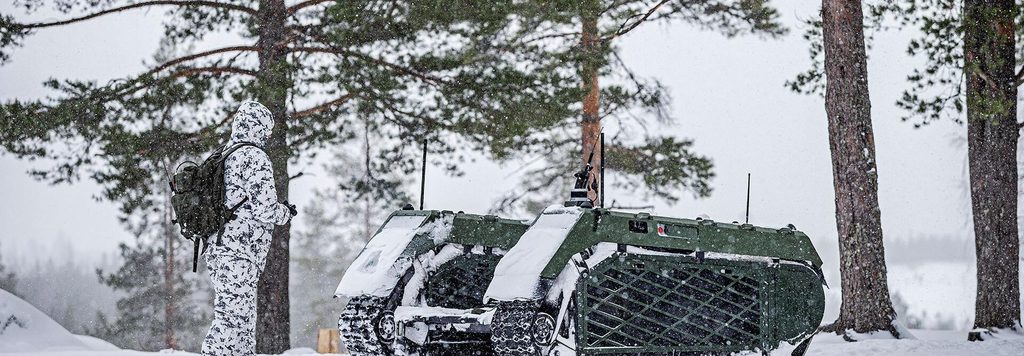
Drones receive enormous attention as platforms. Their communications infrastructure receives less. A remotely operated drone needs a control link. A reconnaissance aircraft needs to send imagery. Autonomous systems can reduce continuous connectivity requirements, but mission updates, targeting information and coordination still require communications.
At hundreds or thousands of unmanned systems, networking becomes a major scaling problem.
Bittium’s Tough SDR Unmanned is designed to bring unmanned air, ground and maritime platforms into the same tactical IP environment as other battlefield nodes. It supports command and control, sensor transmission and the use of unmanned platforms as network relays.
In its report on electromagnetic operations in Ukraine, the Royal United Services Institute (RUSI) noted that fully collective autonomous swarms have yet to appear in Ukraine at meaningful scale. A more immediate development is one operator controlling several platforms and progressively greater networking between autonomous systems.
That is already difficult. Each additional node generates authentication, routing information and traffic. Moving nodes continuously alter topology. Relays consume capacity while forwarding somebody else’s data.
Video is particularly bandwidth-hungry. Bittium gives 4 Mbps as an example for high-quality 1080p video, compared with around 64 kbps for high-quality voice.
One continuous video feed can therefore consume the bandwidth needed for many command messages.
According to Bittium, IP MANET can support hundreds of nodes in one networking domain. In 2024, it announced development for the Finnish Defence Forces of a new IP routing protocol intended to support seamless MANET networks of up to 1,000 nodes in one networking domain and a combination of multiple domains containing thousands of routing devices.
A thousand nodes exchanging occasional commands and positions create a radically different load from a thousand aircraft transmitting continuous video.
As unmanned numbers rise, bottlenecks can emerge in spectrum, routing, interference, processing, relay traffic, power consumption or application bandwidth.
This is one reason edge computing matters. A drone that analyses imagery locally can transmit detections rather than continuous raw video. A radio monitoring the spectrum can send an alert rather than raw RF data. Quality of Service can preserve command traffic when capacity falls.
There is also a countertrend: some systems are deliberately communicating less.
Fibre-optic FPV drones remove the radio-control and video link from the jamming contest altogether. IEEE Spectrum has documented their increasing use on the Ukrainian battlefield. Other systems are using machine vision, terrain matching and greater onboard autonomy to reduce dependence on GNSS and continuous radio links. The future battlefield network will include systems designed both to communicate more intelligently and to avoid communicating whenever possible.
Software Must Move at Wartime Speed
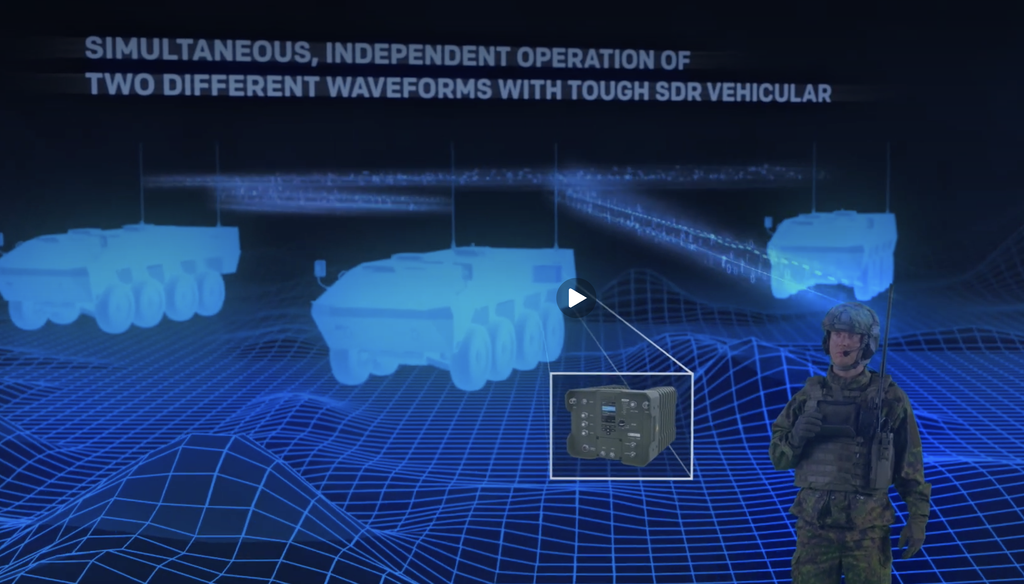
Ukraine has compressed military technology cycles. A countermeasure that works can provoke an adaptation within weeks, days or even less. Equipment built around fixed assumptions about frequencies, drones or jammers can age quickly.
Software-defined radio is one answer because much of the radio’s behaviour can change without replacing the hardware.
Physical limits remain in antennas, amplifiers, processors and RF components. Inside those boundaries, waveforms, routing, configurations and security functions can evolve through software.
That evolution happens at different speeds. Frequency hopping, adaptive modulation and MANET routing respond automatically during operation.
Configuration, cryptographic material and approved software can change more deliberately. Bittium Tactical Device Management allows software, communications keys and device configurations to be managed and updated in the field.
Entirely new waveform functions are harder. They may require engineering, security assessment, spectrum testing, cryptographic approval, interoperability work and national or NATO qualification.
That creates a basic military problem. Wartime adaptation may happen in days or weeks, while feature development can take much longer.
Bittium follows the logic of continuous development. Waveforms continue to be developed as threats evolve, particularly in electronic warfare.
The radio increasingly has to be treated as an evolving capability rather than a fixed piece of hardware.
Europe Needs Radios that Can Talk to One Another
European collaboration adds another problem: allied forces use different national radios, cryptographic systems and command networks.
NATO reinforcement requires them to exchange data quickly across borders and down to the tactical level.
ESSOR, the European Secure Software Defined Radio programme, addresses this through common waveforms and software architecture while allowing countries to retain different national radio platforms.
Bittium is a founding industrial participant. The ESSOR High Data Rate Waveform was adopted as NATO STANAG 5651 in 2023. It provides a common secure MANET waveform intended to operate on software-defined radios from different European manufacturers.
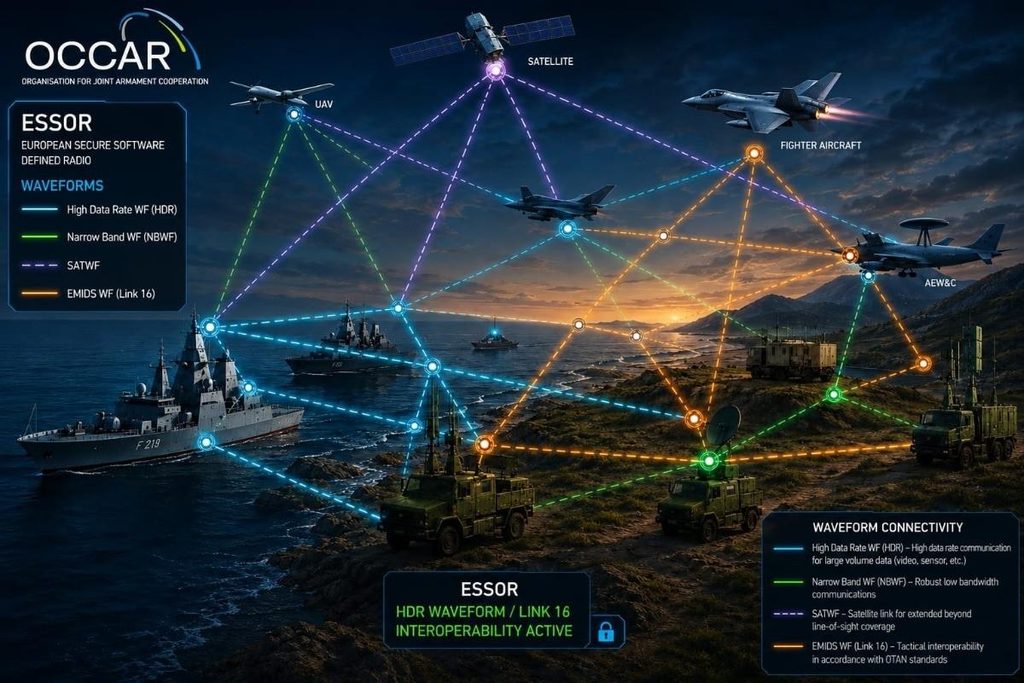
In July 2026, OCCAR and the a4ESSOR industrial consortium expanded the programme to include development of an ESSOR Narrow Band Waveform based on the future STANAG 5630 Edition 2.
Finland, France, Germany, Italy, Poland and Spain participate, represented industrially by Bittium, Thales, Rohde & Schwarz, Leonardo, Radmor and Indra. The programme includes interoperability trials and a reference laboratory for validation.
There are both advantages and constraints in software-defined defence. Software can change rapidly. Coalition interoperability, cryptography and security require controlled testing. The objective is therefore rapid adaptation inside a trusted architecture, rather than the expectation that completely new coalition waveforms can be invented and certified every few days.
Ukraine as an Engineering Environment
European NATO countries have another difficulty: systems developed entirely on controlled training ranges may meet a very different electromagnetic environment in war.
Ukraine is now the most important operational laboratory for electronic warfare, drones and tactical communications in Europe.

“The lessons learned from Ukraine have been extremely valuable,” Bittium chief executive Petri Toljamo told Nordic Defence Review at Eurosatory 2026. He said the company had been able to incorporate them “extensively into the design and development of our products and systems”.
On 25 June 2026, Bittium and Ukrainian tactical communications company HIMERA signed a memorandum of understanding in Gdańsk. The companies plan to explore interoperability and integration between their technologies. Bittium describes HIMERA’s systems as field-proven.
The relationship is significant because it connects Finnish communications engineering with technology developed under direct battlefield pressure.
Many Bittium technologies predate the full-scale invasion in Ukraine. The company’s software-defined radio work has a long development history. Ukraine’s influence is therefore better understood as accelerating requirements, priorities and development cycles. (that affects future software development?)
FOI stresses rapid frequency adaptation, distributed electronic warfare and operating under severe congestion. FFI emphasises electromagnetic resilience, signature management and faster innovation. RUSI highlights networked sensors, distributed electronic intelligence and the need to coordinate friendly jamming.
Bittium’s current architecture addresses many of the same demands: software-defined waveforms, a wide RF range, GNSS-independent synchronisation, distributed MANET routing, field software updates, alternative network paths, unmanned nodes and distributed spectrum sensing.
The hard part is keeping this architecture ahead of an adversary that is adapting at the same time.
The Battle for the Spectrum
Ukraine has exposed a central contradiction in modern warfare. Armies depend increasingly on information moving through networks at the same time as the electromagnetic environment is becoming more crowded, more observable and more heavily attacked.
Resilience therefore comes from having choices: frequencies, waveforms, routes, nodes and communications technologies, combined with the ability to preserve the most important traffic when capacity disappears and to update software as the threat changes. The spectrum is finite, and the demand placed on it is growing rapidly. That makes the battle for the airwaves one of the defining technological competitions of modern warfare.
Read More:
- Swedish Defence Research Agency, FOI: Strategic Outlook 11: Wide Awake in a World of Disorder
- Swedish Defence Research Agency, FOI: Russian Electronic Warfare in Ukraine – A Key Area in Preparedness for Future Conflicts
- Norwegian Defence Research Establishment, FFI: Erfaringer fra krigen i Ukraina – et oppdatert bilde 2024–2026
- Norwegian Defence Research Establishment, FFI: Electromagnetic warfare on the current and future battlefield
- Royal United Services Institute, RUSI: Electromagnetic Operations in Ukraine
- Royal United Services Institute, RUSI: Emergent Approaches to Combined Arms Manoeuvre in Ukraine
- Royal United Services Institute, RUSI: Russian Comms in Ukraine: A World of Hertz
- Royal United Services Institute, RUSI: The UK’s Defence Investment Plan Has a Lethal Drone Swarm Vision
- US Army University Press, Military Review: Russia’s Changes in the Conduct of War Based on Lessons from Ukraine: Adapting Technology, Force Structures, and the Defense Industry
- Center for Strategic and International Studies, CSIS: Operational Art in the Age of Battle Networks
- Center for Strategic and International Studies, CSIS: Lessons from the Ukraine Conflict: Modern Warfare in the Age of Autonomy, Information, and Resilience
- FOI, Swedish Defence Research Agency: Samexistens mellan smalbandiga taktiska radionät, FOI-R–5681–SE
- FOI, Swedish Defence Research Agency: Samexistens mellan smalbandiga taktiska radionät, full report
- FOI, Swedish Defence Research Agency: Flexibel frekvensanvändning för Försvarsmaktens radiosystem – Slutrapport, FOI-R–5839–SE
- FOI, Swedish Defence Research Agency: Flexibel frekvensanvändning för Försvarsmaktens radiosystem – Slutrapport, full report
- FOI, Swedish Defence Research Agency: Samutnyttjande av frekvenser mellan flera bredbandiga bataljonsnät, FOI-R–5520–SE
- US Army: ATP 6-02.70, Techniques for Spectrum Management Operations, 16 September 2025
- USENIX Association: Understanding Congestion in IEEE 802.11b Wireless Networks
- NATO: Alliance Digital Strategy
- NATO: NATO’s Digital Transformation Implementation Strategy 2.0
- NATO: NATO Digital Backbone
- NATO: NATO releases revised AI strategy
- NATO: NATO’s Data and Artificial Intelligence Review Board
- NATO Communications and Information Agency, NCIA: NCIA and Finland strengthen resilience against satellite navigation interference
- OCCAR: NATO ratifies and adopts ESSOR High Data Rate Waveform specification as STANAG 5651 NATO HDRWF
- OCCAR: OCCAR and a4ESSOR Sign Contract Amendment to Strengthen European Tactical Communications
- OCCAR: ESSOR – European Secure Software Defined Radio
- Bittium: Bittium Tactical Wireless IP Network™
- Bittium: Bittium Tough SDR Handheld™ Tactical Radio
- Bittium: Bittium Tough SDR Vehicular™ Tactical Radio
- Bittium: Bittium Tough SDR Unmanned™
- Bittium: Bittium FUSOR™ Software Router for Defence
- Bittium: Tactical Waveforms
- Bittium: Bittium Tactical Network Management™
- Bittium: Tactical Communications for Ground-Based Air Defense
- Bittium: Bittium Develops the Finnish Defence Forces a New IP Routing Protocol to Enable Very Large Networks for Tactical Communications
- Bittium: Inside Information: Bittium Wireless Ltd, a Subsidiary of Bittium Corporation, and Finnish Defence Forces Signed a Partnership Agreement
- Bittium: Inside Information: Bittium Wireless Ltd, a Subsidiary of Bittium Corporation, Continues Supplying the Finnish Defence Forces with Next-Generation Bittium Tough SDR™ Radios
- Bittium: Bittium received purchase orders from the Finnish Defence Forces for Bittium TAC WIN™ devices and system support for the software-defined Bittium Tough SDR™ radios and Bittium TAC WIN™ system
- Bittium: Bittium turns software-defined radios into AI-powered situational awareness sensors
- Bittium: Bittium and NestAI bring adaptive AI to mission-critical communications
- Bittium: Bittium puts unmanned systems on the tactical network
- Bittium: Bittium enables hybrid networking, connecting the tactical edge to strategic command
- Bittium: Bittium and HIMERA signed a Memorandum of Understanding agreement at Ukraine Recovery Conference in Gdańsk
- Bittium: Bittium and Telia Bring Resilient Mission-Critical Communications to 5G Networks for the First Time
- Nordic Defence Review: The Future Battlefield Cannot Run on Foreign Permission
- IEEE Spectrum: How Ukraine’s Killer Drones Are Beating Russian Jamming
- Fraunhofer-Institut für Integrierte Schaltungen IIS: Analog-to-digital conversion the bottleneck for Software Defined Radio frontends
- Tampere University: Nonlinear Distortion in Wideband Radio Receivers and Analog-to-Digital Converters: Modeling and Digital Suppression
- Sensors: Edge CA-CFAR Data Reduction for Bandwidth-Efficient Real-Time Wideband Spectrum Sensing on Low-Cost SDRs
- Nasjonal Kommunikasjonsmyndighet: Nye målinger i Øst-Finnmark viser mindre endringer over Varangerhalvøya (in Norwegian)
- Finnish Defence Forces C5 Agency