
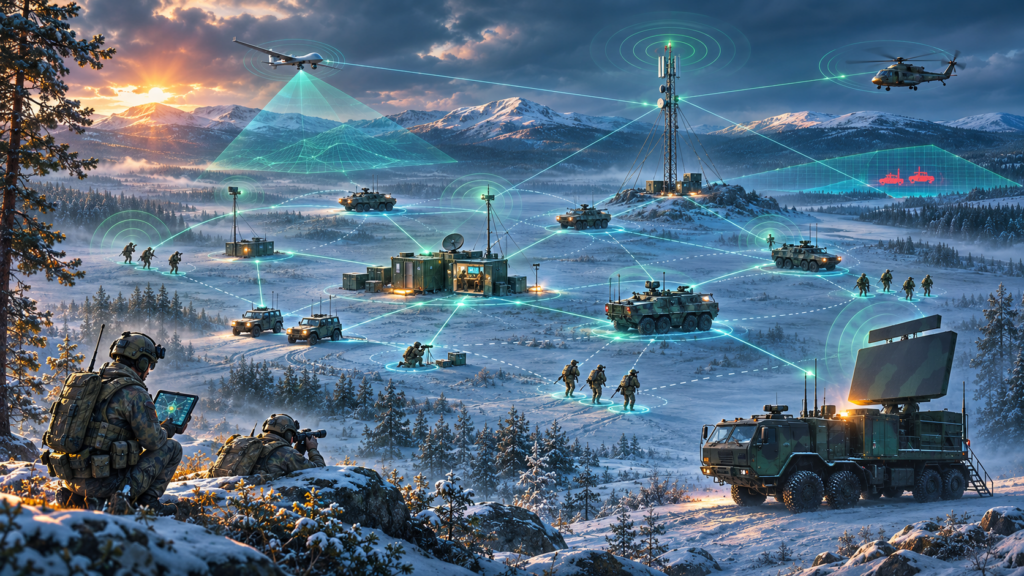
Faster aerial threats, electronic warfare and increasingly complex ground-based air defence architectures are compressing the time available to detect, decide and engage. Communications architecture is becoming an instrument of operational sovereignty in its own right. Finnish technology specialist Bittium sees that the effectiveness of the overall capability increasingly depends on the communications network connecting sensors, command-and-control systems and effectors.
A modern ground-based air defence (GBAD) capability brings together a multitude of technologies. Radars, electro-optical sensors, command-and-control (C2) systems and weapons may originate from several manufacturers, each with its own technological architecture and development cycle.
Yet these individual systems can only operate effectively as an integrated air-defence capability if mission-critical information can move between them reliably and in time. The communications network is therefore no longer simply supporting infrastructure. It is an integral part of the operational capability.
This raises a fundamental question for military procurement: who ultimately controls the network?
For Finnish tactical communications specialist Bittium, customer sovereignty is an underlying design principle with far-reaching operational implications.
“Our principle is to enable communications while ensuring that the end user retains full sovereignty. Our software and equipment are designed so that customers can plan and even maintain their own systems independently of us, should they wish to do so,” said Tarja Hyvönen, Senior Product Manager at Bittium.
The objective is to give armed forces operational control of their communications infrastructure, including its configuration, management and even subsequent development.
“The equipment and software we deliver remain under the customer’s ownership. Customer maintains operational control and is not dependent on vendor presence,” Hyvönen pointed out.
The principle extends to equipment maintenance. Customers can retain control over system operation, configuration and maintenance throughout the system lifecycle.
Such arrangements have particular significance for European armed forces seeking to retain national control and freedom of action throughout the potentially decades-long operational life of their defence systems.
When Milliseconds Matter
The proliferation of increasingly sophisticated aerial threats, including jet-powered unmanned aerial vehicles (UAVs), is adding urgency to the development of communications technologies.
Faster threats compress the time available for detection, identification, decision-making and engagement. That makes the speed at which information moves across the network operationally significant. Communications latency, the delay involved in transferring information between system components, can directly affect how much time remains for detection, decision-making and engagement.
“Latency is one of the central considerations in air defence. We have been developing this capability for around a decade in cooperation with air defence system providers,” emphasised Hyvönen.
Closely associated with latency is Quality of Service (QoS), which determines how network resources are allocated to different types of traffic. In a congested network, mission-critical information must receive the appropriate priority.
Bittium’s TAC WIN and Tough SDR solutions provide a networking foundation for moving mission-critical information between distributed elements of the wider system. High data throughput, low latency and resilient connectivity support time-sensitive information exchange, while its software-defined architecture allows network capabilities to evolve as requirements change.
Overall performance also depends on network design and configuration. In air defence, network topology must be planned to balance coverage, resilience, capacity and, critically, latency.
“Each network needs to be configured according to the customer’s operational requirements to deliver the required performance,” Tarja Hyvönen explained.
Network planning, data management and communications architecture are therefore becoming integral considerations in air defence capability development.
Beyond a Single Communications Channel
Another central element of Bittium’s approach is hybrid networking, the ability to combine different communications technologies within a unified network, helping information continue to flow as available communications paths and operational conditions change.
Military communications infrastructure can incorporate wireless tactical networks, optical fibre, copper cables and third-party Internet Protocol (IP) connectivity.
“Hybrid networking has effectively been built into our system from the beginning,” Hyvönen noted.
“Whether the available connections include copper cables, optical fibre, different radio links or third-party IP solutions, our system can select the most appropriate available connection.”
Bittium’s portfolio includes the TAC WIN system, Tough SDR software-defined tactical radios and the more recently introduced FUSOR software router, designed to facilitate interoperability across different communications networks.
The architecture gives armed forces greater flexibility in incorporating new communications technologies as their requirements evolve.
Electronic warfare is another important consideration. Tactical communications need to be designed to remain resilient in a contested electromagnetic environment, taking into account both deliberate jamming and other sources of interference.
“For air defence, the key is to maintain critical connectivity even when communications conditions deteriorate.”
A Specialised Technology Partner
Bittium occupies a specialised position in the air defence industry’s supply chain. In this market segment, it typically works with air defence system providers responsible for delivering and integrating the complete capability.
“We have long-standing relationships with air defence system providers. Our role is to provide communications technology that can be integrated with their command-and-control systems, sensors, effectors and other capabilities,” Hyvönen explained.
National procurement authorities can specify their communications requirements, while system manufacturers can incorporate Bittium’s technology within their own integrated offerings.
In a market shaped by major multinational defence companies, Bittium differentiates itself through specialised tactical communications expertise and engineering flexibility.
“Our strength is the ability to adapt our communications solutions to the specific requirements of different systems and customers,” Hyvönen said.
Engineering Sovereignty in Northern Finland
Bittium’s technological foundations can be traced to northern Finland’s distinctive wireless communications ecosystem.
Oulu has been an internationally recognised centre of telecommunications engineering for decades, creating a specialised wireless technology ecosystem from which Bittium’s tactical communications expertise has developed.
Bittium’s cooperation with the Finnish military extends over decades. A partnership agreement covering 2025–2036 provides a long-term framework for collaboration on tactical communications and command-and-control systems.
“Finland’s security environment and longstanding emphasis on national preparedness have shaped the operational requirements the Finnish Defence Forces have placed on us,” said Hyvönen.
This background has formed an approach in which resilience, sovereign control and the ability to sustain communications under demanding conditions are treated as fundamental architectural requirements rather than additional features.
For European armed forces, the ownership question will become increasingly consequential as air defence architectures grow in complexity. Individual sensors, weapons and communications technologies will evolve at different speeds.
As the systems become more distributed, heterogeneous and software-driven, the network connecting them becomes part of the capability itself. Control of that network affects not only operational resilience today, but also the freedom to integrate new sensors, effectors and communications technologies tomorrow. Communications architecture is becoming an instrument of operational sovereignty in its own right.
Read More:
- Bittium: Tactical Communications for Ground-Based Air Defense (GBAD) – Application Note
- Bittium: Bittium Tactical Wireless IP Network™
- Bittium: Bittium FUSOR™ Software Router for Defence
- Bittium: Tactical SDR
- Bittium: Bittium Tactical Network Management
- Bittium: Experience next-generation communications at Eurosatory
- Bittium: Inside Information: Finnish Ministry of Defence Decided on a Partnership Agreement with Bittium Wireless Ltd, a Subsidiary of Bittium Corporation
- University of Oulu: CWC at 30: Celebrating three decades of wireless innovation
- University of Oulu: Bittium’s tactical communications system strengthens 6G Test Centre and supports Finland’s innovation ecosystem
- University of Oulu: University of Oulu to build 6G testing capability for defence