
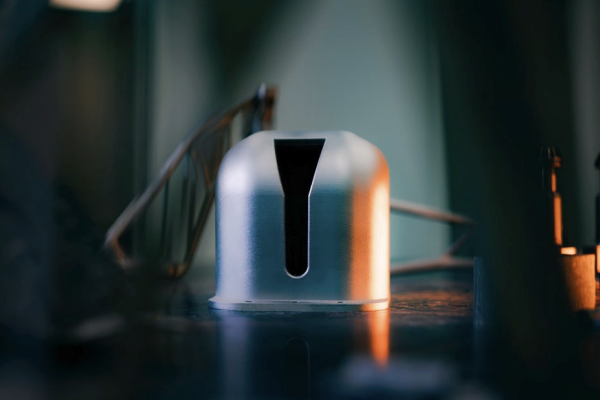
For more than four decades, armour design has revolved around cutting, machining and welding hardened steel plate. Swedish steelmaker SSAB believes that paradigm is about to change. Its launch of Armox 500 AM Powder marks what the company says is the world’s first armour steel powder specifically engineered for additive manufacturing, opening the door to lightweight ballistic protection for components that conventional armour plate cannot adequately protect.
Armed forces are increasingly seeking to protect not only the hulls of vehicles but also the growing number of externally mounted sensors, radars, cameras, communications equipment, remote weapon stations and electronic warfare systems that have become essential to modern combat operations.
Ukraine has demonstrated that destroying a vehicle’s optics, antennae or sensors can neutralise combat capability without penetrating its main armour. That has shifted attention towards protecting hundreds of vulnerable external components that were previously regarded as secondary considerations.
Armour Where Armour Plates Cannot Reach
Traditional armour steel remains unmatched for protecting large flat surfaces such as vehicle hulls. It becomes far less practical when engineers need to shield irregular components including camera housings, radar mounts, cable junctions, hydraulic connectors or complex electronic assemblies.
These parts typically require numerous welded sections, adding manufacturing complexity, weight and potential weak points. Additive manufacturing changes the design philosophy completely.
Instead of cutting protection from flat steel plates, engineers can now build components layer by layer using laser powder-bed fusion. This allows intricate internal lattice structures, honeycomb geometries and energy-absorbing cavities that cannot be manufactured conventionally.
Rather than relying solely on material thickness, designers can optimise geometry to absorb and dissipate blast and ballistic energy while significantly reducing weight.
The concept has attracted increasing interest across aerospace and defence because every kilogram saved on an armoured vehicle, unmanned ground vehicle or naval platform can be reallocated to payload, sensors or additional protection.
Matching Armour Plate Performance
The technical challenge has never been printing steel itself. Metal additive manufacturing has existed for a long time. The difficulty has been producing printed parts with mechanical and ballistic properties comparable to high-end rolled armour steel.
SSAB’s Armox 500 AM Powder announcement at the Eurosatory2026 defence exhibition in Paris reflects a broader trend gathering pace across the defence industry. It achieves mechanical characteristics matching its established Armox armour plate family, eliminating the need for post-print heat treatment and allowing components to be installed directly after manufacture. The company says printed components have undergone ballistic and blast testing to validate their protective performance. If independently confirmed through customer qualification programmes, that represents an important step because heat treatment often introduces distortion, additional manufacturing costs and longer production cycles.
A Response to Changing Battlefield Economics
The launch also reflects how warfare is evolving. Modern armoured vehicles increasingly depend on expensive electro-optical sensors, battlefield management computers, communications antennas, active protection systems and drone countermeasure equipment mounted externally.
Replacing a destroyed camera turret costing tens of thousands of euros may immobilise a vehicle that remains otherwise fully operational.
As Per Elfgren, Head of SSAB Special Steels, argues, customised protection for these exposed systems has become increasingly valuable as demand grows for both armour steel and high-performance metal powders used in additive manufacturing.
The concept is equally relevant for unmanned systems. Ground robots, autonomous logistics vehicles and remotely operated weapon stations frequently carry exposed electronics with limited space for conventional armour. Additive manufacturing enables protective shells designed specifically around individual payloads rather than forcing equipment into standard armour configurations.
From Prototype to Industrial Production
Although defence has become the headline application, SSAB’s announcement also signals the industrial maturity of metal additive manufacturing.
The company will expand powder production at its Oxelösund facility during 2026, with commercial-scale production expected to ramp up from early 2028. Planned capacity is approximately 350 tonnes annually, indicating that SSAB expects large production volumes.
Europe has been attempting to strengthen sovereign production of critical defence materials following Russia’s invasion of Ukraine. Armour steel already represents one of SSAB’s strongest defence specialities, and expanding into certified armour powders extends that position into an emerging manufacturing technology.
Design Freedom Becomes a Combat Capability
Perhaps the greatest significance of Armox 500 AM Powder lies less in the material itself than in what it allows engineers to design. Traditional armour design starts with sheets of steel. Additive manufacturing starts with the threat.
Engineers can tailor internal structures to specific ballistic threats, optimise weight distribution and integrate multiple functions into a single printed component. Protective housings can incorporate mounting points, cooling channels, cable routing and energy-absorbing geometries within one printed part.
That reduces assembly steps while increasing structural efficiency. As defence procurement increasingly focuses on rapid adaptation and shorter development cycles, digital manufacturing also allows components to be redesigned and reprinted without investing in expensive tooling or production lines.
For armed forces seeking to upgrade existing vehicles against emerging drone and precision-guided threats, that flexibility may prove almost as valuable as the armour itself.
The era of armour steel is far from over. Instead, it appears to be entering a new phase where steel plate and additive manufacturing complement one another, each protecting the parts of the battlefield that suit them best.
Read More:
- SSAB: SSAB launches Armox® 500 AM Powder – world’s first protection powder
- SSAB: Shaping a new future of protection
- SSAB: Armox® and Ramor protection steel for civil and defense use
- Lawrence Livermore National Laboratory (arXiv): Laser powder-bed fusion additive manufacturing: physics of complex melt flow and formation mechanisms of pores, spatter and denudation zones