
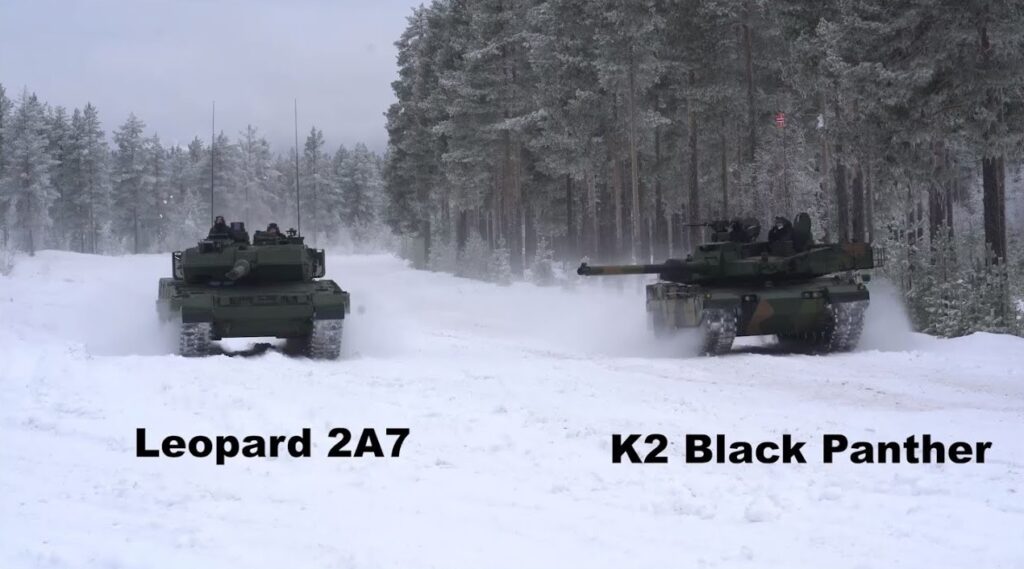
The South Korean K2 main battle tank and Germany’s Leopard 2 rank among the best-selling MBTs in Europe. Poland alone has ordered 1,000 K2s, while the Leopard 2 continues to secure strong demand across the continent. Both are built around heavily protected frontal arcs, but how do their approaches to ballistic protection differ?
The South Korean K2 Black Panther and Germany’s Leopard 2 are two of the most heavily armoured tanks in service worldwide. MBTs concentrate their strongest armour on the frontal sector, the area designed to face the enemy. Extending that level of protection across the entire vehicle would add prohibitive weight and turn a mobile platform into an immobile bunker.
Both tanks face a familiar problem: adding capability drives up weight. The impact is more pronounced with the Leopard 2. The latest variants now exceed 70 tonnes, while the K2 has also grown, rising from around 56 tonnes to over 60 tonnes in the Polish K2PL configuration.
Weight directly affects mobility, and in Norway’s tank trials, the K2 outperformed the Leopard 2 in this area. It is also the newer design, with a notably smaller silhouette thanks to its lower-profile turret.
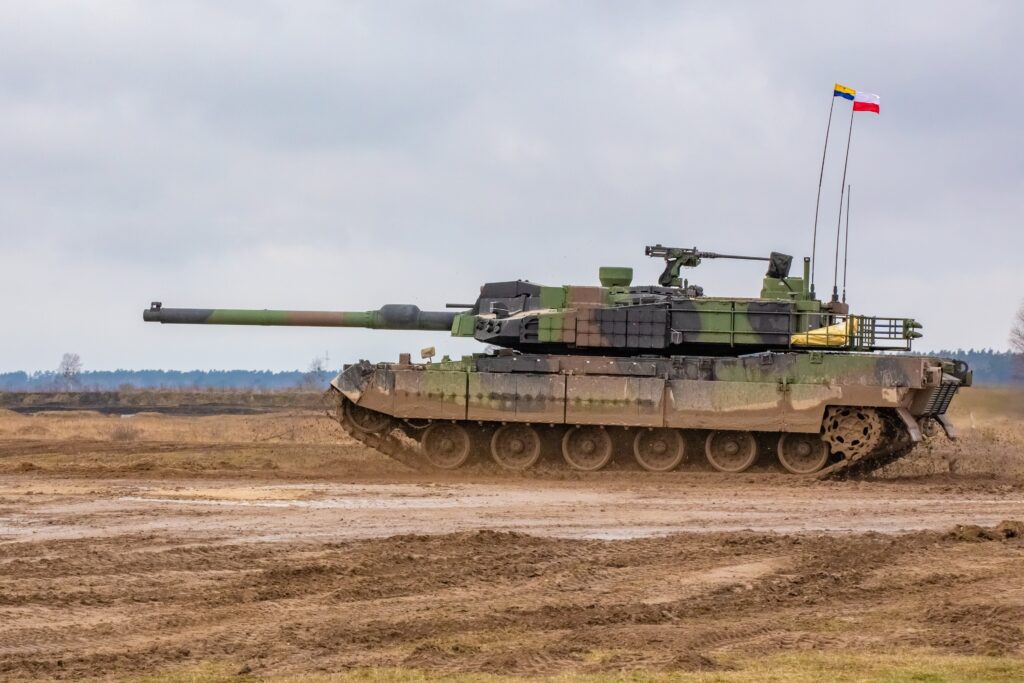
The frontal ballistic protection of the K2 and Leopard 2 warrants closer scrutiny. It is the most heavily armoured section and the part designed to face the enemy.
Are Tanks Obsolete?
Some argue that main battle tanks are becoming obsolete, citing their limited use in Ukraine. That conclusion is premature. Drones have added a new layer to the battlefield, but their current dominance will not last. Counter-drone measures are already being integrated into armoured fighting vehicles (AFV), giving them an increasingly robust self-defence capability.
Disabling a well-protected main battle tank can require 30 to 40 first-person view (FPV) drones. If the vehicle is equipped with layered counter-drone measures and supported by dedicated air-defence units, the task becomes significantly harder.
The key to using main battle tanks on the modern battlefield lies in training and tactics, exploiting mobility to deliver a shock effect. That, in turn, demands employment in massed formations rather than in isolation.
The modern battlefield is increasingly visible due to reconnaissance drones, forcing armoured units to disperse and remain concealed until the moment of attack. They concentrate only when required for a coordinated strike.
There is no substitute for armoured fighting vehicles or manoeuvre warfare. Speed, indirect fire and combined arms operations remain central to modern combat, underpinned by rigorous training. Modern tanks must adapt to the drone threat. The alternative is a return to First World War-style trench attrition, which no one should accept. In that kind of war, victory goes to the side that can absorb the most losses. That outcome must be avoided at all costs.
K2 Black Panther Ballistic Protection: Ceramic-based Laminate Armour
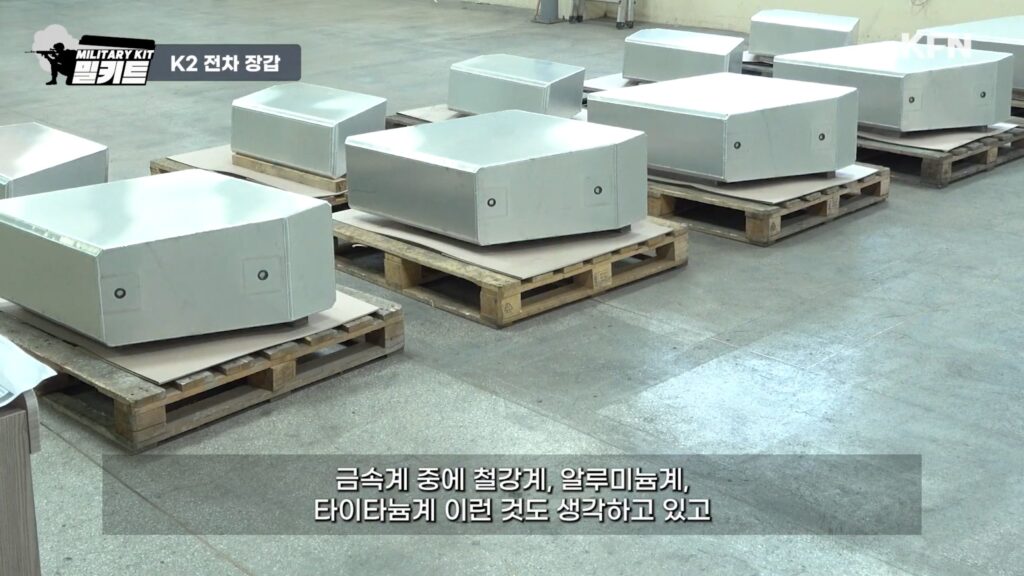
The South Korean K2 main battle tank, built by Hyundai Rotem, uses advanced ceramic-based laminate armour. These modules are mounted onto the tank’s load-bearing rolled homogeneous armour (RHA) steel structure in layered plates.
This laminate system is known as KSAP, or Korean Special Armour Plate. It is the successor to the earlier SAP (Special Armour Plate) modules used on the indigenous K1. While SAP was manufactured in the United States, KSAP is an entirely South Korean design.
KSAP modules and plates are produced by Samyang Composite Technology. Several generations of the armour are in service, and they are believed to incorporate silicon carbide ceramics. Silicon carbide is often described as “cannon-proof”, offering strong resistance under the shock loading caused by high-velocity long-rod penetrators travelling at around 1,500 to 1,800 m/s.
Boron carbide does not perform as well in this context, as it can undergo amorphisation under impact, reducing its protective effectiveness.
Ceramics are also effective against shaped charges due to the way they disrupt the penetration process. Instead of forming a smooth, straight crater, the impact creates an irregular surface. This interferes with the coherence of the shaped charge jet, degrading its penetration performance.
Some credible sources suggest that the K2 may use silicon nitride ceramics in its KSAP modules. Nitride ceramics are generally well-suited to countering hypervelocity threats.
The K2’s protection is further reinforced with explosive reactive armour (ERA), fitted to both the turret and hull in its baseline configuration. The turret carries ERA across the top and sides, while on the hull, it is mounted on the skirt plates and over the ammunition compartment roof.
K2 Protection Level: Can Defeat Most Sabot Rounds
The K2’s turret frontal arc is assessed to withstand hits from South Korea’s K279 APFSDS (Armor-Piercing Fin Stabilized Discharging Sabot) round at a range of 1,000 metres. The K279 penetrator is credited with penetrating around 800 mm of rolled homogeneous armour (RHA) at 2,000 metres and at a 60° impact angle.
Taken together, this suggests the K2’s frontal kinetic protection exceeds the equivalent of 800 mm RHA. That level of protection is substantial and is sufficient to defeat most contemporary sabot rounds.
The turret side armour is designed primarily to defeat kinetic rounds from autocannons. The KSAP plates on the side walls are relatively thin, typically around 50–60 millimetres. Hyundai Rotem states that the cumulative protection of the turret sides is in the range of 400–500 mm of rolled homogeneous armour steel. At the same time, it claims the armour can defeat a PG-7VR tandem-charge warhead fired from an RPG-7, which is rated for penetration in excess of 700 mm homogeneous armour.
Leopard 2 Ballistic Protection: Destabilising Air Gaps
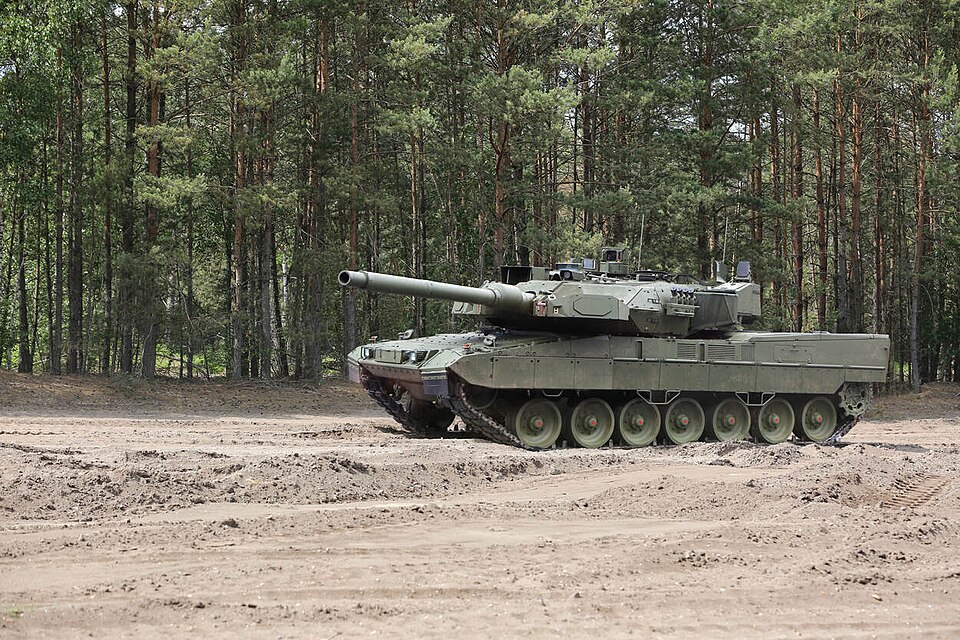
Different Leopard 2 variants use different armour packages, commonly referred to as A, B, C and D technology levels. The “A” standard dates back to the prototype Leopard 2AV (Austere Version), which incorporated NERA (non-energetic reactive armour) elements sandwiched between steel bulkheads in a spaced plate configuration, known in German as Mehrfach-Schottspanzerung mit Beulblech.
A spaced plate layout introduces air gaps between successive NERA layers. These gaps allow the destabilising effect to take hold before the degraded penetrator reaches the next armour plate, improving overall resistance.
In its simplest form, NERA consists of two metal plates separated by an inert layer. On impact, the plates deform and bulge, disrupting the penetrator’s path. The inert layer drives this movement. Materials such as rubber can generate gas under high shock pressure, forcing the plates outward and increasing the armour’s disruptive effect.
When the Leopard 2 entered service in 1979, it was equipped with the so-called “B” armour package. This also incorporated NERA elements in both the turret and hull. The B standard offered slightly lower protection than the earlier A configuration, which had been considered excessive for its time.
The “C” armour package entered service in 1988 and was retrofitted to some earlier Leopard 2 variants. According to declassified British intelligence reports, the C standard introduced the use of ceramic materials within the armour array.
The “D” armour standard was introduced in the early 1990s with the Leopard 2A5, also known as the “Leopard 2 Improved”. It combined upgraded internal armour with distinctive wedge-shaped add-on modules on the turret front, and optionally on the hull glacis.
These wedge-shaped modules are widely assessed to use NERA-type technology, comprising multiple high-hardness steel plates separated by inert interlayers such as rubber. On impact, they generate asymmetrical forces on a kinetic penetrator, causing it to bend, fracture and destabilise before it reaches the main armour array.
The behaviour of a kinetic penetrator under asymmetric loading depends heavily on its material. Depleted uranium (DU) is more ductile than conventional tungsten heavy alloys (WHA), making it more resistant to fracturing under such stresses.
A fifth armour standard, known as “E” technology, has also been introduced. It is used on variants such as the Canadian Leopard 2A4M CAN. According to German sources, it incorporates NERA-type elements (Beulblechpanzerung). Unlike earlier configurations, E-level protection is applied as external add-on modules rather than forming part of the tank’s internal armour array.
Leopard 2 Protection Levels: Tested Against a Country’s Own Systems
(Image: Wikimedia Commons, Author Sonaz, CCA-SA 3.0 Unported)
Estimates of the Leopard 2’s ballistic protection are drawn from declassified British intelligence material and data leaked from Sweden’s main battle tank tender in the early 1990s. Table 1 summarises frontal protection levels across the different armour standards. “Kinetic protection” refers to resistance against APFSDS penetrators, while “cumulative protection” denotes defence against shaped-charge warheads.
Leopard 2 MBT frontal sector ballistic protection values by technology level
| Technology | Year introduced | Kinetic protection (mm RHA) | Cumulative protection (mm RHA) |
| B | 1979 | 350* | 700* |
| C | 1988 | 410-420* | 750-800* |
| D | 1994 | ~670-800** | ~1250-1700** |
* According to old declassified British intelligence documents.
** Values for German made armor package in the Swedish main battle tank trials (1994).
Main battle tank armour is designed to defeat the anti-tank weapons of its era. In practice, because access to adversary munitions is limited, armour packages are typically tested against a country’s own systems.
The kinetic protection of the B-level armour was assessed using DM23 APFSDS rounds fired from a rifled 105 mm tank gun. This penetrator was capable of defeating around 330 mm of rolled homogeneous armour at 800 metres. Cumulative protection was tested against Milan anti-tank guided missiles (ATGM), which had a penetration of roughly 700 mm rolled homogeneous armour.
The C-level armour was trialled against DM23-type APFSDS rounds fired from 120 mm smoothbore guns, with a penetration of around 410 mm RHA at 200 metres. The shaped-charge threat was represented by the HOT-1 anti-tank guided missile, rated at roughly 700 mm RHA with its built-in standoff. That standoff was not optimal, and the missile could exceed 800 mm RHA penetration with improved spacing.
D-level armour packages were tested against significantly more capable threats, as reflected in the protection values in Table 1. The kinetic test round was comparable to the penetrator used in the 120 mm DM53 APFSDS, while the shaped-charge threats involved warheads of 143 mm and 165 mm calibre.
Future Armour: Lighter and More Mobile Tanks
Next-generation main battle tanks have yet to enter production. They are now being designed around lessons from the war in Ukraine. The focus is shifting towards lighter, more mobile platforms with stealth features, integrated counter-drone systems, and additional armament, including drones for reconnaissance and loitering munitions.
One of the central constraints facing current-generation tanks is weight growth. The Leopard 2 illustrates the problem clearly. When it entered service in 1979, it weighed around 55 tonnes. The latest variants, including the Leopard 2A7+ and 2A8, exceed 70 tonnes. That increase is significant, and the margin for further growth is effectively exhausted. Track systems, engines and transmissions are already operating at their limits.
When designing a new main battle tank, lessons from current conflicts cannot be applied wholesale. They are shaped by specific environments, and future wars will differ in both terrain and character.
There is no viable alternative to armoured fighting vehicles (AFV) in ground operations. They will adapt to the threat environment now visible in Ukraine, not disappear because of it. The only real alternative would be a return to First World War-style trench warfare, which no one is prepared to accept.
Read More:
- Wikipedia: K2 Black Panther
- Wikipedia: Leopard 2
- Hyundai-Rotem: K2 Black Panther
- Army Recognition: South Korea Launches K2 Tank Engineered for Extreme Heat Warfare in Middle East
- KNDS: Leopard 2A7