
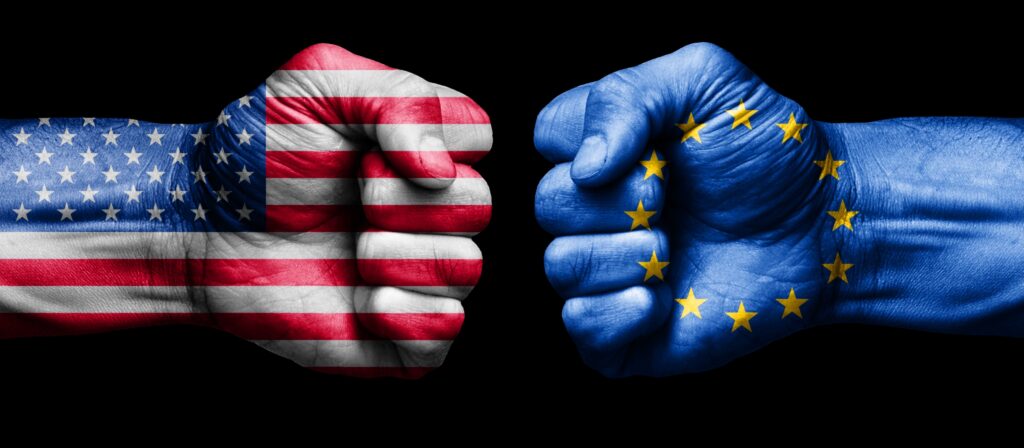
U.S. President Trump’s new National Security Strategy (NSS), especially its leaked passages, has provoked sharp warnings from Europe’s leaders that it undercuts eight decades of transatlantic unity. The draft NSS singles out the European Union itself as a problem and even mentions forming a new “Core 5” of powers without EU members. It explicitly names Austria, Hungary, Italy and Poland as targets to “pull…away” from the EU and urges support for right-wing nationalist parties in Europe that are “staunchly pro-American”. NSS does not list Russia as a threat.
European officials say the new National Security Strategy (NSS) is tantamount to U.S. meddling in EU affairs. Polish Prime Minister Donald Tusk bluntly told Washington: “Europe is your closest ally, not your problem”, recalling that for 80 years Americans and Europeans have faced common enemies as allies. The messages from Europe’s capitals have been consistent: the United States must not treat a united Europe as an adversary.

European showed unity in a joint statement issued after their meeting in Berlin on 15 December, and signed by European Council President António Costa and European Commission President Ursula von der Leyen, alongside German Chancellor Friedrich Merz, Danish Prime Minister Mette Frederiksen, Finnish President Alexander Stubb, French President Emmanuel Macron, Italian Prime Minister Giorgia Meloni, Dutch Prime Minister Dick Schoof, Norwegian Prime Minister Jonas Gahr Støre, Polish Prime Minister Donald Tusk, Swedish Prime Minister Ulf Kristersson, and UK Prime Minister Keir Starmer, the leaders agreed that safeguarding Ukraine’s security, sovereignty and prosperity is essential to broader Euro-Atlantic security.
Quotes from National Security Strategy of the United States of America (November 2025)

– “We will oppose elite-driven, anti-democratic restrictions on core liberties in Europe, the Anglosphere, and the rest of the democratic world, especially among our allies.”
– “We reject the disastrous “climate change” and “Net Zero” ideologies that have so greatly harmed Europe, threaten the United States, and subsidize our adversaries.”
– “The larger issues facing Europe include activities of the European Union and other transnational bodies that undermine political liberty and sovereignty, migration policies that are transforming the continent and creating strife, censorship of free speech and suppression of political opposition, cratering birthrates, and loss of national identities and self-confidence.”
– “The Ukraine War has had the perverse effect of increasing Europe’s, especially Germany’s, external dependencies. Today, German chemical companies are building some of the world’s largest processing plants in China, using Russian gas that they cannot obtain at home.”
– “The Trump Administration finds itself at odds with European officials who hold unrealistic expectations for the war perched in unstable minority governments, many of which trample on basic principles of democracy to suppress opposition. A large European majority wants peace, yet that desire is not translated into policy, in large measure because of those governments’ subversion of democratic processes. This is strategically important to the United States precisely because European states cannot reform themselves if they are trapped in political crisis.”
– “American diplomacy should continue to stand up for genuine democracy, freedom of expression, and unapologetic celebrations of European nations’ individual character and history. America encourages its political allies in Europe to promote this revival of spirit, and the growing influence of patriotic European parties indeed gives cause for great optimism. Our goal should be to help Europe correct its current trajectory. We will need a strong Europe to help us successfully compete, and to work in concert with us to prevent any adversary from dominating Europe.”
– “Our broad policy for Europe should prioritize:
• Reestablishing conditions of stability within Europe and strategic stability with Russia;
• Enabling Europe to stand on its own feet and operate as a group of aligned sovereign nations, including by taking primary responsibility for its own defense, without being dominated by any adversarial power;
• Cultivating resistance to Europe’s current trajectory within European nations;
• Opening European markets to U.S. goods and services and ensuring fair treatment of U.S. workers and businesses;
• Building up the healthy nations of Central, Eastern, and Southern Europe through commercial ties, weapons sales, political collaboration, and cultural and educational exchanges;
• Ending the perception, and preventing the reality, of NATO as a perpetually expanding alliance; and
• Encouraging Europe to take action to combat mercantilist overcapacity, technological theft, cyber espionage, and other hostile economic practices.
European relations with Russia are now deeply attenuated, and many Europeans regard Russia as an existential threat. Managing European relations with Russia will require significant U.S. diplomatic engagement, both to reestablish conditions of strategic stability across the Eurasian landmass, and to mitigate the risk of conflict between Russia and European states.
The Ukraine War has had the perverse effect of increasing Europe’s, especially Germany’s, external dependencies. Today, German chemical companies are building some of the world’s largest processing plants in China, using Russian gas that they cannot obtain at home.”
Transatlantic Row and Wider Reaction
European media and analysts have seized on the NSS rhetoric as unprecedentedly hostile. The Washington Post warned of “transatlantic turmoil”, and the leaked strategy has been described as akin to a far-right pamphlet or even Kremlin talking points. British columnist Andrew Rawnsley wrote that the unpublished NSS “oozes contempt” for Europe and urged the EU to take Trump’s words as a “wake-up call” for greater unity and funding. In the United States, Democrats reacted forcefully: Senator Richard Blumenthal warned that the NSS “foreshadows forsaking our allies… throwing Ukraine under the bus”, and veteran diplomat Daniel Fried spoke of “ideological hostility toward Europe” driving an incoherent retreat from global leadership.
Russia’s response has been predictably upbeat. Kremlin spokesman Dmitry Peskov openly praised the NSS as aligning with Moscow’s vision, noting that Trump’s document does not list Russia as a threat. Many European officials pointed out the irony: critics note that an American strategy encouraging EU breakup is exactly what Russia has long sought.
On the ground, the crisis has prompted NATO’s European members to accelerate defence plans rather than draw inward. At the NATO summit in December, leaders agreed on steep new spending goals (3.5 % of GDP by 2035 on core defence, plus 1.5 % on related needs), a reflection of broader unease over uncertain U.S. commitment. The EU High Representative for Foreign Affairs and Security Policy, Estonian Kaja Kallas, while rebuffing the NSS criticism as a provocation, also argued Europe must become more self-reliant: “We have to be more self-confident about our own power,” she said, echoing calls by Macron and others to strengthen a European defence identity. The NATO Secretary-General, the Dutch Mark Rutte, similarly said Europe and Canada will have to “do more for our shared security,” even as he affirmed belief that America still backs NATO.
The Trump administration’s new strategy has set off alarms in European capitals. Leaders from Berlin to Tallinn have denounced any attempt to pitch EU and American interests as opposed. Whether the NSS’s radical proposals will become policy is unclear, but for now, they have prompted a vigorous reaffirmation among NATO allies: Europe and the U.S. remain partners, albeit ones that must now reckon with doubts about each other’s plans for the future.
Reactions to the NSS
Poland: The most outspoken reactions have come from Poland, one of the countries named in the leaked strategy. Poland’s new President, Karol Nawrocki, aligned with Trump, welcomed talk of closer U.S. ties, having already called for “major reform of the EU” to restore national sovereignty. But Poland’s ruling pro-EU prime minister, Donald Tusk, immediately rebuffed the strategy. In a widely shared social media post, he wrote, “Dear American friends, Europe is your closest ally, not your problem. We have common enemies… We need to stick to this – it is the only reasonable strategy of our common security”. Poland’s defence and foreign officials have also expressed concern.
Germany: German leaders have been unusually candid. Chancellor Friedrich Merz said while the NSS “did not come as a complete surprise,” parts of it are plainly “unacceptable… from a European perspective”. He insisted that Europe must become more independent: “As Europe – and therefore also Germany – we must become far more independent from the U.S. in terms of security policy,” he said. Merz rejected claims that Europe censors free speech or political opposition, noting that if democracy ever needed saving, Europeans can “manage that on our own”. He even paraphrased President Trump’s “America First” slogan, allowing that it is fine to prioritise America, but warning “‘America Alone’ can’t be in your interest – you need partners in the world, and one of those partners can be Europe”.
Opposition and civil society figures in Germany went further. Norbert Röttgen, a senior opposition lawmaker, said the new U.S. stance marks “the first time since World War II that the U.S. has not stood at Europe’s side”. Left-wing and Green leaders echoed calls for stronger European defence. As Green co-leader Franziska Brantner put it: “Anyone who sticks to a purely national security policy now jeopardises our freedom and security in Europe.”
“There is no need for Americans to ‘save’ democracy in Europe – if it needed saving, we would manage it ourselves,” Chancellor Merz, speaking for Europe, told reporters, echoing Poland’s sentiment. Polling still shows most Poles strongly support EU membership, so pushing Warsaw away from Brussels risks a domestic backlash.
The Nordics: Sweden’s leaders reacted more coolly. Defence Minister Pål Jonson and Foreign Minister Maria Malmer Stenergard counselled fellow Europeans to keep calm. After a U.S. speech hinted Europe must fend for itself, Jonson advised “let’s have a bit of ice in our stomach” (i.e. don’t panic). Malmer Stenergard agreed, saying, “I already have a proper lump of ice in my stomach, and that’s how we’re going to stay”. Prime Minister Ulf Kristersson likewise urged “we should have ice in our stomachs and not react to everything”. But he stressed Europe will continue supporting Ukraine and must rapidly rearm. “We should say less and do more,” he said, warning of a risk of a new “Yalta-like” division of Europe and calling for a dramatic pace of rearmament to meet Ukraine’s needs. Former Swedish Prime Minister Carl Bildt noted with alarm that the NSS’s language resembles Kremlin propaganda. He quipped on social media that the only place one hears such “civilisational erasure” talk is from “bizarre minds of the Kremlin”.
Norway and Finland have not publicly criticised the NSS in detail, but their leaders, like others, have signalled intent to assume more of their own defence burdens.
Earlier in 2025, facing pressure from then-US political figures over Greenland, a Danish territory of strategic importance, Frederiksen rejected suggestions that it could be sold to the United States. She framed such ideas as unrealistic and insisted Denmark would protect its sovereignty, highlighting tensions when US actions are seen to challenge European interests.
The Baltics: Former Latvian Prime Minister Krišjānis Kariņš similarly warned that “the happiest country reading this is Russia,” since splitting the EU is long a Moscow goal. The EU High Representative for Foreign Affairs and Security Policy, the former Estonian Prime Minister Kaja Kallas, told the Doha Forum that while some American critiques of European bureaucracy “have some basis,” the EU is fundamentally “the very essence of freedom” and remains America’s biggest ally. In short, even in Central and Eastern Europe, where some governments are broadly sympathetic to stronger nationalist currents, senior figures have stressed loyalty to the EU and NATO.
France: French officials similarly warned of a serious breach in trust. Junior Army Minister Alice Rufo, formerly Macron’s deputy security adviser, labelled the NSS a “very brutal clarification” of U.S. ideology. Speaking to the French parliament, she said bluntly that “we live in a world of carnivores… Europe will be respected only if it knows how to make itself respected.” Rufo’s terse message, that Europe must double down on its defence, reflects Macron’s longstanding call for EU strategic autonomy. President Macron himself has stressed the need for unity with the U.S. on Ukraine, but on the NSS he simply warned that “unity between Europe and the US on Ukraine is essential”, implicitly rejecting any notion of open conflict.
Italy: Italy’s Prime Minister Giorgia Meloni used the NSS revelations to argue even more strongly for a European defence. At a rally in Rome, she said, “Trump has said most emphatically that the U.S. intends to disengage and Europeans must organise to defend themselves”. Meloni noted that for 80 years, Italy “outsourced our security to the U.S.” and now pays a price for that dependency. In practical terms she urged building a European defence “capable of engaging with global powers on equal terms,” calling repeatedly for a “European NATO” of equal strength to America.
NATO: The Netherlands’ former Prime Minister Mark Rutte – now the NATO Secretary-General – sought to reassure Europeans that U.S. commitment endures, even as he backed higher defence spending. In June, Rutte told Chatham House that “America’s allies have broad shoulders, and Europe and Canada will do more for our shared security,” adding that the U.S. remains “rock-solid” on NATO. He publicly called for NATO members to meet an ambitious spending target (5 % of GDP by 2035) to counter threats from Russia. This tone – urging allies to “pull their weight” – has become common among leaders from Germany to the Netherlands. Even those critical of the Trump strategy insist they will honour NATO commitments, but they say it simply underlines the need for Europe to bolster its own defences.
United Kingdom and Commonwealth: Britain’s government has been more reticent, focusing on continuity of the “special relationship” and on Ukraine. In Parliament, Labour’s defence spokesman warned that assumptions about U.S. support are being “shattered”, but ministers replied that the U.S. “remains a strong, reliable and vital ally” for Europe. Canada’s leaders have similarly emphasised close ties with Washington while ramping up their own defence plans. NATO Secretary-General Rutte’s remarks included both “Europe and Canada” as part of the effort.
Read More:
- The Whitehouse: National Security Strategy of the United States of America
- Le Monde: Europeans stunned and challenged by new US security strategy
- The Observer: Time to sound the alarm: the United States no longer behaves like a friend
- Time: Trump’s National Security Strategy Sparks European Backlash Over ‘Far-Right’ Rhetoric
- Washington Post: A line in the sand moment for Europe and the U.S.
- Reuters: France calls new US security doctrine ‘brutal clarification’
- Reuters: EU’s Kallas says criticism of liberties in Europe should be aimed elsewhere
- Polskie Radio: European leaders push back on U.S. strategy, urge greater autonomy
- Notes from Poland: Fuller version of Trump security strategy reportedly calls for ‘pulling Poland away from EU
- European Newsroom (dpa): EU leaders warn US not to interfere in internal affairs
- The Guardian: Danish intelligence accuses US of using economic power to ‘assert its will’ over allies
- Euronews: Meloni calls for Europe to strengthen defence as US signals pullback
- CNN: Finnish foreign minister reacts to Trump’s national security strategy
- Chatham House: NATO chief Mark Rutte warns Russia could use military force against alliance in five years
- Anadolu Agency: NATO chief downplays concerns over new US strategy, affirms American commitment
- Anadolu Agency: Germany’s Merz sharply criticizes new US security strategy:
- EU Neighbours East: EU European leaders committed to provide robust security guarantees and economic recovery support measures for Ukraine