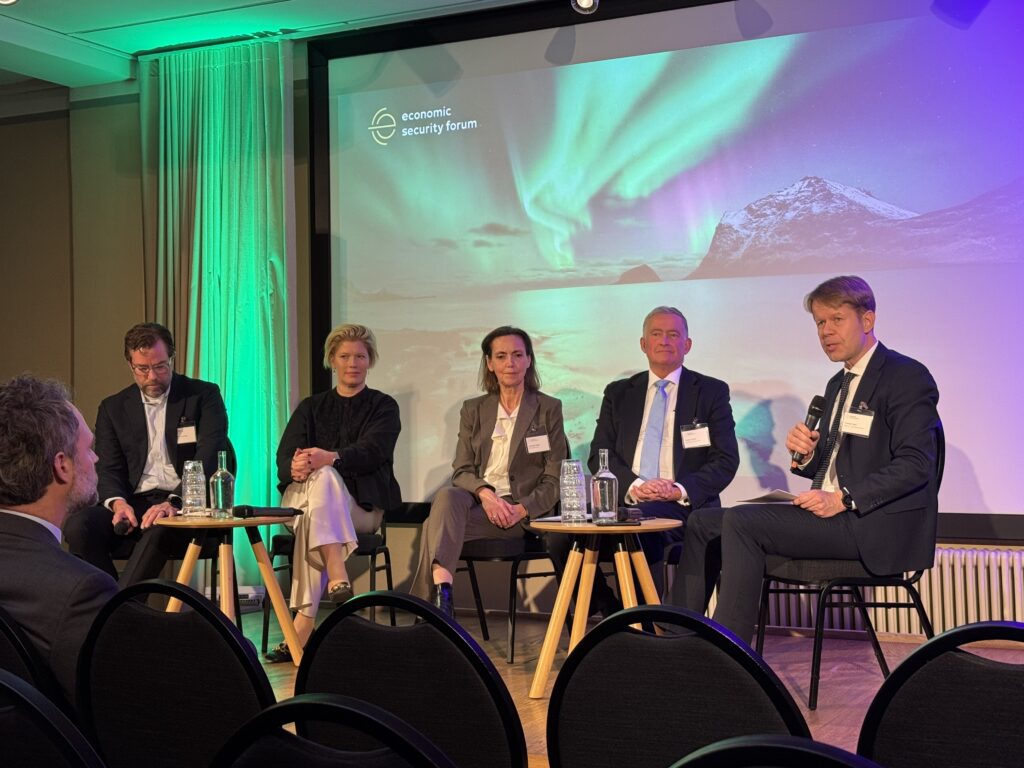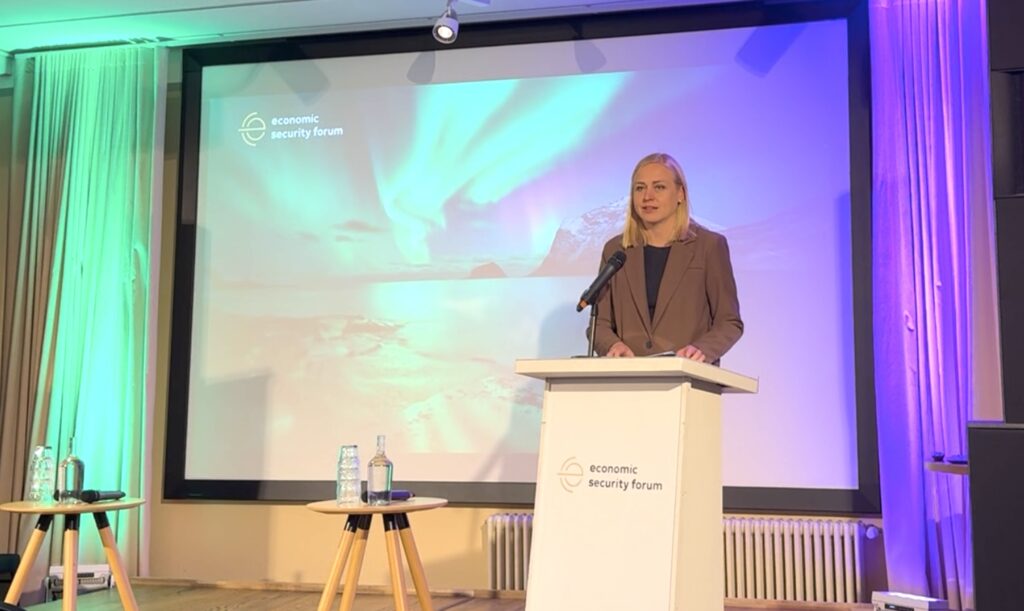
Emphasising the recurring rise of geoeconomics, Finland’s Foreign Minister Elina Valtonen used the launch of the Nordic Economic Security Programme (NESPO) in Helsinki to pitch a bold economic initiative for the Alliance: a free-trade zone covering the entirety of NATO.
Support for Ukraine will weigh on Nordic national budgets for years, if not decades — but “you cannot put a price tag on freedom,” minister Valtonen reminded.
“I personally think that the entire NATO region should be an area of free trade, an integrated transatlantic economy which strengthens not only our prosperity, but also our collective security,” Finland’s Foreign Minister Elina Valtonen told the audience, speaking at Sock Hall, Helsinki, where the Economic Security Forum unveiled its Nordic Economic Security Programme (NESPO).
Valtonen argued that the security of the Nordic countries requires sustainable economic growth through strategic competitiveness — especially vital because of the Russian-Ukrainian war.
“Together with our allies and partners, we have engaged in a three-fold strategy,” Valtonen said. “First of all, our commitment and support for Ukraine in political, economic, and military terms. Second, continued pressure on the Russian war economy. The European Union recently adopted its 19th sanctions package, and the sanctions actually do work. Finally, strengthening European defence and deterrence for the long term. This strategy does not come for free,” Valtonen reminded.
“Support for Ukraine and increased defence expenditure will weigh on our national budgets for years, if not decades, to come. But the truth is, you cannot put a price tag on freedom.”
Turning Nordic Resilience into Competitive Advantage
The event also served as the public launch of the Nordic Economic Security Programme itself.
Mikael Wigell, CEO of the forum, presented its geoeconomic preparedness framework — a practical toolbox to help Nordic governments and companies map dependencies, reduce strategic vulnerabilities, and coordinate responses to coercive economic measures. The framework draws on his earlier work at the Finnish Institute of International Affairs on how Europe should handle geoeconomic pressure from major powers.
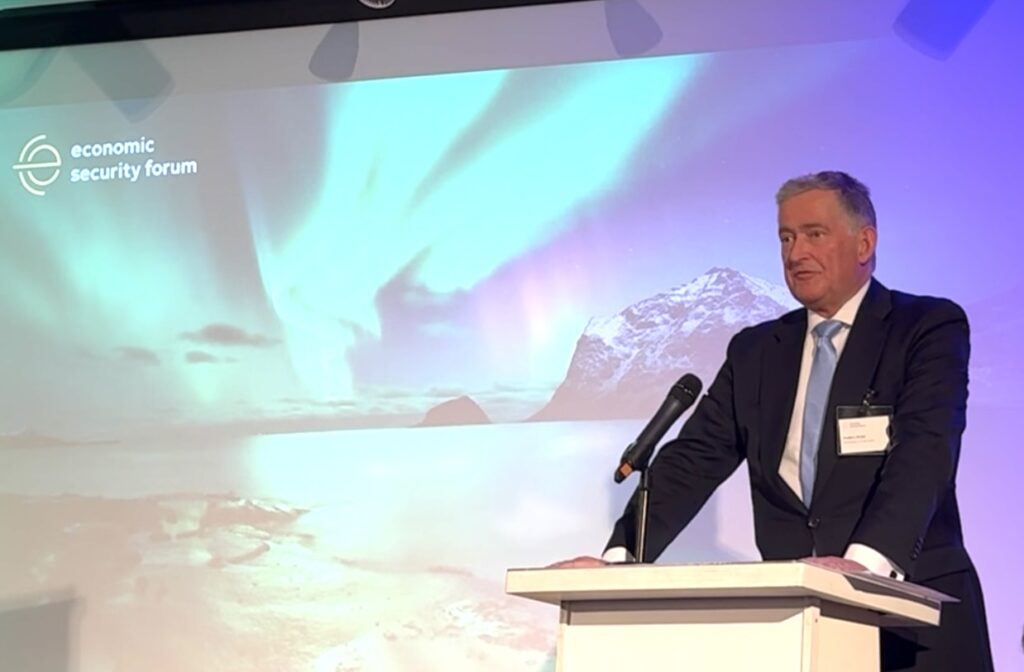
Director-General Anders Ahnlid of the National Board of Trade Sweden, reminded the audience of the Rise of Geoeconomics and the economic and demographic shifts changing the EUnes’s relative market power.
“The rise of countries like and economies like Indonesia, India, and Brazil is an important factor,” Ahnlid reminded. “That also leads to turning that is in turn likely to impact the so-called Brussels effect, that is, the EU’s ability to influence global standards and rules through its own regulations that we have to rethink,” Ahnlid said.
Mikael Wigell agreed on the rise of geoeconomics and constantly shifting balance of market power.
“The world is not flat anymore. We’re an archipelago, islands still connected to each other, but with friction in between that we need to learn to manage this friction,” Wigell said at the kick-off. “That is why we see economic policymaking being focused very much on resilience these days and on managing the vulnerabilities that come from weaponised trade and from — and we see all these new instruments of economic policymaking, investment screening regimes, export control, sanctions, tariffs.”
The aim of the forum is to ensure that the Nordic countries remain competitive in key sectors of the economy — the very strategic sectors that also carry strong security interests.

“So strategic inputs and resources, critical minerals, those are essential for our competitiveness going forward and for our resilience. Strategic technologies, these critical technologies like AI, quantum, and biotech, require certain inputs in our economy,” he listed.
Wigell warned that if the Nordic countries are not competitive in these sectors, “we will be locked into other external platforms that make us essentially hostages. If we don’t manage to produce our critical materials, our own or have certain technological digital infrastructure platforms, we’ll be hostages of external powers. That is the mode of today’s international system.”
Key Elements of Strategic Competitiveness
- Strategic logistics (transport, supply chains, flow of goods)
- Strategic raw materials / mining / critical resources
- Strategic energy (infrastructure, supply security)
- Strategic tech / digital / defence industrial capacities
- Strategic manufacturing (industrial base, dual-use goods)
- Strategic defence / digital / raw-materials intersections (e.g. dependencies in defence tech)
- Strategic finance (implicit in economic-security framing, though not always listed explicitly)
Wigell said the goal is to make the Nordics first movers in economic-security policy: small, highly open, tech-intensive, export-driven economies cannot wait for larger blocs to decide for them. The forum plans a series of ministerial- and CEO-level roundtables in 2025–26 to push for common Nordic positions on supply-chain security, foreign-investment screening, and critical-infrastructure protection.
Economic Defence, Weaponised Interdependence
Valtonen’s idea lands at the intersection of three trends the forum was established to address:
- Weaponised interdependence — Russia’s war and China-related export controls have shown how energy, technology and transport chokepoints can be used as leverage.
- Defence-industrial scaling — NATO governments want more munitions, ISR and space-based services — fast — but fragmented rules and procurement markets slow this down.
- Trusted-network economics — Nordic countries in particular prefer to trade and innovate within predictable, rules-based networks: the kind NATO provides politically, but not yet economically.
A NATO-wide free-trade zone would not replace EU trade policy but would create a security-driven fast lane for dual-use technologies, defence supply chains, cybersecurity services and space-based capabilities — all areas the Nordic Economic Security Programme says must be shielded from adversarial leverage.
That approach matches the forum’s core ambition: turning resilience into a competitive advantage.