
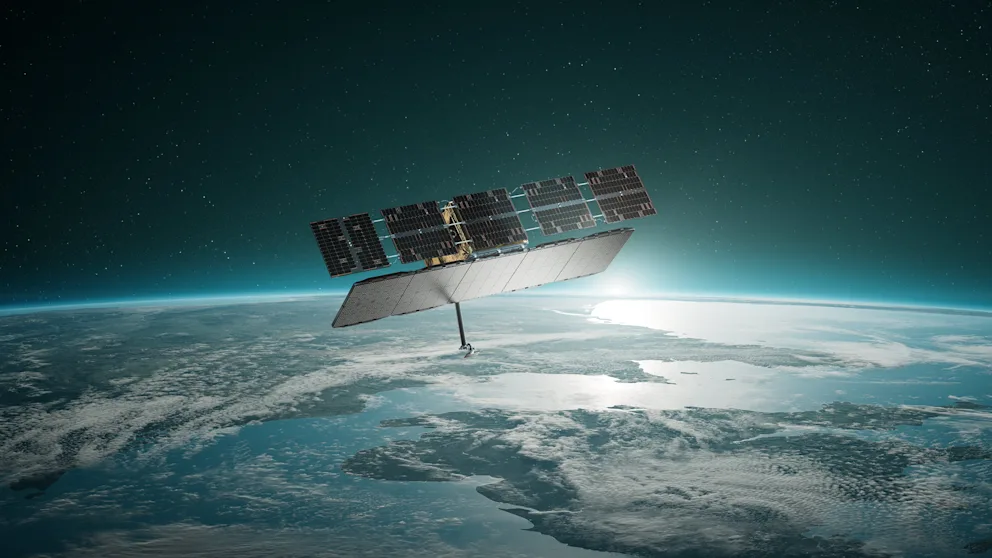
Germany’s Bundeswehr is on the verge of commissioning a major new satellite constellation from an unprecedented partnership between defence giant Rheinmetall AG and Finnish start-up ICEYE. According to Rheinmetall CEO Armin Papperger, the plan is to deliver 40 low-Earth orbit (LEO) reconnaissance satellites to the German military over the next two years.
This deal would mark the first satellite order in Rheinmetall’s history, with an estimated contract value of about €4 billion. The contract is reportedly “unterschriftsreif”, ready to sign, pending final review by the Bundeswehr’s procurement office and funding approval by the Bundestag’s budget committee, which could come by the end of this year. If greenlit, production would ramp up quickly: the joint venture aims to begin operations before year-end 2025 and have the first satellites rolling off the line by 2026.
Proposed deal:
- Constellation Size: ~40 small SAR (Synthetic Aperture Radar) satellites in LEO, providing high-frequency, all-weather radar imaging coverage.
- Contract Value: Approximately €3 billion. Defence industry experts estimate the order at about three billion euros, with some variations depending on the final scope. If Rheinmetall also operates the constellation as a service, the value could increase further.
- Timeline: 2026–2027 deployment. Rheinmetall plans to build and deliver all 40 satellites within roughly two years, dramatically expanding Germany’s space-based surveillance capabilities by 2027.
- Manufacturing in Germany: The satellites will be co-developed with ICEYE but manufactured at Rheinmetall’s plant in Neuss, Germany. A former automotive components factory in Neuss is being converted for satellite production, integrating ICEYE’s cutting-edge tech with Rheinmetall’s mass-production know-how.
- Filling an Intel Gap: German defence officials see this constellation as closing a critical “Informationsgewinnungslücke” – an information-gathering gap – for the Bundeswehr. The high-revisit SAR network would provide near real-time reconnaissance imagery, addressing a shortfall in Germany’s current surveillance capabilities.
The Bundeswehr already operates a SAR satellite system called SARah, which succeeded the 2007-era SAR-Lupe constellation. SARah’s three satellites, launched in 2022–2023, offer high-resolution radar imagery, but a 40-satellite LEO network would massively increase coverage and revisit frequency. The new small-satellite constellation, built with ICEYE’s technology, is expected to complement these existing assets and dramatically improve Germany’s autonomous observation capacity. In effect, this deal would catapult Germany into a new level of space-based intelligence, with homegrown satellites providing round-the-clock eyes in the sky.
Rheinmetall’s Expansion into Space Technology
Rheinmetall AG – traditionally known for tanks, artillery, and automotive defence systems – is pivoting into the space arena as part of a broader growth strategy. Headquartered in Düsseldorf with over 40,000 employees worldwide, Rheinmetall has been aggressively diversifying its portfolio in response to heightened security demands in Europe. Recent moves include the €1+ billion acquisition of naval shipbuilder Lürssen’s military division (NVL) in 2025, expanding into warship production. Now, with satellites, Rheinmetall is extending its reach to the final frontier.
The company’s foray into space began with a partnership approach. In mid-2024, Rheinmetall, through its Nordic subsidiary, made a strategic investment in ICEYE, recognised as an international leader in small SAR satellites. By September 2024, Rheinmetall had secured exclusive rights to market ICEYE’s radar satellite services to military and government customers in Germany and even Hungary. This close cooperation quickly deepened: in May 2025, Rheinmetall and ICEYE signed a memorandum of understanding to form a joint venture focused on satellite manufacturing.
Rheinmetall ICEYE Space Solutions GmbH, the new joint venture, was officially established in November 2025, just five months after the MoU. Rheinmetall holds a 60% majority stake and ICEYE 40%. The JV is headquartered in Neuss, Germany, where it will anchor Rheinmetall’s emerging “Space Cluster”. Operations are slated to start immediately, late 2025, with plans to produce the first satellite on German soil by 2026. By venturing into satellite production, “Rheinmetall is strengthening its activities in the space sector,” the company notes, citing a sharply rising global demand for space-based reconnaissance.
Rheinmetall’s role in the partnership is to bring industrial scale, systems integration, and defence-market access to ICEYE’s proven technology. The company will leverage its large manufacturing base, even repurposing an auto-parts plant in Neuss, to produce satellites rapidly and in larger quantities than ICEYE could alone. Rheinmetall’s global defence sales network will likewise help in marketing the new satellites and related intelligence services to other nations. In fact, Rheinmetall’s ambitions go beyond just this initial SAR constellation. Insiders report the firm aims to develop additional satellite constellations for communications and optical Earth observation for the Bundeswehr in the future. Such constellations, depending on size, “could cost up to €10 billion” and would further expand Rheinmetall’s footprint in space-related defence tech. The company also plans to offer value-added services, working with ICEYE to analyse satellite data and deliver actionable intelligence to customers, not just raw images.
This joint venture and upcoming satellite deal represent a strategic leap for Rheinmetall. The 134-year-old defence contractor – famed for Leopard tank cannons and munitions – is reinventing itself as a comprehensive defence technology provider, now spanning land, sea, air and space. This aligns with NATO’s recognition of space as a new operational domain, and positions Rheinmetall to compete with traditional aerospace players in fulfilling Europe’s defence needs.
ICEYE: Small Satellites with Big Impact
Founded in 2014, ICEYE Oy has quickly risen to prominence as a pioneer of miniaturised radar satellite technology. The Helsinki-based company operates the world’s largest SAR satellite constellation, consisting of dozens of microsatellites that can image the Earth in high resolution, up to ~25 cm detail, day or night, through clouds. ICEYE’s technology uses synthetic aperture radar to penetrate weather and darkness, providing persistent surveillance capabilities that traditional optical satellites, limited by daylight and clear skies, cannot match. This innovation has attracted global attention, making ICEYE a “globally leading SAR satellite manufacturer,” as Rheinmetall describes it.
Despite its relatively small size – ICEYE has about 900 employees as of 2025 – the company has made outsized contributions in the defence and intelligence arena. Its satellites have been providing critical imagery in conflict zones and disaster areas alike. ICEYE gained renown for its support to Ukraine’s defence: when Russia’s invasion highlighted gaps in surveillance, ICEYE’s SAR constellation was able to deliver timely recon imagery. In fact, under the Rheinmetall partnership, ICEYE satellites have already been supplying the Ukrainian military with radar imagery to aid in spotting Russian forces. In November 2024, Rheinmetall (with support from the German government) signed a contract to provide enhanced ICEYE SAR data and services to Ukraine, expanding on earlier emergency assistance. This move helped address Ukraine’s urgent intelligence needs during the war and demonstrated ICEYE’s value as a defence partner.
ICEYE is also directly equipping European allies with space assets. Poland, for example, struck a deal in 2024 to acquire its first military reconnaissance satellites from an ICEYE-led consortium. The Polish Ministry of Defence’s MikroSAR program will deploy at least three ICEYE-built SAR satellites (with an option for three more) to give Poland its own independent imaging capability. The initial contract, worth about 860 million zloty (~€200+ million), underscores that even mid-sized countries see strategic merit in ICEYE’s smallsat technology. By late 2025, the first Polish ICEYE satellite was being prepared for launch on a SpaceX Falcon 9 rocket, signalling how quickly such systems can be fielded. These satellites will enable Poland to “capture any images it desires” with 25 cm resolution, giving it a sovereign eye-in-the-sky for the first time.
Other defence-related milestones for ICEYE:
- Exclusive Defence Partnerships: In 2024, ICEYE granted Rheinmetall exclusive rights to market its SAR satellites to military customers in Germany and Hungary, cementing a path for deeper collaboration and foreshadowing the joint venture.
- Global Operations: ICEYE has established offices and ground stations in countries like Finland, Poland, the UK, US, and more to support worldwide clients. It offers not just satellites but also data services (e.g. near-real-time flood and disaster monitoring for governments and insurers). This dual commercial-and-defence focus has helped ICEYE scale rapidly.
- Tactical Access Service: The company recently introduced a “Tactical Access” program guaranteeing military customers prioritised imaging and ultra-fast data delivery (sub-1-hour latency) during critical operations. This kind of service caters directly to defence users who need timely intelligence on the battlefield.
ICEYE’s growing list of accomplishments made it an attractive partner for Rheinmetall’s venture. By integrating ICEYE’s agile NewSpace approach with Rheinmetall’s resources, the partnership aims to produce more satellites, faster – marrying innovative tech with industrial muscle. For ICEYE, the tie-up provides capital and manufacturing capability to undertake large projects like Germany’s 40-satellite constellation, which would have been difficult to execute alone. It’s a symbiotic relationship that could reshape Europe’s defence industry by bridging a nimble startup with a heavyweight contractor.
Strategic Significance: Closing Gaps and Enhancing European Autonomy
Beyond the business and technical details, this prospective Rheinmetall-ICEYE satellite constellation carries broad strategic implications. For Germany’s Bundeswehr, it promises a new level of information superiority. As noted, the 40 SAR satellites will fill a long-recognised gap in Germany’s intel, surveillance, and reconnaissance (ISR) capabilities. Unlike the handful of existing SARah satellites, a large constellation can provide near-persistent coverage, significantly reducing the wait time for fresh images of any area of interest. All-weather SAR imaging means German forces can track movements on the ground continuously, even at night or through clouds – a crucial advantage for both peacetime situational awareness and wartime targeting. In modern conflicts like Ukraine, ubiquitous satellite imagery has proven decisive for detecting threats such as troop buildups and tracking mobile missile launchers. By investing in its own constellation, Germany ensures its military won’t have to rely solely on allies or commercial providers for such critical data.
Crucially, this move is also about European strategic autonomy in space. European militaries, including Germany’s, have historically depended heavily on American satellite capabilities for high-end intelligence. The war in Ukraine – and even prior rifts like the Trump-era uncertainty around intelligence-sharing – have been a wake-up call. European leaders are now pushing to reduce reliance on U.S. assets and develop sovereign space infrastructure. In March 2025, EU Commissioner Andrius Kubilius revealed that the EU is exploring its own LEO spy-satellite network to generate rapid imagery updates, every 30 minutes, and “reduce its reliance on United States military assets”. Although a full EU-owned constellation would be a massive endeavour, initiatives like IRIS², the EU’s planned secure multi-orbit communications constellation by 2027, and various national programs all signal a trend: Europe wants independent space-based intelligence.
The Rheinmetall-ICEYE project can be seen as a concrete step toward that autonomy. It creates a domestically built system under European control, rather than purchasing American or other foreign satellites. As ICEYE’s CEO Rafal Modrzewski put it, the joint venture is aimed at “securing the sovereign defence capabilities of Europe”. By leveraging European technology and industrial base, the continent gains more control over its security tools. The new constellation would allow Germany, and potentially its European partners via intelligence-sharing arrangements, to obtain real-time reconnaissance without needing U.S. satellite tasking or data. This complements efforts by other EU nations, for instance, France and Italy’s optical spy satellites, or Poland’s mixed fleet of ICEYE radar sats and Airbus-built optical sats, to assemble an ecosystem of European surveillance assets. Over time, these could be networked together, reducing duplication and providing Europe a robust collective ISR capability parallel to, but not dependent on, that of the United States.
Another aspect of autonomy is the resilience and operational freedom it affords. If geopolitical tensions ever restrict Europe’s access to external systems (imagine a scenario where U.S. intelligence is preoccupied elsewhere or political frictions intervene), having one’s own “eyes in space” is invaluable. It also means Europe can pursue security missions aligned with its own interests – for example, monitoring its eastern flank or Africa – with less external constraint. This aligns with NATO’s calls for members to bolster their “national space assets” as part of the alliance’s overall strength, ensuring multiple redundant sources of intel.
Lastly, the deal underscores how defence and industry collaboration is evolving in Europe. Non-traditional players like ICEYE are being brought into the fold alongside established defence primes, accelerating innovation. The Nordic countries’ burgeoning space sector, the new launch sites in Norway/Sweden for small rockets, and partnerships like this all feed into Europe’s attempt to catch up in the new space race. While the U.S. still vastly outspends and out-launches Europe in space, such projects show Europe leveraging its niche strengths (like ICEYE’s SAR tech) to close the gap. As Reuters observed, the EU is scrambling to boost independent capabilities partly because of events like Elon Musk’s control over Starlink raising concerns during the Ukraine war. Europe clearly “has been rushing to find alternatives” in both communications and reconnaissance. In conclusion, the Rheinmetall-ICEYE satellite venture could be a game-changer for European defence. It delivers a powerful surveillance tool to the Bundeswehr, strengthens Europe’s high-tech defence industry, and moves the needle on Europe’s long-term goal of strategic autonomy in space. If the €3–4 billion deal goes through as anticipated, Germany will soon possess one of the most advanced radar satellite constellations in the world, made by Europeans for European security. This not only closes an intelligence gap for today but also lays the groundwork for Europe to stand on its own feet when it comes to critical space-based capabilities, a development with implications reaching far beyond Germany’s borders.
Read More:
- Deutschlandfunk: Rheinmetall steht vor Satelliten-Auftrag der Bundeswehr (in German)
- Golem: Rheinmetall vor Satelliten-Großauftrag der Bundeswehr (in German)
- Handelsblatt: Rheinmetall steht kurz vor Satelliten-Großauftrag der Bundeswehr
- Defense News: Poland sets up first-ever military satellite launch
- SpaceIntel Report: Rheinmetall-Iceye JV nears first big order for radar satellites from German Bundeswehr
- Bild: Rüstungs-Riese Rheinmetall baut bald Satelliten
- IntelNews: European Union exploring spy satellites to replace its reliance on US network
- Reuters: Europe looks to Nordic space race to scale back US dependence
- ICEYE: Rheinmetall and ICEYE establish joint venture in Neuss
- ICEYE: ICEYE launches Tactical Access, providing guaranteed satellite tasking for time-critical missions
- Rheinmetall: Rheinmetall und ICEYE kooperation