
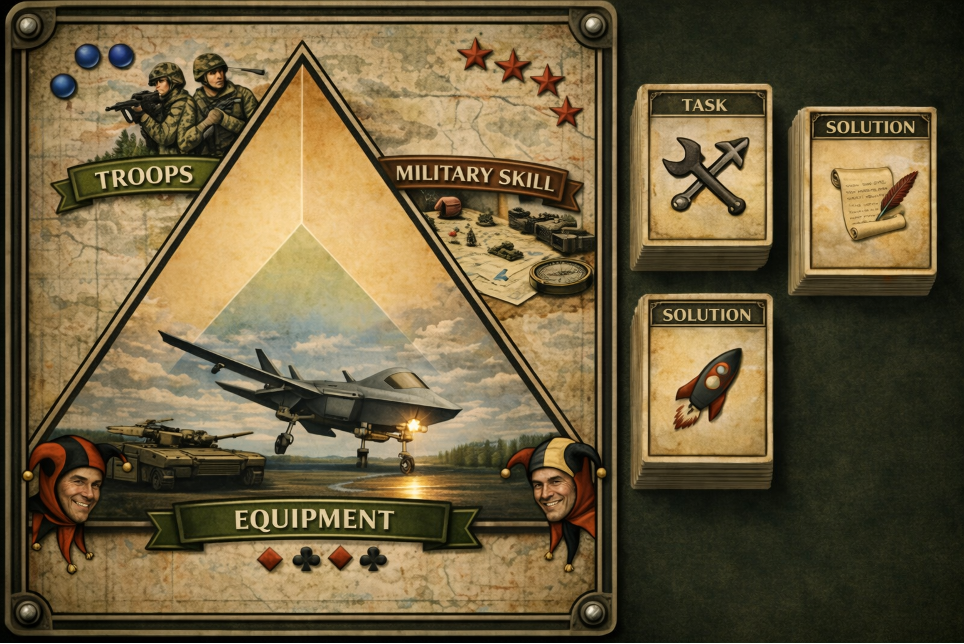
In discussions about drones, the first card typically played is “The battle tank is dead!” After a brief back-and-forth, the matter is dismissed by throwing down the “Drones are not wonder weapons” card. The first starts the conversation; the second ends it. Too often, they’re played so quickly in succession that the discussion dies before it even begins. This, of course, doesn’t stop the conversation outside the Defence Forces — but when that happens, the Defence Forces risk marginalising themselves from an increasingly heated public debate, because drones are coming regardless.
A third card in the deck brings the discussion back to square one, as if it had never happened. It reads: “Only the battle tank combines firepower, mobility, and protection.” It’s a circular argument: if something must be like a tank, only a tank will do.
Let’s take a closer look at what these cards actually contain.
The Game and Its Cards
When the “The battle tank is dead!” card is played, few notice the fine print. It actually says: “The current form of the battle tank is dead.” So the question isn’t whether armoured vehicles are needed, but rather that the battle tank must evolve into the combat vehicle of the future.
The brilliance of the “Drones are not wonder weapons” card lies in the fact that it can be played even if no one has played the “Drones are wonder weapons” card. It also contains a claim that’s impossible to refute — everyone knows there are no wonder weapons. Nothing is a wonder weapon. In the West, we don’t believe in miracles, so invoking them is a clever psychological move: anyone who talks about wonder weapons is, by implication, a believer in miracles — and therefore not credible.
Still, we can ask: what would qualify as a wonder weapon, if any weapon deserved the title? Would it be one that causes 80% of casualties in modern warfare at a cost of half a thousandth of the price of the destroyed system? Far more expensive mines, shells, and missiles together account for only 20% of casualties. Would the title go to a system that allows a navy with virtually no ships to drive an enemy fleet back into its harbours? Or perhaps to a weapon that enables a country without strategic missile forces or an air force to extend its reach across the enemy’s entire territory — crippling exports, energy production and distribution, banking, and air and sea traffic? We know drones are not wonder weapons. But if any weapon were to earn that title, it would be the drone.
If you examine the circular-logic card under a magnifying glass, you’ll see it actually says: “Of the technologies known to me, only the battle tank combines the firepower of a direct-fire cannon carried with it, protection focused on the frontal sector, and tactical mobility.” Its validity can be questioned by asking: why is protection focused on only one sector? Why must the main weapon be direct-fire? Why must the platform go to the target? And why is protection based largely on absorbing hits rather than avoiding them?
The Task and the Solution
In the defence-system game, there are three piles: problem, task, and objective cards in one; solution cards in another; and innovation cards in a third. Integrating firepower, protection, and mobility is a solution card, not a task card. The rulebook states that the player who starts the round must play a task card, after which the next player must choose a suitable solution card from their hand. If none fit, they may draw an innovation card from the research and development deck.
The rules forbid placing solution cards in the problem pile. Thus, playing the firepower–mobility–protection card as both the task and the solution breaks the game’s logic, which dictates that a task leads to a solution, but a solution does not lead to a task.
The task deck contains strategic, operational, tactical, and technical cards. The battle tank card in the solution deck corresponds to a tactical task card that reads: “Develop a means to penetrate the enemy’s defences, advance deep, and destroy the enemy’s sources of power using 20th-century technology.” There’s also another task card: “Develop a means to destroy the enemy’s sources of power first, and only then attack — using 21st-century technology.” Both belong to the group whose operational goal is to paralyse the enemy’s systematic defence and avoid a war of attrition.
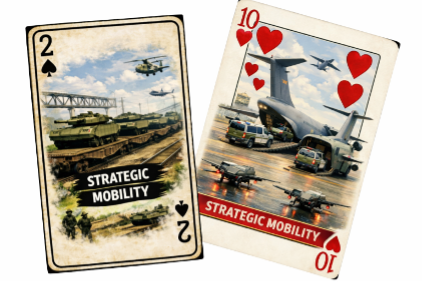
Using 20th-century technology — that of the First and Second World Wars — one could only strike at the enemy’s sources of power by shooting at them with a cannon. The cannon had to be dragged close to the target, after which the headquarters, supply point, or firing position was bombarded with all available firepower. To get the cannon close, it had to be transported through the enemy’s front line. By attaching a tractor engine and a combustion motor to the cannon, it became self-propelled. Since the gun crew travelled with the cannon and had to pass through enemy defences, they needed protection — hence the armoured shell. Thus was born the tank: gun, crew, engine, and armour — all in one package.
Each card has three fields: soldiers, military skill, and equipment. The card’s value is the product of these factors. According to the game’s logic, a card is worthless if even one of the three fields is empty. Successful play, therefore, requires simultaneous consideration of soldiers, skill, and technology.
The winning team differs from the losing one in that it includes players who master all three corners of the triangle. Losing teams, by contrast, are homogeneous — their view of the battlefield is uniform, and their attitude toward those who bring diversity of thought is dismissive or, in the worst cases, hostile.
Range of Effect
Instead of physical mobility, what matters is the range of effect. This is reflected in the American performance model, where effect is the combined result of fire and movement. I use the term range of effect, defined as the sum of the platform’s mobility and the weapon’s range — that is, how far or widely the system can exert influence within a given time.
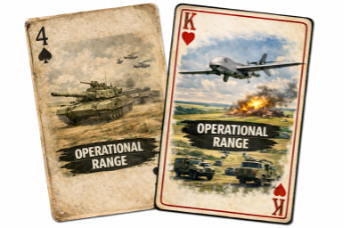
If your task card is to develop, using 20th-century technology, a means to destroy the enemy’s sources of power, you’ll likely end up with a hand containing a cannon, a tractor, and a bunker. But if your task card asks for a solution to the same problem using 21st-century technology, many possibilities open up.
In a hundred years, technology has advanced to the point where the performance package can be unbundled: lift your eyes to the sky, send the cannon forward without men, and keep the crew far from danger. If the weapon is not a tank gun but a drone, missile, or loitering munition, the platform — the vehicle — need not go near the target. It therefore doesn’t need to break through defences, and the crew doesn’t need protection from direct fire — that is, from the front sector. The eyes detached from the cannon and tractor can be small, agile, and inconspicuous observers in the sky, scouting and locating the enemy’s sources of power. And if the effect is based on drones, it reaches far beyond what a forest-bound cannon ever could. In that case, the winning hand consists of drones, a light vehicle, and an indirect weapon.
Diversity of Discussion Is Essential
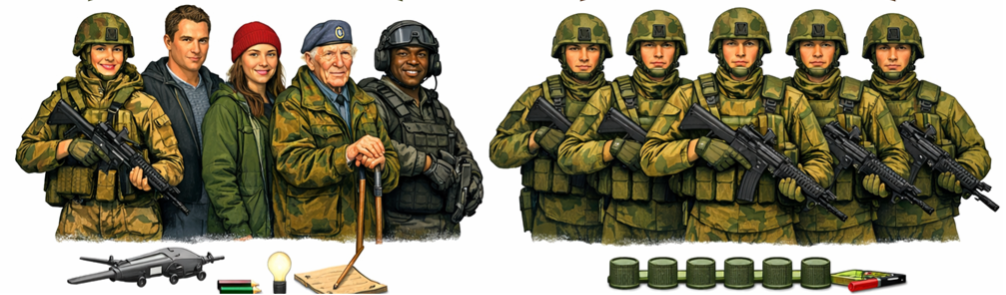
In successful organisations, multifaceted discussion is used as a tool for managing the risks of strategic decision‑making. The purpose of such multidimensional dialogue is to ensure that an issue is examined from as many perspectives as possible, so that no risk goes unidentified and no opportunity goes unnoticed. Understanding different perspectives requires different kinds of people — specifically, people who think differently. This in turn demands a variety of personality types as well as diverse educational and experiential backgrounds.
The Drone Debate and Its Polarisation
An unfortunate polarisation has emerged in the drone debate — a “drones versus tanks/ships/aircraft” setup — where those clinging to traditional concepts sometimes seek to exclude proponents of drones from the discussion, arguing that tanks were not part of their master ’s-level education. Yet one can certainly take part in the drone debate without ever having operated a drone.
If we assume that only someone with a master’s degree in military science is entitled to discuss military art and technology, we lose the opportunity to influence and persuade society at large. Had such an attitude prevailed in the 1930s and 1940s, most of the military professionals we now hold in high regard — Airo, Siilasvuo, Raappana, Pajari, Marttinen, Heiskanen, Talvela, Öhquist, Heinrichs, Nenonen, and Lagus — would have been excluded from the debate on military art. To my knowledge, none of them attended the cadet school.
Let’s keep that in mind and welcome everyone who wishes to join the discussion on Finland’s defence. Those of us who imagine we know the subject can use factual arguments to demonstrate our professionalism. At the same time, we accept that the world is not black and white — and that every issue has many perspectives.
The author Jyri Kosola is the former Director of Research in the Finnish Defence Forces. He continues his work through his company Pathfinder Solutions.