
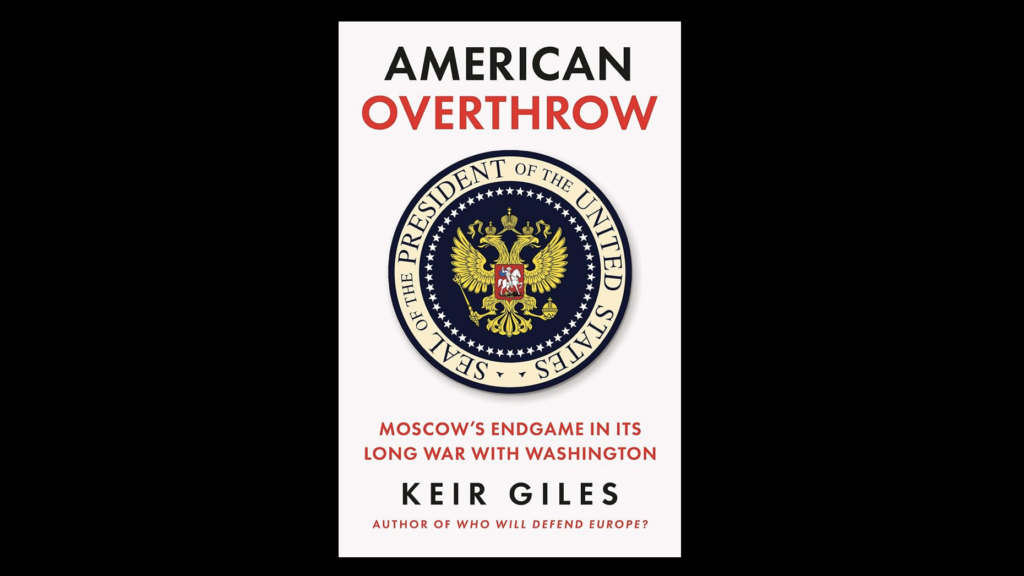
Keir Giles’s new book, American Overthrow, argues that Washington is delivering many of Moscow’s most cherished strategic objectives. From Switzerland’s extraordinary tariff diplomacy to Ukraine’s dependence on Starlink, the consequences for European security are becoming increasingly tangible.
The Kremlin has spent decades trying to weaken NATO, divide Europe from the United States and convince Western governments that Russia must have a decisive say over the security of its neighbours. According to British Russia specialist Keir Giles, Donald Trump’s second administration has advanced many of those objectives with remarkable speed.
In American Overthrow: Moscow’s Endgame in Its Long War with Washington, published by Hurst in September 2026, Giles examines a disturbing possibility: the United States is adopting aspects of the political behaviour and international outlook that have characterised Vladimir Putin’s Russia.
For European defence planners, the implications extend far beyond the political controversies surrounding Trump. They reach into military procurement, intelligence, satellite communications, nuclear deterrence and the fundamental question of who ultimately controls Europe’s ability to defend itself.
Giles brings a particular advantage to the subject. After decades studying Russia, its intelligence services and its methods of political warfare, he recognises patterns that other observers may regard as disconnected developments.
His central argument is that Russia has long sought to dismantle the Western institutions and alliances that constrain its ambitions. Trump has weakened several of those institutions while pursuing a rapprochement with Moscow.
The strategic results matter regardless of whether they arise from Russian influence, personal admiration for Putin, ideological affinity or independent decisions made in Washington.
A Kremlin Victory Without a Russian Invasion
Giles examines developments both inside and outside the United States. Domestically, he draws parallels between the Trump administration’s treatment of government institutions, political opponents, independent media and the judiciary, and the consolidation of power under Putin.
Abroad, he concentrates on the weakening of alliances, pressure on neighbouring states and Washington’s changing attitude towards Russia’s war in Ukraine.
The most consequential argument concerns the European security order.
For decades, Moscow has demanded recognition of a privileged sphere of influence encompassing countries that were once part of the Soviet Union or the Warsaw Pact. The Kremlin has repeatedly sought restrictions on NATO enlargement and on the strategic independence of neighbouring states. These demands have acquired a new significance under Trump.
During a visit to Helsinki in November 2026, Giles told Finnish broadcaster Yle that the United States had begun entertaining Russian proposals for a new European security architecture. He warned that allowing Russia to define the terms of negotiations would already represent a diplomatic success for Moscow.
The latest negotiations involving Washington, Moscow and Kyiv have reinforced those concerns. American negotiators have discussed arrangements extending beyond Ukraine itself, potentially involving the wider European security order.
Giles argues that Washington is increasingly treating European security as something that can be negotiated between great powers.
Such an approach has obvious consequences for Finland, Sweden, the Baltic states and Poland. Their security policies rest on sovereign decisions, NATO membership and the principle that other countries cannot determine their alliances.
The danger is that Europe’s security becomes a bargaining chip in negotiations conducted by powers with interests very different from its own.
This is where Giles’s earlier book, Who Will Defend Europe?, meets his latest work. His previous analysis explored Europe’s insufficient preparedness for the Russian threat. American Overthrow adds the prospect that Europe’s principal military guarantor may pursue policies fundamentally at odds with European security interests.
Alexander Dugin: The Man Who Wrote the Blueprint
In Keir Giles’s American Overthrow, Alexander Dugin plays a significant role as an early architect of the geopolitical vision that Giles believes is now being realised through the Trump administration. However, Giles explicitly rejects the popular description of Dugin as Putin’s brain.
“I am the last person you will find overstating the influence of Aleksandr Dugin, or calling him ‘Putin’s brain’,” Giles noted when promoting the book. The connection centres on Dugin’s 1997 book, Foundations of Geopolitics.
According to Giles, Dugin outlined a strategy for restoring Russian dominance in Europe by weakening the United States from within. The proposed approach included encouraging the isolationist right of the Republican Party, undermining America’s global commitments and persuading Washington to retreat towards the Western Hemisphere, leaving Europe exposed to Russian influence.
In a September 2026 interview, Giles said he was astonished by the resemblance between Dugin’s proposed strategy and the direction taken by the Trump administration almost three decades later. He specifically highlighted the renewed emphasis on the Monroe Doctrine, under which the United States prioritises its own hemisphere.
Giles sees a remarkable convergence between Russian strategic ambitions and American policy. He does not establish that Dugin personally directed Putin or that American officials consciously implemented Dugin’s instructions.
How influential is Dugin in the Kremlin?
Alexander Dugin has been an influential figure in Russia’s nationalist and imperial intellectual circles, especially through his advocacy of Eurasianism and opposition to Ukrainian independence.
Yet his direct access to Putin remains uncertain. A substantial 2025 examination in The New Yorker concluded that the personal relationship between the two men has often been exaggerated. It suggested that Putin’s adoption of Dugin-like ideas may have been indirect, reflecting a broader tradition of Russian imperial thought.
Dugin’s significance therefore lies partly in the ideological climate he helped cultivate, particularly among nationalist and security elites. The New Yorker
The most useful interpretation of Giles’s argument is that Dugin supplied a strategic blueprint which appears remarkably relevant to contemporary events. Whether he had a decisive influence on Putin, or whether the Kremlin and Dugin independently drew upon similar imperial traditions, is a separate and unresolved question.
How Far Does the Evidence Go?
The book has attracted considerable attention in British and American security circles. The Financial Times, reviewing Giles alongside other recent books on Russia, praised his detailed catalogue of parallels between Trump’s America and Putin’s Russia. However, it also raised doubts about the suggestion that Russian intelligence could have engineered such a sweeping American political transformation.
Major Luke Turrell, reviewing the book for The British Army Review, similarly observed that parts of the argument resemble a carefully constructed conspiracy theory. Nevertheless, his review took seriously the book’s broader account of America’s changing political and strategic direction.
Martin Dewhirst, writing for Rights in Russia, focused particularly on Giles’s warning that the damage to confidence in the United States could outlast Trump himself.
The book has also received endorsements from former US national security adviser Fiona Hill, historian Anne Applebaum, former Estonian president Toomas Hendrik Ilves and former senior CIA officer John Sipher.
Hill’s interpretation is particularly revealing. She describes the transformation as Moscow-inspired and Washington-made.
Policy convergence is observable. The precise mechanism behind it is considerably harder to establish. The available evidence does not demonstrate that Trump operates under Kremlin direction, and ideological alignment or commercial interests can explain decisions that benefit Moscow.
Nor is American policy uniform. Congress approved additional Russia sanctions in September 2026, and American intelligence support for Ukraine has continued, even while the administration has pursued sanctions waivers, reduced direct military assistance and pressed Kyiv for concessions.
Angela Stent, writing for Russia Matters after the November midterm elections, described an administration pursuing closer economic and diplomatic relations with Moscow while seeking to end the war through territorial concessions by Ukraine.
The divergence between the president, Congress and elements of the American security establishment remains strategically significant.
For European governments, however, uncertainty about Washington’s intentions has become a defence planning problem in its own right.
Switzerland Discovers the Price of American Goodwill
One of the book’s most revealing episodes concerns Switzerland, a wealthy and traditionally cautious country that found itself unexpectedly exposed to American economic pressure.
In August 2025, Trump imposed a 39 per cent tariff on many Swiss exports to the United States, an exceptionally severe rate for a developed European economy.
A delegation of influential Swiss business leaders, including executives associated with Rolex, Richemont and Partners Group, visited the White House in November. They brought a Rolex table clock and an engraved gold bar.
Within days, Washington and Bern announced a framework agreement reducing tariffs from 39 to 15 per cent. Swiss companies also pledged investments in the United States totalling $200 billion by the end of 2028.
The sequence attracted international criticism, although it does not by itself establish that the gifts caused the tariff reduction or constituted bribery.
Swiss and German-speaking newspapers were particularly interested in what the deal revealed about the balance of power.
The Wall Street Journal described the episode as gold-bar diplomacy. Germany’s Frankfurter Allgemeine Zeitung published a commentary entitled Die Kapitulation der Schweiz, or The Capitulation of Switzerland.
Switzerland’s own public broadcaster, SRF, reported criticism from the Neue Zürcher Zeitung and Tages-Anzeiger. The newspapers questioned the concessions made by Bern and the unusual influence exercised by private business leaders over state diplomacy.
The French-language Swiss newspaper Le Temps examined the parallel diplomacy of the business executives and later reported that US Senator Ron Wyden had demanded explanations about the expensive gifts and the apparently arbitrary tariff decisions.
The allegations also produced political complaints in Switzerland. Yet the Swiss government’s defence of the arrangement deserves attention.
In October 2026, Helene Budliger Artieda, Switzerland’s senior trade official, maintained that the gifts were intended for the American people rather than Trump personally. She said they had been properly registered and defended the legality of the business delegation’s conduct.
For Swiss exporters, the reduction to 15 per cent delivered substantial economic relief. Bern had limited attractive alternatives and considerable commercial interests at stake.
The affair illustrates a characteristic of transactional diplomacy: governments and businesses may find themselves negotiating access to established markets through personal relationships, investment promises and political concessions.
It also exposes a strategic vulnerability. A country whose prosperity depends heavily on access to a larger power’s market has limited room to resist abrupt changes in that power’s policy.
Switzerland’s experience is particularly interesting because its difficulties with Washington extend into defence procurement.
In 2026, Bern reduced its planned F-35 purchase from 36 aircraft to approximately 30 amid a dispute over costs. Deliveries of American Patriot air defence systems were also delayed, with subsequent estimates suggesting delays of five to seven years.
The Swiss authorities have consequently examined acquiring an additional air defence system from a European supplier. The French-Italian Eurosam consortium has emerged as a reported contender.
By October, Swiss armaments chief Urs Loher was publicly discussing attempts to buy some equipment directly from American manufacturers rather than through the US government’s Foreign Military Sales programme.
The reasoning was practical. Swiss officials had encountered delivery delays, changing American priorities and limited legal remedies in procurement disputes.
The same question now confronts much of Europe: how much control does a country retain over its defence when crucial equipment, technology and delivery decisions remain subject to another government’s discretion?
Sweden Chooses Collective Resistance
Sweden’s response to Trump’s tariffs offers an instructive contrast. As an EU member, Sweden approached the trade dispute through European institutions. In April 2025, Prime Minister Ulf Kristersson defended free trade and argued that rising barriers would make societies poorer and the world less secure.
He emphasised Sweden’s intention to act through the EU.
The confrontation became more politically charged in January 2026, when Trump threatened additional tariffs against Sweden, Britain and several other European countries in connection with the dispute over Greenland.
Former Swedish prime minister and foreign minister Carl Bildt described the threatened measures as a clear breach of the existing EU-US agreement and called for European and British countermeasures.
The contrast with Switzerland is instructive. Switzerland attempted to secure relief through bilateral bargaining and business diplomacy. Sweden relied on the combined weight of the EU and argued for a coordinated response.
Neither model eliminates dependence on the American market. European collective action, however, gives smaller countries access to negotiating power that they cannot exercise individually.
The strategic significance is broader than tariffs. European governments increasingly have to consider trade policy, technological dependence and military security as interconnected questions.
Starlink Exposes Europe’s Digital Vulnerability
The most immediate military example is satellite communications. Russia’s full-scale invasion of Ukraine turned SpaceX’s Starlink network into an essential component of modern warfare. Ukrainian forces have used satellite connectivity for battlefield communications, reconnaissance and drone operations.
By autumn 2026, that dependence had become a source of serious concern.
Restrictions affecting Starlink and its military-oriented counterpart, Starshield, disrupted Ukrainian operations. President Volodymyr Zelensky criticised speed restrictions affecting drone capabilities, while Washington disputed suggestions that the administration had deliberately imposed the limitations.
The exact responsibility remains contested, but the strategic consequence is clearer.
Max Bergmann of the Center for Strategic and International Studies warned in October that interference with satellite services supplied under commercial and government contracts could inflict lasting damage on confidence in American defence and technology companies.
The problem extends way beyond Ukraine. European armed forces depend on American technology across intelligence collection, military satellite communications, airborne surveillance, missile warning, precision weapons and command systems.
A potential adversary needs to exploit only a few of these dependencies to create substantial operational difficulties.
The International Institute for Strategic Studies has repeatedly identified America’s disproportionate contribution to NATO’s high-end supporting capabilities. Europe’s armed forces possess large numbers of aircraft, ships and armoured vehicles, but important elements of the infrastructure needed to employ those forces effectively remain American.
For European defence ministers, the lesson from Ukraine is immediate: access to a service during peacetime offers limited assurance about its availability during a political or military crisis.
Can Europe Replace Starlink?
Europe already possesses several relevant capabilities, although a comprehensive battlefield substitute remains some distance away.
The most established commercial alternative is Eutelsat OneWeb, operated by the Franco-British satellite company Eutelsat. Its constellation of roughly 600 to 650 active low-Earth-orbit satellites already provides services in Ukraine.
OneWeb can support command-post connectivity, government communications and backup networks. Its terminals, costs and operating characteristics currently make it less suitable than Starlink for some demanding mobile drone applications.
Swedish company SatCube has also provided satellite terminals to Ukraine with German support. These offer useful portable connectivity, although some use American-owned satellite capacity and cannot independently solve Europe’s dependence.
Other solutions include terrestrial mobile networks, tactical radio relays, mesh communications and increasingly autonomous unmanned systems capable of continuing their missions when communication links fail.
The EU’s GOVSATCOM programme has been operational since January 2026. It pools existing governmental satellite capacity to provide secure services.
A more substantial development is IRIS², Europe’s planned sovereign satellite communications constellation.
In August 2026, the European Commission announced an accelerated implementation agreement expanding the system to 348 satellites, with enhanced capacity for defence and security applications. Initial launches are scheduled for 2029, with services expected from 2030.
The system is being developed through the SpaceRISE consortium, which includes Eutelsat, Luxembourg’s SES and Spain’s Hispasat.
IRIS² represents a serious attempt to establish European control over critical satellite connectivity. Its military value will depend on the availability of suitable terminals, resistance to electronic warfare, reliable launch capacity and integration with operational systems.
Finnish-Polish satellite company ICEYE, founded by Pekka Laurila and Rafał Modrzewski, operates the world’s largest commercial synthetic-aperture radar (SAR) satellite constellation, providing reconnaissance through cloud and darkness.
Its joint venture with Germany’s Rheinmetall secured a €1.7 billion Bundeswehr contract, with dedicated satellites already monitoring NATO’s eastern flank. On 17 November 2026, ICEYE launched a €2 billion takeover bid for Italy’s Avio, manufacturer of the Vega launch rockets and missile propulsion systems. The proposed acquisition could bring satellite production, launch capabilities and space intelligence into an integrated European industrial group. Italian government approval remains a significant hurdle.
More directly relevant to Starlink, ICEYE and Nokia announced plans in October to develop sovereign military satellite communications, with nations controlling their own satellites, ground infrastructure and terminals. First launches are envisaged for 2028. The companies have also signed a letter of intent with Ukraine’s Ministry of Defence to explore an independent communications capability.
Another Finnish company, Kuva Space, is developing hyperspectral satellites capable of identifying surface materials through their distinctive spectral signatures. The technology could help distinguish synthetic camouflage netting from natural vegetation, identify sufficiently large exposed artificial or metallic surfaces and reveal concealed military activity through anomalies. Actual detection depends on spatial resolution and conditions. Kuva Space is cooperating with Japan’s IHI on military applications, including camouflage and decoy detection.
Europe’s most urgent vulnerabilities exist today, while its ambitious new architecture remains under development.
Sovereignty in satellite communications also requires control of the ground segment, encryption, software, service contracts and operational decisions. Satellite ownership alone cannot provide all these assurances.
Britain is Indispensable to European Strategic Sovereignty
The case for greater European independence has sometimes become entangled with arguments about EU institutional integration.
Britain remains one of the continent’s leading military powers, possessing nuclear forces, advanced intelligence capabilities, submarines, combat aircraft and a substantial defence industry.
Norway’s maritime position and energy infrastructure are vital to northern European security. Sweden and Finland contribute advanced military and defence-industrial capabilities. Denmark’s position, including Greenland and the Faroe Islands, links the Baltic, North Atlantic and Arctic theatres.
A functioning European defence architecture must encompass these countries, regardless of EU membership.
Britain and France signed the Northwood Declaration in July 2025, committing to closer coordination between their independent nuclear deterrents. They also agreed to develop a Combined Joint Force capable of operating across multiple domains.
In November 2026, British and French officials met again to advance their nuclear cooperation.
The European Council on Foreign Relations has proposed building European defence around existing NATO command structures, EU financing and flexible coalitions able to operate even with substantially reduced American assistance.
The model addresses an immediate challenge. Europe needs operational capabilities and political arrangements that can function under pressure, including when Washington is unwilling or unable to participate.
Such a system would also benefit the United States. A Europe capable of carrying more of its own defence burden would be a more resilient security partner and less vulnerable to disruptions in American domestic politics.
European aerospace, communications and defence companies possess significant expertise across satellites, sensors, air defence, electronic warfare and military networking. Firms including Airbus, Saab, Thales, Leonardo, BAE Systems, Kongsberg and Patria form important parts of that ecosystem.
The challenge involves integrating these capabilities into reliable operational systems, expanding production and ensuring sufficient interoperability and resilience.
Dependence cannot be eliminated quickly. Europe will continue to operate American aircraft, missiles and other advanced systems for decades. Diversification, alternative supply chains and greater control over critical software and communications can nevertheless reduce the risks.
Strategic autonomy is ultimately a question of operational freedom.
A Warning That Goes Beyond Trump
One of the most important passages discussed in international reviews of American Overthrow concerns the possibility that Europe’s problems with Washington will survive the current administration.
Giles compares the assumption that American politics will return to its previous patterns after Trump with earlier Western hopes that Russia would become less confrontational after Putin.
The comparison is debatable, given the substantial differences between American and Russian political institutions. Nevertheless, the possibility of lasting changes in US foreign policy deserves serious attention.
American attitudes towards alliances, trade and international commitments have evolved over several administrations. The growing American focus on China and the Indo-Pacific also creates pressures that are independent of Trump’s relationship with Putin.
Europe therefore faces a structural problem extending beyond the current White House.
Giles’s analysis is most persuasive when it examines the strategic outcomes of American policy and their resemblance to long-standing Kremlin objectives. Its more speculative implications about Russian control or hidden leverage require stronger evidence.
The developments since the book’s September publication have made that question more urgent.
Europe’s future security will depend on its ability to make decisions and execute military operations without requiring Washington’s permission at every critical stage. That is the lasting strategic question raised by American Overthrow, whatever historians eventually conclude about Trump’s motives and his relationship with Vladimir Putin.
Read More:
- Hurst Publishers: American Overthrow: Moscow’s Endgame in Its Long War with Washington
- Financial Times: Russia’s long war with the west — and with itself
- The British Army Review: American Overthrow: Moscow’s Endgame in its Long War with Washington
- Rights in Russia: Martin Dewhirst reviews ‘American Overthrow’ by Keir Giles
- Foreign Policy: Trump and Putin Are Alike in War: ‘American Overthrow’ Excerpt
- Yle: Arvostettu brittitutkija kertoo, miten Yhdysvallat on muuttumassa Venäjäksi: ”Trumpin Putin-ihailu lähenee palvontaa” (in Finnish)
- Russia Matters: The Midterms and U.S. Policy Toward Russia and Ukraine
- SRF: Vereinbarung Schweiz-USA – In den Medien wird der Zoll-Deal mit Trump kritisch kommentiert
- Le Temps: Derrière l’accord avec les Etats-Unis, la diplomatie parallèle des patrons suisses
- Le Temps: «Un apparent conflit d’intérêts»: l’horloge Rolex et le lingot d’or offerts à Donald Trump dans le viseur du Sénat américain
- SWI swissinfo.ch: Switzerland’s top trade official says gifts to Trump ‘were for the American people’
- SWI swissinfo.ch: Switzerland seeks direct defence contracts with US manufacturers
- SRF: Bundesrat engt Rennen um Luftabwehr ein und hält an Patriot fest
- Government Offices of Sweden: Statement from the Prime Minister in response to US tariffs
- SVT Nyheter: Bildt om Trumps tullbesked: Klart och entydigt avtalsbrott (in Swedish)
- Center for Strategic and International Studies: Throttling Starlink Is a Disaster for Ukraine and the United States
- Center for European Policy Analysis: Starlink Squeeze: Europe Searches for Alternatives
- The Insider: Tethered to Starlink: There are reasons why it’s not so easy for Ukraine to quit using Elon Musk’s services
- European Commission: The European Union is accelerating and reinforcing IRIS²
- European Space Agency: ESA Programme Related to EU Secure Connectivity – IRIS²
- European Council on Foreign Relations: Making defence European again
- International Institute for Strategic Studies: Defending Europe Without the United States: Costs and Consequenceshttps://www.iiss.org/research-paper/2025/05/defending-europe-without–the-united-states-costs-and-consequences/
- UK Government: UK-France Nuclear Steering Group Advances Progress Under Northwood Declaration
- Financial Times: Satellite group Iceye launches €2bn bid for Italian rocket maker Avio
- Defense News: Finland’s Iceye bids €2 billion for Italian rocket maker Avio
- Rheinmetall: Rheinmetall and ICEYE win billion-euro contract for space reconnaissance
- Rheinmetall: Major milestone achieved: Rheinmetall ICEYE Space Solutions provides the German Armed Forces with exclusive access to SAR satellites
- ICEYE: ICEYE and Nokia partner to launch secure and sovereign satellite communications for governments and defense customers
- Nokia: ICEYE and Nokia partner with the Ministry of Defence of Ukraine to develop sovereign satcom capability
- Kuva Space: IHI Corporation and Kuva Space partner to advance hyperspectral intelligence across Japan and East Asia
- Kuva Space: Seeing more in the same picture: what our Copernicus pilot showed about Europe’s land cover
- Keir Giles, LinkedIn: Keir Giles’ Post
- Bette Dangerous: AMERICAN OVERTHROW: A Q&A with Keir Giles, Part 2
- Fault Lines with Dr Matthew Godwin: American Overthrow: What Britain Must Learn from America — with Keir Giles
- The New Yorker: The Imperialist Philosopher Who Demanded the Ukraine War