
Stanley Kubrick’s 1975 masterpiece finds the same struggle for power on the battlefield and in the drawing room. Its extraordinary historical detail makes the past tangible, while its measured storytelling exposes the violence beneath the manners.
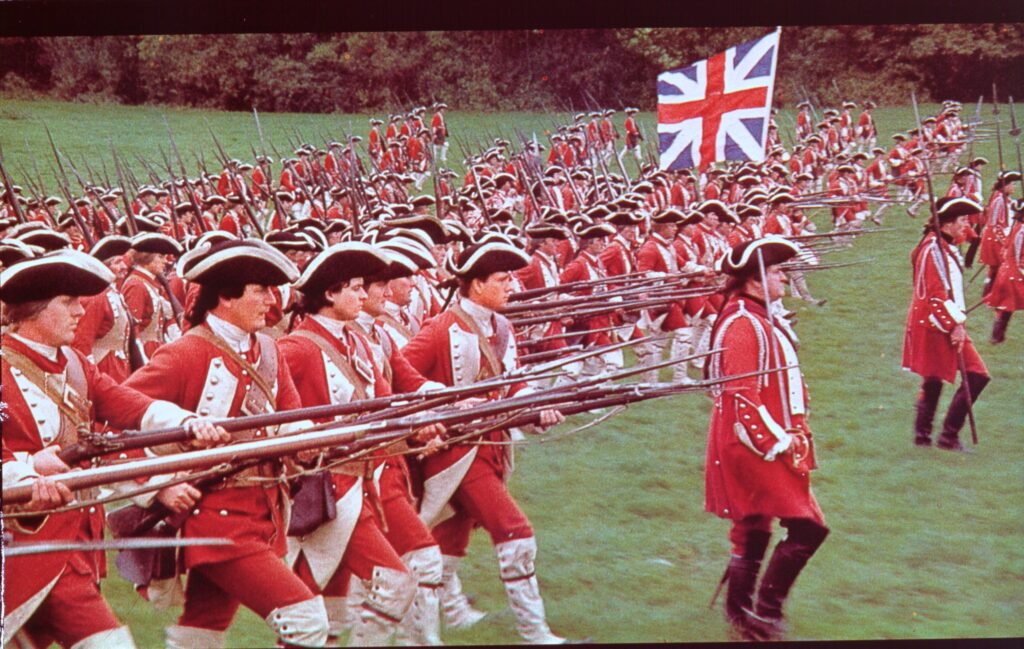
There is a particular terror in watching soldiers advance slowly towards men preparing to shoot them. In Barry Lyndon, the British infantry cross an open field in ordered ranks. Their red coats brighten the landscape. Drums maintain the rhythm. Men fall, and the survivors continue forwards. Kubrick allows the movement to last long enough for its discipline to become frightening.
The scene provides a key to the whole film. People move through arrangements they understand only partly, obeying rules that may destroy them. A soldier maintains formation. A gentleman accepts a challenge. A social climber purchases the outward signs of belonging. Each hopes that correct behaviour will secure his future. Kubrick watches those hopes come apart.
Often overshadowed in popular discussion by 2001: A Space Odyssey, A Clockwork Orange and The Shining, Barry Lyndon deserves a place alongside his finest work. Its reputation has grown considerably, although calling it forgotten would overlook its four Academy Awards and established critical standing. It remains the Kubrick film most likely to be admired for its appearance before being understood as a complete achievement.
Its beauty carries the argument. Landscapes, uniforms, candlelit faces and grand houses show a society capable of exquisite craftsmanship and casual cruelty. The pleasure of looking becomes uncomfortable because the world being admired distributes suffering so efficiently.
An Adventurer Carried Into History
Adapted from William Makepeace Thackeray’s nineteenth-century novel, the film follows Redmond Barry, a young Irishman whose romantic ambitions lead him through duelling, military service, desertion, gambling and an advantageous marriage.
Ryan O’Neal gives Barry an unsettling mixture of physical confidence and emotional simplicity. He can be brave, affectionate, calculating and vicious. Experience improves his methods more reliably than his judgement.
His progress initially resembles an adventure story. Encounters arrive with the promise of escape or advancement. Gradually, the opportunities narrow. The second half becomes a study of the cost of maintaining a position he has acquired without learning how to inhabit it.
The Seven Years’ War supplies the machinery that first carries him beyond Ireland. Britain and Prussia were allies in the conflict, making his successive service in their armies historically coherent, even as the circumstances of his transfer belong to the picaresque tradition of improbable encounters and reversals.
The war itself stretched far beyond the European fields shown here. Fighting in North America, India and elsewhere helped reshape imperial power. Kubrick gives us the limited horizon of one participant rather than an account of that global struggle. The National Army Museum’s history provides a useful corrective to the film’s deliberately narrow perspective.
For Barry, international politics becomes an immediate question of survival. The causes matter less than the uniform he wears, the officer questioning him and the possibility of getting away.
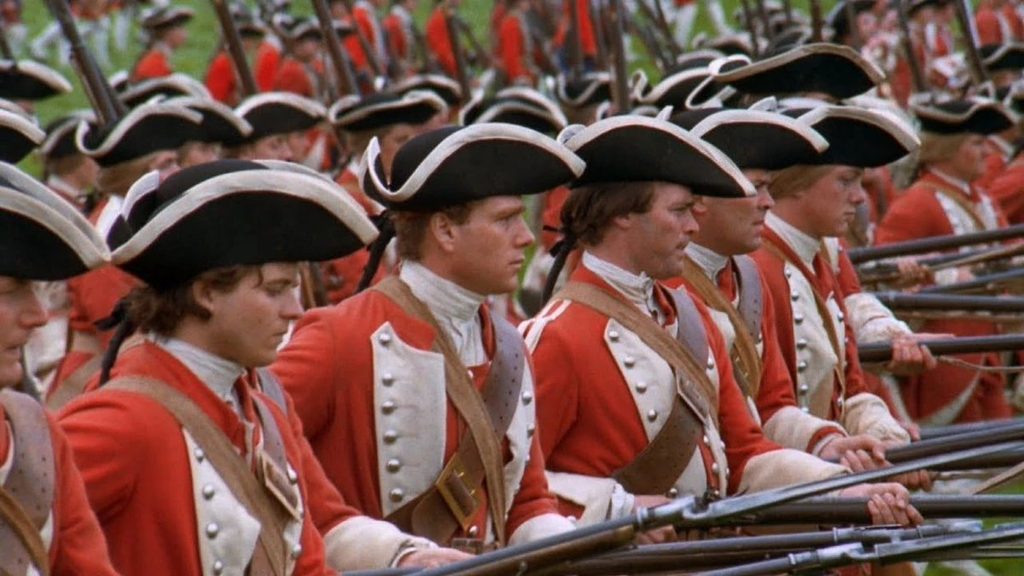
The military scenes have a persuasive material weight. Bodies occupy space, weapons take time to prepare, and orders must travel through formations. A soldier’s freedom of movement is constrained by the men around him.
Kubrick employed historical adviser John Mollo, an authority on military dress who later became celebrated for his costume work on Star Wars. His involvement establishes serious specialist input, although it cannot certify every uniform, drill movement or battlefield decision as correct.
The infantry’s close-order formations fit the broad realities of eighteenth-century European warfare. Smoothbore muskets, collective fire, bayonets and the difficulty of controlling large bodies of men made cohesion essential. An ordered advance exposed soldiers to fire, but breaking formation could expose them to different dangers and destroy a unit’s effectiveness.
The film encourages us to feel the human cost of that system. Historical judgement requires an additional step: the tactics had practical purposes. Their appearance of madness to a modern viewer does not establish that the officers employing them were simply foolish.
The Battle of Minden in 1759 offers an example of this. British and Hanoverian infantry advanced against French cavalry and maintained their cohesion under counter-attack. Their discipline helped produce victory. This was a battlefield system whose effectiveness depended heavily on men continuing to act together under extreme pressure.
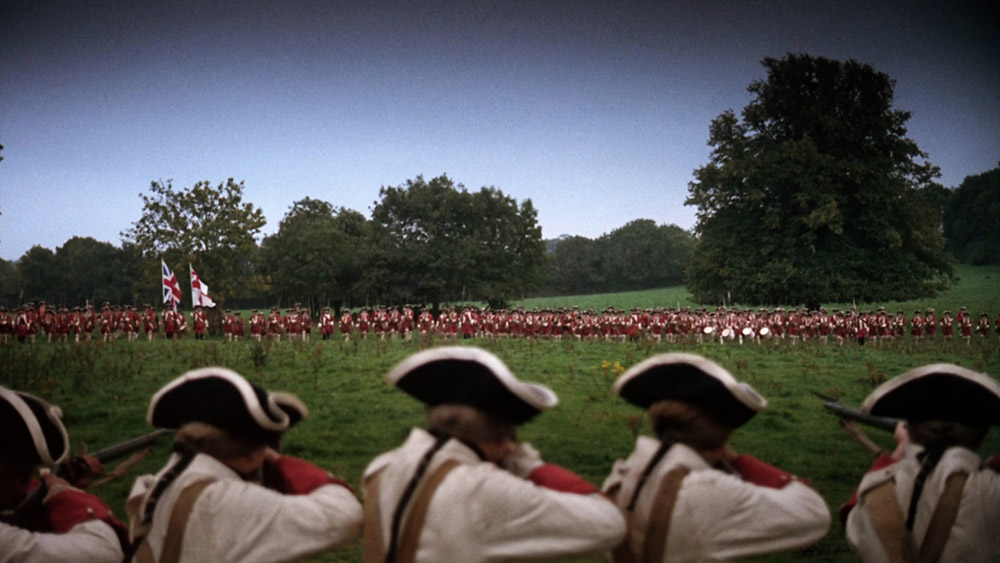
Kubrick selects from that reality to create an exceptionally clear image of vulnerability. His battlefield is also conspicuously readable. We can follow the lines, see the casualties and grasp the direction of movement. Actual engagements could involve much greater confusion, obscured visibility, uneven ground, disrupted commands and the interaction of artillery, cavalry and infantry.
The result is a carefully shaped representation. It conveys the experience of being trapped within a formation more effectively than it explains the conduct of a complete battle.
There is also reason to resist confidently attaching a famous battle name to every military sequence. The narrator describes one action as an obscure skirmish. Its significance comes from what it does to Barry and his companions. Kubrick places personal loss beside the indifference of the historical record.
Recruitment, Punishment and the Army as an Employer
Some of the film’s strongest historical observation concerns life around the fighting. Barry enters military service after his civilian options collapse. The army offers food, money, companionship and a place in an organisation. It also subjects him to coercion and punishment.
That relationship is credible. The National Army Museum documents eighteenth-century recruitment through bounties, exaggerated promises and deception. Its collections include the testimony of an ordinary soldier describing ruthless recruiting practices and the hardships of service.
The film’s Prussian episodes sharpen the sense that a soldier is a resource to be retained. Barry’s nationality matters less than his usefulness and his inability to leave. Punishment establishes the institution’s authority over the body.
Hardy Krüger’s Captain Potzdorf embodies this world particularly well. His intelligence and composure make him more formidable than a shouting caricature would have been. Barry encounters a man who can recognise ability, reward service and enforce obedience without experiencing those actions as contradictory.
Kubrick also allows genuine affection within military life. Captain Grogan’s warmth gives Barry a relationship that the institution itself cannot provide. Its loss briefly breaks through the film’s formal restraint. These moments connect Barry Lyndon with Paths of Glory and Full Metal Jacket. Across very different periods, Kubrick returns to the conversion of individuals into instruments, and to the unequal distribution of the consequences.
The Drawing Room Continues the Campaign
Military service occupies only part of the running time. Its logic extends through the rest. Barry learns to read clothes, rank, money and patronage. Later, he applies those lessons to marriage and social advancement. Officers and aristocrats inhabit related hierarchies. Access depends on introductions. Advancement requires resources. Reputation can be damaged with devastating speed.
The film’s greater historical achievement lies in its observations of social structures. Class operates through property, inheritance, credit, family connections and recognition by other people. Barry can acquire wealth and employ servants, yet his acceptance remains conditional.
His marriage gives him access to a great estate. His subsequent behaviour demonstrates how badly he misunderstands the security of that position. Spending becomes a means of purchasing respectability, creating obligations that make him increasingly vulnerable.
The scenes are often very funny. Kubrick’s humour grows from the precision with which people justify their appetites.
A Past Seen Through Paintings
The film’s compositions draw on eighteenth-century portraiture and landscape painting. Figures sit within carefully arranged rooms, while trees, walls and distant buildings organise the outdoor scenes.
That gives the historical world a remarkable visual coherence. Paintings preserve conventions of representation as well as evidence about clothes, interiors and landscapes. Elite portraits were performances of status.
Kubrick’s slow outward zooms are especially effective. A person initially commands our attention, then becomes a smaller element within a room, garden or landscape. Individual feeling remains visible, surrounded by an environment that will outlast it.
Handel’s Sarabande, arranged by Leonard Rosenman, supplies a sense of ceremony and approaching consequence. Its recurring weight makes private conflicts feel ominously public.
Schubert’s Piano Trio in E-flat brings another register, particularly to the encounter between Barry and Lady Lyndon. The music grants emotional depth to people who reveal little through speech.
It is also a deliberate chronological departure. Schubert dated the trio in November 1827, decades after the film’s action. Kubrick discussed choosing it despite that distance from the period.
The choice helps define the film’s historical method. Authentic objects and settings establish a credible world. Music can then interpret that world from a later vantage point.
The soundtrack’s mixture of Handel, Schubert, military marches and Irish music gives the story several emotional histories at once. The past is remembered, judged and mourned as well as reconstructed.
Barry Lyndon earns its place among the great historical films through this connection between material detail and moral structure. Its military scenes are persuasive in their discipline and coercion, while remaining selective and stylised. Its aristocratic world makes power visible in rooms, gestures and transactions. Its photography and music turn those observations into an experience that remains emotionally disturbing long after the final image.
Read More:
- British Film Institute: Barry Lyndon 40th anniversary: behind the scenes with Stanley Kubrick
- American Cinematographer: Photographing Stanley Kubrick’s ‘Barry Lyndon’
- The Criterion Collection: Barry Lyndon: Time Regained
- Kinema: A Journal for Film and Audiovisual Media: Barry Lyndon and the Limits of Understanding
- National Army Museum: Seven Years War
- National Army Museum: ‘A Recruiting Party’, 1797
- National Army Museum: In Their Own Words: Unknown Soldier of the 100th Foot
- Pen and Sword Books: Titles by John Mollo
- American Film Institute: Barry Lyndon
- Konserthuset Stockholm: Schubert’s Piano Trio
- The Kubrick Site: Kubrick speaks in regard to ‘Barry Lyndon’
- Academy of Motion Picture Arts and Sciences: The 48th Academy Awards | 1976