
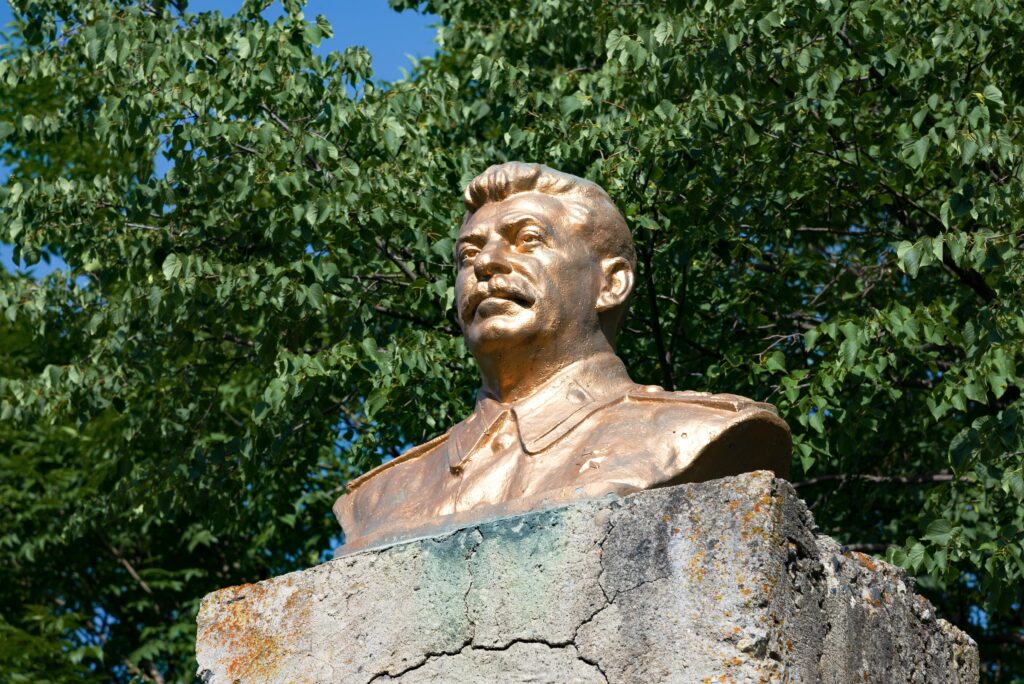
The rehabilitation of Joseph Stalin has moved from the fringes of Russian politics into public space, schools, museums and law. Statues are multiplying, Stalin has returned to the Moscow Metro, and a majority of Russians now describe him positively. The Kremlin’s version is selective: Stalin appears as the victorious commander, industrialiser and builder of a great power.
Stalin’s terror recedes from view. For a Russia fighting a long war against Ukraine, this past has an obvious political use. It teaches endurance, obedience, sacrifice and the primacy of the state, while reminding Russia’s neighbours what Moscow once considered its legitimate sphere of control.
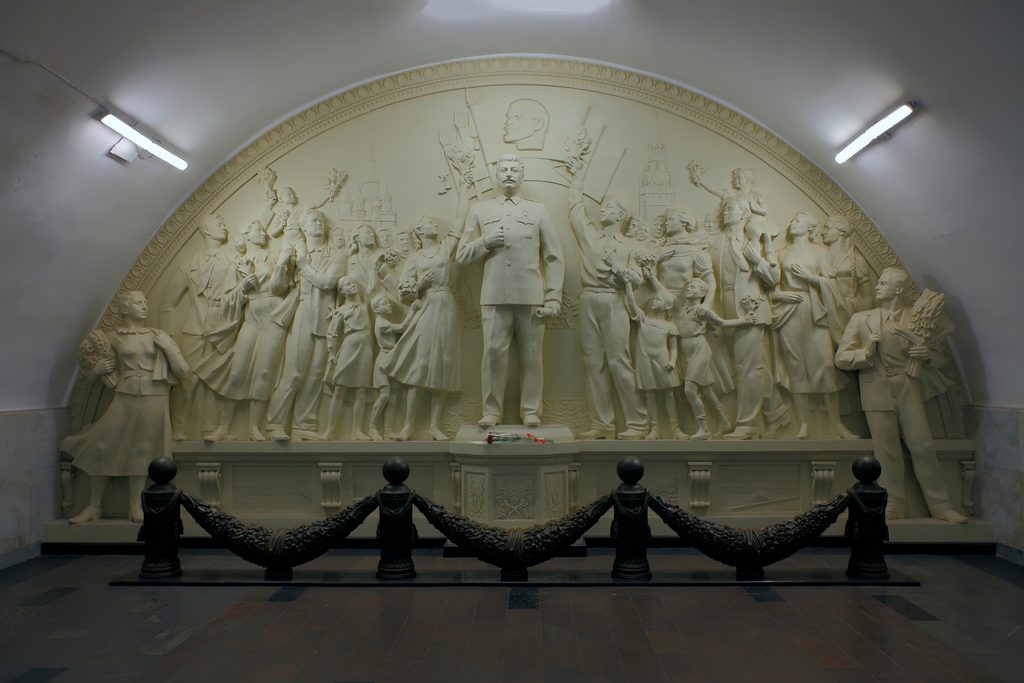
A commuter changing trains at Moscow’s Taganskaya station now passes an image that would have been extraordinary in the Russian capital a generation ago.
Joseph Stalin stands in military uniform at the centre of a monumental wall relief, surrounded by Soviet citizens offering flowers. Above him is Lenin. The work is called Gratitude of the People to the Leader and Commander.
The original composition, dated from 1950, disappeared in the 1960s. Moscow’s transport authorities reconstructed it from archival photographs and documents and unveiled it on 15 May 2025, as the metro celebrated its 90th anniversary. The official announcement described it as a historical composition devoted to victory in the Great Patriotic War. Stalin’s name was conspicuously absent from the announcement, even though his figure dominates the work.
That ambiguity captures the wider Russian approach remarkably well.
There has been no formal Kremlin decree rehabilitating Stalin. Vladimir Putin still occasionally acknowledges the repression. In September 2025 he said that the crimes of the period should neither be erased nor forgotten. In the same remarks, however, he argued that it would also be unjust to forget Stalin’s role in victory and suggested the issue should be “depoliticised”.
The result is a selective rehabilitation whose political meaning becomes clearer every year. Stalin the mass murderer remains formally regrettable. Stalin the commander, moderniser, disciplinarian and creator of a superpower is returning to favour. And the numbers suggest the message is working.
Stalin has overtaken Putin
The most striking evidence comes from the independent Levada Center. In April 2025, Russians were asked an open-ended question about the “most outstanding people of all time and nations”. Stalin came first, named by 42 per cent. Vladimir Putin followed at 31 per cent, with Lenin at 28 per cent. Stalin’s score had risen by 18 percentage points since December 1991.
This was broader than a ranking of Russian leaders. Yet the result remains remarkable: in contemporary Russia, the figure most frequently volunteered as one of humanity’s outstanding individuals was Joseph Stalin.
New polling published in August 2026 makes the trend still clearer. Fifty-nine per cent of Russians expressed a positive attitude towards Stalin, including 44 per cent who said they respected him, 7 per cent who felt sympathy and 8 per cent admiration. Only 7 per cent expressed clearly negative feelings.
More importantly, 56 per cent agreed that Stalin had been a “great leader”. In 2016, the equivalent figure had been 28 per cent.
The change is generationally uneven. Older Russians remain considerably more pro-Stalin than younger people, but Stalinism is no longer simply the nostalgia of elderly Soviet citizens. Even among younger groups the overwhelming reaction is increasingly indifference rather than condemnation.
Polling in an authoritarian state needs careful interpretation. Fear, media control and the disappearance of meaningful political competition all shape public opinion. Levada itself argues that Russian surveys remain methodologically useful, while noting that authoritarian control of the information environment profoundly influences what people know and therefore what they believe.
That distinction strengthens rather than weakens the significance of the Stalin numbers. They show what a society exposed to two decades of increasingly controlled historical narratives has come to accept.
The Statues are Multiplying
The Moscow Metro relief is the most visible example because it belongs to the everyday architecture of the capital. Across Russia, the rehabilitation is also taking a more conventional form.
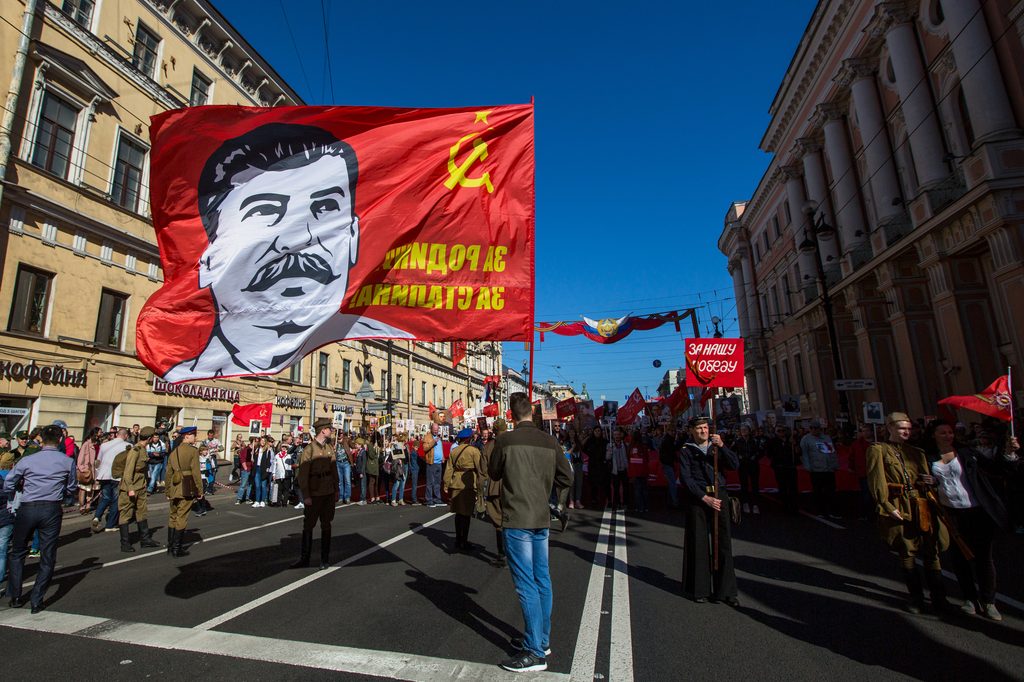
Stalin monuments are appearing at an accelerating rate. The Russian Communist Party, which actively campaigns for their installation, counted two new Stalin monuments in 2022, three in 2023, six in 2024 and about 13 in 2025. The party itself described 2025 as a record year and explicitly connected the growth to the war in Ukraine, which it calls the “Special Military Operation”.
Independent Russian reporting puts the total number of Stalin monuments at more than 110. Only a small fraction survived continuously from Soviet times. Most were erected under Putin, with the trend accelerating after the annexation of Crimea in 2014.
Some remain Communist Party projects erected with private donations. Others have received official support, local-government approval or placement on state property.
Russia is not simply witnessing an uncontrolled grassroots Stalin cult. State institutions have increasingly opened the door.
In December 2024, Vologda governor Georgy Filimonov personally backed the installation of a Stalin monument at the state museum Vologodskaya ssylka, devoted to the city’s history as a place of political exile. Other Stalin monuments followed in the region. A court dispute later emerged over procurement procedures, yet the political endorsement was unmistakable.
In April 2026, authorities in Khakassia held a public vote on erecting a Stalin monument in Victory Park in Abakan. According to the official tally publicised by the Communist Party, 78.5 per cent of participants supported the project.
Even geography is becoming part of the rehabilitation. In April 2025 Putin gave Volgograd airport the historical designation Stalingrad. Volgograd itself officially changes its road signs back to Stalingrad on nine commemorative days each year.
These are symbols, yet authoritarian states invest heavily in symbols because symbols define what citizens are expected to admire.
The War has Accelerated the Return
Stalin’s recovery began well before the invasion of Ukraine. The Soviet anthem returned under Putin in 2000. Victory in the Second World War gradually became the central civic myth of the Russian state. The annexation of Crimea in 2014 accelerated the process, as military victory, imperial restoration and confrontation with the West became increasingly intertwined.
The full-scale invasion of Ukraine in February 2022 pushed this politics of memory into a different category.
Jussi Lassila of the Finnish Institute of International Affairs describes Russia’s wartime ideological system as a form of increasingly codified indoctrination. Since 2022, propaganda has moved systematically into schools. Russia’s new 11th-grade history textbook presents a strongly re-Sovietised account of the twentieth century and culminates in an overwhelmingly positive depiction of Putin-era Russia. Lassila argues that the timing reveals a regime seeking to justify the war and manage its social consequences.
Historian Dina Gusejnova’s related academic work on Russian textbooks points to the same mechanism. Shortly after the invasion began, presidential aide and former culture minister Vladimir Medinsky called for the “mobilisation” of historical education. The resulting narrative portrays Russia as a permanently threatened fortress whose wars are defensive struggles for national survival.
Stalin fits this wartime narrative almost perfectly. He represents a country surrounded by enemies. He represents industrial mobilisation. He represents enormous casualties endured without political collapse. He represents victory achieved through centralised command. He represents internal enemies, spies and traitors. Above all, he represents the idea that the survival and greatness of the state justify extraordinary demands on individuals.
Those are useful lessons for a government asking its population to accept a long, expensive and bloody war.
A Dictator Stripped of his Victims
The rehabilitation works through omission as much as celebration. Russia does not need to persuade every citizen that the Great Terror was desirable. It needs the terror to become secondary when Stalin is judged.
That process has been visible for years in education. Political scientist Todd Nelson found as early as the late 2000s that Russian school textbooks increasingly foregrounded Stalin-era industrialisation and the victory of 1945 while diminishing the importance of repression. His conclusion was explicitly political: the narrative helped legitimise a strong centralised state by presenting centralisation as the system that historically delivered Russia’s greatest achievements.
The same hierarchy of memory now extends far beyond textbooks.
Memorial, the organisation that spent decades documenting Soviet repression and naming its victims, was ordered liquidated by Russian courts at the end of 2021. During the case, prosecutors accused it of creating a “false image of the USSR as a terrorist state” and distorting historical memory.
Then came another extraordinary step. Moscow’s Gulag History Museum was closed in November 2024, officially because of fire-safety problems. In February 2026 the authorities confirmed that the institution would be replaced by a new Museum of Memory centred on Nazi crimes and the “genocide of the Soviet people”.
The physical location where Moscow had presented the Soviet state as perpetrator is therefore being transformed into a museum presenting the Soviet people primarily as victims of an external enemy.
The historical importance of Nazi atrocities against Soviet citizens is beyond dispute. The Soviet Union suffered catastrophic losses during the Second World War.
The political importance lies in the replacement. At the same time, Russian legislation is placing ever tighter legal boundaries around the approved version of the war. Federal Law No. 100, signed in April 2026, amended the Criminal Code to allow imprisonment for public denial or approval of the legally defined “genocide of the Soviet people”, or for insulting the memory of its victims. State Duma chairman Vyacheslav Volodin said Russia had adopted 19 federal laws on the preservation of historical memory since 2014.
History in Russia is increasingly becoming part of security law.
Stalin and Putin Do not Need to be Identical
Putinism is not a reconstruction of the Soviet Union. Private property remains. The Communist Party has no monopoly on power. The Orthodox Church holds a position Stalin’s atheist state would have found impossible. Nationalist, imperial and religious ideas coexist with Soviet imagery.
The rehabilitation is therefore highly selective. Andrei Kolesnikov of the Carnegie Endowment has described Putin as deeply hostile to important parts of the Soviet inheritance, particularly Lenin’s federal conception of the USSR. Yet the Stalinist elements that survived the selection are precisely the ones useful to modern Russian authoritarianism: the powerful state, imperial status, mobilisation, victory, suspicion of the West and the language of internal enemies.
Stalin provides a historical answer to one of Putinism’s central problems. How can citizens be taught to accept hardship, casualties and repression while regarding those sacrifices as evidence of national greatness?
The answer is 1945.
Russia suffered catastrophically and still emerged victorious. A state that treats victory as the ultimate moral verdict can turn almost any preceding sacrifice into something that appears retrospectively justified.
That is why Stalin’s rehabilitation has accelerated during the Ukraine war.
The Moscow Metro Leads Directly to Occupied Ukraine
The external dimension becomes clearest outside Russia’s internationally recognised borders. On 8 May 2025, a Stalin bust was unveiled in Russian-occupied Melitopol, in Ukraine’s Zaporizhzhia region. The Russian Communist Party described it as the first such monument in what it called “modern Novorossiya”. Its inscription honoured Stalin as the organiser and inspiration of the Soviet victory over Nazi Germany.
The choice of location gives the Stalin revival a meaning that no Moscow monument can hide.
The Russian state says it is fighting “Nazism” in Ukraine. Soviet victory symbolism is used to frame the present invasion as a continuation of the war that ended in Berlin in 1945. Russian troops become the descendants of the Red Army. Ukrainians resisting Russian rule can then be placed into the propaganda category of fascists, collaborators and historical traitors.
A Stalin monument in occupied Ukraine performs territorial politics. It says that Russian military occupation brings with it a Russian version of the past.
Recent scholarship on Russian memory policy in occupied Ukrainian territories describes precisely this process: Russian curricula, monuments and commemorative practices are used to weaken Ukrainian identity and replace it with an imperial and Soviet-Russian historical framework.
The argument matters because the war itself has increasingly become a war over history.
Russia’s justification for invading Ukraine contains territorial claims presented as historical facts. Putin has repeatedly denied that Ukraine possesses a fully independent historical identity and has described Russians and Ukrainians as essentially one people. Military action then appears, within that narrative, as restoration rather than conquest. Stalin belongs naturally inside this worldview.
For Poland, the Rehabilitation Strikes at 1939
No NATO country, with the exception of the three Baltic States, has more reason than Poland to treat Russian Stalinism as a contemporary political issue.
The Soviet Union signed the Molotov-Ribbentrop Pact with Nazi Germany in August 1939. Its secret protocol divided parts of eastern Europe into German and Soviet spheres. Germany invaded Poland on 1 September. The Soviet Union invaded from the east on 17 September.
The NKVD subsequently murdered thousands of Polish officers, policemen and members of the intelligentsia at Katyn and other execution sites.
Modern Russia formally acknowledged key elements of this history during the late Soviet and early post-Soviet periods. That process is now under pressure.
Polish historians Jan Szumski and Bogdan Musiał have shown something particularly important about current Russian historical rhetoric: Moscow’s modern interpretation of the origins of the Second World War increasingly resembles arguments personally shaped by Stalin.
Their research examined the Soviet pamphlet Falsifiers of History, published in 1948. Stalin extensively edited the text. It shifted responsibility for the road to war towards the Western powers and defended Soviet policy towards Nazi Germany. Szumski and Musiał argue that important elements of this Stalin-era interpretation have reappeared in contemporary Russian official history.
This is more consequential than another bronze bust. Stalin is returning as an author of Russia’s historical argument with Europe.
For Poland, Russian neo-Stalinism therefore touches directly on current information security. Moscow already exploits Polish-Ukrainian historical disputes, particularly the Volhynia massacres, in an effort to weaken the strategic relationship between Warsaw and Kyiv.
The Stalinist narrative provides the deeper framework: Poland becomes an irresponsible or hostile actor, Russia becomes the state that ultimately defeated fascism, and Soviet expansion becomes a matter of strategic necessity.
For the Baltics, Stalin Means Occupation
In Estonia, Latvia and Lithuania, the disagreement is even more fundamental. The Russian account of 1945 emphasises liberation from Nazi occupation. Baltic historical memory includes the return of Soviet occupation, political repression, deportation and the destruction of independent statehood.
The Molotov-Ribbentrop secret protocols had placed the Baltic states in the Soviet sphere. Soviet forces occupied and annexed Estonia, Latvia and Lithuania in 1940.
This history is one reason arguments over monuments and commemorations in the Baltic region have repeatedly become matters of national security rather than heritage management.
The International Centre for Defence and Security in Tallinn has described Russian memory politics as an instrument that increasingly fused Victory Day symbolism with political pressure on neighbouring states. Long before the full-scale invasion of Ukraine, Estonia’s 2007 Bronze Soldier dispute demonstrated how a Second World War monument could become a trigger for domestic unrest, Russian information operations and cyber attacks.
The renewed cult of Stalin sharpens that conflict because it narrows the possibility of a shared interpretation. A Russia capable of acknowledging Soviet victory over Nazism and Soviet repression in eastern Europe could sustain a complicated historical dialogue with its neighbours.
A Russia that elevates Stalin while criminalising challenges to its preferred wartime narrative moves in the opposite direction.
Finland Should Read the Same Message
For Finland, Stalin is inseparable from the Winter War. The Soviet Union attacked Finland on 30 November 1939, little more than three months after signing the Molotov-Ribbentrop Pact. Finland preserved its independence through the Winter War and later the Continuation War, while losing territory and suffering heavy casualties.
That history has an immediate contemporary relevance. Russian Stalin rehabilitation does not by itself constitute evidence of plans for military action against Finland. It does reveal what kind of historical statecraft the Kremlin increasingly rewards.
The borders created or challenged by force are presented as products of strategic necessity. The security demands of the great power outweigh the sovereignty concerns of smaller neighbours. Military sacrifice becomes proof of virtue. Negotiated spheres of influence re-enter respectable historical discussion.
Those ideas have obvious resonance in a country that has spent years demanding a rewritten European security order and insisting that neighbouring states’ foreign-policy choices must accommodate Russian security interests.
The Finnish Institute of International Affairs has long argued that the cult of the Great Patriotic War has become one of the central resources of Russian state legitimacy and that modern Russian wars are repeatedly framed through its language. Since 2022, the connection between the 1941–45 narrative and the war in Ukraine have become explicit.
For Finland, the relevant question is therefore wider than whether Russians like Stalin. It is what Russians are being taught Stalin proved.
A Political Model for a Long War
The most useful Stalin for the Kremlin is neither Marxist theorist nor Georgian Bolshevik revolutionary. He is the leader who demands everything and wins. That is the Stalin now appearing on metro walls, in provincial parks and in opinion polling.
He allows the Russian state to present coercion as seriousness, casualties as sacrifice, geopolitical expansion as security, economic mobilisation as patriotism and political dissent as weakness in the face of an external enemy.
His return also solves a practical wartime problem. Russia needs a historical framework capable of making an open-ended struggle with the West appear normal.
Putin provided that framework in his Victory Day speech in May 2025. Russia, he said, must defend its national interests, thousand-year history, culture and traditional values, while resisting attempts to distort the history of the Second World War. More than 1,500 soldiers who had fought in Ukraine marched in the anniversary parade, physically placing the current war inside the choreography of the 1945 victory.
The message is difficult to miss. The war of 1941 is being made to explain the war of the 2020s. And Stalin is being brought back because the political system built for that earlier struggle offers a powerful story about what Russians should tolerate in this one.
The Danger Lies in What Becomes Normal
Russia is still far from Stalin’s Soviet Union. Contemporary repression remains smaller in scale, society retains forms of private life that Stalinism destroyed, and the modern Russian economy and elite operate according to very different rules.
The political direction of historical memory is nevertheless clear.
A dictator once officially condemned by the Soviet state itself has become the most admired historical political figure in Russian polling. His monuments are multiplying. His wartime image has returned to one of Moscow’s most important public spaces. His name is being restored to geography. Institutions commemorating his victims are disappearing. Schools teach an increasingly militarised history. The law defines the permissible boundaries of historical interpretation.
Each development reinforces the others. For Russia’s neighbours, Stalin’s return therefore deserves attention from defence ministries as well as historians.
Historical narratives help define which borders a state considers legitimate, which wars it regards as defensive, which sacrifices it can demand from its population and which neighbouring nations it considers fully sovereign.
Moscow is teaching a new generation that the Soviet Union under Stalin was brutal, powerful and victorious, with the emphasis increasingly falling on the last two words.
For Ukraine, that ideology already has a battlefield. For Poland and the Baltic states, it rehabilitates the man who helped destroy their sovereignty in 1939 and 1940.
For Finland, it rehabilitates the leader who ordered the Red Army across its border.
And for Russia itself, Stalin supplies the home front with the political morality required for a long war: the state is surrounded, victory requires unity, sacrifice proves patriotism, and history eventually vindicates those who are strong enough to prevail.
That is why the relief at Taganskaya matters.
Stalin has returned to the Moscow Metro because the Russia above ground has become ready for him.
Read More:
- Deutsche Welle: Stalin wasn’t so bad, was he?
- Levada Center: Отношение к фигуре Сталина в июле 2026 года
- Levada Center: The Most Outstanding People of All Time and Nations: April 2025
- Levada Center: On the Question of the Surveys in Russia
- Moscow Transport: Восстанавливаем утраченный исторический барельеф, который посвящен Победе в Великой Отечественной войне
- Interfax: Путин призвал не забывать о репрессиях и роли Сталина в Победе
- Communist Party of the Russian Federation, КПРФ: Юбилейный 2025-й: В год 80-летия Великой Победы в стране установлено рекордное количество памятников И.В. Сталину
- The Moscow Times, Russian edition: Еще один российский регион установит памятник Сталину
- Communist Party of the Russian Federation, КПРФ: Материал о памятнике Сталину в Вологодской области
- Communist Party of the Russian Federation, КПРФ: Материал о голосовании за памятник Сталину в Абакане
- Garant.ru: Указ о присвоении аэропорту Волгограда исторического наименования «Сталинград»
- President of Russia, Kremlin: Parade marking the 80th anniversary of the Great Victory
- Finnish Institute of International Affairs: Russia’s wartime ideology: Radicalization, rent-seeking and securing the dictator
- Finnish Institute of International Affairs: Russian Nationalism and the Ukraine Crisis: he Historical Roots of Russia’s Annexation of Crimea
- Cambridge University Press, Memory, Mind & Media: ‘Living the last chapter of History’: Anxiety as a force for rewriting history textbooks in Putin’s Russia and before
- Post-Soviet Affairs, Taylor & Francis: History as ideology: the portrayal of Stalinism and the Great Patriotic War in contemporary Russian high school textbooks
- Carnegie Endowment for International Peace: The Competition for Memory in Putin’s Russia
- Carnegie Endowment for International Peace: Putin’s Anti-Soviet Russia
- Deutsche Welle: Russia to convert Gulag museum into Nazi crimes memorial
- State Duma of the Russian Federation: Материал о законах по защите исторической памяти
- Official Internet Portal of Legal Information of the Russian Federation: Федеральный закон от 09.04.2026 № 100-ФЗ «О внесении изменений в статьи 243-4 и 354-1 Уголовного кодекса Российской Федерации»
- Communist Party of the Russian Federation, КПРФ: Материал об открытии бюста Сталина в Мелитополе
- Institute of National Remembrance Review, Poland: Stalin and the Pamphlet “Falsifiers of History”: “Interpretations”, Guidelines and Their Implementation
- Royal United Services Institute, RUSI: Russia and Ukraine: ‘One People’ as Putin Claims?
- Royal United Services Institute, RUSI: Poland, Ukraine, and Russia’s War on History
- International Centre for Defence and Security, ICDS: Russia’s Memory Wars: Poland and the Forthcoming 75th Victory Day
- European Parliament: Importance of European remembrance for the future of Europe
- Latvijas Sabiedriskais Medijs, LSM: Pāvels Širovs: Staļins, kurš joprojām ir ar mums
- LRT: Siekdama pateisinti karą Ukrainoje, Maskva gaivina Stalino kultą – metro pastatė paminklą
- ResearchGate: From Soviet to Imperial Memory: Russia’s Politics of Memory in the Occupied Ukrainian Territories