USA

How States Think (2023)

Bunker Books: How States Think by John J. Mearsheimer and Sebastian Rosato (2023)

John J. Mearsheimer and Sebastian Rosato’s How States Think: The Rationality of Foreign Policy (2023) presents a rigorous defense of realism in international relations, arguing that states, regardless of their internal politics or ideological preferences, behave rationally to maximize their security and power. How States Think: The Rationality of Foreign Policy seeks to counter the

Bunker Books: How States Think by John J. Mearsheimer and Sebastian Rosato (2023) Read More »

China’s DeepSeek AI: A Digital Power Play with Serious Security Risks

China has launched DeepSeek-R1, a highly advanced artificial intelligence model, positioning itself as a direct challenger to Western AI dominance. This open-source system, developed by Chinese startup DeepSeek, is designed to rival technologies like OpenAI’s ChatGPT. But its emergence is as alarming as it is impressive, particularly for NATO countries concerned about security threats, espionage,

China’s DeepSeek AI: A Digital Power Play with Serious Security Risks Read More »

A Financial Times newspaper with the headline Trump is back.

Predictable Incoherence: Understanding Trump’s Foreign Policy

For decades, American foreign policy has been a cornerstone of global stability—a steady framework within which allies and adversaries alike have navigated their international relationships. Under President Donald Trump, however, this framework took on a markedly unpredictable character, or so it appeared. Trump’s first-term foreign policy was less unpredictable than incoherent—a critical distinction that reveals

Predictable Incoherence: Understanding Trump’s Foreign Policy Read More »

Conflicts in 2025

Global Conflict Landscape in 2025: Local Wars and Uprisings

The year 2025 is marked by escalating global tensions and volatile geopolitics. Key flashpoints include rising friction in the Baltic Sea, the conflict between Iran and Israel, growing unrest across Asia and Africa, and the ongoing war in Ukraine against Russia. President Donald Trump’s second term hints at a return to isolationist policies. As a

Global Conflict Landscape in 2025: Local Wars and Uprisings Read More »

Israel’s Pre-emptive Strikes in Syria

Following the unexpected collapse of President Bashar al-Assad’s regime, Israel launched a series of pre-emptive strikes across Syria. These operations aimed to neutralize potential threats from advanced weaponry and prevent their acquisition by hostile entities amid the ensuing power vacuum. The sudden downfall of Assad’s government, precipitated by a swift rebel offensive, led to significant

Israel’s Pre-emptive Strikes in Syria Read More »

A man speaks with supporters of Green Party presidential candidate Jill Stein on the evening before the start of the Democratic National Convention.

How Middle East Crises and Third-Party Candidates Impacted 2024 U.S. Elections

In the 2024 U.S. presidential election, Green Party candidate Jill Stein emerged as a significant figure, particularly among Muslim voters in key battleground states like Michigan. Her outspoken stance on the Palestinian issue resonated with many voters dissatisfied with the major parties’ positions on the Middle East conflict. Both Russia and Iran had a role

How Middle East Crises and Third-Party Candidates Impacted 2024 U.S. Elections Read More »

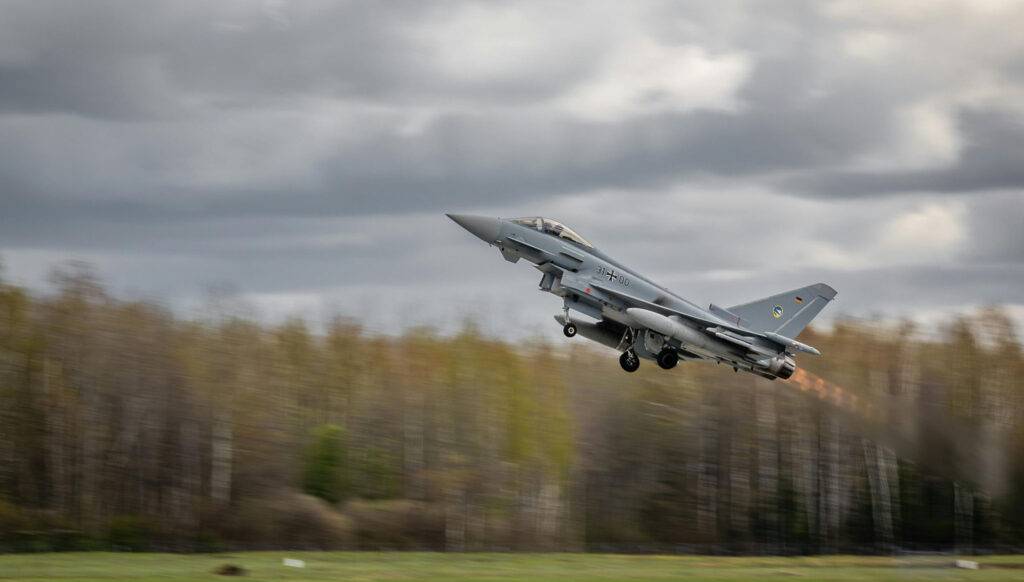
A German Air Force Eurofighter Typhoon takes off from Lielvarde Air Base in Latvia during a Baltic Air Policing rotation on 17 April 2024. (Image: NATO)

With Trump and Scholz – What Happens to Europe’s Rearmament?

The potential refocusing of American defence strategy during a second Trump presidency is not the only uncertainty shaping Europe’s future defence posture. Germany’s political landscape stands at a crossroads, grappling with internal crises while preparing for upcoming elections. Meanwhile, across Europe, NATO countries are accelerating defence modernisation and boosting defence spending. Donald Trump’s stance on

With Trump and Scholz – What Happens to Europe’s Rearmament? Read More »

Rheinmetall has developed a 130-millimetre calibre smoothbore tank gun for future Main Battle Tanks. (Source: Wikimedia Commons, Rheinmetall)

Going Hypervelocity

Hypervelocity, as defined by the U.S. Army, refers to a projectile leaving the muzzle of an artillery weapon at over 3,500 ft/s (1,067 m/s) or a tank cannon at more than 3,350 ft/s (1,021 m/s). It’s important to note this isn’t the same as hypersonic speeds, which exceed Mach 5 (1,715 m/s). Tank gun kinetic

Going Hypervelocity Read More »

AI in War.

Who’s Pulling the Trigger? Why the West Can’t Afford to Fall Behind in AI Warfare

The rise of artificial intelligence in military decision-making is transforming modern warfare, from battlefield operations to strategic planning. One fact stands clear: the West must adapt and advance its AI capabilities to stay ahead of competing, challenging state powers like China and Russia, as well as the threat posed by rogue states and non-state actors,

Who’s Pulling the Trigger? Why the West Can’t Afford to Fall Behind in AI Warfare Read More »

NATO in the North.

NATO to Establish Two New Headquarters in Finland: Mikkeli and Lapland

The Northern European Army headquarters will be based in Mikkeli, reflecting its historical significance as Finland’s military command hub during both the Winter and Continuation Wars. In Lapland, Swedish-led NATO’s headquarters is planned for either Rovaniemi or Sodankylä, focusing on the Forward Land Forces (FLF) to enhance Northern Finland’s defence. Mikkeli was chosen for its

NATO to Establish Two New Headquarters in Finland: Mikkeli and Lapland Read More »

×