
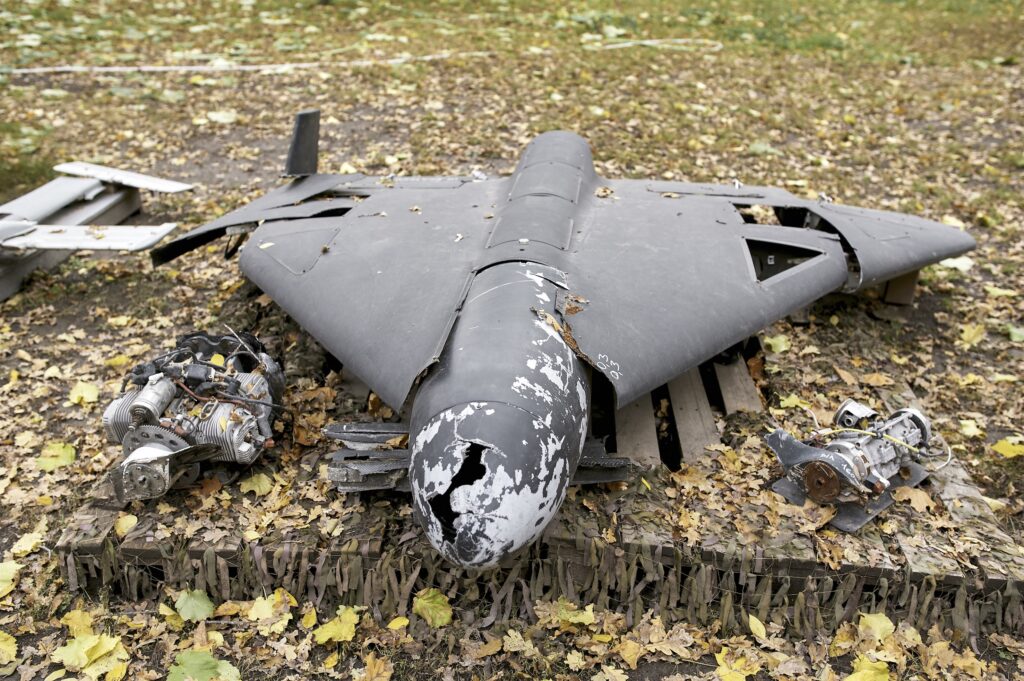
Long-range Ukrainian strike drones aimed at targets around the Leningrad Oblast have, in several cases, strayed or pushed beyond intended routes, crossing into the airspace of Finland, Estonia, Latvia, Lithuania and Poland. Whether by navigation failure, electronic interference, or deliberate ambiguity, the result is the same: NATO airspace is no longer a distant observer of drone warfare.
In spring 2026, several long-range Ukrainian strike drones targeting Russian infrastructure around Saint Petersburg and Leningrad Oblast crossed into NATO airspace. The incidents are documented across multiple countries:
Finland. Several Ukrainian-origin long-range drones entered Finnish airspace and later crashed near, relatively near the Eastern border, one near the city of Kouvola. Finnish authorities tracked the object and assessed that it posed no immediate threat.
Estonia. Drones entered Estonian airspace, with one impacting infrastructure at the Auvere power plant. This marked one of the most serious physical consequences among the Baltic incidents.
Latvia. Latvian authorities confirmed that at least one drone crossed into their territory and crash-landed. The military acknowledged the incursion as part of the same broader pattern.
Lithuania. A drone entered Lithuanian airspace and crashed into a lake. The event was linked to the same operational wave connected to strikes toward Russia’s Baltic region.
Poland. In September 2025, Poland became the first NATO country to actively shoot down hostile drones linked to the war in Ukraine. During a large-scale Russian strike, multiple drones crossed into Polish airspace, prompting an immediate military response supported by NATO aircraft. Polish forces, alongside allied jets including F-16s and F-35s, intercepted and destroyed several drones deemed a direct threat. Prime Minister Donald Tusk described the incursion as an “act of aggression”, underlining the seriousness of the breach. More than a dozen drones were detected, some of which were shot down over eastern Poland. Debris from the interceptions caused damage on the ground, including to residential buildings, highlighting the real civilian risk even when defences succeed.
Drone Warfare Q&A
For NATO, these drone incidents force real-time decisions on interception, escalation, attribution, and civilian risk. They expose gaps in detection, coordination, and rules of engagement across the eastern flank. What do these errant drones mean for NATO, the Baltic states and Finland? Answers are given by Jyri Kosola, former Director of Research at the Finnish Defence Forces, CEO of Pathfinder Solutions, and author of a recent non-fiction work on drone warfare.
What kind of drones entered the Baltic and Finnish airspace in spring 2026?
They were long-range attack drones originating from Ukraine. From a purely technical standpoint, reaching Finland is entirely feasible.
Why didn’t Finland shoot them down?
The Finnish Air Force confirmed it was aware of the drones and made a tactical decision not to engage. The assessment was that over forest flying drones posed no danger to the population. Letting them run out of fuel avoided the risk of debris falling into populated areas.
Finland does not react automatically. Decisions are risk-based.
How have Estonia, Latvia, Lithuania and Poland acted in similar situations?
Responses vary, but these countries have shown a lower threshold for engagement, especially closer to active conflict zones. Poland in particular, has demonstrated readiness to intercept if the risk escalates.
How dangerous are these drones really?
They are real weapon systems, not reconnaissance toys. With explosive payloads, they are capable of causing serious destruction. Even if the warhead is not armed, it can detonate when moved or touched.
What happens if a drone hits a house?
The damage would be severe. A direct hit with a 50–75 kg payload could effectively destroy the structure.
Will this happen again?
Yes, more incidents are likely. Disruptions may extend beyond land targets to aviation and maritime traffic. This looks less like an isolated case and more like the beginning of a pattern.
How does a drone attack actually work?
Drones rarely operate alone. They move in coordinated swarms, similar to a wolf pack. Different drones perform different roles, reconnaissance, jamming, target marking, and strike.
They fly low to avoid radar detection. Some are decoys, designed to force defenders to activate systems, break radio silence, reveal positions, and waste interceptors on low-value targets. The threat is systematic and mass-based.
How are drones countered?
There is no single solution. Effective defence is layered, combining sensors, electronic warfare, and kinetic interception.
Not every drone needs to be shot down. In many cases, jamming or disrupting control systems is enough.
Is Finland behind in drone defence? What about other NATO eastern flank states?
Finland is lagging in counter-drone capability. Other eastern NATO members have moved faster, driven by proximity to the war in Ukraine.
How long would it take for Finland to build a credible drone defence?
Under a traditional procurement model, it could take up to ten years, from requirements definition to deployment.
Under an accelerated national security procurement model, timelines could look very different:
- Low-altitude detection capability within 6–12 months from contract
- Early warning capability within 12–24 months
- Gradually improving interception capability within 12–48 months
When do accidental incursions become deliberate testing?
It is difficult to determine intent. Attribution remains uncertain in many cases.
Could Russia deliberately use such incidents to signal escalation to NATO countries like the Baltics and Finland?
Possibly. Plausible deniability lowers the threshold for such actions.
Is Finland already a testing ground for Russian drone activity?
Unlikely at this stage.
Russia has long jammed GPS signals near the eastern border. Will this end as drone technology evolves?
Unlikely. The cheapest drones will remain vulnerable to GNSS jamming, and electronic interference will continue to be widely used.
From where could drones realistically reach the Baltics and Finland?
From almost anywhere, it depends entirely on the operator’s intent and launch point.
Could they come from Kaliningrad, mainland Russia, or across the sea at low altitude?
Yes, all of those routes are technically viable.
Why is Finland not part of a Baltic-style drone shield or air policing system?
This is a political and strategic question, best directed to the Ministry of Defence.
Does Finland have its own dedicated drone defence system?
There is no clear evidence of a comprehensive, dedicated system currently in place.
How many drones can Finland, the Baltics or Poland intercept simultaneously?
That information is not publicly available, and for obvious reasons, likely classified.
What if a swarm includes e.g. 100 drones?
The challenge becomes exponential. Saturation attacks are designed to overwhelm defences.
What happens if a drone hits critical infrastructure like a power substation, port or data centre?
Operations would likely be disrupted or halted entirely, depending on the impact.
Have Finland and other Eastern NATO countries trained for this?
Recent events suggest preparedness is still developing.
What intelligence can drones collect?
They can map critical infrastructure, identify layouts and protection levels, monitor activity patterns and routes, and gather signal intelligence, including electronic emissions.
Under international law, when can a drone be shot down? When is it considered an act of war?
There is no simple threshold.
An airspace violation becomes a military act when it is treated as such, meaning when a state responds with military force.
Should Finland develop its own mass production of drones, like Ukraine?
Yes. Drone warfare has fundamentally changed the economics of war, favouring scalable and decentralised production.
The UK has gained frontline drone warfare insight by training Ukrainian soldiers. Do other member countries have access to similar knowledge through NATO or JEF?
Access exists, but the most effective approach would be direct participation in drone and electronic warfare coalitions.
Finnish, Baltic and Polish defence companies cooperate with Ukrainian drone firms. How current is Ukrainian drone intelligence?
If you are directly engaged on the ground, the information is close to real-time.
Read More:
- OSW – Ośrodek Studiów Wschodnich: Baltic states respond to incidents involving Ukrainian drones
- AeroTime: Ukrainian drone crashes in Finland after veering off course during attack on Russia
- European Pravda: Ukrainian drones targeting Russia end up in NATO countries due to electronic warfare interference
- Reuters / KSL: Poland downs drones in its airspace, becoming first NATO member to fire during war in Ukraine
- Associated Press / PBS: Poland says it shot down Russian drones that violated its airspace during strikes on Ukraine
- South China Morning Post / Reuters: Poland shoots down Russian drones, a first for Nato member during Ukraine war
- Arms Control Association: NATO Downs Russian Drones over Poland