
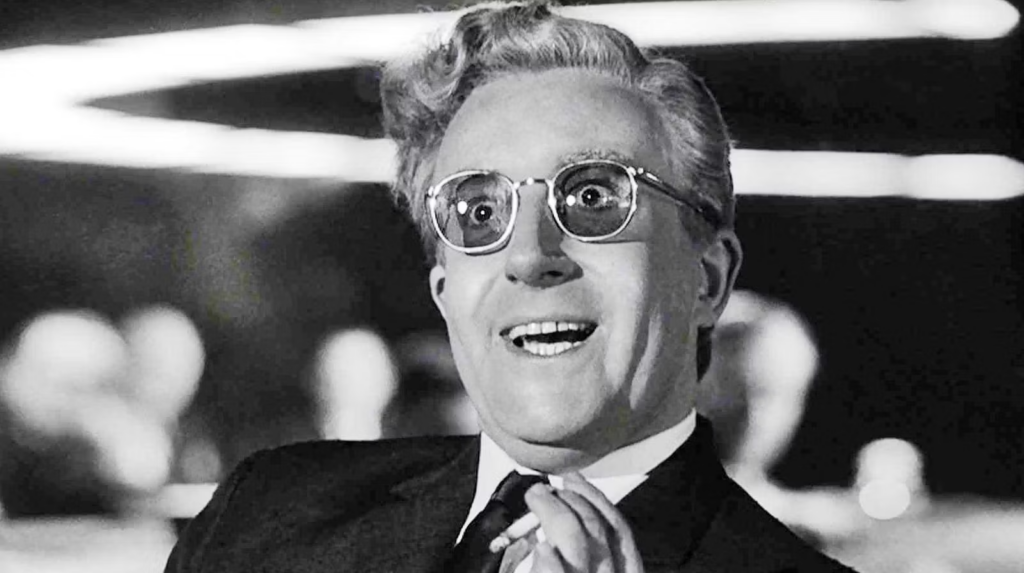
Stanley Kubrick’s Dr. Strangelove or: How I Learned to Stop Worrying and Love the Bomb remains the most breathtaking cinematic dissection of Madman deterrence theory and nuclear strategy ever put on screen. It plays as absurd comedy, yet every mechanism in the film rests on real doctrine, real fears, and real institutional logic.
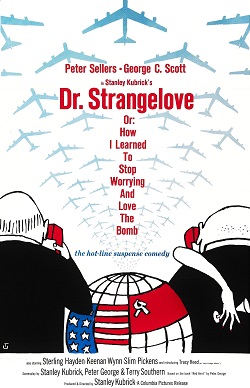
Kubrick and co-writer Terry Southern built the film on Peter George’s novel Red Alert, itself rooted in Cold War command-and-control anxieties. In the plot, a rogue US Air Force general orders a nuclear strike on the Soviet Union, exploiting a system designed to guarantee retaliation even if leadership is decapitated.
That system existed in spirit. Strategic Air Command in the 1950s and early 1960s maintained airborne alert bombers and pre-delegation concepts under extreme conditions. The logic was straightforward: if the enemy believes you might still strike after losing Washington, deterrence holds. The film shows what happens when that logic is pushed to its edge.
General Jack D. Ripper’s unilateral launch is fiction, but the vulnerability it exploits is not. Scholars of nuclear command have long debated Negative control versus Positive control: who can launch, and who can stop it. Kubrick sides with the nightmare scenario: too much decentralisation invites catastrophe.
Theatre of Rational Madness: The War Room
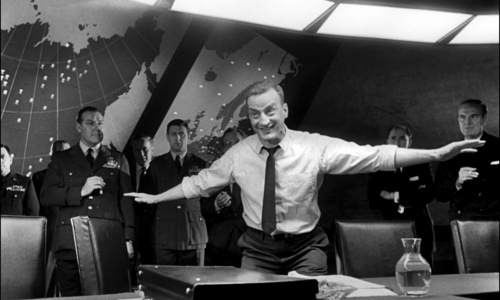
The War Room scenes in the movie may be treated as a satire of political incompetence. But they show rational actors trapped inside a system that rewards irrational outcomes.
President Muffley tries to de-escalate. The Soviet ambassador seeks clarity. General Turgidson pushes for an advantage. Each position reflects real strategic schools.
The tension mirrors the work of Thomas Schelling, whose Cold War writing framed nuclear deterrence as a bargaining process under extreme uncertainty. Schelling argued that credible threats often rely on the risk of things slipping out of control. In his The Strategy of Conflict, he describes deterrence as “the threat that leaves something to chance.”
Kubrick turns that abstract idea into a narrative. The system works because it might fail.
The Doomsday Machine: Dead Hand
The Soviet Doomsday Machine in the film is often dismissed as pure satire. In the 1970s and 1980s, Soviet strategists developed automated retaliation concepts, most famously the Perimeter system, known in the West as Dead Hand (Russian: Mertvaya Ruka). The system entered service in January 1985.
The logic is identical to the film: remove human hesitation, guarantee retaliation, eliminate the incentive for a first strike. This Soviet-era automated nuclear retaliatory system ensures that even if Russia’s top command and leadership are destroyed in a surprise nuclear strike, a decapitation strike, a catastrophic retaliatory response can still be launched.
Deterrence depends on the enemy knowing the system exists. In the film, the Soviets have not announced it yet. The result is strategic nonsense: a perfect deterrent that deters nothing.
This detail is lifted straight from deterrence theory. A threat must be credible, and credibility requires communication. Kubrick’s joke lands because it is doctrinally correct.
The Madman Strategy, Stripped of Glamour
The so-called Madman Theory is usually linked to Richard Nixon, who wanted adversaries to believe he might act irrationally, even escalate to nuclear use. The idea persists in modern commentary around leaders who cultivate unpredictability.
Dr Strangelove shows the internal version of that logic. In the movie, it is not a leader pretending to be mad, but a system that produces madness as a by-product of its own rules.
Ripper is not a strategist, but a breakdown inside the machine. Yet the structure around him amplifies his decision into a global catastrophe. Once a system is built to operate under worst-case assumptions, it does not need a rational actor to trigger it.
Modern Madman signalling tries to weaponise uncertainty. Kubrick shows uncertainty already embedded in nuclear systems. Adding theatrical unpredictability on top of that looks less like strategy and more like playing with a loaded mechanism.
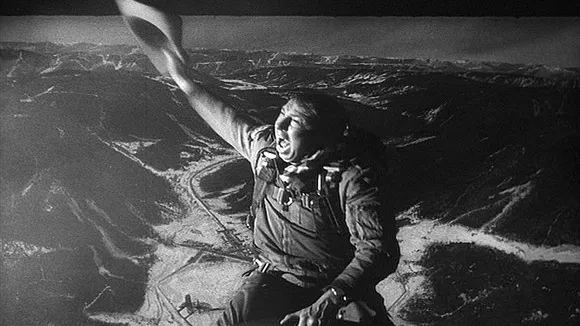
For a film full of slapstick, the technical texture is strikingly accurate. The B-52 sequence reflects real procedures, coded communications, and fail-safe points. The crew behaves professionally. Major Kong rides the bomb because he believes in the mission. Nuclear war, if it happens, will be carried out by disciplined professionals following orders, not by villains.
Cultural Satire with Strategic Precision
Kubrick understood that satire could carry truths that formal discourse softened. The sexual metaphors, the absurd names, and the bureaucratic squabbling all serve one purpose: to expose the gap between human intention and system behaviour.
Dr. Strangelove himself, played by Peter Sellers, embodies technocratic hubris. He proposes post-apocalyptic survival plans with clinical detachment. The famous Mineshaft Gap argument mirrors real Cold War debates about survivability and advantage after nuclear exchange.
The film mocks the belief that strategy can fully control the forces it unleashes.
The Cold War structure has changed, but the logic has not disappeared.
Nuclear deterrence still relies on credibility, communication, and the management of risk. Command-and-control systems are more sophisticated. They are also more complex. Cyber vulnerabilities, AI-assisted decision-making, and compressed timelines introduce new forms of uncertainty.