

Ukraine has inflicted its most serious damage yet on Russia’s bridge to occupied Crimea, destroying its main road span and threatening maritime traffic between the Black Sea and the Sea of Azov. The blow to Moscow’s prestige is enormous. Its military consequences are more complicated. Russia has spent years developing alternative supply routes through occupied southern Ukraine, while the Kerch railway bridge remains operational. The real test is whether Ukraine can sustain pressure on the entire Russian logistics network rather than a single spectacular target.
The attack of 16–17 November was fundamentally different from Ukraine’s earlier strikes against the Kerch Bridge. Previous attacks in October 2022 and July 2023 damaged conventional bridge spans and temporarily interrupted traffic. This time, Ukrainian missiles and drones brought down the 227-metre steel arch supporting the road crossing’s main navigational span.
The structure, weighing more than 5,000 tonnes, collapsed into the Kerch Strait. Images examined by BBC Verify and independent analysts confirm the destruction of the road section. The adjacent railway arch remains standing, although it sustained damage whose full structural implications have yet to be established.
David MacKenzie, a bridge specialist with the international engineering consultancy COWI, told the BBC that the attack had struck the most critical part of the bridge. He expects restoring full road traffic to take more than a year.
Ukrainian military publication Defense Express examined the original construction process. Assembling the steel arch took approximately 11 months, with the wider manufacturing and installation programme extending towards two years. Rebuilding under wartime conditions could take longer.
Other structural specialists have suggested a minimum of six months for some form of restoration, with more than a year considerably more likely. Any estimate remains conditional on the condition of the surviving foundations and the methods used to replace the destroyed structure.
The Kremlin has promised to rebuild the crossing. Russia has the engineering experience to do so, having constructed the original bridge and repaired earlier damage. Its immediate problem is the scale of the work and the continuing threat of Ukrainian attacks. There has already been another development. During the night of 18–19 November, Russian-installed Crimean governor Sergei Aksyonov reported a further attack and a temporary suspension of traffic. The extent of any additional damage, particularly to the railway section, remains unverified.
Russia Has Already Reorganised its Supply Network
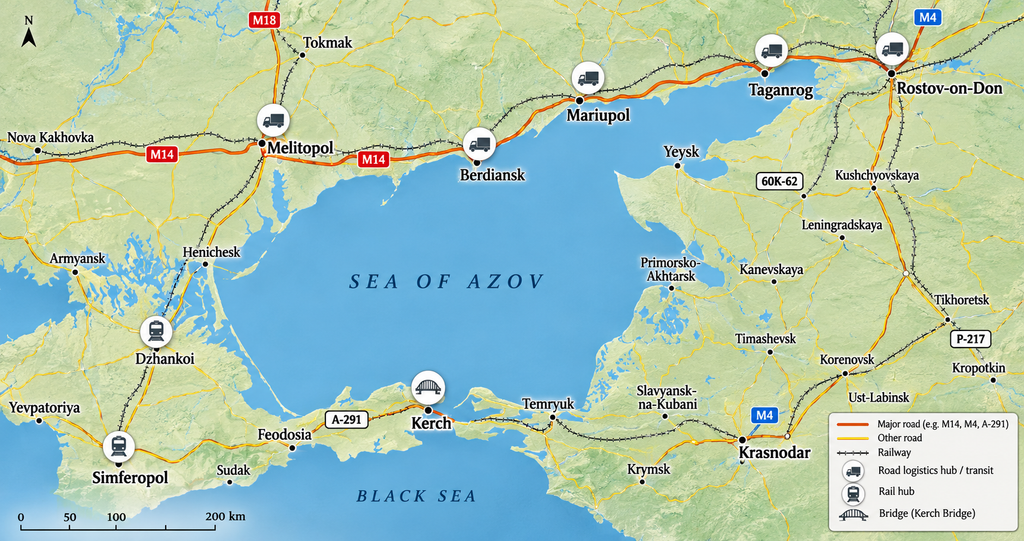
The military significance of the destroyed road span must be judged against the substantial changes in Russian logistics since 2022.
The original bridge, opened to road traffic by Vladimir Putin in May 2018, provided a direct connection between Russia’s Krasnodar region and occupied Crimea. It initially represented an enormous logistical advantage. Russia could move personnel, equipment, fuel, ammunition and civilian supplies without relying on ferries or crossing Ukrainian territory north of the peninsula.
That position changed following the full-scale invasion. By capturing Mariupol and consolidating its occupation of Ukraine’s Azov coastline in 2022, Russia established another continuous land connection between its territory and Crimea.
The route runs from Rostov-on-Don through occupied Mariupol, Berdiansk and Melitopol towards the Crimean Peninsula. Sections of the M-14 and M-18 highways have been incorporated into the Russian-designated R-280 Novorossiya corridor.
Russia has invested heavily in this infrastructure, improving roads and attempting to establish additional railway connections across the occupied territories.
By the middle of 2026, this overland system had become indispensable to Russia’s southern military operations.
The Royal United Services Institute (RUSI) reported in July 2026 that heavy goods vehicles were already unable to use the Kerch Bridge. Freight transport had been diverted to the occupied land corridor, where Ukrainian drone attacks were disrupting convoys and forcing changes to established routes.
A substantial proportion of the heavy military freight that might once have crossed the Kerch Strait had already been transferred elsewhere. Destroying the road arch therefore removes much less military carrying capacity than a simple comparison with the pre-war transport system would suggest.
The Russian-appointed authorities in Sevastopol have gone further, claiming that the bridge was barely being used for freight and that the attack had not interrupted supplies to the city.
That claim cannot be independently verified. Nevertheless, it broadly matches reports that Russia had substantially reduced its dependence on the bridge for heavy road transport.
Retired Ukrainian naval officer Andrii Ryzhenko offered another perspective in an interview with RBC-Ukraine on 17 November. He estimated that roughly a quarter to a third of relevant Russian military supplies had been moving across the Kerch Bridge, while most travelled through the occupied land corridor.
His estimate has considerable uncertainty. Publicly available figures do not establish the volumes carried by each route, the split between civilian and military freight, or the proportion transported by rail. Russia has alternatives capable of sustaining military operations, although diverting traffic places additional pressure on those alternatives.
The Railway Matters More than the Road
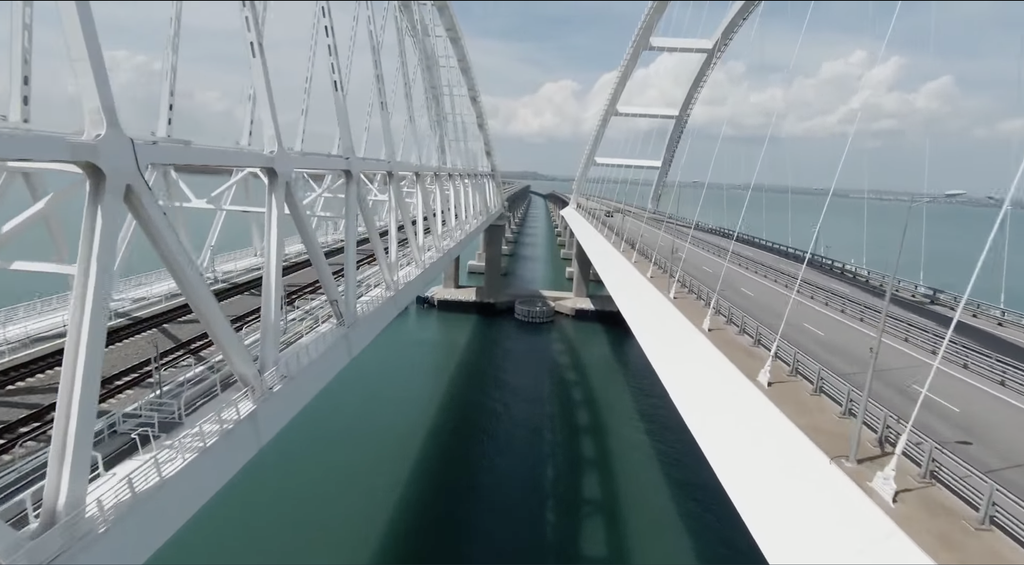
Military logistics depend heavily on rail transport. A freight train can carry quantities of fuel, ammunition and heavy equipment that would require numerous lorries.
The railway crossing is therefore central to assessing the military impact of the attack.
Russia’s Ministry of Transport initially suspended both road and rail traffic on 17 November. By that afternoon, trains had resumed using one track.
On 18 November, Russian authorities stated that railway services were operating according to their scheduled timetable. Footage taken from a passenger train crossing the Kerch Strait corroborated the resumption of rail traffic.
Passenger trains crossing the bridge establish that part of the railway remains usable. They provide no reliable measurement of its freight capacity or permissible axle loads following the attack. Russia has published no independently verifiable assessment of the railway structure’s remaining carrying capacity.
If military freight trains can continue using the crossing, even at reduced capacity, Russia retains a significant logistical advantage. Any substantial and sustained restrictions on those trains would represent a much more consequential military setback.
Russia has also been developing rail connections through occupied Donbas and southern Ukraine.
Existing lines through occupied Donetsk and the Volnovakha railway network provide alternative freight connections. Moscow has advertised plans for a more extensive railway system along the Azov coastline, intended to reduce dependence on the Kerch crossing.
The extent of its completion remains disputed.
The analytical publication Re:Russia notes that Russian authorities have reported substantial reconstruction and new rail freight movements. Ukrainian occupation researchers dispute claims that a fully operational, continuous railway along the Azov coast has been completed. Russia consequently possesses an alternative rail network, but the evidence does not establish that it could absorb all Kerch railway traffic without serious disruption.
Ukraine is Attacking the Entire Logistics System
The destroyed bridge becomes much more significant when viewed alongside Ukraine’s wider campaign against Russian military supply routes.
Throughout 2026, Ukrainian forces have pursued an operation described as Logistics Lockdown. Its objective is to disrupt the movement of supplies to Russian forces by attacking transport infrastructure, military logistics and fuel distribution.
The campaign has increasingly concentrated on occupied southern Ukraine.
Poland’s Centre for Eastern Studies (OSW) reported in September that repeated drone strikes had already damaged road and railway connections into northern Crimea, including crossings near Henichesk and Chonhar.
Russia responded by deploying additional air defences and establishing temporary crossings.
Those measures preserved transport links, although at greater cost and with reduced efficiency.
OSW’s September assessment was strikingly cautious about the Kerch Bridge itself. Its analysts concluded that destroying the crossing offered relatively little immediate operational benefit beyond its symbolic value because alternative supply routes remained available.
That was an important judgement, and the November developments require it to be reconsidered.
Ukraine has now demonstrated an ability to inflict serious structural damage on the Kerch crossing while continuing attacks against other components of the network.
Indeed, the Ukrainian campaign against the R-280 corridor intensified before the bridge’s destruction.
According to OSW, Ukrainian strikes repeatedly interrupted traffic across the Mius River in Russia’s Rostov region in November. On 17 November, the same day that the main Kerch road arch collapsed, another attack reportedly affected the alternative highway corridor.
RUSI’s earlier research described how Ukrainian drone attacks had compelled Russian transport operators to reorganise freight movements, with additional delays and security requirements.
There is a significant difference between interrupting individual roads and making an entire supply network unreliable.
A military logistics system can usually absorb isolated disruptions. It becomes progressively less efficient when several transport links experience interruptions, deliveries must be rescheduled, and additional vehicles are needed to carry the same quantity of supplies.
These effects accumulate. A longer journey requires more fuel, drivers, vehicles and maintenance. Delayed deliveries reduce the efficiency of supply depots and complicate military planning.
Even where transport continues, Russia pays more to maintain the same military output.
The Kerch Bridge was an important element of Russian logistical redundancy. Its road section provided another option when other transport corridors were disrupted.
With that option unavailable, the surviving transport network must absorb additional traffic precisely when Ukraine is imposing sustained pressure on it.
There is also a geographical distinction. Russian forces operating in eastern Donbas can receive supplies through routes that do not pass through Crimea at all. The effects of the Kerch attack are likely to be more pronounced for forces and installations based on the peninsula and for the southern grouping dependent on the occupied land corridor.
This helps explain why a spectacular strike against the bridge need not produce an equally spectacular change on the battlefield.
A sustained shortage of fuel or ammunition, delayed equipment deliveries or demonstrable reductions in Russian operational activity would provide stronger evidence of military effectiveness. For the moment, credible public information is insufficient to establish such a result.
The Unexpected Consequence: Maritime Traffic
The collapse of the road arch has created another problem for Russia, potentially extending beyond the military logistics of Crimea.
The Kerch Strait is the maritime connection between the Black Sea and the Sea of Azov. Shipping through its principal navigational channel serves Russian ports including Taganrog, as well as occupied Ukrainian ports such as Mariupol and Berdiansk.
A 227-metre steel structure lying in the channel presents a serious obstruction to larger vessels.
OSW warned on 17 November that the debris could prevent shipping through the main fairway until clearance work was completed. Ukrainian naval specialists suggested that restoring navigation might take weeks or months.
Russian reporting provides evidence that work has begun.
On 18 November, the Russian publication EADaily reported, using VesselFinder tracking data, that ten specialised and auxiliary vessels were operating around the damaged bridge. These included tugs, a dredger and vessels capable of supporting clearance work.
The same report indicated that smaller, shallow-draught vessels could still move around the area.
Consequently, the available evidence supports a substantial obstruction to the principal shipping channel. The duration and precise extent of restrictions on maritime traffic remain uncertain.
The economic consequences could nevertheless be significant.
Commercial shipping through the Kerch Strait serves ports involved in transporting grain, bulk commodities and industrial goods. Prolonged restrictions would create additional costs for Russian maritime trade and the occupation economy of Ukraine’s Azov coast.
Russia’s ferry services offer another partial alternative for cross-strait transport. Their usefulness is limited by capacity, earlier Ukrainian attacks and weather conditions. Ferry movements were suspended during storms on 18 November. Maritime transport therefore provides some flexibility, although Russia cannot confidently rely on it to replace the destroyed road crossing.
A Difficult Reconstruction Under Fire
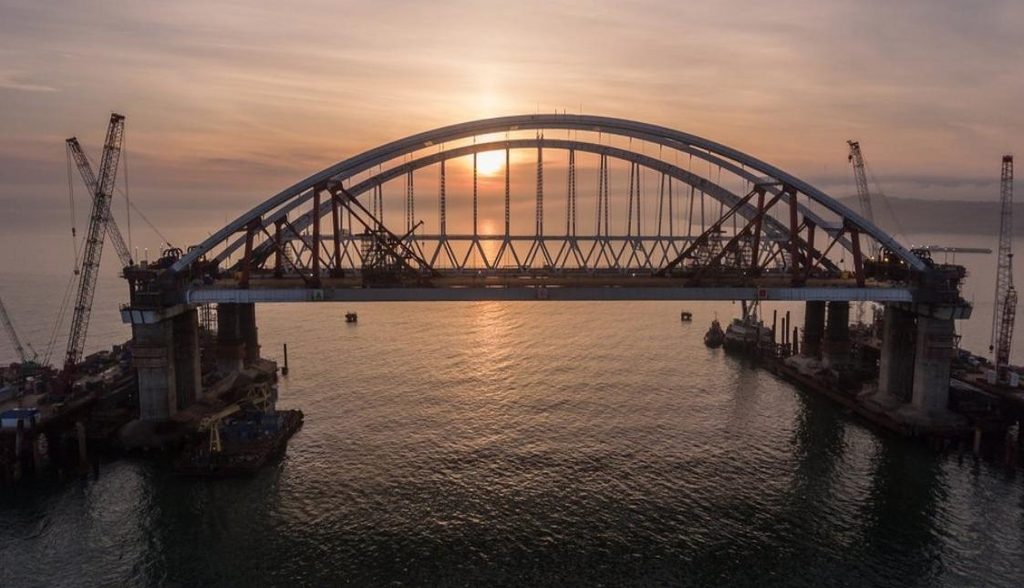
Restoring the bridge creates a demanding engineering problem. The destroyed road arch was an individually fabricated structure rather than a standard bridge section. Its replacement would require extensive steel fabrication, specialised marine equipment and careful assessment of the existing supports.
The original structure was assembled on land before being transported by water and installed. Repeating that process while fighting continues in southern Ukraine would be exceptionally difficult.
The surviving railway bridge also complicates access to the destroyed span.
MacKenzie told Radio Free Europe/Radio Liberty that a replacement arch would have to be assembled on the Sea of Azov side of the bridge and floated into position. The location of the railway structure prevents straightforward delivery of a complete arch from the Black Sea.
The engineering challenge is compounded by winter storms, potential problems obtaining specialist equipment under sanctions and the uncertainty of conducting prolonged construction work during the war.
Russian officials have promised a rapid reconstruction but have offered no substantiated timetable.
A year or more is a credible expectation for full restoration, while a period exceeding two years is technically plausible.
Russia might attempt temporary engineering solutions or accelerate selected repairs. Their feasibility cannot be established from the publicly available damage assessments. The more substantial point is that a bridge repair programme of this scale would consume specialised equipment, engineering resources and considerable money at a time when Russia is already sustaining an expensive war.
Putin’s Political Monument Has Become a Military Liability
The Kerch Bridge has always carried a political meaning beyond its engineering and transport functions.
When Putin drove a truck across the new road bridge in 2018, the inauguration celebrated Moscow’s claim that Crimea had been permanently incorporated into Russia.
The structure was designed to make that claim visible and tangible. It physically connected the occupied peninsula to the Russian mainland and demonstrated the Kremlin’s ability to undertake an enormous infrastructure project despite international condemnation of the annexation.
Ukraine has now destroyed the bridge’s most conspicuous structural feature.
The political embarrassment is compounded by the apparent failure of Russian air defences to protect one of the country’s most important and heavily defended infrastructure assets.
Ukraine’s president Volodymyr Zelenskyy described the attack as the culmination of a seven-stage operation prepared over several weeks. Ukrainian officials reported employing domestically developed drones and missiles against both sections of the bridge.
The Institute for the Study of War noted that Russian military commentators responded with unusually direct criticism of their country’s air defence organisation.
Their complaints concerned the fragmented system for protecting strategic infrastructure and the difficulty of defending an increasingly large area against Ukrainian long-range weapons.
The successful attack therefore has implications beyond Crimea.
It demonstrates that Ukraine can plan and execute complex operations against heavily protected infrastructure. It also challenges Moscow’s assurances that the Russian rear remains secure.
However, the political and military effects operate on different timescales.
A humiliating loss of prestige is immediate. The logistical effects emerge through additional costs, lost capacity and the ability of transport operators to maintain deliveries.
Russia has already demonstrated considerable capacity to adapt its supply arrangements. Its railway troops, military engineers and transport authorities have repeatedly restored damaged infrastructure, established temporary crossings and moved freight to alternative routes.
These capabilities should not be underestimated.
Ukraine, meanwhile, has developed increasingly sophisticated systems for attacking infrastructure and transport movements far beyond the immediate battlefield.
The contest is becoming one of endurance, industrial capacity and the ability to protect and maintain networks under persistent attack.
For Moscow, the destruction of the road bridge creates a considerable political defeat and a lasting logistical burden. For Kyiv, it opens an opportunity to make Russian military supply operations progressively more expensive and unreliable.
Read More:
- BBC News / BBC Verify: How the attack on Putin’s prized Crimean Bridge unfolded
- Defense Express: Скільки років може піти на відновлення Кримського мосту, та чому його навряд чи вдасться відновити до кінця бойових дій
- OSW, Centre for Eastern Studies: Ukraine is destroying the Crimean Road Bridge. Day 1728 of the war
- OSW, Centre for Eastern Studies: A bridge too far? Ukraine’s operation to isolate Crimea
- Royal United Services Institute: Ukraine’s Logistics Targeting Raises Questions for Russia’s Rear Defences
- Institute for the Study of War: Russian Offensive Campaign Assessment (November 17, 2026)
- Institute for the Study of War: Russian Offensive Campaign Assessment (November 18, 2026)
- The Insider: Roads of death: Ukrainian strikes on transport corridors are disrupting Russia’s military logistics
- Re:Russia: Corridor of Opportunity: Ukrainian mid-range strikes threaten the main achievement of Russian occupation – the land corridor to Crimea
- Radio Free Europe/Radio Liberty: Ukraine Wrecked Putin’s Bridge. Now It Can Choke Russian Supplies To Crimea
- RBC-Ukraine: На ремонт Кримського мосту може знадобитися понад рік, – експерт
- Hromadske: «Якщо Україна не дасть дозвіл». Ремонт Кримського мосту буде важким, а то й неможливим — експерти
- Kommersant: В Минтрансе допустили использование паромов как альтернативы Крымскому мосту
- Kommersant: Минтранс организует дополнительные поезда в Крыму
- EADaily: Без раскачки: у Крымского моста начались восстановительные работы
- The War Zone: Ukraine Strikes Kerch Bridge Once Again: Crimea Governor
- Ukrainska Pravda: New footage shows destroyed road section of Crimean Bridge as rail traffic resumes
- Wikipedia: Crimean Bridge