
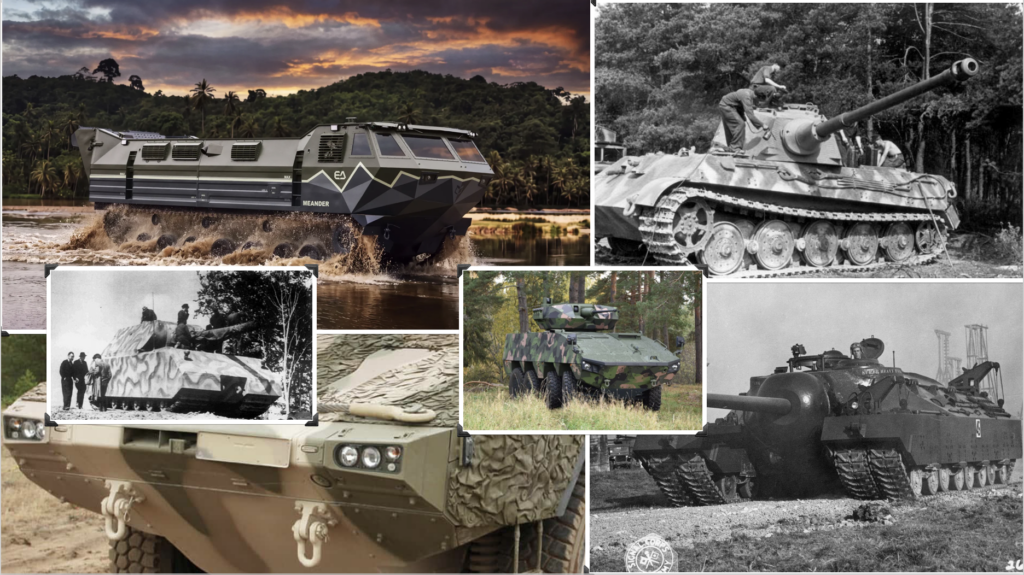
A new Czech amphibious vehicle capable of carrying 70 soldiers raises a century-old question: how big is too big? From Hitler’s 188-tonne Maus to today’s increasingly heavy tanks and eight-wheeled infantry carriers, the pursuit of greater protection and firepower has repeatedly come at the expense of mobility, affordability and operational flexibility. Ukraine’s experience with the Abrams demonstrates both the value and limitations of heavy armour in drone warfare. A comparison of European, Nordic and Asian designs reveals why the future of armoured warfare may depend as much on mobility, repairability and numbers as on armour and firepower.
From the gigantic tanks of the First World War and Hitler’s 188-tonne Maus to America’s Abrams and Germany’s latest Leopard, the history of armoured warfare is littered with attempts to reconcile greater firepower and protection with mobility. Ukraine’s drone-saturated battlefields are exposing the limits of that ambition, while also demonstrating why armies still need heavily protected vehicles.
On 21 October 2026, Czech defence group Czechoslovak Group (CSG) presented an unusual new military vehicle at the Future Forces Forum exhibition in Prague. Measuring more than 11 metres long and weighing up to 33 tonnes when fully loaded, the Meander resembles an enormous, tracked land vehicle with the bow of a ship.
Its manufacturer says the machine can carry 70 standing soldiers, 12 stretchers, a medium-sized military truck or a standard 20-foot shipping container. It can travel over rough ground, negotiate swamps and cross rivers under its own power.
Developed by CSG’s Excalibur Army and New Space Technologies, Meander represents an attempt to solve one of the oldest problems in land warfare: getting men, supplies and vehicles across difficult terrain when roads and bridges are unavailable, destroyed or under enemy observation.
The Czech vehicle also provides an excellent starting point for examining a much broader question facing European armies.
Are modern armoured vehicles becoming too big, too heavy, too expensive and too difficult to operate on the battlefield?
The history of military engineering offers a remarkable collection of warnings. Several of the largest tanks ever constructed were spectacular technological achievements that proved practically useless. Others entered combat and demonstrated formidable capabilities, but suffered from severe mechanical, logistical or tactical limitations.
Modern armoured vehicles are considerably more sophisticated than those that became bogged down in Ukrainian mud during the Second World War. Yet the latest war in Ukraine has demonstrated that advances in armour and firepower cannot overcome the inherent vulnerability of a large, conspicuous target.
Some of the most revealing evidence comes from Ukrainian soldiers operating the American M1 Abrams, long regarded as one of the world’s most capable main battle tanks.
The Czech Meander: 70 Soldiers in One Vehicle
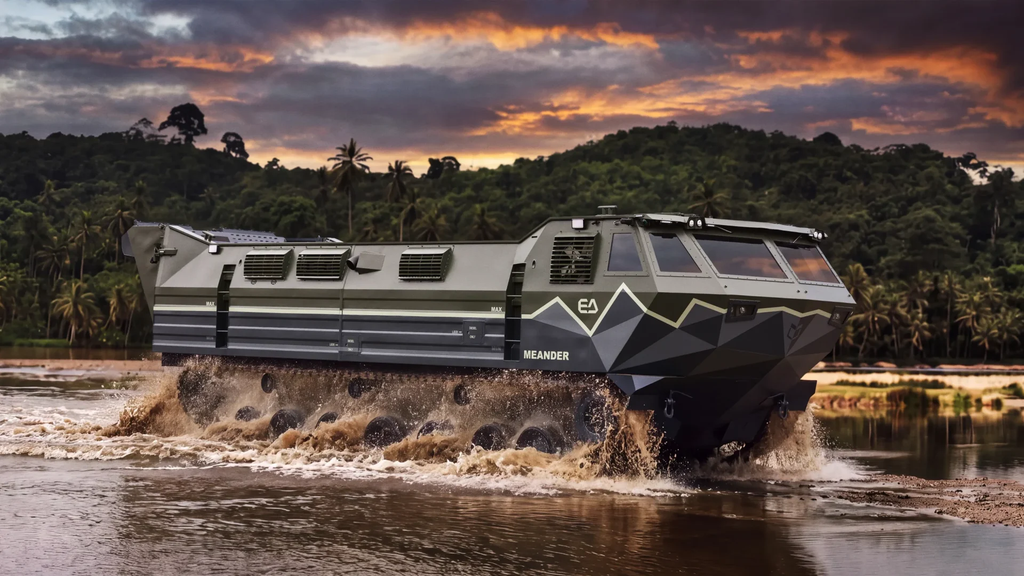
- Maximum gross weight: 33 tonnes
- Payload: 13 tonnes
- Length: over 11 metres
- Cargo deck: 22 m²
- Capacity: up to 70 standing troops
- Maximum speed: 48 km/h on land, approximately 12 km/h in water
- Engine: 440 kW Tatra diesel
The new Czech Meander is an amphibious transport designed primarily for military logistics, water crossings and operations in difficult terrain. Its current configuration has considerably more in common with an amphibious engineering vehicle or military ferry than with a conventional infantry fighting vehicle.
The prototype originates from the KALAN civilian rescue vehicle, which New Space Technologies developed for applications including flood response. Czech firefighters have already been testing KALAN. The military version introduces modifications, including a different propulsion system for travelling through water.
Meander is propelled by tracks on land and propellers in water. Its 440 kW Tatra engine delivers sufficient power for a vehicle that, despite its enormous physical size, has a fully loaded weight of 33 tonnes.
Its military value derives principally from the ability to move substantial loads across waterways without waiting for an engineering bridge.
That capability could be especially important in countries where rivers, wetlands and destroyed infrastructure present major obstacles to military movement.
Ukraine has demonstrated the importance of such equipment. Rivers divide operational areas, bridges become high-priority targets, and forces can become dependent on a small number of predictable crossing points. Meander could potentially help disperse such movements or provide alternatives when existing crossing infrastructure has been destroyed.
The Problem with Transporting 70 Soldiers Together
The most striking specification is the advertised ability to carry 70 soldiers.
The cargo platform measures approximately 22 square metres. At maximum personnel capacity, this provides just over 0.3 square metres per person, roughly three standing soldiers per square metre.
Such capacity makes sense for relatively short ferry movements, provided conditions permit it.
On a modern battlefield, concentrating 70 soldiers in one vehicle creates a potentially catastrophic vulnerability.
The concentration becomes particularly problematic during river crossings, where mobility is inherently constrained and the vehicle may have limited opportunities to manoeuvre or escape.
A precision-guided artillery round, anti-tank missile, loitering munition or repeated drone attack could disable the transport and endanger everyone aboard.
There is also a protection issue. The manufacturer advertises capacity for 70 standing troops. It has provided no publicly established specification demonstrating that those 70 soldiers would have the same protected seating, mine protection or overhead protection normally expected from a modern armoured personnel carrier.
Meander’s maximum troop capacity should therefore be understood as a transport specification. Its suitability for moving that number of troops under enemy fire remains unproven.
The prototype was presented in its basic transport configuration. Specialised and armed variants are possible, although none has been announced as an operational military system.
As of late October 2026, Meander remains at the prototype stage, with no publicly confirmed military customer or production order.
Nevertheless, the size itself is relatively easy to justify. An amphibious vehicle needs sufficient hull volume for buoyancy, a large deck for cargo and adequate propulsion to negotiate difficult terrain.
At 33 tonnes fully loaded, Meander is considerably lighter than many contemporary Western main battle tanks.
Its unusual dimensions are therefore a consequence of its specialised task.
The more difficult question concerns armoured fighting vehicles whose weight has steadily increased over successive generations.
Europe’s Eight-Wheeled Arms Race
The growth of European armoured vehicles has extended far beyond main battle tanks. Modern eight-wheeled infantry fighting vehicles are approaching the weight of Cold War tanks. A comparison of German, Finnish, French, Turkish, American and South Korean designs reveals markedly different approaches to protection, firepower and mobility.
| Vehicle | Weight |
| Schakal | 38.5 tonnes |
| AMV XP | Up to 32 tonnes |
| K808 | 20 tonnes |
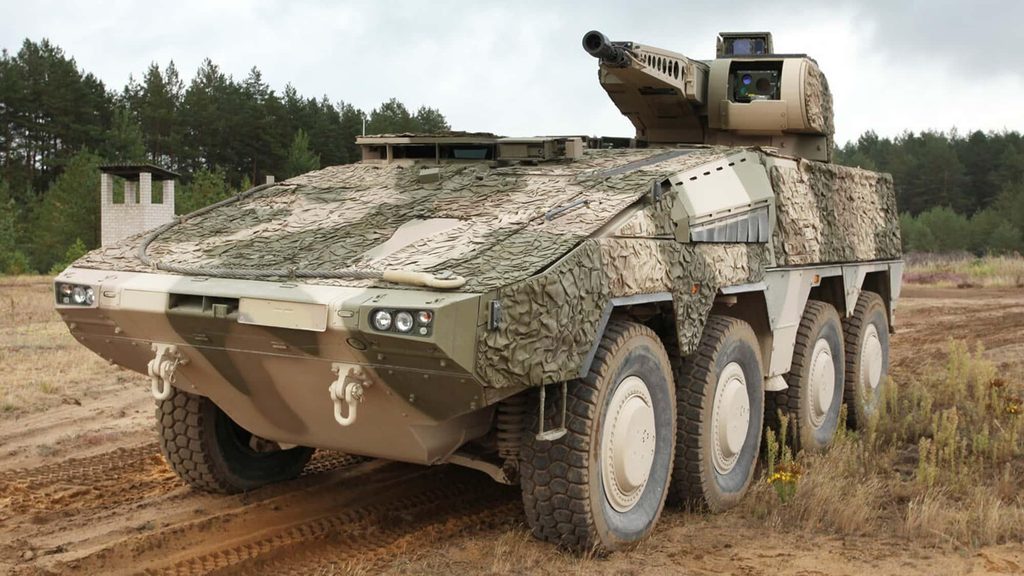
Germany and the Netherlands are investing heavily in one of the world’s most sophisticated wheeled infantry fighting vehicles, the Schakal, also known as Boxer RCT30.
The vehicle combines the Boxer 8×8 chassis developed jointly by Rheinmetall and KNDS Deutschland with the unmanned turret of the tracked Puma infantry fighting vehicle. It carries a 30 mm automatic cannon, anti-tank guided missiles and a heavily protected infantry compartment.
On 29 October 2026, Rheinmetall issued a further announcement concerning 69 additional Schakals for Germany and the Netherlands. The procurement had formally been agreed by OCCAR on 7 August.
The additional order increases the total programme to 291 vehicles, comprising 185 for Germany and 106 for the Netherlands.
The original contract for 222 vehicles, announced in October 2025, was valued at approximately €4.7 billion, including associated programme elements.
The Schakal is designed to support Germany’s new Mittlere Kräfte, or medium forces, which are intended to move rapidly over considerable distances without depending on the heavy transport infrastructure required by tracked formations.
Yet the vehicle itself weighs approximately 38.5 tonnes in the configuration specified by KNDS.
The wider Boxer family now has a manufacturer’s maximum weight rating of up to 45 tonnes, although actual operational weights depend on the variant. This makes Boxer one of the heaviest families of wheeled armoured vehicles in Western service.
Leading Wheeled Vehicles Compared
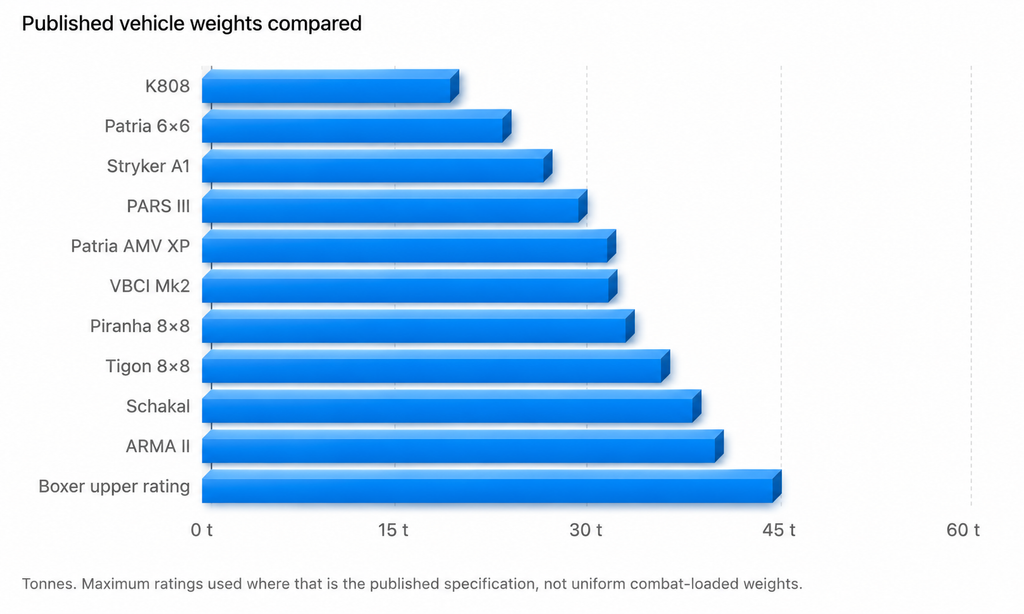
The following figures are published manufacturer or official specifications. Some describe actual combat weight, while others represent maximum permitted or gross vehicle weight. The latter indicate the platform’s carrying capacity and growth potential, rather than the weight of every vehicle delivered.
| Vehicle and country | Weight | Configuration and primary role |
| Hyundai Rotem K808 , South Korea | 20 t | 8×8 personnel carrier |
| Patria 6×6 CAVS, Finland | Up to 24 t | 6×6 personnel carrier |
| Stryker A1, United States | Up to 27.2 t | 8×8 personnel carrier |
| FNSS PARS III, Türkiye | 30 t | 8×8 combat vehicle |
| Patria AMV XP, Finland | Up to 32 t | 8×8 modular combat vehicle |
| KNDS VBCI Mk2, France | Approx. 32 t | 8×8 infantry fighting vehicle |
| Iveco-Oto Melara Centauro II, Italy | Up to 32 t | 8×8 fire-support vehicle, 120 mm gun |
| GDELS Piranha 8×8, Switzerland | Up to 33 t | 8×8 modular combat vehicle |
| Hanwha Tigon 8×8, South Korea | 34–36 t | 8×8 modular combat vehicle |
| Rheinmetall–KNDS Schakal, Germany | 38.5 t | 8×8 infantry fighting vehicle |
| Otokar ARMA II, Türkiye | Up to 40 t | 8×8 modular combat vehicle |
| Rheinmetall–KNDS Boxer family, Germany | Up to 45 t | Maximum published platform rating |
The table compares different vehicle roles and protection configurations. The 45-tonne Boxer figure is the manufacturer’s upper platform rating, while 38.5 tonnes is the published weight of the RCT30 configuration. The Centauro II carries a 120 mm gun but does not transport an infantry section. Sources include Patria, KNDS, Hyundai Rotem, General Dynamics, FNSS, GDELS, Otokar and the Italian Army.
The German Approach: A Small Infantry Section Inside a Very Large Vehicle
The Schakal illustrates how different the modern infantry fighting vehicle has become from its predecessors. Its 38.5-tonne weight approaches that of some historical main battle tanks.
The original Soviet T-72 weighed approximately 41 tonnes. The German Leopard 1 weighed around 40 tonnes in its initial configuration.
Yet Schakal is a wheeled infantry fighting vehicle designed to transport a relatively small infantry section.
KNDS describes a dismount capacity of six soldiers in the German-Dutch programme.
The weight is explained partly by its unusually high levels of protection, powerful turret, fire-control electronics, ammunition and integrated missile system.
It is intended to operate in combat environments where substantially lighter personnel carriers would face serious risks.
The vehicle also has genuine advantages. Its powerful engine, sophisticated suspension and all-wheel-drive system provide high road speeds and substantial cross-country capability.
Wheeled formations can cover long distances with less dependence on heavy-equipment transporters. Road movement can also impose lower maintenance requirements than tracked vehicles in comparable operations.
However, the weight creates unavoidable physical constraints. At 38.5 tonnes, the vehicle carries an average static load of approximately 4.8 tonnes per wheel.
The corresponding figure for South Korea’s 20-tonne K808 is 2.5 tonnes. Actual axle loads, tyre pressures and contact areas differ, so these calculations do not directly establish ground pressure. Nevertheless, the substantially greater loads create difficult engineering requirements for the suspension, tyres and drivetrain, and can affect mobility on weak ground.
In areas with peatlands, soft soil, forest roads and smaller bridges, this matters considerably. The additional protection may prove indispensable during high-intensity combat. The costs appear most clearly in the logistical infrastructure required to support a sizeable fleet.
Finland: Two Competing Solutions Within the Same Company
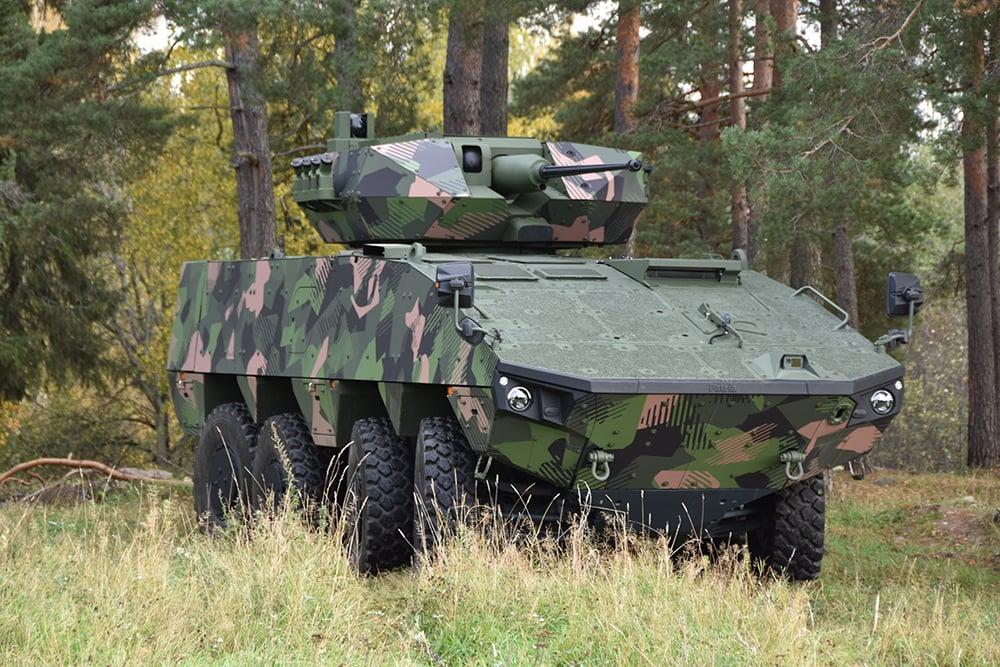
Finland’s Patria offers an especially revealing comparison because it produces both heavier and lighter armoured vehicles.
The Patria AMV XP represents the company’s heavyweight wheeled combat platform.
With a maximum combat weight of 32 tonnes and maximum payload capacity of 15 tonnes, it can be equipped with substantial weapon systems, including automatic cannons, missile systems and the 120 mm Patria NEMO mortar.
It is designed to combine high levels of protection with excellent mobility in difficult terrain.
The AMV family has accumulated extensive operational experience in several countries, including Afghanistan through the Polish-built Rosomak variant.
Patria’s lighter 6×6, meanwhile, has a maximum combat weight of 24 tonnes. It carries ten soldiers in addition to its two-person crew, and offers optional amphibious capability.
It is intended primarily for protected troop transport and combat-support tasks.
An army requiring hundreds of vehicles for moving infantry may find substantial advantages in the lighter 6×6 design. An army requiring direct-fire support, heavier protection and greater weapons integration may favour the AMV XP. Patria has deliberately maintained both approaches.
An Unexpected Partnership: KNDS is helping produce Finland’s lighter vehicles
The most interesting recent development concerns KNDS itself. On 30 September 2026, the German-French defence group and Patria announced strengthened industrial cooperation in the multinational Common Armoured Vehicle System programme (CAVS).
Under an agreement signed in August, KNDS Deutschland Maintenance will assemble and integrate Patria 6×6 vehicles for the German armed forces at its Freisen facility.
Thus, the same German defence-industrial group that manufactures 38.5-tonne Schakals is also helping to produce 24-tonne Finnish-designed personnel carriers.
The industrial arrangement reflects a wider recognition that armies require vehicles optimised for different protection and mobility requirements.
Norway has also joined the CAVS procurement programme. In August 2026, the Norwegian Defence Materiel Agency signed a contract for 20 Patria 6×6 vehicles, with options for another 40.
The initial Norwegian contract is valued at approximately NOK 500 million, including equipment, support, training and other programme elements. For Northern European armies, this provides a practical alternative to relying exclusively on increasingly heavy wheeled vehicles.
South Korea: From 20 Tonnes to 36 Tonnes
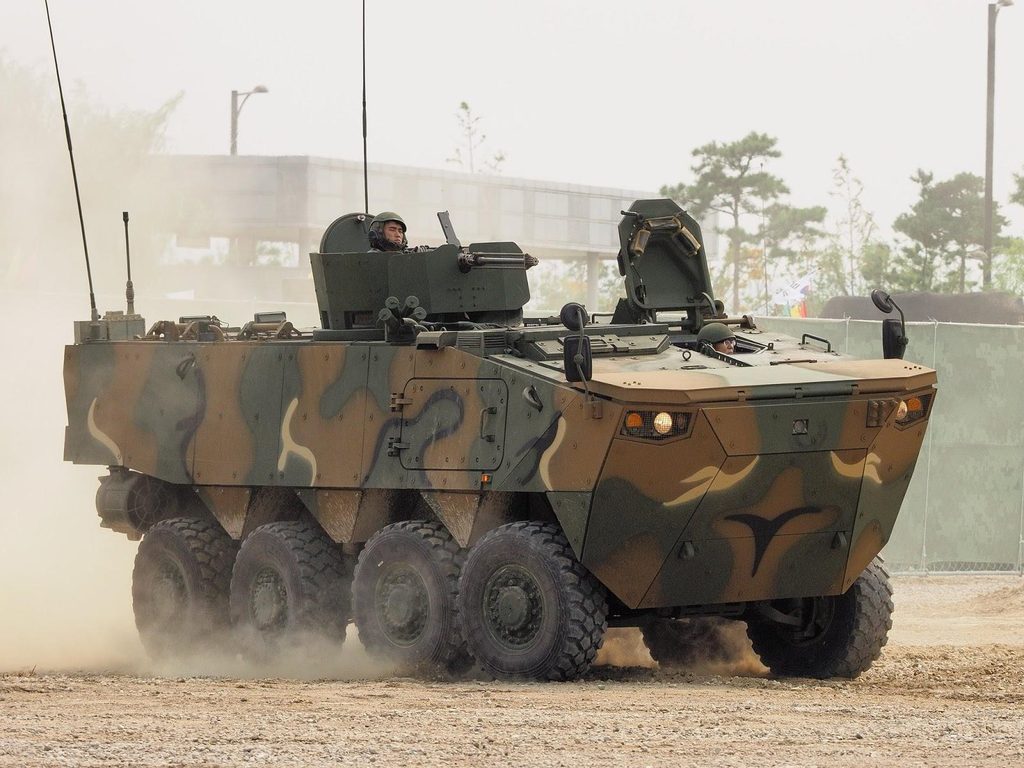
South Korea offers an instructive example of two different vehicle philosophies. Hyundai Rotem’s K808, sometimes called White Tiger, has a published combat weight of 20 tonnes.
It is an amphibious 8×8 armoured personnel carrier with a maximum road speed of 100 km/h and water speed of approximately 8 km/h.
It primarily provides protected transport rather than the heavy firepower expected from a modern infantry fighting vehicle.
The K808 uses a relatively modest weapons installation and provides lighter protection than much heavier Western alternatives.
South Korea has deployed the type in substantial numbers. Hyundai Rotem has also proposed a next-generation wheeled vehicle, potentially weighing up to 30 tonnes, with more advanced armament and alternative propulsion technology.
Meanwhile, the country’s other major defence company, Hanwha Aerospace, has developed its Tigon family of armoured wheeled vehicles.
Here, the trend is towards heavier designs. The Tigon 6×6 is a 21-tonne vehicle. The Tigon 8×8, demonstrated at international defence exhibitions including BSDA 2026 in Romania, has been described at approximately 34 to 36 tonnes depending on configuration.
It can accommodate significantly heavier weapons, including anti-tank guided missiles and large-calibre fire-support systems.
South Korea is therefore pursuing the same trade-off confronting European manufacturers. Relatively light wheeled vehicles remain attractive for troop transport, while heavier configurations offer greater protection and considerably more combat capability.
Türkiye and France: Heavy Vehicles with Different Design Priorities
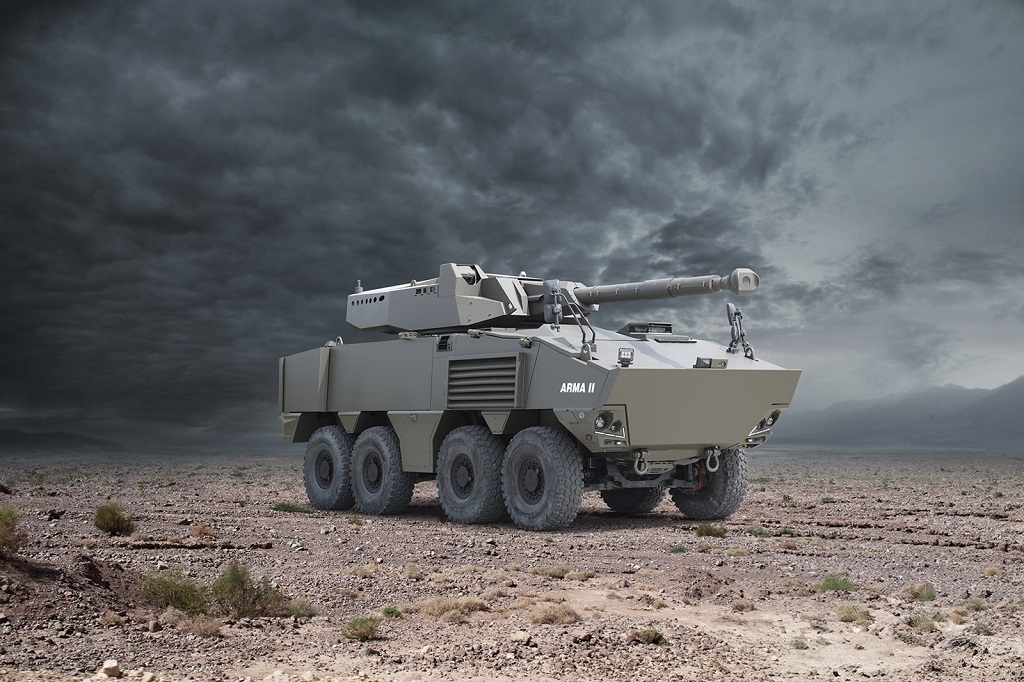
Türkiye’s defence industry has also moved into the heavyweight 8×8 category. Otokar’s ARMA II has a maximum gross vehicle weight of 40 tonnes.
It can integrate weapon systems up to 120 mm calibre, allowing the platform to undertake fire-support tasks normally associated with much heavier vehicles.
Its 720-horsepower diesel engine and modern suspension are intended to preserve mobility despite the vehicle’s considerable weight.
Another Turkish manufacturer, FNSS, offers the PARS III 8×8 at a published combat weight of 30 tonnes.
France’s KNDS VBCI Mk2, meanwhile, weighs approximately 32 tonnes in its combat configuration.
Equipped with a 40 mm cannon and Akeron MP anti-tank missiles, it offers substantial firepower at a lower weight than the German Schakal.
The newer French variant also emphasises anti-drone capabilities through greater weapon elevation and programmable ammunition.
The examples show that considerable firepower can be incorporated into vehicles weighing around 30 to 32 tonnes. However, their armour protection, internal layouts and mission requirements differ, making direct equivalence with Schakal difficult to establish.
The Price of Protection
The financial differences are striking. The German-Dutch Schakal programme’s initial €4.7 billion contract covers 222 vehicles, yielding an average programme value of approximately €21.2 million per vehicle.
Finland’s June 2023 procurement of 91 Patria 6×6 vehicles, including equipment and training, had a total value of approximately €208 million. That amounts to approximately €2.3 million per vehicle.
The resulting programme averages differ by a factor of more than nine.
These figures are not directly comparable unit purchase prices. Contract scope, protection, weapon systems, associated equipment and support arrangements vary considerably.
The Schakal’s advanced turret, missiles, sensors and higher protection standards account for some of the very substantial difference.
Nevertheless, the comparison demonstrates why European armies are increasingly pursuing mixed fleets.
The procurement budget that purchases a limited number of highly sophisticated infantry fighting vehicles may purchase many more simpler protected personnel carriers. An army needs both capabilities, but the ratio between them can have profound consequences for the number of protected vehicles available during a prolonged conflict.
A Century of Armoured Giants
The temptation to build increasingly large armoured vehicles appeared almost immediately after the tank’s invention.
The original British tanks of 1916 had been conceived as machines capable of breaking through barbed wire, crossing trenches and suppressing machine-gun positions.
As soon as engineers recognised that tanks could transform land warfare, they began imagining vehicles that could carry more guns, thicker armour and larger crews. The result was an extraordinary period of experimentation.
1918: Germany’s A7V and the Tank that Required 27 Men
A7V Sturmpanzerwagen
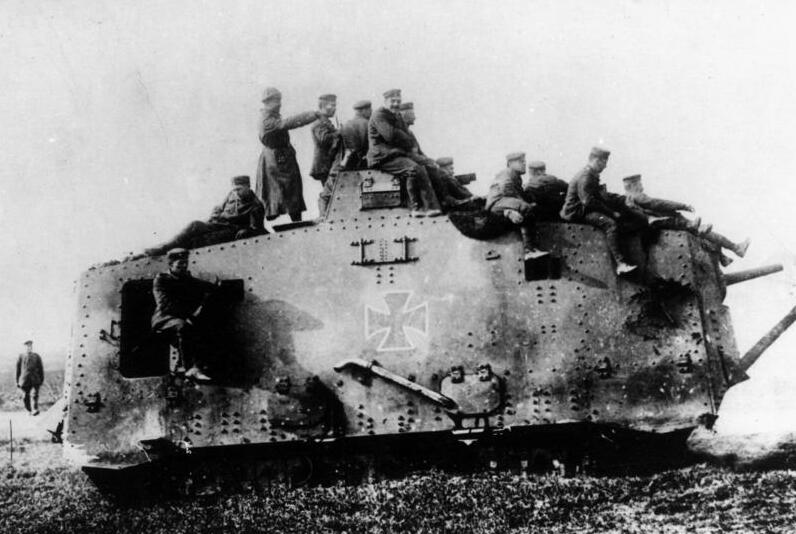
- Approximately 30 tonnes, crew of 18, six machine guns and a 57 mm cannon
Only 20 were built. The vehicle’s poor trench-crossing ability revealed how physical size could coexist with inadequate battlefield mobility.
Germany’s first operational tank, the A7V, represented an early attempt to create a mobile armoured fortress.
At approximately 30 tonnes, it was considerably smaller than later super-heavy vehicles, yet it carried an astonishing crew of 18 men.
Introduced in 1918, the vehicle possessed considerable firepower for its day. Its high, box-shaped structure and relatively short tracks created serious mobility problems.
According to Britain’s Tank Museum, the tracks were positioned too far beneath the hull to negotiate the trenches and broken ground that British tanks had been specifically designed to overcome.
One surviving example, named Mephisto, became immobilised in a shell crater during the fighting around Villers-Bretonneux. Australian soldiers subsequently recovered it, and it remains preserved in Queensland. Germany was simultaneously developing something far larger.
Großkampfwagen K-Wagen
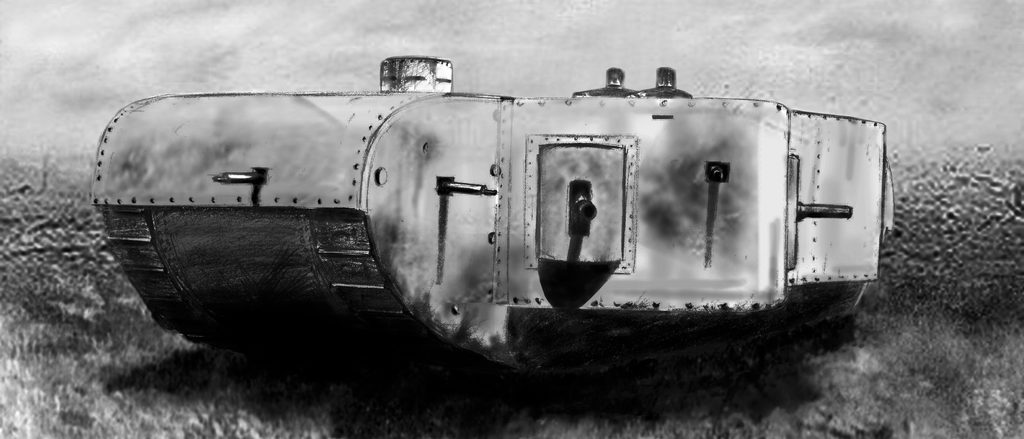
- Approximately 120 tonnes in its revised design, with a planned crew of 27 and four 77 mm guns.
Two were under construction when the war ended in November 1918. Neither was completed.
The K-Wagen was conceived as a breakthrough vehicle capable of overwhelming enemy defences through sheer firepower.
Its planned dimensions were extraordinary: approximately 13 metres long and six metres wide including its side-mounted armament.
The tank was so large that military planners intended to dismantle it into sections for railway transport and reassemble it near the front.
That requirement exposed a fundamental contradiction.
A weapon intended to break through enemy defences depended on an elaborate transport and assembly operation before it could even reach the battlefield.
The project consumed engineering capacity and materials at a time when Germany desperately needed practical equipment in substantial quantities.
Two vehicles were approaching completion by the Armistice. Neither ever fought. The K-Wagen established a precedent that would reappear repeatedly throughout armoured warfare: as designers pursued greater combat power, the supporting logistics became an increasingly difficult engineering problem in their own right.
France’s Char 2C: A giant that never reached the battlefield
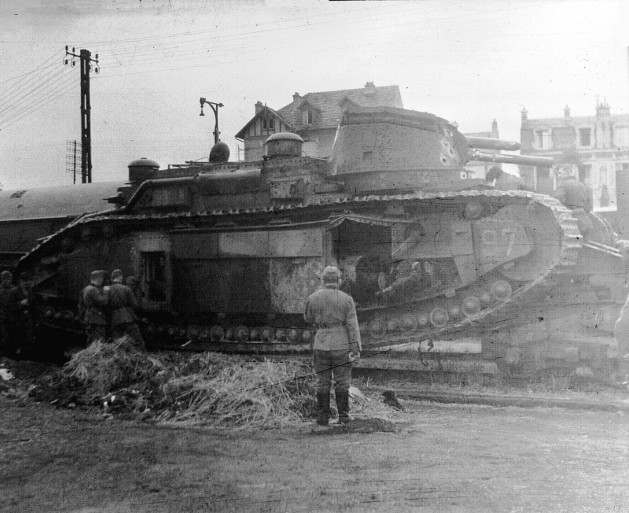
The French Char 2C offers perhaps the clearest historical example of a tank whose size defeated its military purpose.
Designed during the First World War and introduced into service in 1921, the Char 2C weighed approximately 68 to 69 tonnes.
It measured more than ten metres in length, carried a crew of 12 and mounted a 75 mm gun. Only Ten were produced.
At the time, the idea was understandable. Military planners believed heavily fortified positions required exceptionally powerful machines, able to withstand enemy fire while crossing trenches and destroying strongpoints.
By the beginning of the Second World War, however, armoured warfare had changed profoundly.
Germany was emphasising operational speed, coordinated formations and manoeuvre.
The Char 2C remained an enormous, slow-moving machine with extremely restricted strategic mobility.
When Germany invaded France in May 1940, the surviving French giants had to be evacuated by rail.
Their specialised transport arrangements made them particularly vulnerable to disruption. In June 1940, the railway evacuation became blocked amid the collapse of French communications and transport.
The crews destroyed the tanks to prevent their capture. The Char 2C’s entire operational career ended without its enormous armour and firepower being tested in battle. The vehicle was effectively defeated by the practical difficulties of moving it to where it might have been needed.
Hitler’s Maus: The 188-tonne Dead End
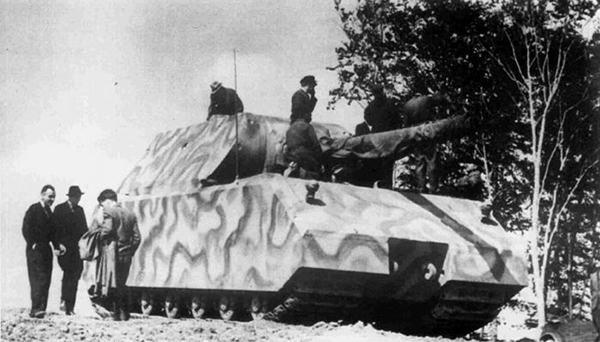
The most notorious example arrived during the Second World War. Germany’s Panzer VIII Maus weighed approximately 188 tonnes, making it the heaviest tank ever constructed.
Designed under Ferdinand Porsche’s direction, the vehicle embodied the German leadership’s increasing fascination with enormous weapons of exceptional destructive power.
The Maus was intended to combine extraordinarily thick armour with a powerful 128 mm main gun and a secondary 75 mm weapon.
Its armour could theoretically protect it against virtually all contemporary Allied tank guns from many angles.
Yet increasing protection created an escalating series of engineering complications. The vehicle required a massive drivetrain, specialised suspension arrangements and enormous amounts of industrial material.
Its sheer weight made conventional bridges a major problem. Its low speed and limited operating flexibility would have constrained deployment.
The German designers attempted to solve some of these problems through engineering innovations, including arrangements intended to allow deep-water crossings.
Such measures added still further complexity. Only two prototypes were constructed. Neither entered combat.
The Tank Museum’s historical account documents how successive design changes and rising weight repeatedly delayed the programme.
The project illustrates how enormous technological sophistication can generate very little useful military capability when the complete vehicle becomes impractical. Yet an important distinction must be made between Maus and Germany’s other heavy tanks. Several substantially lighter vehicles did fight, and some were dangerous opponents.
Tiger II and Jagdtiger: Formidable weapons with a logistical weakness
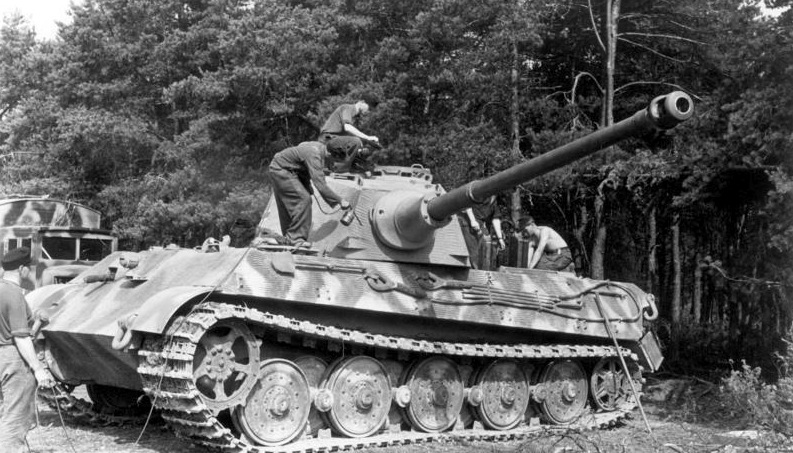
Tiger II
- Approximately 69.8 tonnes, 88 mm gun, nearly 500 produced.
The Tiger II, commonly known as the King Tiger, was one of the most powerful tanks deployed during the Second World War.
Its long-barrelled 88 mm gun could destroy many Allied tanks at substantial distances. Its exceptionally thick frontal armour made it a difficult target. The problem was reliability and operational mobility. The Tiger II suffered mechanical difficulties and was extremely demanding to maintain. Its size and weight restricted movement across infrastructure and difficult terrain.
Jagdtiger
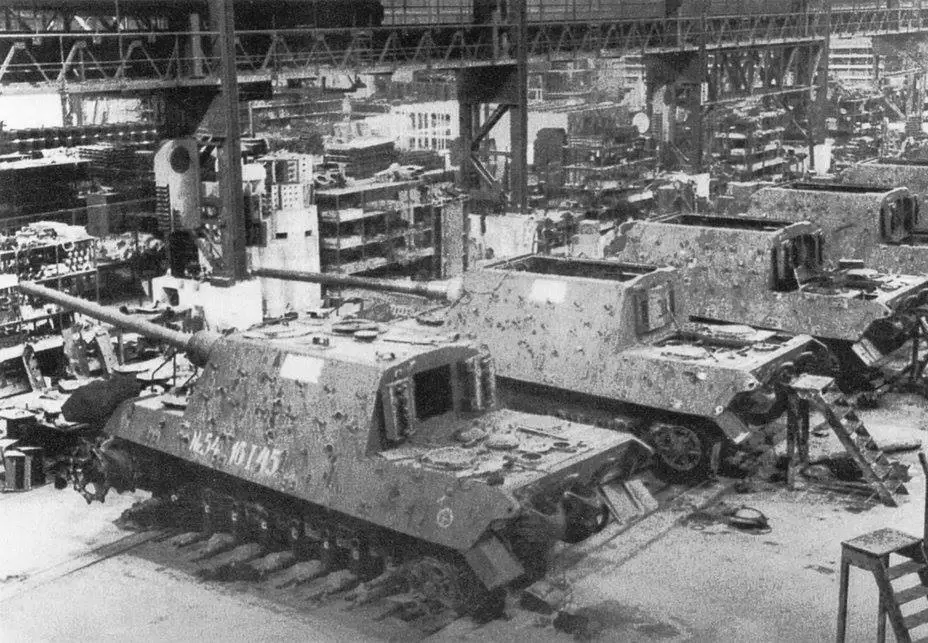
- Approximately 70 tonnes, 128 mm gun, around 85 built.
The Jagdtiger pushed the same philosophy further. Armed with a 128 mm gun and protected by approximately 200 mm of frontal armour, this enormous tank destroyer could be devastating from a concealed defensive position.
Its weight, however, strained its mechanical systems. Britain’s Tank Museum identifies breakdowns as a major problem for both vehicles. It also records the tactical danger that the Jagdtiger posed when properly positioned.
These examples are important because they demonstrate the genuine military value of heavy armour and powerful guns. When fighting from favourable positions, such vehicles could be extremely effective.
Their weaknesses became most apparent when they needed to move repeatedly, operate across extensive areas, recover from breakdowns and sustain lengthy campaigns.
The question was whether the increased battlefield effectiveness of an individual vehicle justified the reduction in mobility, availability and production numbers. For late-war Germany, increasingly short of fuel, industrial capacity and trained personnel, that was a particularly unfavourable calculation.
Britain and America Made the Same Mistake
German super-heavy tank development has acquired a reputation for extravagance, but the temptation was hardly unique to Germany.
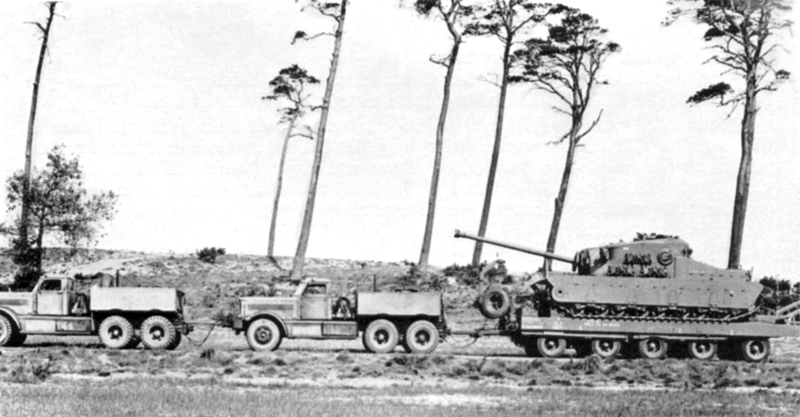
Britain developed the A39 Tortoise, an enormous assault vehicle weighing approximately 79 British tons.
Its purpose was to destroy fortifications and survive heavy defensive fire during the final advance into Germany.
The Tortoise was powerful, heavily protected and exceedingly slow. Six prototypes were constructed, but the war ended before it became operational.
The Tank Museum records that two prototypes were sent to Germany in 1948 partly to investigate whether local infrastructure could accommodate vehicles of such weight.
The very ability to operate across bridges, roads and military infrastructure had become a subject requiring separate examination.
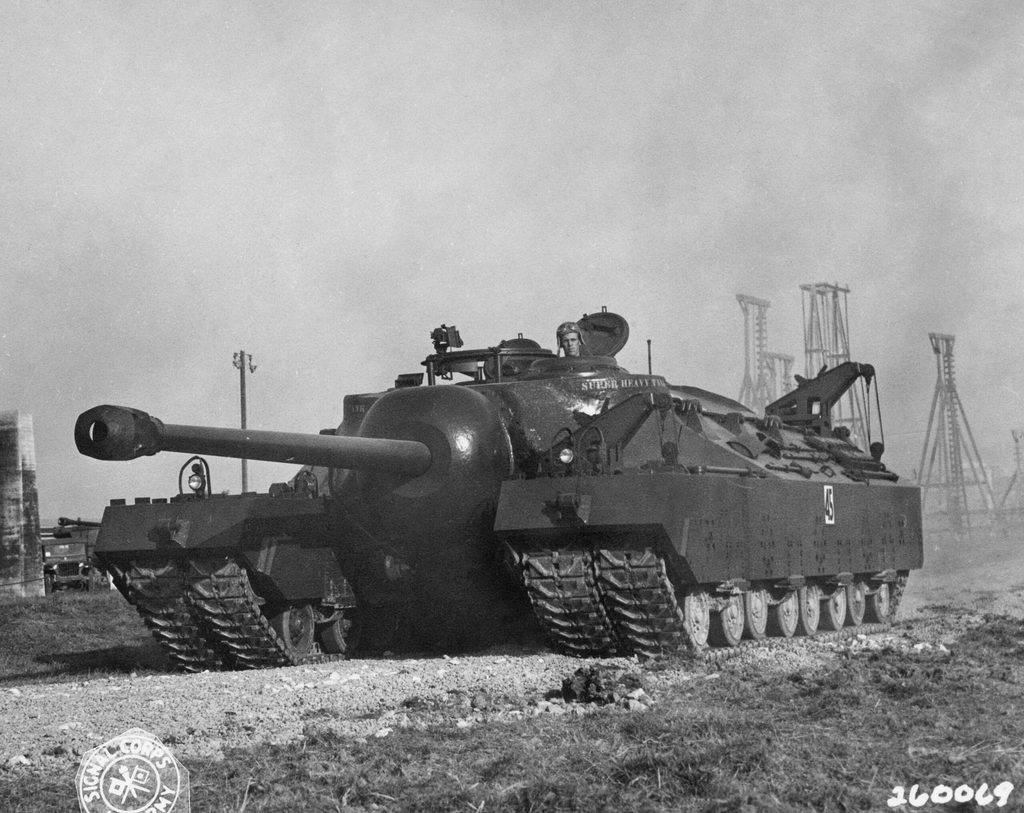
The Americans developed the T28 super-heavy assault vehicle, subsequently also designated T95, to tackle powerful German fortifications.
At approximately 95 US tons, equivalent to roughly 86 metric tonnes, it was the heaviest American tank design to reach the prototype stage.
Its extraordinary weight and specialised configuration made strategic mobility extremely difficult. Only two prototypes were produced, and the vehicle never entered combat.
The US Army’s historical publication ARMOR identifies the T28 as one of the heavy experimental vehicles developed for the Second World War that never became operational.
These projects demonstrate that the pursuit of extreme protection was a recurring response to the possibility of confronting heavily fortified positions. The problem was particularly acute when the mission for which a specialised vehicle had been developed disappeared before the vehicle was ready.
The Cold War: Heavy Tanks Survived
The end of the Second World War brought a more pragmatic approach to tank development, although experimentation with very heavy vehicles continued.
Britain introduced the FV214 Conqueror during the 1950s.
Weighing roughly 66 tons and armed with a 120 mm gun, it was intended to provide long-range anti-tank firepower against powerful Soviet vehicles.
Unlike Maus or Tortoise, Conqueror entered military service.
It represented a useful capability during a particular period, when heavier guns and superior protection required a specialised vehicle.
However, developing main battle tanks increasingly combined the firepower of heavy tanks with the mobility and flexibility of medium tanks.
The British Chieftain and American M60 formed part of this wider transition.
The Soviet Union experimented with an especially unconventional design, Object 279.
Completed in 1959, this approximately 60-tonne tank used four tracks, arranged in two pairs, and a distinctive rounded hull.
The design sought improved mobility on soft ground and protection against some effects associated with nuclear explosions.
Its unusually broad running gear offered potential advantages in distributing weight.
However, the complicated mechanical arrangement presented considerable maintenance and manoeuvrability challenges.
Object 279 never entered series production. The Soviet Union subsequently abandoned this particular approach to heavy tank development.
The broader trend was towards a single principal tank category combining mobility, firepower and protection in a balanced design.
That transition helped establish the modern main battle tank.
Yet over the decades that followed, main battle tanks themselves became progressively heavier.
The modern heavyweight: Abrams, Leopard and Challenger
The modern main battle tank has accumulated weight through successive generations of improvements.
The original American Abrams entered service at approximately 55 tonnes. Later configurations became substantially heavier as designers added armour, survivability equipment, new electronics and other capabilities.
M1 Abrams
- Approximately 60–73 tonnes across major variants and configurations.
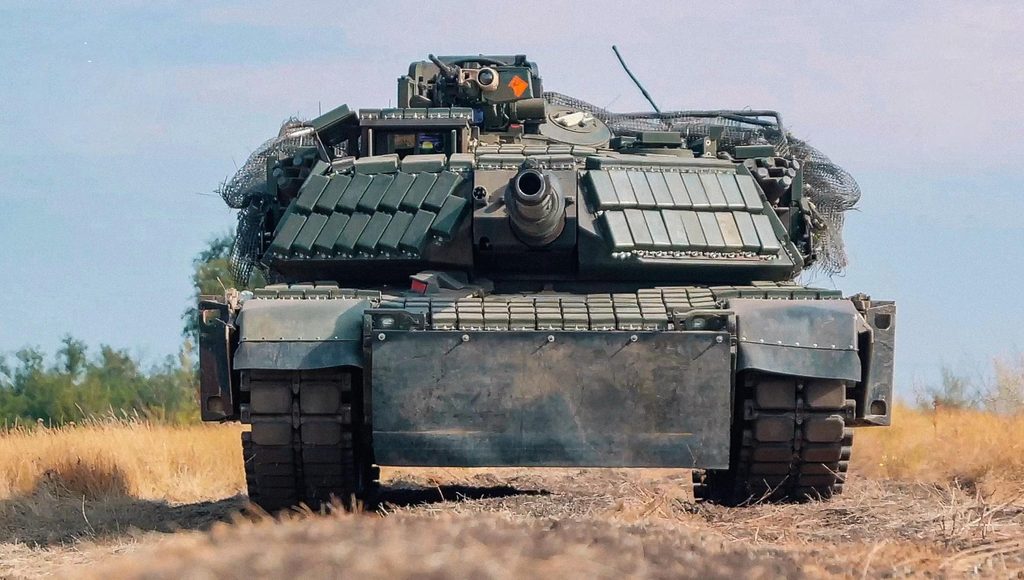
Leopard 2A8
- Approximately 69.5 tonnes in the publicly reported configuration.
The German Leopard 2 followed a similar path. Earlier Leopard 2 models weighed approximately 55 tonnes. The latest Leopard 2A8 approaches 70 tonnes, incorporating extensive improvements in protection and combat systems.
The increase has an understandable explanation. Military threats have evolved continuously.
Modern tanks must survive sophisticated anti-tank missiles, mines, armour-piercing projectiles, improvised explosive devices and, increasingly, attacks from above.
A heavy tank also needs a sufficiently powerful weapon to destroy other heavily protected vehicles and reinforced defensive positions.
Additional armour, however, creates a recurring problem. The increased weight requires stronger suspension, drivetrain components and recovery equipment.
These improvements can themselves increase weight. The resulting cycle has sometimes been described as an armour-weight spiral.
Eventually, the benefits of further protection must be weighed against the loss of mobility and the burden placed on the supporting military organisation.
The latest Leopard 2A8 illustrates the dilemma particularly well. Its advanced protection, including the Trophy active protection system, addresses the very real threat posed by modern guided weapons.
At nearly 70 tonnes, however, the tank must operate within an entire logistical system designed to support extremely heavy equipment. The tank’s technical mobility is only one element of that system.
Challenger 2
- Roughly 63–75 tonnes, depending on protection configuration.
Rheinmetall Pursuing Two Different Approaches
The German company Rheinmetall is frequently associated with large, heavily protected vehicles.
Its Lynx KF41 infantry fighting vehicle exemplifies the substantial growth in size and weight of modern infantry carriers.
A configuration equipped with the Lance turret and protection appropriate for fighting similarly equipped adversaries was originally advertised at approximately 44 tonnes.
Later technical documentation gives the platform a maximum weight capacity of up to 50 tonnes. That makes Lynx an exceptionally heavy infantry fighting vehicle compared with many historical equivalents.
The weight buys considerable advantages in protection, internal space, future upgrade capacity and weapons integration.
It also brings the expected restrictions associated with a large vehicle. Rheinmetall’s latest developments, including a reconnaissance version equipped for counter-drone operations, demonstrate the increasing demand for additional sensors and protection systems.
Rheinmetall KF51 Panther
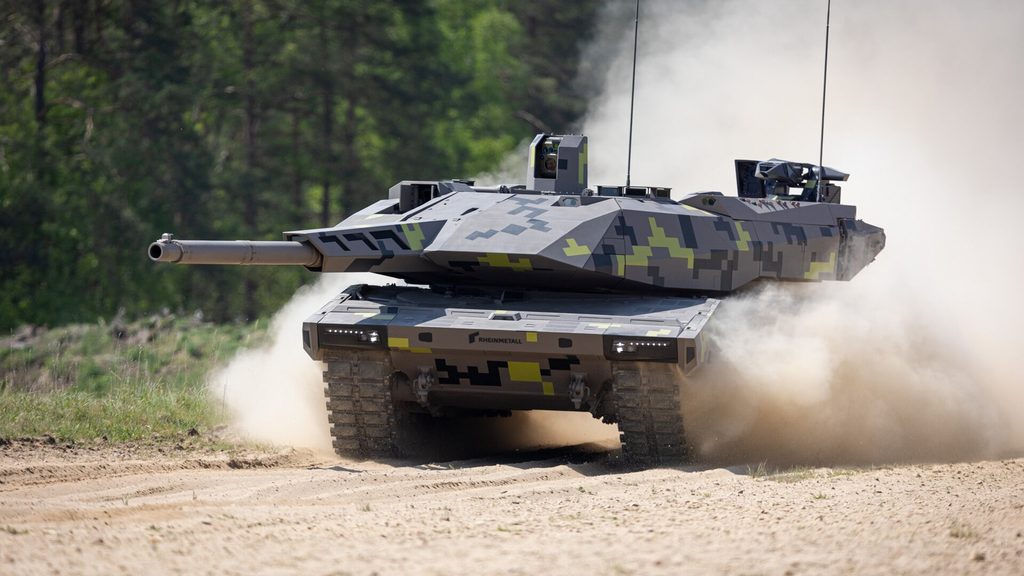
- Advertised combat weight below 59 tonnes.
Yet Rheinmetall’s KF51 Panther main battle tank demonstrates a different philosophy.
The company advertises its new tank at a combat weight below 59 tonnes, considerably lighter than many current Leopard 2 upgrades.
The Panther is designed to carry a 130 mm main gun while benefiting from modern digital systems, sensors and integration with drones.
Rheinmetall specifically emphasises its strategic mobility and compatibility with transport infrastructure.
The company therefore appears to recognise that weight has become a significant operational constraint.
Its answer is to seek increased combat effectiveness through advanced technology and improved systems integration, while controlling mass. This is arguably one of the most important developments in contemporary European tank design.
Ukraine: The Abrams confronts a different kind of battlefield
Ukraine provides a particularly revealing test of the modern Western approach to tank development. The United States supplied 31 M1A1 Abrams tanks, which began arriving in September 2023.
Australia subsequently donated another 49 M1A1 vehicles. All 49 Australian tanks had been delivered by December 2025, bringing the publicly announced combined total to 80.
The original American contribution had suffered substantial losses, and the Abrams initially generated disappointing headlines.
In April 2024, Associated Press reported that Ukraine had temporarily withdrawn its American-supplied Abrams tanks from frontline operations because of the threat posed by Russian drones.
At that point, five of the original 31 had reportedly been lost. The underlying problem was increasingly apparent.
Russian surveillance drones could locate vehicles and follow their movements, while attack drones could strike weak points or repeatedly attack disabled equipment.
The arrival of the Australian tanks subsequently allowed additional Ukrainian units to operate Abrams vehicles.
One was the 425th Separate Assault Regiment, known as Skala or Skelia. In September 2026, Ukrainian crews provided a particularly illuminating account of their experiences in interviews with the independent Ukrainian broadcaster Hromadske, subsequently reported in detail by The War Zone.
The accounts challenge some conventional assumptions about the Abrams. The Ukrainian soldiers praised the tank’s accuracy, powerful engine, crew protection and mobility.
One crew member described his experience of surviving more than 20 drone strikes during an operation. Additional improvised protection had helped preserve the tank and its crew.
The Abrams also proved surprisingly mobile, even over difficult ground.
One commander reported driving at very high speed across country and said that serious bogging down was relatively uncommon.
A heavy tracked vehicle with a powerful engine, appropriate track design and effective suspension can retain excellent tactical mobility.
A high total weight does not automatically mean that a tank will become stuck. Ground pressure, track area, vehicle balance, terrain and driving technique all influence mobility.
The Price of Keeping an Abrams Operational
The logistical shortcomings were equally conspicuous. According to the crews interviewed by Hromadske, the Abrams’ fuel consumption could reach approximately 400 litres per 100 kilometres on paved roads.
In difficult terrain, it could rise towards 700 litres per 100 kilometres or more. These are reported operational experiences, rather than standardised manufacturer consumption figures.
The crews also described demanding maintenance requirements, particularly for the running gear. Components needed repeated inspection, lubrication and replacement following operations.
Such requirements become particularly problematic when the battlefield is under continuous observation. Fuel deliveries, repair vehicles and recovery operations all create opportunities for enemy attack.
A disabled tank can become a much larger logistical problem than its initial mechanical failure suggests.
The March 2026 Operation that Changed the Equation
One operation near Pokrovsk illustrated the dilemma with unusual clarity. On 31 March 2026, Skala deployed an armoured group in an attempt to secure an industrial area and restrict Russian movements towards Hryshyne.
The operation had been prepared for more than two weeks. Ukrainian commanders examined the terrain, studied the movement routes and waited for weather conditions expected to interfere with Russian drone operations.
Fog and rain initially provided some concealment. Nevertheless, four of the five armoured vehicles involved were destroyed, according to the commanders’ account.
Russian drones attacked after conditions changed. The episode reinforced the importance of continuous enemy surveillance, reconnaissance and the growing ability to strike mobile targets even during carefully planned operations.
By September, the regiment’s commander reported that his unit had stopped deploying its Abrams in combat because the drone threat had become overwhelming.
His assessment concerned his unit and its immediate operating environment. Other Ukrainian formations had operated Abrams tanks, and the report did not establish a nationwide withdrawal of the type.
The crews nevertheless continued to regard the Abrams as an exceptionally valuable combat vehicle.
They described how its armour could protect soldiers, how its gun could deliver precise direct fire and how its mobility allowed infantry operations that would otherwise be considerably more dangerous. The problem was the changing relationship between the tank’s combat effectiveness and its exposure to repeated strikes.
The Decisive Issue: Recovery and Repair
One of the most important analyses of contemporary armoured warfare appeared in October 2025.
In the Royal United Services Institute report Emergent Approaches to Combined Arms Manoeuvre in Ukraine, military analyst Jack Watling examined how Ukrainian forces were adapting to the modern battlefield.
His findings are highly relevant to the debate over heavy tanks. Ukrainian commanders consistently emphasised mobility, endurance and repairability.
They appreciated the crew protection offered by Western vehicles, but considered many Western tanks excessively heavy and difficult to repair.
Watling found that the speed at which damaged vehicles could be recovered and restored to operation was becoming critical.
A heavily protected vehicle that remains unavailable for long periods after relatively minor damage contributes little to a unit’s continuing combat capability.
Conversely, a vehicle that can be repaired rapidly and returned to the battlefield may provide greater cumulative military value.
The research also found that armour remained indispensable in certain tactical situations.
Ukrainian tank units operating in small formations could provide powerful direct fire, help suppress enemy positions and draw attacks away from infantry.
One Ukrainian platoon described in the research had kept four captured Russian tanks operating for more than a year despite repeated damage.
The crews repaired and replaced protection as required. The wider lesson concerned operational availability.
The number of functioning, deployable vehicles available over time may matter more than the maximum protection offered by any individual vehicle.
This raises an important question for procurement authorities. Would an army gain greater combat effectiveness from 100 extremely heavily protected vehicles that require specialist maintenance and recovery, or 150 somewhat lighter vehicles that can be repaired more rapidly?
The answer depends on the mission, threat environment and overall force structure. However, the Ukrainian experience makes the question increasingly difficult to ignore.
Heavy Tanks Can Still Win Battles
It would be a mistake to conclude that large armoured vehicles have become fundamentally impractical.
The history of warfare offers strong evidence to the contrary. American Abrams tanks were highly successful during the 1991 Gulf War, operating as part of well-supported formations with considerable intelligence, air power and logistical capabilities.
In April 2003, American forces demonstrated the effectiveness of heavy armour during the rapid advance on Baghdad.
The 3rd Infantry Division’s famous Thunder Run operations used Abrams tanks and Bradley infantry fighting vehicles to penetrate the Iraqi capital.
The first major raid on 5 April included approximately 30 Abrams tanks and 14 Bradley vehicles, supported by engineers and other elements.
The operation illustrated the advantages of protected mobility, powerful direct fire and coordinated manoeuvre.
Heavy armour allowed American soldiers to undertake operations that would have been extremely hazardous for lightly protected formations.
Its effectiveness depended heavily on the supporting military system and the nature of the opposing forces.
The historical record therefore demonstrates that extremely capable tanks can justify their weight and cost when the operational conditions favour their employment.
The same principle applies in Ukraine. An Abrams tank providing accurate direct fire while protecting its crew from repeated attacks may offer considerable military value even if the vehicle ultimately requires extensive repair. Protection cannot be evaluated solely by whether the vehicle survives. The survival of trained crews is itself a major military advantage.
Are European Armies Approaching the Practical Weight Limit?
There is another constraint that is especially significant for Europe. Military vehicles must travel across roads, bridges, rail networks and transport corridors that were often built long before modern 70-tonne tanks were envisaged.
The NATO Military Load Classification system provides a framework for assessing whether bridges and other infrastructure can safely accommodate military equipment.
Vehicle weight is an important component, alongside factors such as axle loads, track loads and the characteristics of the crossing.
A vehicle’s ability to travel at high speed on a test range says relatively little about whether an entire formation can move rapidly across a country whose transport infrastructure is fragmented.
Estonia offers a clear example. In August 2024, Estonian public broadcaster ERR reported on improvements to roads and bridges partly intended to accommodate heavy NATO equipment.
Officials specifically identified bridge load capacity as a significant constraint on the movement of armoured formations.
The problem becomes particularly acute in the Baltic states, where allied reinforcements may need to cross numerous bridges and restricted routes.
Similar challenges arise in the Nordic countries. Northern Finland, Sweden and Norway contain extensive forests, peatlands, wetlands, rivers and areas with relatively sparse road infrastructure.
Winter creates additional difficulties. Frozen ground may sometimes improve mobility, while snow, thawing conditions and unstable terrain can impose severe restrictions.
Sweden’s Defence Research Agency, FOI, examined these operational challenges in a September 2025 study.
The institute emphasised that infrastructure limitations and difficult environmental conditions substantially increase logistical demands.
Longer supply routes, slower transport, greater fuel consumption and more frequent mechanical difficulties can all constrain military operations. These are precisely the conditions in which the theoretical performance of a heavy armoured vehicle must be judged against the realities of sustaining an entire formation.
The Nordic Alternative: Light and Highly Mobile Tracked Vehicles
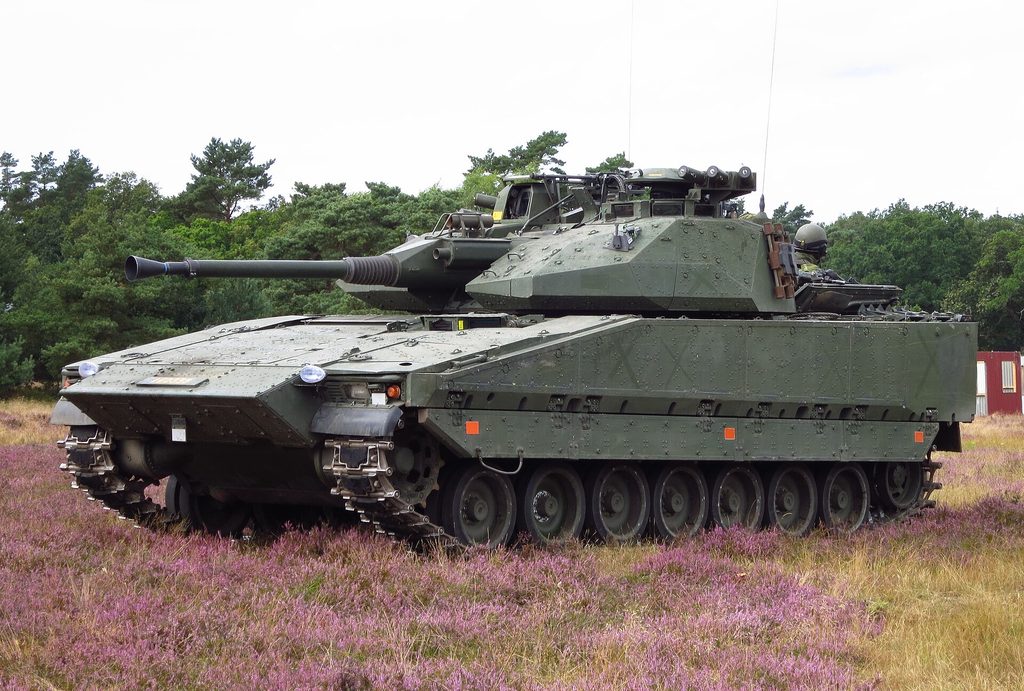
The Nordic defence industry provides an interesting contrast to the trend towards increasingly heavy combat vehicles.
Sweden’s BAE Systems Hägglunds has developed the CV90 family, which balances firepower and crew protection with the need to operate in demanding terrain.
The current CV90 MkIV has a gross vehicle weight rating of approximately 38 tonnes.
It is substantially lighter than a modern main battle tank, although it occupies a different battlefield role.
The company has strengthened mobility through improved engines, suspension and transmission technology while incorporating active protection capabilities.
Finland’s Patria has pursued a different approach through the Patria 6×6 armoured personnel carrier.
The vehicle can transport ten soldiers in its protected rear compartment, in addition to the two-person crew.
It has optional amphibious capability. The manufacturer’s technical specifications give a maximum combat weight of 24 tonnes.
Its design emphasises versatility, protection, ease of operation and maintainability.
These characteristics are particularly important when armies need large numbers of vehicles capable of transporting troops across widely dispersed operating areas.
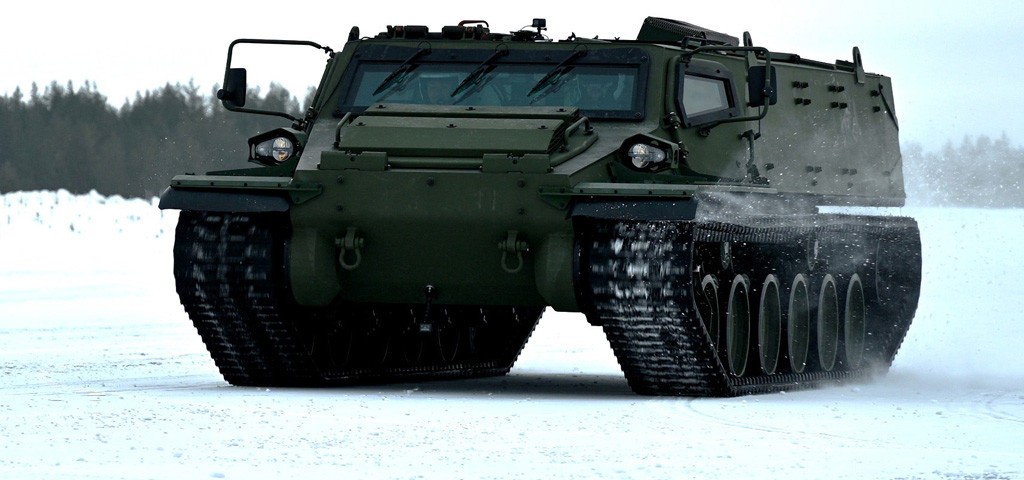
An even more revealing development is Patria’s new TRACKX family.
The company has developed a tracked vehicle intended for the 13–18-tonne category.
It employs wide tracks, a low centre of gravity and advanced suspension to improve movement through snow, marshland and difficult terrain.
Its design reflects the challenges facing Northern European land forces. Importantly, the programme is progressing beyond the initial concept stage.
On 30 September 2026, Finland and Sweden announced their first procurements. Finland has ordered pre-series vehicles, with an initial contract valued at approximately €13 million.
Sweden has ordered five TRACKX vehicles for testing. Deliveries are scheduled to begin in 2027.
The vehicles will then undergo operational evaluations, including testing in demanding northern conditions.
These programmes illustrate how European armies are seeking different answers to different operational requirements.
A main battle tank must deliver powerful direct fire and survive some of the most demanding threats on the battlefield.
An infantry fighting vehicle must combine substantial protection with the ability to transport a relatively small infantry section.
An armoured personnel carrier prioritises protected movement. An amphibious logistics vehicle such as Meander must be able to carry large loads across obstacles.
Trying to combine every capability in a single vehicle would create severe engineering compromises.
The Americans are Reconsidering the Abrams Itself
Perhaps the strongest evidence that the balance has shifted comes from the United States Army.
In January 2026, the Army publicly unveiled an early prototype of its next-generation M1E3 Abrams. The programme places particular emphasis on reducing weight, improving protection and decreasing the logistical burden.
The Army described the vehicle as designed to respond to emerging threats, including drones and long-range precision weapons.
Its development also emphasises adaptability and the ability to incorporate new technology rapidly.
Michelle Link, a senior US Army acquisition official, specifically identified reduced weight and a smaller logistical footprint as central objectives.
The development is significant because the United States possesses the extensive engineering, recovery, fuel and transport resources required to operate very heavy tanks.
Even this military organisation now considers the logistical burden of its existing main battle tank sufficiently important to justify a fundamental redesign.
The Abrams is therefore an instructive example of the limits of incremental development.
Decades of modifications have produced increasingly sophisticated vehicles, but the accumulated weight and support requirements have become substantial constraints.
The next generation of tanks will need to preserve battlefield survivability while reducing the costs associated with sustaining that protection.
The Next Armoured Revolution: Survivability Over Armour Thickness
Historically, designers responded to more powerful anti-tank weapons by adding thicker armour. That strategy had an obvious logic when the principal threat came from guns and missiles attacking predictable parts of a vehicle.
The widespread introduction of drones has changed the geometry of the threat.
Attackers can now approach from above, target vulnerable components and repeatedly strike a vehicle after it has been disabled.
Armour remains essential, but the modern protection problem extends far beyond the thickness of steel or composite material.
Active protection systems, electronic countermeasures, camouflage, decoys, counter-drone weapons and improved situational awareness are increasingly important.
These systems can potentially provide protection without requiring the same increase in structural weight as additional passive armour.
They also have limitations. Electronic countermeasures cannot be relied upon against every type of guided drone, particularly systems using fibre-optic connections or greater autonomy.
Hard-kill active protection systems must cope with threats arriving from different directions and at different speeds. They may also face saturation attacks.
Consequently, armoured warfare is becoming increasingly dependent on layered protection.
A vehicle must detect threats, avoid detection where possible, disrupt an enemy attack and survive impacts that cannot be prevented.
The distinction between protection and mobility is also becoming less straightforward.
A vehicle that moves rapidly, changes position frequently and can be repaired quickly may be more difficult to destroy over a prolonged campaign than a better-armoured machine confined to predictable routes.
The most successful future designs may therefore be those that balance survivability with tactical freedom and operational availability.
Read More:
- Czechoslovak Group (CSG): CSG unveils Meander, a new and unique amphibious vehicle for military use
- Česká tisková kancelář (ČTK): Skupina CSG dnes veřejnosti představila nové pásové vozidlo Meander
- Janes: Future Forces Forum 2026: CSG unveils Meander tracked amphibious vehicle
- CZDEFENCE: Future Forces 2026: Světové premiéry, nové zbraňové systémy a technologie, které mění moderní bojiště
- Rheinmetall: Panther KF51 – Rheinmetall’s new main battle tank
- Rheinmetall: Rheinmetall unveils the Lynx KF41 next-generation combat vehicle
- Defense News: KNDS unveils the Leopard 2A8, first new battle tank build since 1992
- The Tank Museum: The First Tanks
- The Tank Museum: A7V Replica
- Queensland Museum: Mephisto: The sole surviving WW1 tank
- The Past: The Kaiser’s secret weapons
- History of War: Char de Rupture 2C/ Char 2C
- The Tank Museum: A Maus Tale
- The Tank Museum: Tiger II
- The Tank Museum: Jagdtiger
- The Tank Museum: Tortoise
- Royal United Services Institute: Emergent Approaches to Combined Arms Manoeuvre in Ukraine
- The War Zone: How Russian Drones Forced Ukraine To Park Its M1 Abrams Tanks
- Australian Department of Defence: Australia completes delivery of tanks to Ukraine
- The United States Army: Thunder Run in Baghdad, 2003
- The United States Army: US Army unveils early Abrams prototype at North American International Auto Show
- Totalförsvarets forskningsinstitut (FOI): Bedömer västländers förmåga att operera långt i norr
- Patria: Finland and Sweden acquire the first Patria TRACKX tracked vehicles
- Försvarets materielverk (FMV): Sverige köper det bandgående fordonet TrackX från Patria
- Finnish Ministry of Defence: Finnish Army to boost mobility of northern forces
- ERR News: Estonia to upgrade roads, bridges to bear weight of allied armor
- OCCAR: OCCAR Executes Option for Additional 69 BOXER RCT30 Wheeled Infantry Fighting Vehicles for Germany and the Netherlands
- Rheinmetall: 222 Jackals (Schakal) for Germany and the Netherlands – order value at €4.7 billion
- KNDS: BOXER RCT30
- KNDS: BOXER
- Patria: Patria AMV XP – Performance evolved
- Patria: Patria 6×6
- KNDS: KNDS and Patria reaffirm cooperation on the European 6×6 vehicle program CAVS
- Forsvarsmateriell: Forsvaret får 20 hjulgående panservogner
- Finnish Ministry of Defence: Defence Forces to purchase armoured 6×6 personnel carriers
- Hyundai Rotem: K808/K806 WAV
- MILMAG: BSDA 2026: Hanwha Aerospace presents Tigon 8×8
- KNDS: VBCI RCT40
- General Dynamics European Land Systems: PIRANHA Wheeled Armored Vehicle
- General Dynamics Land Systems: STRYKER
- FNSS: PARS III 8×8 Technical Specifications
- Otokar: Otokar’s Armored Unmanned Vehicle Alpar And Arma II On International Stage
- Esercito Italiano: Blindo Centauro 2